
The mechanism is the whole difference
Both devices are sold as “wine preservers” and both sit on the same shelf, which hides the fact that they are solving the problem in opposite directions.
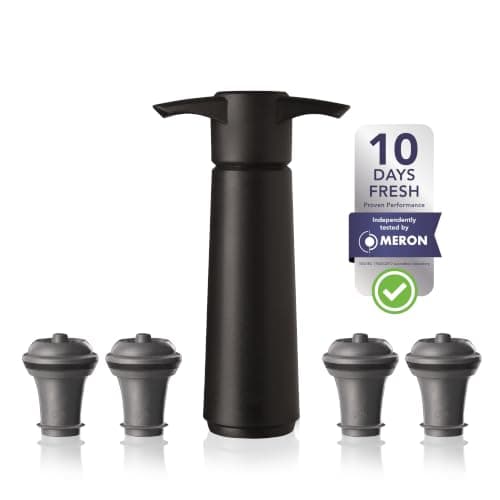
Vacu Vin removes air. You seat a rubber stopper in the neck and work a hand pump until it clicks. That pulls most of the air out of the headspace, so there is less oxygen left in contact with the wine. Less oxygen means slower oxidation. It does not mean no oxidation: a hand pump cannot pull a laboratory vacuum, and whatever oxygen remains is still dissolved in the wine and still working.
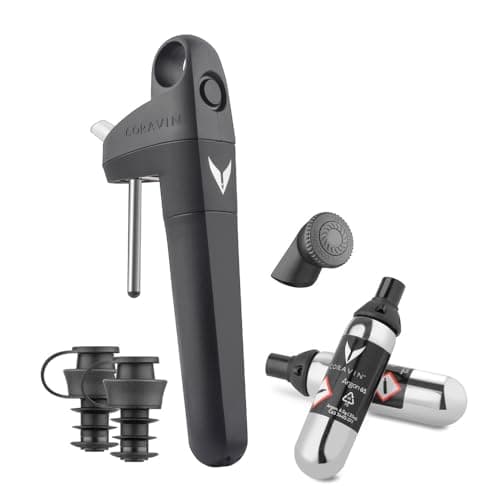
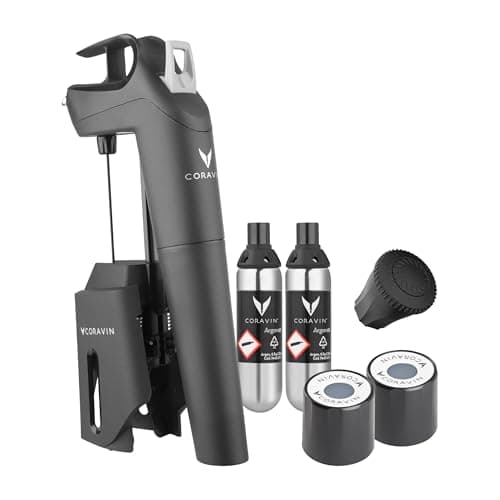
Coravin replaces air with argon. Argon is inert and heavier than air, so it sits on the wine as a blanket and physically keeps oxygen off the surface. The Timeless goes further: a hollow needle passes through the cork, argon pressurizes the bottle, wine pours out through the needle, and the cork reseals when the needle is withdrawn. The bottle is never opened, so air never gets in at all.
That distinction is not marketing. One approach reduces the amount of oxygen present; the other prevents oxygen from arriving. It is the reason the claimed durations differ by orders of magnitude, and it is the reason the two products are not really competitors for the same job.
Argon is not exotic, either, which is worth saying because the technology sounds it. Wineries have used inert gas to blanket tanks and top barrels for decades. The Coravin applies a standard cellar practice at bottle scale.
What each maker actually claims
We quote these as claims rather than findings. We have not run a controlled tasting panel, and anyone who tells you a preservation period is exact is guessing — the real figure depends on the wine, the headspace and the storage temperature.
Read down the duration row and the shape of the decision appears. Ten days covers the overwhelming majority of real situations — a Tuesday bottle finished on Friday, a dinner party leftover, a glass before bed across a week. Four weeks covers the rest of them. “Months or years” is not a better version of the same thing; it is a different activity, which is drinking single glasses from bottles you would otherwise never open.
The running cost nobody puts on the box
Vacu Vin has no consumables. You buy the pump and the stoppers once, and the cost per preserved bottle is zero forever. That is a genuinely unusual property in this category and it is the strongest argument for the product.
Both Coravin systems run on argon capsules, so every preserved bottle has a marginal cost. Whether that cost is reasonable depends entirely on the wine. On a weeknight bottle, paying a per-pour fee to preserve something you were going to finish anyway is hard to justify. On a bottle you have been keeping for ten years, the capsule is a rounding error against the alternative, which is drinking the whole thing in one evening or not opening it at all.
We are not going to print a per-capsule figure here. Capsule prices move, pack sizes vary, and a number baked into this page would be wrong within months — check the current capsule price at the same time as you check the device price. The structural point stands regardless of what the capsules cost: one of these systems has a running cost and the other does not.
Where each one simply does not work
Sparkling wine kills the Vacu Vin outright. Pulling a vacuum on a sparkling bottle extracts the dissolved carbon dioxide, which is the thing you are trying to keep. A vacuum stopper is the wrong tool for Champagne in the same way a corkscrew is the wrong tool for a screwcap. Use a sprung Champagne stopper instead.
A vacuum also pulls aromatics. This is the quieter cost and it is real: the same suction that removes oxygen removes volatile aromatic compounds, which matters on a delicate wine and matters very little on a robust one. If you mostly drink structured reds you will probably never notice. If you drink aromatic whites you might.
The Timeless needs a cork. The needle has to pass through something it can reseal, so a screwcap bottle needs the separate accessory. Given how much of the sub-twenty-dollar market is now screwcapped, that is worth checking against what you actually buy before committing.
Neither fixes a warm room. Preservation slows what oxygen does; it does nothing about what heat does. An open bottle left at seventy-five degrees will deteriorate whichever device is in the neck. Both work substantially better with the bottle back in a cool cabinet — see how to store opened wine for the storage half of the problem, and how long wine lasts after opening for the baseline these devices are improving on.
Which one you should buy
For most people reading this, the honest answer is the cheap one. If your pattern is opening a bottle and finishing it within a few days, Vacu Vin does that job, has no running cost, and costs less than the wine it is protecting. Buying a Coravin for that pattern is paying for a capability you will not use.
Buy the Pivot if your bottles routinely survive longer than a week and you want the argon mechanism without the Timeless price — four claimed weeks is a real upgrade over ten claimed days, and it is not restricted to natural cork.
Buy the Timeless for one specific reason: you own bottles you want a single glass from without committing the rest. That is the use case nothing else on the market addresses, and if it is your use case the price stops being the relevant number. If it is not, it is an expensive way to do what a twenty-dollar pump does.
The wider field, including sprung stoppers and the chilled-service options, is compared in the preservation systems roundup, and the stopper-only approaches sit in best wine stoppers.