Store cork-sealed bottles flat if you are keeping them more than a few months: it keeps the cork in contact with wine so it cannot dry and shrink. Screw caps and synthetic corks can go either way. An opened bottle should stand upright, which minimizes the wine surface exposed to the air trapped inside.
This page sits in Wine Storage Guides, where the rest of the category is compared the same way.
How this page is funded. Cork & Cool earns a commission if you buy through the Amazon links below, at no extra cost to you. It never changes the order of this list — see our editorial policy and affiliate disclosure. We do not publish prices, because a stale number helps nobody.
Our picks
Storing flat is a hardware question as much as a technique one — the rack or cabinet has to cradle bottles horizontally. All three of these do, at three different scales.
How this page is funded. Cork & Cool earns a commission if you buy through the Amazon links below, at no extra cost to you. It never changes the order of this list — see our editorial policy and affiliate disclosure. We do not publish prices, because a stale number helps nobody.
#1 — A bare kitchen wall
Sorbus Wall Mount Wine Rack (9 bottle)
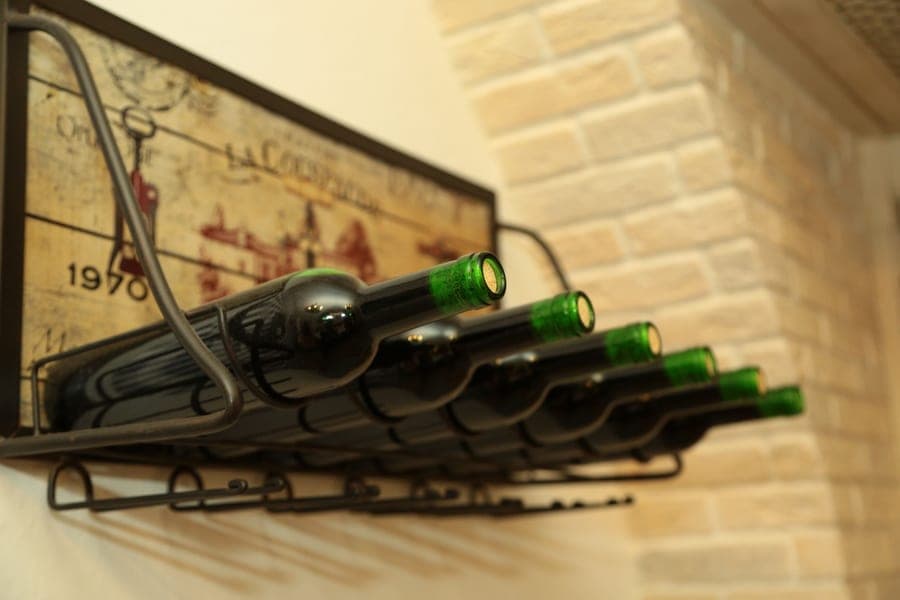
Nine bottles on the wall in welded black steel — the simplest way to get bottles off a counter.
Illustrative photograph — not an image of the Sorbus Wall Mount Wine Rack (9 bottle).
Bottles sit horizontal, keeping corks in contact with wine
What does not
Needs studs or proper anchors — nine full bottles is roughly 25 lb
Open racking gives no protection from light
Who should skip it. Skip it if the wall gets direct sunlight. Light is a real wine fault mechanism and an open wall rack offers none of the UV glass a cabinet does.
Rated for built-in installation, so the front vent is designed for an enclosed opening
23.4-inch width drops into a standard 24-inch cabinet run
Two independently set zones across the full 40-66°F span
What does not
No published dB rating, so noise cannot be compared numerically against rivals
46 bottles is the manufacturer's count using standard Bordeaux bottles — heavy Burgundy or Champagne bottles reduce it
Who should skip it. Skip it if your opening is under 24 inches, or if you need more than about four dozen bottles — stepping up to a 160-bottle cabinet costs less per bottle.
A natural cork seals because it is slightly compressed and slightly moist. Stand a cork-sealed bottle upright for years and the cork has wine below it and air above and around it. The exposed part gradually dries, hardens and shrinks — and a shrunken cork no longer seals, so air reaches the wine.
Lay the bottle down and the wine is in contact with the whole inner face of the cork continuously. The cork stays saturated and stays sealed. That is the entire mechanism, and it is why every cellar in the world lays bottles down.
It also interacts with humidity, which acts on the same component from the other side — wine fridge humidity covers that, and a dry room plus upright storage is the combination that genuinely ruins bottles.
How long is “more than a few months”? Under about six months, orientation makes little practical difference — corks do not dry out quickly. Past a year it matters. Past five years it matters a great deal.
Screw caps and synthetic corks
A screw cap seals with a liner against the glass rim and does not care about moisture. A synthetic cork does not dry out either. So for both, orientation makes no mechanical difference at all and upright storage is perfectly correct.
Which is genuinely useful if your wine is mostly modern New World bottles, a great many of which are screw-capped: it means a shelf is as good as a rack, and you can store more bottles in the same space upright than lying down.
Two practical reasons to lay them down anyway: a rack you already own is easier to use flat, and labels stay readable. Neither is about the wine.
Opened bottles stand up
The rule inverts the moment you open the bottle, and almost nobody knows this.
Once a bottle is open, the cork is no longer the issue — the air inside is. Oxidation happens at the surface where wine meets air, so you want that surface as small as possible. A bottle standing upright presents only the narrow neck cross-section. The same bottle on its side presents a long oval several times larger.
So: unopened cork-sealed bottles lie down; opened bottles stand up, resealed and refrigerated. Both are correct, for opposite reasons. The full routine is in how to store opened wine.
The exceptions
Orientation by situation
Situation
Store
Why
Cork-sealed, keeping over a year
Flat
Keeps the cork saturated so it cannot shrink
Screw cap or synthetic cork
Either
No cork to dry; upright is fine and often more space-efficient
Opened bottle
Upright
Minimizes the wine surface exposed to trapped air
Sparkling wine, unopened
Flat
Under cork, same reasoning — and the pressure keeps the cork compressed
An old bottle you plan to decant
Upright for a day first
Lets sediment settle to the base before you pour
Bottles in rotation, weeks not years
Either
Too short a horizon for orientation to matter
That fifth row is the one people find contradictory: bottles live on their side for years, then stand upright for a day before decanting so the sediment drops to the base rather than lying along the flank. It is temporary handling, not storage — best wine decanters covers the pour.
Questions people actually ask
▸ Should wine be stored on its side?
Cork-sealed bottles kept more than a few months, yes — it keeps the cork in contact with wine so it cannot dry and shrink. Screw caps and synthetic corks can be stored either way with no mechanical difference.
▸ Is it bad to store wine upright?
For a cork-sealed bottle over a long period, yes, because the cork dries and the seal fails. For screw caps, for synthetic corks, and for anything you are drinking within a few months, upright is completely fine.
▸ Should an opened bottle of wine stand up or lie down?
Stand up. It minimizes the surface of wine in contact with the air trapped in the bottle, and that surface is where oxidation happens. This is the opposite of unopened storage.
▸ Does it matter for screw cap wine?
No. A screw cap seals against the glass rim with a liner and does not dry out, so orientation makes no difference to the seal.