From 75°F, America's Test Kitchen measured 34 minutes in a salted ice bath, 67 minutes in the freezer and 105 minutes in plain ice water. A wine fridge is slower again - it is built to hold a temperature, not to pull one down - so chill the bottle elsewhere and store it there.
How this page is funded. Cork & Cool earns a commission if you buy through the Amazon links below, at no extra cost to you. It never changes the order of this list — see our editorial policy and affiliate disclosure. Prices come from Amazon and are refreshed daily; the price on Amazon when you buy is always the one that counts.
Our picks
Four devices for the four versions of this problem: chilling in the pour, bringing a warm red down, holding a cold bottle cold at the table, and carrying three bottles somewhere. Each one's timing claim is its manufacturer's, quoted as such.
How this page is funded. Cork & Cool earns a commission if you buy through the Amazon links below, at no extra cost to you. It never changes the order of this list — see our editorial policy and affiliate disclosure. Prices come from Amazon and are refreshed daily; the price on Amazon when you buy is always the one that counts.
#1 — Chilling in the pour
Ravi Instant Wine Chiller
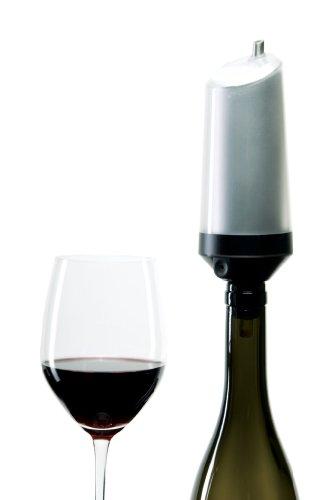
Lives in the freezer and chills the wine as it passes through a cold steel tube on its way to the glass.
Before any timing matters, know the target. Chilling is not a single job, because the finish line moves by about 20°F depending on what is in the bottle.
Serving temperature by style, and the distance from a 72°F room
Style
Serving temperature
Drop needed from 72°F
Sparkling and Champagne
40–45°F
About 30°F
Light whites and rosé
45–50°F
About 25°F
Full-bodied whites
50–55°F
About 20°F
Light reds
55–60°F
About 15°F
Full-bodied reds
60–65°F
About 10°F
Two things follow. A red usually needs cooling, not chilling — a 10°F drop, which almost nothing published on this subject acknowledges. And a bottle taken from a wine cabinet at 55°F is already most of the way there for every style, which is the real point of owning one. The settings in full are in wine fridge temperature settings.
The measured times by method
Most chilling advice is recycled estimate. There is at least one controlled comparison: America’s Test Kitchen chilled wine from 75°F by three methods and measured how long each took.
Time to chill wine from 75°F — measured (America's Test Kitchen)
Method
Measured time
Notes
Ice brine (ice water plus salt)
34 minutes
Fastest. Salt lowers the bath's freezing point, so the water itself gets colder
Freezer
67 minutes
Twice as slow as the brine, and it is easy to forget
Plain ice water
105 minutes
Three times the brine. Ice alone is not the trick; the salt is
The useful conclusion is not the individual numbers, it is the ranking: a salted ice bath beats the freezer by a factor of two and plain ice water by a factor of three. Water conducts heat away from glass far faster than air, which is why both baths beat an air-cooled freezer per degree of difference, and the salt is what makes the fast bath fast.
Those figures are from 75°F to serving temperature for a white. Start from a cooler room or aim at a red’s 60–65°F and everything shortens proportionally — the smaller the gap, the faster it closes.
Why a wine fridge is the slowest option
This is the part people find counter-intuitive, and it is worth understanding rather than working around.
A wine cabinet is engineered to hold a temperature against a small difference — a 55°F interior in a 70°F room is 15°F of work. Its cooling capacity is sized for that, which is exactly why it is quiet, cheap to run and gentle on the bottles. A freezer is engineered to overcome a 70°F difference and has the capacity to match. Put a warm bottle into a wine cabinet and the cabinet has neither the cold reserve nor the airflow to pull it down quickly; it will get there in hours, and in the meantime it has warmed the air around every other bottle in the cabinet.
No manufacturer in our registry publishes a pull-down time, which is both a data gap and a tell — it is not the specification the appliance is built around, so nobody measures it. We are not going to estimate one.
The practical rule: chill elsewhere, store in the cabinet. A cabinet at 55°F means you never need to chill from room temperature in the first place, because every bottle is already within 10°F of where it needs to be. That is the honest answer to “how long does a wine fridge take to chill wine” — the question is a symptom of not having one.
If a cabinet genuinely is not holding its setting at all, that is a different problem: wine fridge not cooling.
Where the devices fit
Four different problems, four different tools, and each claim below is the manufacturer’s own.
Ravi Instant Wine Chiller — chilling in the pour. A pre-frozen stainless tube that fits over the bottle neck; the wine chills as it passes through on the way to the glass. The manufacturer claims it is about 40 times faster than other chilling products. The catch is honest and important: it chills what passes through it and leaves the bottle warm, and it has to have been in the freezer already.
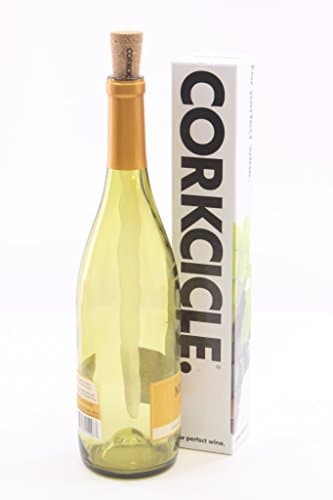
Corkcicle Classic — bringing a red down. A freezable gel stick that goes into the bottle. The manufacturer states twelve minutes inside a room-temperature red lowers it to the mid-60s°F and that it keeps whites chilled for up to an hour, with a 90-minute freeze time. This is the device for the 10°F problem at the top of this page, which is the one ice buckets handle badly.
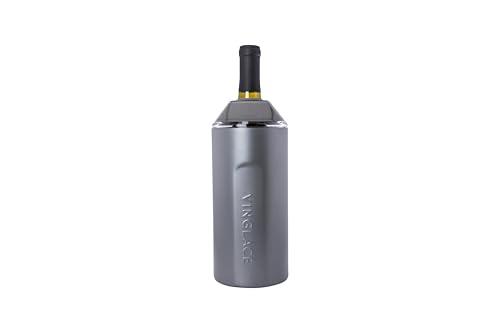
Vinglacé Wine Chiller — holding, not cooling. A vacuum-insulated stainless sleeve the bottle sits in. It does not chill at all; it holds the temperature you give it, without ice and without a condensation ring on the table. Chill the bottle first.
Corkcicle Eola Bucket Cooler — three bottles, somewhere else. An insulated carry bucket for three bottles plus ice, which becomes the table bucket when you arrive. It needs ice, unlike the sleeve.
The wider field, including electric chillers and buckets, is in best wine chillers.
The twenty-minute recipe
You have twenty minutes and a warm bottle. In order of what actually works:
Salted ice bath. A bucket or a deep pan, ice, cold water to cover the bottle to the shoulder, and a generous handful of salt. Spin the bottle occasionally. This is the method that measured 34 minutes from 75°F, so in twenty minutes you will be most of the way to a white’s target and comfortably at a red’s.
A wet towel plus the bath. Wrapping the bottle in a wet cloth adds evaporative cooling on the exposed neck. Marginal, free.
An in-bottle stick such as the Corkcicle Classic, if it has been in the freezer. About twelve minutes to the mid-60s°F for a red, per the manufacturer.
The freezer, with a timer. 67 minutes to a white’s target from 75°F in the measured test, so twenty minutes gets you part-way. Set an actual timer.
Not the wine fridge. It will not do it in twenty minutes and it will warm its neighbours trying.
A kitchen refrigerator sits between the measured freezer and ice-water figures — plan on a couple of hours for a white from room temperature. A salted ice bath did the same job in 34 minutes in America’s Test Kitchen’s test.
▸ How long does a wine fridge take to chill a bottle?
Hours, and no manufacturer in our registry publishes a figure. A wine cabinet is built to hold a temperature against a small difference, not to pull a warm bottle down. Chill elsewhere and store in the cabinet.
▸ What is the fastest way to chill wine?
A salted ice bath. In the measured comparison it took 34 minutes from 75°F, against 67 in the freezer and 105 in plain ice water. Salt lowers the bath’s freezing point so the water itself gets colder.
▸ Can I chill wine in the freezer?
For a short, timed period yes — 67 minutes from 75°F in the measured test. Never unattended and never with sparkling wine: freezing wine expands and the bottle can crack.
▸ How long should I chill red wine?
Far less than you would think. Reds serve at 55–65°F, so from a 72°F room that is a 10–15°F drop — fifteen or twenty minutes in an ice bath, or about 15 minutes with an in-bottle chilling stick per its maker’s claim.