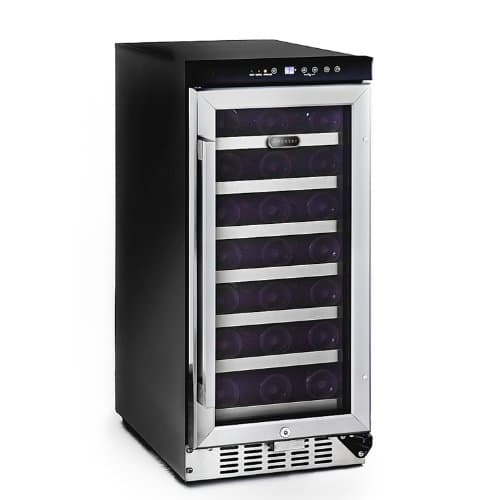
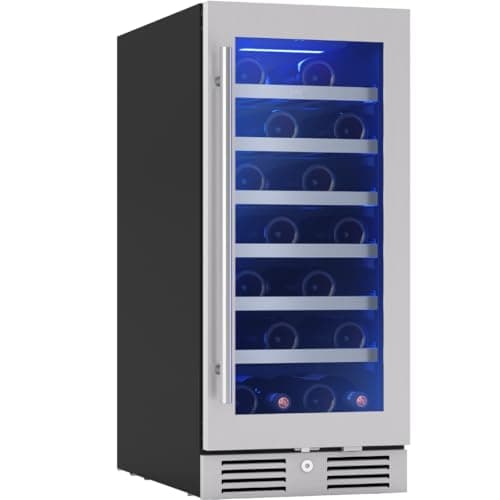
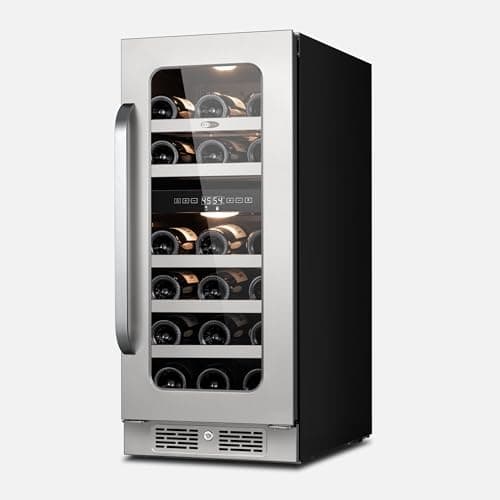
The Whynter BWR-33SD is the pick: 33 bottles in a 15-inch cabinet with a security lock and key fitted as standard. The Zephyr Presrv PRW15C01CG adds a door-open alarm, and the Summit SWC1535B carries a factory-installed lock with a commercial-grade listing.
This page sits in Wine Fridges, where the rest of the category is compared the same way.
How this page is funded. Cork & Cool earns a commission if you buy through the Amazon links below, at no extra cost to you. It never changes the order of this list — see our editorial policy and affiliate disclosure. Prices come from Amazon and are refreshed daily; the price on Amazon when you buy is always the one that counts.
Quick picks
Every model below, on the specifications that decide the purchase. Tap a row to jump to the full write-up.
Comparison of wine storage models by zones, capacity, cooling type, width, published noise rating and vibration.
#
Product
Best for
Zones
Bottles
Cooling
Width
Noise
Vibration
Price
1
Whynter BWR-33SDThe 15-inch default
Thirty-three bottles in a 15-inch cabinet, with a published noise ceiling and seven wooden shelves
#ad — paid link. How this is funded. Price as of November 11, 2026; check Amazon for the current price.
“Not published” means the manufacturer does not publish that figure. We do not estimate it. Prices and product photographs come from Amazon and are refreshed daily; where a model is not sold on Amazon the thumbnail is an illustrative category photograph and the link is a search.
How we compared
We compared published manufacturer specifications, official product documentation and verified owner reports across 6 models. We do not physically test these units, we have no laboratory, and we do not accept payment for placement. Where a manufacturer does not publish a figure — noise ratings, most often — this page says so rather than estimating it.
What we weighted
Whether the manufacturer publishes a lock at all — a glass door with no documented lock is not lockable
What kind of lock it is: a keyed cylinder, a security lock, or a latch
Whether keys are supplied, and how many
Secondary deterrents such as a door-open alarm, which tells you about access even when the door is not locked
The usual storage specs — published range, capacity, width — because a lock is a reason to buy, not a substitute for the rest
Every model in detail
#1 — The 15-inch default
Whynter BWR-33SD
Thirty-three bottles in a 15-inch cabinet, with a published noise ceiling and seven wooden shelves — the capacity ceiling at this width, and the widest temperature band on this page.
Product photograph via Amazon.
Published specifications
Capacity
33 bottles
Zones
1
Cooling
compressor
Temperature range
40–72°F
Noise rating
42 dB
Installation
both
· Exterior: 15.0 in W x 22.5 in D (24.5 in with the handle installed) x 34.0 in H
· Capacity: 33 standard 750 ml bottles
· Noise published as "< 42 dBA" — a ceiling, not an average
Thirty-three bottles is the highest published capacity at this width
Whynter publishes a decibel ceiling, which almost nobody in this category does
Seven wooden shelves rather than the wire shelving usual at this price
40-72°F is the widest published band here, so it will also hold a bottle at room temperature
Rated for built-in or freestanding use, so an opening is optional rather than required
What does not
Single zone only — one temperature for the whole cabinet
The published figure is "< 42 dBA", a maximum rather than an average, so it cannot be compared like-for-like against a manufacturer quoting a flat number
At 15.0 inches published it is the widest cabinet in this group, which matters if your opening is tight
Depth grows to 24.5 inches once the handle is on, which is the figure that matters in a shallow run
33 bottles assumes standard Bordeaux shapes; a Burgundy-heavy collection will fit fewer
Who should skip it. Skip it if you need to serve whites cold and hold reds at cellar temperature in the same cabinet — one zone cannot do both. Skip it too if your opening measures under 15 inches, because this is the one cabinet here that needs the full module.
#ad — paid link. How this is funded. Price as of November 11, 2026; check Amazon for the current price.
#2 — Storage, not just chilling
Zephyr Presrv PRW15C01CG
Twenty-seven bottles, a published 39 dBA, and the only cabinet in this width whose maker documents a vibration dampening system — you are paying for the storage conditions, not the bottle count.
Product photograph via Amazon.
Published specifications
Capacity
27 bottles
Zones
1
Cooling
compressor
Temperature range
38–65°F
Noise rating
39 dB
Installation
both
· Exterior: 15 in W x 33-7/8 in H x 23-3/8 in D
· Capacity: 27 bottles (750 ml), 3.4 cu ft
· Sound level: 39 dBA published
· Racking: six full-extension black wood racks with stainless trim
· Glass: dual-pane, Low-E, argon-filled
· Field-reversible door with concealed zero-clearance hinges, door lock, door-open alarm
· Energy Star certified; Sabbath mode; carbon-filtered air filtration
· Weight: 101 lb · Power: 115 V, 60 Hz at max 1.5 A
· Warranty: 2 years parts and labor, 5 years compressor
The only 15-inch cabinet here whose manufacturer documents vibration control at all
Publishes a flat decibel figure rather than a ceiling, so it can be compared properly
Reaches 38°F, the lowest published minimum in this group, which matters for sparkling wine
Full-extension racks mean you can reach a bottle at the back without unloading the shelf
Five-year compressor warranty against the usual one or two
What does not
Twenty-seven bottles against thirty-three for the same width — the racks take the space
23-3/8 inches deep, the deepest cabinet in this group
Costs materially more than the Whynter and Summit cabinets it sits beside
Who should skip it. Skip it if the wine is going to be drunk within a year or two. Vibration control and a 38°F floor are long-storage features, and you can have eight more bottles for less money without them.
#ad — paid link. How this is funded. Price as of November 11, 2026; check Amazon for the current price.
#3 — Commercial-grade listings
Summit SWC1535B
Thirty-three bottles in 14.75 inches, listed to NSF-7 and UL-471 for commercial premises — the one you buy for a bar, a rental or anywhere an inspector might look.
Illustrative photograph — not an image of the Summit SWC1535B.
Published specifications
Capacity
33 bottles
Zones
1
Cooling
compressor
Temperature range
41–64°F
Noise rating
Not published by the manufacturer
Installation
both
· Exterior: 33.88 in H x 14.75 in W x 22.75 in D
· Shelving: six slide-out wooden shelves; remove alternate shelves for wider Burgundy bottles
· Door: glass with stainless steel trim, reversible, factory-installed lock
· ETL-S listed to NSF-7 standards and meets UL-471 for use in commercial establishments
· Automatic defrost
· Weight: 77 lb
· ADA-height sibling sold separately as the ALWC15
Commercial listings that no other cabinet in this width carries
Floor space takes three wider bottles, which Summit states rather than leaving you to discover
Factory-fitted lock and a reversible door as standard
Rated for built-in or freestanding use and finished on all sides
What does not
Summit does not publish a decibel rating
The published range stops at 64°F, slightly short of the 65-66°F most rivals quote
Single zone
Who should skip it. Skip it if this is going into a home kitchen and nobody will ever ask about NSF listing — you are paying for commercial certification you will not use.
Twenty-nine bottles split ten over nineteen across two zones that each cover the whole 40-65°F range — so either half can hold a red, which the other dual-zone cabinet at this width cannot.
Product photograph via Amazon.
Published specifications
Capacity
29 bottles
Zones
2
Cooling
compressor
Temperature range
40–65°F
Noise rating
38 dB
Installation
both
· Exterior: 14.8 in W x 22.4 in D x 33.9 in H
· Internal volume: 3.0 cu ft
· Capacity: 29 standard 750 ml bottles — 10 in the upper zone, 19 in the lower
· Both zones: 40-65°F / 5-18°C
· Noise published as "< 38 dB" — a ceiling, not an average
· Shelving: five removable beechwood shelves
· Door: seamless stainless-trimmed double tempered UV-resistant glass, reversible, cylinder lock with two keys
Both zones are rated across the full 40-65°F span, so the split is yours to set rather than the factory's
Whynter publishes a decibel ceiling, which the other dual-zone cabinet at this width does not
14.8 inches wide and 22.4 inches deep, the shallowest of the full-depth cabinets here
Beechwood shelves and a reversible door, so the hinge side is not decided for you
Rated for built-in or freestanding use, so an opening is optional rather than required
What does not
Twenty-nine bottles against thirty-three for the single-zone cabinets — the divider costs four
The upper zone holds only ten bottles, so the split is lopsided whichever way you use it
The published figure is "< 38 dB", a maximum rather than an average
29 bottles assumes standard Bordeaux shapes; a Burgundy-heavy collection will fit fewer
Who should skip it. Skip it if you only ever hold one temperature. The divider costs four bottles and a whole zone of shelf space, and a single-zone cabinet at this width gives both back.
#ad — paid link. How this is funded. Price as of November 11, 2026; check Amazon for the current price.
#5 — An 18-inch-deep run
Summit SDHW1532
Eighteen inches deep instead of the usual twenty-two and a half — the answer when the cabinet run is shallow and every other 15-inch cabinet sticks out.
Illustrative photograph — not an image of the Summit SDHW1532.
Published specifications
Capacity
18 bottles
Zones
1
Cooling
compressor
Temperature range
41–68°F
Noise rating
Not published by the manufacturer
Installation
both
· Exterior: 33.75 in H x 14.75 in W x 18.0 in D (19.75 in D with the handle)
· Shelving: six removable steel shelves in black with stainless trim
41°F floor is cold enough for sparkling wine service
Compressor cooling holds its setting regardless of room temperature
A lock, which most units this size omit
What does not
One zone only
A compressor in a small cabinet is audible in a quiet room
Who should skip it. Skip it if the unit will sit in a bedroom or a quiet home office. At this size the compressor is close to you and there is no published dB figure to reassure you.
#ad — paid link. How this is funded. Price as of November 11, 2026; check Amazon for the current price.
Who actually needs a lock
Four situations, and they are more common than the category suggests.
A house with teenagers. The most frequent reason people search for this, and the one manufacturers are most coy about.
A rental, an office or a shared kitchen. A cabinet in a communal space with no lock is a cabinet with a shared inventory.
A short-term let. Owners who leave stock in the property need the door secured, not just closed.
A genuinely valuable shelf. If one shelf is worth more than the cabinet, a lock is cheap.
It matters that you buy it fitted. The lock on a wine fridge goes through the door frame and engages a catch in the cabinet body; there is no aftermarket version that does the same job on a glass door, and drilling a double-pane insulated door to add one wrecks both the seal and the warranty. This is a specification to filter on before you shop, not after.
What each manufacturer publishes
“Lockable” is not a standardized term, so the table below uses each manufacturer’s own words rather than ours.
The lock as each manufacturer describes it, with the cabinet's other published specs
Cabinet
Lock as published
Published range
Bottles
Width
Whynter BWR-33SD
Security lock and key
40–72°F
33
15 in
Zephyr Presrv PRW15C01CG
Door lock, plus a door-open alarm
38–65°F
27
15 in
Summit SWC1535B
Factory-installed lock
41–64°F
33
14.75 in
Whynter BSR-029DW
Cylinder lock with two keys
40–65°F, both zones
29
14.8 in
Summit SDHW1532
Factory-installed lock
41–68°F
18
14.75 in
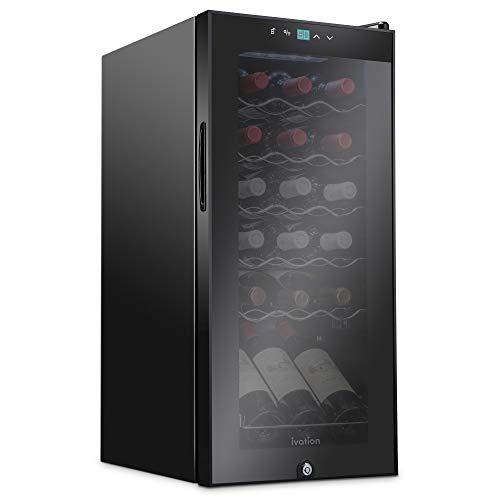
Ivation 18-bottle compressor
Lockable door
41–64°F
18
Not published
Three things fall out of that table.
The Whynter BSR-029DW is the only one that publishes a key count. Two keys, on a cylinder lock. That sounds trivial until you have one key for a cabinet in a house with two adults, and it is the kind of detail that only appears in the specifications.
The Zephyr is the only one with a second layer. A door-open alarm does something a lock cannot: it tells you the door has been left open, whether that is a teenager or a bottle resting against the seal. On a cabinet with a 38°F floor and dual-pane Low-E argon glass, that is a coherent set of choices rather than a feature list.
Both Summit cabinets say “factory-installed”. It is the phrase that matters most on this page, because it is the difference between a lock engineered into the door and a hole drilled in one. The SWC1535B is also ETL-S listed to NSF-7 and meets UL-471 for commercial premises, which is why it turns up in offices and tasting rooms where a lock is not optional.
What a wine fridge lock is not
It is a deterrent on a glass door. It will stop casual access and it will not stop anybody determined — the door is tempered glass in a thin frame, and the cabinet is not anchored to anything. Treat it the way you treat a lock on a drinks cabinet: it changes what is easy, not what is possible.
Two practical consequences. First, if the cabinet is freestanding and light, consider where it stands as part of the security question, not just whether it locks — the Summit SDHW1532 is 88 lb and the Whynter BSR-029DW 68.9 lb, which is liftable. Second, if you are putting the unit into cabinetry anyway, the housing does more than the lock does; see how to install a wine fridge under a counter.
Choosing between the six
All six lock. The decision is therefore the same decision as on any other cabinet: how much wine, in how wide a gap, at what temperature.
33 bottles, one zone, the widest published range: Whynter BWR-33SD. Its 40–72°F range is the broadest here, and Whynter publishes noise as “< 42 dBA” — a ceiling rather than an average, which is more than most brands offer.
Cold service plus an alarm: Zephyr Presrv PRW15C01CG. Fewer bottles, better glass, Energy Star certified, and the only door-open alarm in the registry.
Commercial premises: Summit SWC1535B, for the NSF-7 and UL-471 listings.
Two zones in 14.8 inches: Whynter BSR-029DW, with both zones running the full 40–65°F.
A shallow run: Summit SDHW1532, at 18 inches deep rather than the usual 22 to 23 — see the dimensions guide.
The cheapest route to a locked door: Ivation 18-bottle compressor, which reaches 41°F and locks, and asks you to give up shelf quality for it.
If a lock is not actually a requirement, you are filtering out most of the market for no reason — the main wine fridge list is the wider field.
Questions people actually ask
▸ Can you add a lock to a wine fridge that does not have one?
Not properly. The lock engages a catch in the cabinet body, and drilling a double-pane insulated glass door to retrofit one damages the seal and voids the warranty. Buy it fitted.
▸ Do all wine fridges come with a lock?
No, and most do not. Of the 26 wine cabinets in our registry, six publish a lock. It is a specification worth filtering on early, because it is not something you can add later.
▸ Which lockable wine fridge gets coldest?
The Zephyr Presrv PRW15C01CG, at a published 38°F floor. The Whynter BWR-33SD and BSR-029DW both publish 40°F, which is already cold enough for sparkling wine service.
▸ Is a wine fridge lock secure?
It is a deterrent, not a safe. The door is tempered glass in a thin frame and the cabinet is not anchored. It stops casual access, which is what most people actually need.
▸ Do lockable wine fridges cost more?
Not inherently — the Ivation 18-bottle compressor is one of the cheapest compressor cabinets in the registry and it locks. Prices move weekly, so check the current figure on each card above rather than assuming a premium.