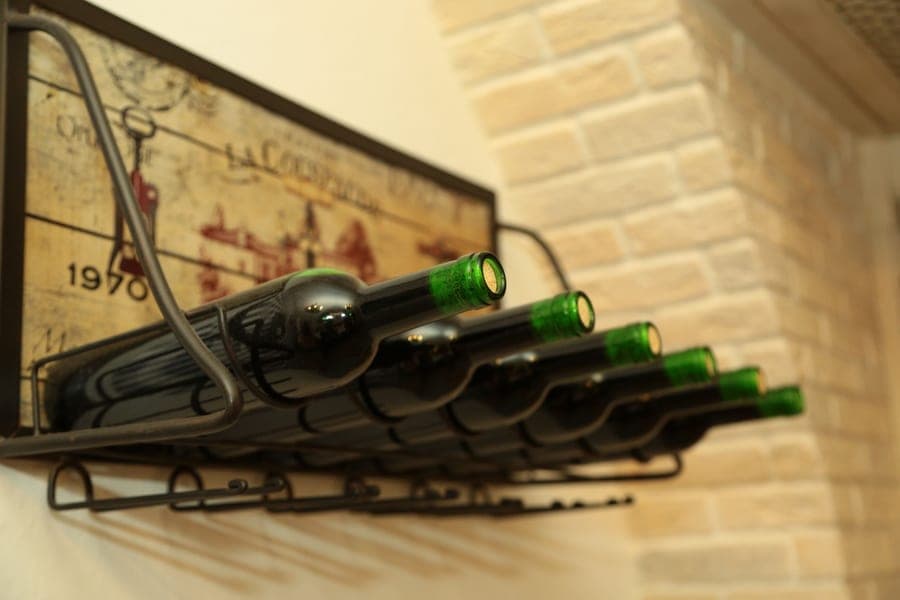
The Oenophilia Halfpipe is the cleanest modular option: matte black iron 3-bottle units that stack with no assembly, so you add capacity six bottles at a time. The Sorbus mahogany wall set extends the same way horizontally. Past about 40 bottles, stop stacking and buy one large floor rack instead.
How this page is funded. Cork & Cool earns a commission if you buy through the Amazon links below, at no extra cost to you. It never changes the order of this list — see our editorial policy and affiliate disclosure. We do not publish prices, because a stale number helps nobody.
Quick picks
Every model below, on the specifications that decide the purchase. Tap a row to jump to the full write-up.
Comparison of wine storage models by zones, capacity, cooling type, width, published noise rating and vibration.
#
Product
Best for
Zones
Bottles
Cooling
Width
Noise
Vibration
Price
1
Oenophilia Halfpipe Stackable Wine Rack (6 bottle)Growing one shelf at a time
Two three-bottle iron units that stack and repeat, so the rack grows with the collection instead of being sized for it up front.
“Not published” means the manufacturer does not publish that figure. We do not estimate it. Thumbnails are illustrative category photographs, not photographs of the specific models.
How we compared
We compared published manufacturer specifications, official product documentation and verified owner reports across 3 models. We do not physically test these units, we have no laboratory, and we do not accept payment for placement. Where a manufacturer does not publish a figure — noise ratings, most often — this page says so rather than estimating it.
What we weighted
How the unit extends — vertically, horizontally, or not really at all
Whether extending requires assembly or tools
Stability when stacked and fully loaded
Material, since a stacked load is carried by the units underneath
Cost per additional bottle of capacity
The point at which a single larger rack becomes the better buy
Cost per bottle stored is a fraction of any powered cabinet
Labels stay readable, so you can actually find a bottle
No power, no compressor, nothing to fail
What does not
No temperature control, no humidity control, no UV protection — the room does all of that or nothing does
150 full bottles is roughly 400 lb; the floor has to take it
Who should skip it. Skip it if the room swings more than a few degrees across the year, or gets above the mid-60s°F in summer. A rack in the wrong room ages wine faster than no rack at all.
Almost nobody buys wine storage once. You buy a rack for the bottles you have, and within a year you have more bottles — because storage gets used, and because having somewhere to put wine makes buying wine easier.
A modular rack accepts that in advance. Instead of replacing a full rack with a bigger one (and owning a redundant rack), you add a unit. The economics are better and the aesthetic stays consistent, which matters if the rack is somewhere it can be seen.
Three ways to extend
The Oenophilia Halfpipe is the purest version: two 3-bottle matte black iron units that stack, no assembly, no tools. Six bottles today, twelve when you buy another pair. Iron rather than coated wire is a genuinely better material at this price, and it is the pick if your growth is happening on a shelf or a counter.
The Sorbus mahogany wall set extends sideways instead. Three 3-bottle racks in the box; buy a second set and the arrangement grows along a wall, around a doorway or up a stairwell. You are trading installation effort — three fixings per set — for capacity that does not consume floor or counter space at all. See wall-mounted racks for the fixing detail, which matters here.
The Sorbus 150-bottle floor rack is on this page as the honest endpoint. It is not modular. It is what to buy instead of stacking once the collection is past the point where adding units makes sense — and its open shelving keeps labels readable, which stacked small units increasingly do not.
How each one grows
Rack
Extends
Effort to extend
Sensible ceiling
Oenophilia Halfpipe
Vertically, by stacking
None — place another unit
Roughly 24 bottles
Sorbus mahogany set of 3
Horizontally, along a wall
Three fixings per set
Wall space, and patience
Sorbus 150-bottle floor rack
Not modular
n/a
150 bottles
Where stacking stops
Three limits, and they arrive sooner than people expect.
Stability. A stack is only as stable as the surface under it and the bottom unit. Loaded with glass, a tall stack on a flexing shelf is a bad arrangement. Keep stacks low and on something solid.
Finding anything. Small stacked units bury labels behind each other. Past a couple of dozen bottles you stop being able to see what you own, which is exactly when a single open-shelf rack becomes worth more than its capacity.
Cost per bottle. Modular capacity is bought at a premium per bottle. Around 40 bottles, one large floor rack becomes cheaper than the equivalent stack — see floor racks.
And the constant: a rack of any configuration inherits the room’s climate. If the growing collection includes bottles worth keeping for years, the question stops being how to stack and becomes whether the room is good enough — rack vs fridge.
Questions people actually ask
▸ Are stackable wine racks a good idea?
Yes for a collection that is growing, because you add capacity instead of replacing the rack. Keep stacks low and on a solid surface, and switch to a single large rack once you are past roughly 40 bottles.
▸ How high can you stack wine racks?
No listing publishes a limit, so use judgment: low enough that the stack is stable when fully loaded and you can load the top without leaning on it. On a flexing shelf, lower still.
▸ When should I buy one big rack instead of stacking?
Around 40 bottles. Past that, a single large floor rack usually costs less per bottle stored and — more usefully — keeps labels visible, which stacked small units do not.