The three materials
Every shelf in this site’s registry is one of three things, and the manufacturers are reasonably honest about which.
Shaped wood, usually beech. The default above entry level. Beech is dense, stable in a humid cabinet and cheap enough to use at this price point; milled into a cradle it supports a bottle along its curve rather than at two points. That does three useful things: the bottle cannot rock as the compressor cycles, the paper label does not drag across metal when you slide the bottle out, and bottles stop rolling into each other. Published by name: Kalamera KRC-46DZB (“natural beech wood”), Newair AWR-460DB (“removable beechwood”), Whynter BSR-029DW (“five removable beechwood shelves”), Koolatron WC12-35D (“five removable beech wood sliding shelves”).
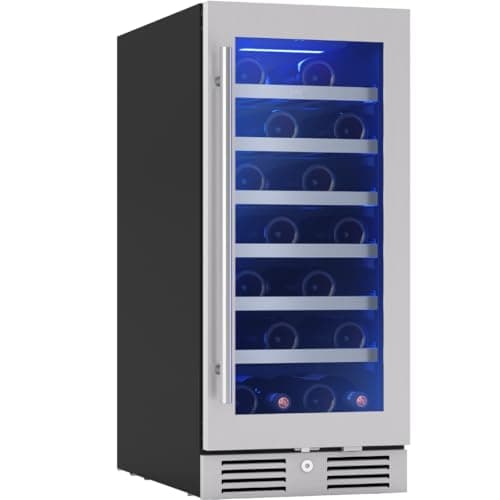
Unspecified wood. Most of the rest. Whynter publishes “removable wooden flat slide-out shelves” on the BWR-1642DZ (fifteen) and BWR-1662SD (sixteen), and “seven removable wooden shelves with stainless steel shelf fronts” on the BWR-33SD. Summit publishes “six slide-out wooden shelves” on the SWC1535B. Zephyr publishes “six full-extension black wood racks with stainless trim.” Not naming the species is normal and not a red flag; the shelf still behaves like wood.
Metal — wire, chrome or steel. The Whynter WC-201TD publishes “five removable stainless-trimmed chrome shelves” and the Summit SDHW1532 “six removable steel shelves in black with stainless trim.” Metal is cheaper, lighter, easier to wipe down and immune to damp. It is also the one that rocks bottles and scuffs labels. There is one legitimate case for it beyond price: a cabinet that holds cans and bottles mixed, or lives somewhere that gets cleaned often. See can a wine fridge be used for beer and soda.
A fourth type appears once: the Whynter BWR-1662SD publishes sixteen wooden shelves plus a wire display shelf. A display shelf angles a bottle label-forward, holds far fewer bottles, and is there to be looked at. Spend it on presentation, not storage.
Fixed, slide-out and full-extension
Three different claims, and only the third one means the shelf comes all the way out.
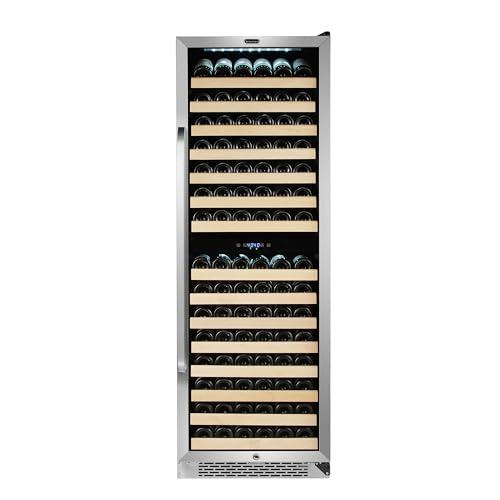
The distinction decides whether the back of a deep shelf is storage or dead space. In a 12-bottle cabinet it does not matter — you can see and reach everything. Above about 40 bottles it matters a lot, and above 100 it is the difference between a navigable cellar and an excavation. That is why the two Whynter 24-inch towers carry fifteen and sixteen slide-out shelves respectively: at 164 bottles, a fixed shelf would make the rear half unusable.
Zephyr is the only cabinet here making the stronger claim. Six full-extension racks on a 27-bottle cabinet is close to a rack per four bottles, every one of which pulls fully clear. At the other end of the same idea, the Koolatron WC12-35D has five sliding shelves for twelve bottles — you never reach past anything.
Removable, and the wide-bottle problem
This is the single most useful shelf property and the one buyers ignore. A shelf that comes out is the only mechanism any cabinet gives you for storing a bottle the shelf pitch was not designed for.
The bottles that cause the problem are Burgundy and Rhône shapes — wider at the shoulder than a Bordeaux bottle — Champagne, which is both wider and heavier, and magnums, which are both wider and taller. A cabinet rated for 46 standard bottles may take only a handful of those without a shelf coming out.
Summit is the most explicit, publishing the move for the SWC1535B directly: remove alternate shelves to take wider Burgundy bottles. Whynter publishes “removable” on the BWR-33SD, BWR-1642DZ, BWR-1662SD and BSR-029DW; Newair on the AWR-460DB; Koolatron on the WC12-35D; and even the metal-shelf cabinets — the Whynter WC-201TD and Summit SDHW1532 — publish removable shelves.
Where a manufacturer does not use the word, do not assume. The Kalamera KRC-46DZB cradles each of its 46 bottles individually, which is excellent for standard Bordeaux and the opposite of flexible for anything else. And the arithmetic is unforgiving: pulling one shelf out of a seven-shelf cabinet costs roughly a seventh of your capacity to buy one double-height bay, so plan which bay before you load. Detail in best wine fridges for large-format bottles and best wine fridges for Champagne.
Shelf pitch, and why capacity lies
Shelf count and shelf pitch together decide real capacity, and a published bottle count hides both.
Run the numbers on two cabinets with the same rating. The Whynter BWR-33SD holds 33 bottles on seven shelves — a little under five bottles per shelf. The Summit SWC1535B also holds 33, on six slide-out shelves plus the floor. Same capacity, different pitch: fewer shelves means each bay is taller, which means the Summit tolerates a tall bottle better without any shelf coming out, and the Whynter gives you more independent layers to organize with.
Neither is better in the abstract. What matters is matching the pitch to what you drink: mostly Bordeaux and standard shapes, take the extra shelves; a mixed collection with Burgundy and Champagne in it, take the taller bays. Either way, plan on 70 to 80 percent of the published rating in real bottles, because the rating assumes standard bottles filling every bay. Full arithmetic in what size wine fridge do I need, and layout practice in how to arrange bottles in a wine fridge.
Cracked, warped or missing shelves
Shelves outlast compressors in most cabinets, and when one does fail there is almost always a cause worth fixing rather than just a part to replace.
- A warped or stained wooden shelf is a water story. Either the drip tray overflowed, the drain is blocked, or the door seal is failing and condensing onto the shelf. Replace the shelf if you like, but find the water first — wine fridge condensation.
- A cracked runner on a slide-out shelf is usually overload: a shelf of Champagne weighs a great deal more than a shelf of Bordeaux. Heavy and large belongs on the bottom shelf, which is also where the cabinet is most stable.
- A shelf that smells is wood plus trapped damp plus time, and the shelf is the symptom. See why a wine fridge smells musty.
- Sourcing a replacement means the manufacturer, by model number. Shelf runners, widths and mounting are model-specific, so generic shelving rarely fits; this is also an argument for buying from a brand that still lists spares for cabinets it sold five years ago, which the brand picture in wine fridge brands compared touches on.
Cleaning, in one line: a barely damp cloth, then dry the shelf before it goes back in. No soaking, no dishwasher, no solvent cleaner in a cabinet that has to stay odor-free. The rest of the routine is in wine fridge maintenance, and the cabinets with the best published shelving are in best wine fridges with wooden shelves.