
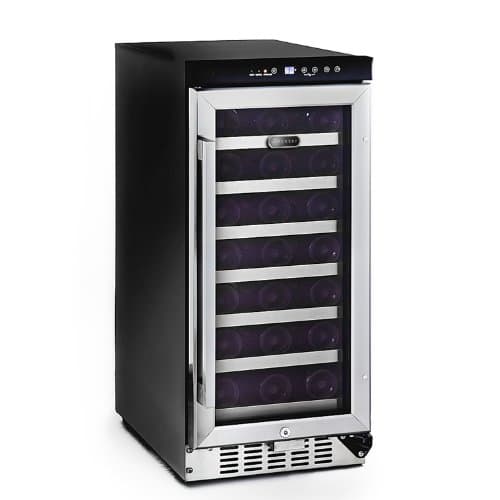
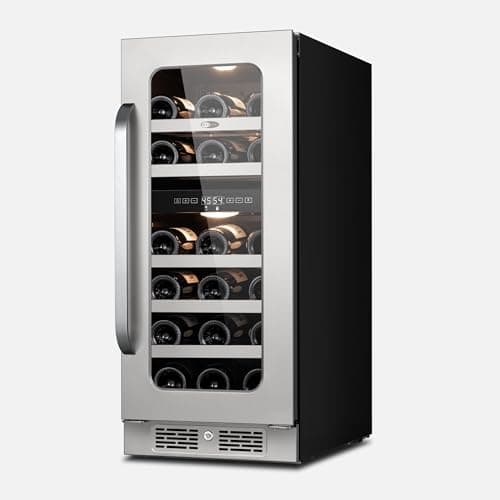
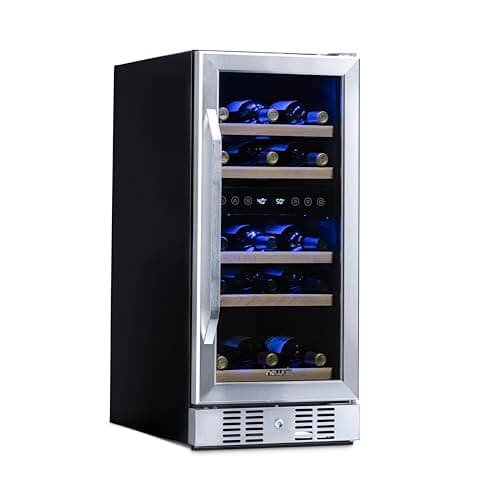
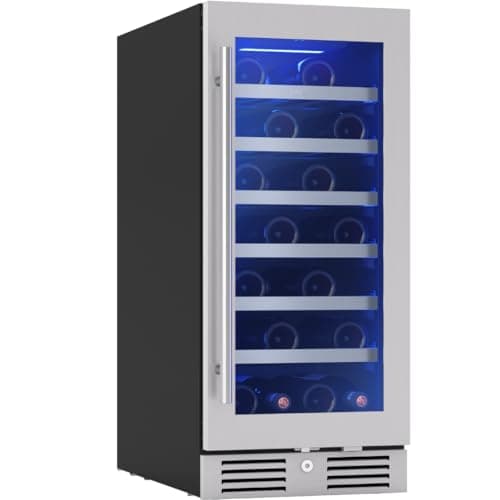
Why 30 bottles is the capacity most people land on
Nobody sets out to buy a thirty-bottle wine fridge. People arrive at it, and they arrive from both directions.
From below: a twelve or eighteen-bottle countertop unit filled up within a few months, which is what happens the moment buying wine by the case becomes normal. Twelve bottles is one case. It is not storage, it is a holding pen.
From above: a hundred-bottle cabinet is a piece of furniture. It needs its own floor space, it costs several times as much, and for a household drinking two or three bottles a week it is storing wine that has nowhere to go. The hundred-bottle class is genuinely for collections.
Thirty bottles is where those two pressures meet. It is roughly two and a half cases, which is a stocked household rather than a collection — enough that there is always something appropriate open-able, not so much that bottles are aging by accident. It is also the capacity the industry has standardized on, which is why this band has more genuine competition than any other.
If you are not sure thirty is your number, working out what size wine fridge you need runs the arithmetic from consumption rather than from aspiration.
Thirty bottles is not thirty of your bottles
This is the single most useful thing on this page, and no listing in the band says it plainly.
Every capacity figure here — 27, 29, 33 — is counted in standard 750 ml Bordeaux bottles: the straight-sided shape most Cabernet, Merlot and Rioja arrives in. The shelf spacing and the rack cut-outs are designed around that diameter. Put a different shape in and the number falls, sometimes sharply:
Burgundy bottles — Pinot Noir, Chardonnay, most of Oregon and Burgundy itself — have sloping shoulders and a wider body. They do not seat properly in a cut-out sized for Bordeaux, and the usual fix is to remove alternate shelves, which costs you the bottles those shelves were holding. Summit states this outright for the SWC1535B: take out alternate shelves and the floor space takes three wider bottles. We quote that because it is published; most makers leave you to find out.
Champagne and sparkling bottles are wider still and heavier. Expect them to occupy roughly the space of two Bordeaux bottles each, on a shelf that will take them at all.
Magnums and odd shapes — dessert wine, some Italian and German bottles — generally do not fit standard racking at this size, full stop.
The practical consequence: if your drinking is Burgundy-heavy, treat a 33-bottle rating as mid-twenties and a 29-bottle rating as low twenties. That derating is the real reason people describe a thirty-bottle cabinet as “smaller than I expected,” and it is not the manufacturer lying — it is a standard everyone quotes and nobody explains.
The same capacity at two different widths
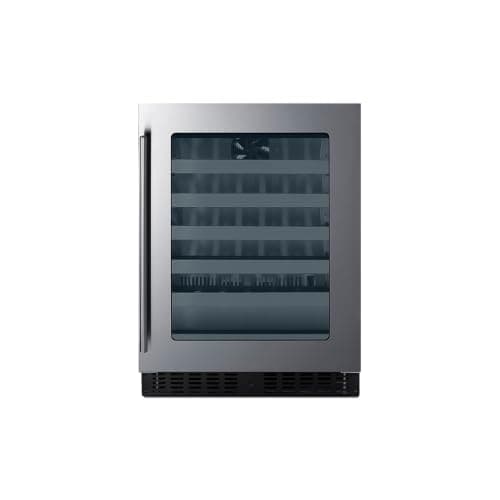
Something unusual happens in this band: you can buy thirty bottles in a cabinet fourteen and three-quarter inches wide, or in one twenty-four inches wide. That is a near-doubling of width for the same bottle count, and it is not a mistake.
The 15-inch cabinets reach thirty-odd bottles by being full depth and full height and racking tightly. Five of the six units here do exactly that. The 24-inch Summit ASDW2412 reaches thirty-three by being unusually shallow — under eighteen inches deep instead of the usual twenty-two and a half — and by sitting at 32 inches tall for ADA counters, with legs that raise it to 34.
So the width question is really a depth question. If you have a narrow gap at the end of a run, buy a 15-inch cabinet. If you have a wide opening but a shallow one — a peninsula, an island with services behind it, an older cabinet run — the 24-inch shallow unit is the only cabinet in this band that fits, and you pay for that in money rather than in bottles.
Two notes on reading that table. First, the depth figure in brackets is the one that fails: a cabinet quoted at 22.5 inches becomes 24.5 once the handle is on, and a 24-inch-deep run has no room for it. Second, Summit does not publish a temperature range for the ASDW2412 in the listing we checked, so the cell is empty rather than filled with a plausible-looking number.
If your opening is narrow and the width is the whole decision rather than the capacity, the 15-inch comparison ranks the same class by fit instead, and the dimensions guide covers how to measure an opening properly before you order anything.
What the second zone costs you here
Two of these six are dual zone, and at this capacity the divider is expensive in a way it is not at a hundred bottles.
The Whynter BSR-029DW holds 29 against its single-zone sibling’s 33. Four bottles is the direct cost of the divider. The split is also lopsided: ten bottles above, nineteen below. Whichever way you use it, one zone is small.
What the Whynter buys for that is the useful part. Both of its zones are rated across the full 40-65°F span, which means you decide what each half does — two serving temperatures, two cellar temperatures, or one of each. The Newair AWR-290DB holds the same 29 bottles but fixes its upper zone at 40-50°F, so that half of the cabinet can never hold a red at cellar temperature. It is a service cabinet by design, not a storage cabinet with options.
If you only ever hold one temperature, the single-zone cabinets give you the four bottles and the full-height shelving back, and the 40-72°F band on the Whynter BWR-33SD is wide enough to cover anything from sparkling service to room temperature on its own. Single zone against dual zone works through the decision in full, and dual-zone temperature settings covers what to actually set them to.
The band where noise actually gets published
All six cabinets here are compressor-cooled, which means all six cycle: the compressor starts, runs for a few minutes and stops. The starting is what people notice, and in an open-plan kitchen or a studio it is the specification that decides whether you regret the purchase.
Unusually for this category, three of these six publish a figure. The Zephyr publishes 39 dBA as a flat number. Whynter publishes “< 38 dB” for the BSR-029DW and “< 42 dBA” for the BWR-33SD — those are ceilings, not averages, and they cannot be compared like-for-like against a flat number. The two Summit cabinets and the Newair publish nothing, and we have not estimated for them.
The Zephyr is also the only cabinet in this band whose manufacturer documents anything about vibration: it specifies a dampening system intended to minimize disturbance to the wine. Vibration is a long-storage concern rather than a noise concern — agitation interferes with the slow settling that aging depends on — and it is worth paying for only if the wine is staying for years. If it is not, the quiet cabinet list ranks on mechanism across the whole site, and wine fridge noise explained separates the sounds that are normal from the ones that are a fault.
Choosing by the constraint you have
All six hold roughly thirty bottles and all six hold their setting regardless of the room. What separates them is one specification each.
If thirty turns out to be too few once you have applied the bottle-shape derating above, the honest move is to skip a size rather than buy twice. If it is too many, the small cabinet list starts at ten bottles, and the main roundup compares the whole category on the same specifications.