Whynter publishes two things most of this category will not: a decibel ceiling and a wattage figure. Here is what each of its cabinets is actually for.
The Whynter BWR-33SD is the best Whynter wine fridge for most households: 33 bottles in a 15-inch body, a published 40-72°F span, under 42 dBA, seven removable wooden shelves, a lock and a carbon filter. For capacity, the 166-bottle BWR-1662SD. The budget pick is the thermoelectric WC-201TD, which has no compressor at all.
This page sits in Wine Fridges, where the rest of the category is compared the same way.
How this page is funded. Cork & Cool earns a commission if you buy through the Amazon links below, at no extra cost to you. It never changes the order of this list — see our editorial policy and affiliate disclosure. Prices come from Amazon and are refreshed daily; the price on Amazon when you buy is always the one that counts.
Quick picks
Every model below, on the specifications that decide the purchase. Tap a row to jump to the full write-up.
Comparison of wine storage models by zones, capacity, cooling type, width, published noise rating and vibration.
#
Product
Best for
Zones
Bottles
Cooling
Width
Noise
Vibration
Price
1
Whynter BWR-33SDThe 15-inch default
Thirty-three bottles in a 15-inch cabinet, with a published noise ceiling and seven wooden shelves
“Not published” means the manufacturer does not publish that figure. We do not estimate it. Prices and product photographs come from Amazon and are refreshed daily.
How we compared
We compared published manufacturer specifications, official product documentation and verified owner reports across 5 models. We do not physically test these units, we have no laboratory, and we do not accept payment for placement. Where a manufacturer does not publish a figure — noise ratings, most often — this page says so rather than estimating it.
What we weighted
Published capacity and, where Whynter gives one, the per-zone split
Published temperature span per zone, since Whynter's cabinets differ more on span than on capacity
The published decibel ceiling, which Whynter prints on several models and almost no rival prints at all — stated as a ceiling rather than an average, because that is what it is
Published wattage, which Whynter also prints and which is the only honest route to a running-cost estimate
Shelving: how many shelves, whether they are wood, and whether they slide out
Installation rating, since Whynter sells both built-in-only columns and dual-rated undercounter cabinets
Whether the model has a live Amazon listing today, which on this brand varies by model
Every model in detail
Every Whynter cabinet in this site's registry, ranked by how many households each one suits rather than by price. Each card carries the Whynter specification page it was read from.
#1 — The 15-inch default
Whynter BWR-33SD
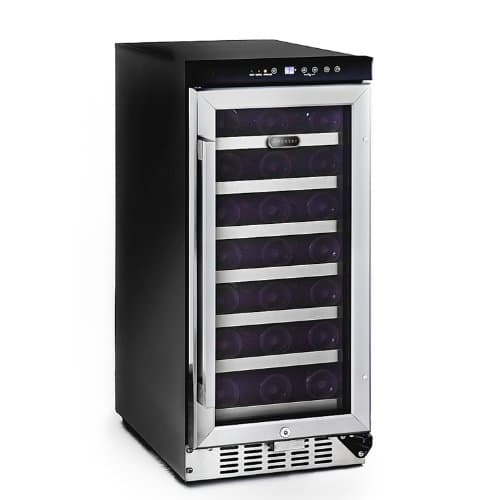
Thirty-three bottles in a 15-inch cabinet, with a published noise ceiling and seven wooden shelves — the capacity ceiling at this width, and the widest temperature band on this page.
Product photograph via Amazon.
Published specifications
Capacity
33 bottles
Zones
1
Cooling
compressor
Temperature range
40–72°F
Noise rating
42 dB
Installation
both
· Exterior: 15.0 in W x 22.5 in D (24.5 in with the handle installed) x 34.0 in H
· Capacity: 33 standard 750 ml bottles
· Noise published as "< 42 dBA" — a ceiling, not an average
Thirty-three bottles is the highest published capacity at this width
Whynter publishes a decibel ceiling, which almost nobody in this category does
Seven wooden shelves rather than the wire shelving usual at this price
40-72°F is the widest published band here, so it will also hold a bottle at room temperature
Rated for built-in or freestanding use, so an opening is optional rather than required
What does not
Single zone only — one temperature for the whole cabinet
The published figure is "< 42 dBA", a maximum rather than an average, so it cannot be compared like-for-like against a manufacturer quoting a flat number
At 15.0 inches published it is the widest cabinet in this group, which matters if your opening is tight
Depth grows to 24.5 inches once the handle is on, which is the figure that matters in a shallow run
33 bottles assumes standard Bordeaux shapes; a Burgundy-heavy collection will fit fewer
Who should skip it. Skip it if you need to serve whites cold and hold reds at cellar temperature in the same cabinet — one zone cannot do both. Skip it too if your opening measures under 15 inches, because this is the one cabinet here that needs the full module.
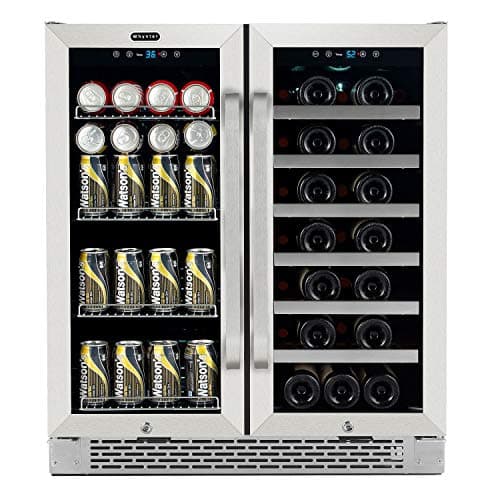
Thirty-three bottles on one side and 113 cans on the other, with both zones rated across the whole 36-72°F span — the only combination cabinet here that does not decide for you which half is the serious one.
Product photograph via Amazon.
Published specifications
Capacity
33 bottles
Zones
2
Cooling
compressor
Temperature range
36–72°F
Noise rating
38 dB
Installation
both
· Exterior: 29.75 in W x 22.25 in D (24.25 in with handles) x 34.00 in H
· Capacity: 33 standard 750 ml bottles in the right zone, 113 standard 12 oz cans in the left
· Both zones independently adjustable across 36-72°F / 2-22°C
· Cabinet storage: 6.0 cu ft
· Shelving: 10 removable pull-out sliding shelves — 6 stainless-trimmed wood in the wine zone, 4 chrome wire in the beverage zone
· Door: tempered double-pane gray-smoked glass for UV protection, French swing, NOT reversible
· Noise published as “under 38 dB” — a ceiling, not an average
· Power: 100 W / 0.9 A at 115 V, 60 Hz
· Weight: 120 lb net
· Cylinder lock with two keys; soft white LED interior lighting
Both zones cover the full 36-72°F range, so the wine side can hold cellar temperature while the other side gets genuinely cold
Six wood shelves on the wine side rather than wire, which is unusual in a combination cabinet
Gray-smoked double-pane glass is a real UV treatment rather than plain tempered glass
113 cans is the largest beverage half in this group by a wide margin
Publishes a decibel ceiling and a wattage figure, which most combination cabinets do not
What does not
Thirty inches wide — it will not drop into the standard 24-inch opening most kitchens have
The door is not reversible, so the French swing is fixed and the hinge sides are decided for you
Noise is published as a maximum rather than a measured average
Whynter's own page gives a per-shelf can breakdown that does not add up to the 113 total, so treat the can figure as nominal
Who should skip it. Skip it if your cabinet run is 24 inches. This is a 30-inch cabinet and no amount of wanting will shrink it — take the 24-inch Newair instead and accept the smaller can count.
No compressor means no start-up thump and no vibration path into the wine
65 W is a fraction of a compressor cabinet's draw
46°F floor is cold enough for sparkling service
What does not
Thermoelectric cooling works against ambient temperature, so a warm room raises the achievable minimum
Freestanding only — it must not be enclosed
Who should skip it. Skip it if the unit will live anywhere that gets hot: a garage, a conservatory, or a cabinet run with no air gap. Thermoelectric units lose the argument above roughly 77°F ambient.
Most of this category publishes a bottle count, a temperature range and nothing else. On several models Whynter publishes two figures that almost nobody else does: a decibel ceiling and a wattage. That is the reason this brand gets a page of its own on a site that otherwise ranks by specification rather than by badge — when a maker prints numbers, you can compare its cabinets honestly instead of comparing marketing copy.
Three Whynter cabinets in our registry publish a noise ceiling: under 42 dBA on the BWR-33SD and under 38 dB on the BWB-3388FDS. Three publish a wattage: 80 W on the BWR-33SD, 140 W on the BWR-1662SD, 160 W on the BWR-1642DZ and 100 W on the BWB-3388FDS. None of the big-brand built-in cabinets on this site publishes either.
Every Whynter cabinet in the registry, on Whynter's published figures
Model
Bottles
Zones
Span
Shelving
Noise
Power
BWR-33SD
33
1
40–72°F
7 removable wooden
Under 42 dBA
80 W
BWR-1662SD
166
1
40–65°F
16 wooden slide-out + wire
Not published
140 W
BWB-3388FDS
33 + 113 cans
2
36–72°F both zones
6 wood + 4 wire, pull-out
Under 38 dB
100 W
WC-201TD
20
1
46–66°F
5 removable chrome
Not published
65 W
BWR-1642DZ
164 (86 + 78)
2
40–65°F both zones
15 wooden slide-out
Not published
160 W
The range, model by model
The BWR-33SD is the volume cabinet and our top pick: 15 inches wide, 33 bottles at one temperature across a 40–72°F band — the widest span of any cabinet on this site, wide enough to hold a bottle at room temperature deliberately — with seven removable wooden shelves with stainless fronts, a gray-smoked UV door, a key lock, an activated carbon filter and a dual built-in or freestanding rating. It is 24.5 inches deep once the handle is on, which is the figure to check against your cabinetry.
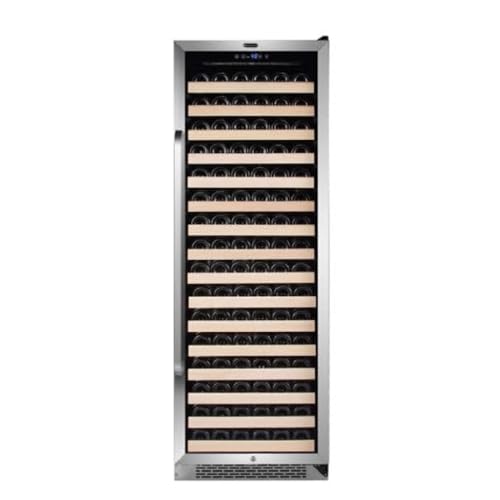
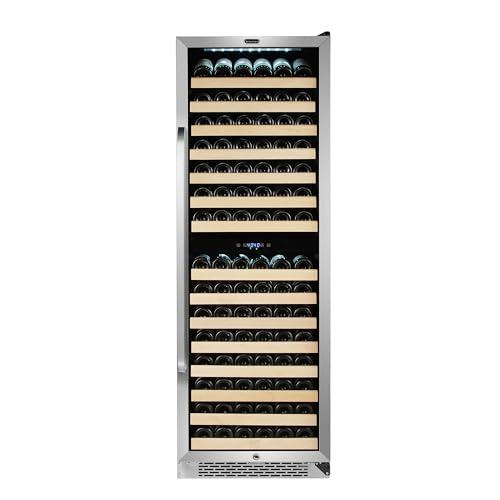
The BWR-1662SD and BWR-1642DZ are the same 24-inch built-in column sold as one zone and as two. The single-zone version carries 166 bottles on 16 slide-out wooden shelves with uniform spacing because there is no partition; the dual-zone version carries 164 split 86 above and 78 below, both zones adjustable across 40–65°F. The one-zone cabinet draws 140 W against the other’s 160 W. Which to buy is a real decision and it has its own page in the BWR-1642DZ against the BWR-1662SD.
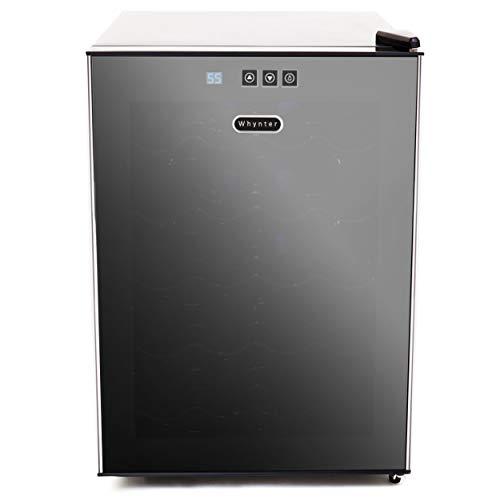
The BWB-3388FDS is the combination cabinet: 29.75 inches wide, 33 bottles on one side and 113 cans on the other, with both zones adjustable across the whole 36–72°F span — the coldest published floor on this site. Its French-swing door is not reversible, so the hinge sides are fixed. The WC-201TD is the odd one out and the cheapest: 20 bottles cooled thermoelectrically at 65 W, freestanding only, with no compressor to cycle.
Decibel ceilings, and how to read them
Whynter publishes noise as a ceiling — “under 42 dBA”, “under 38 dB” — and is explicit that this is a maximum rather than an average. That is more honest than it first looks, and it is also awkward: a rival quoting a flat 34 dB is not necessarily quieter in a room, because the two figures are not the same kind of measurement.
Read a ceiling as a promise about the worst case and a flat figure as a claim about the typical one. Both are useful; neither is comparable to the other. We do not convert between them, and we do not rank a ceiling against an average as though they were one scale. The cabinets on this site that publish a flat number are listed in best quiet wine fridges.
Wattage, and what it costs to run
Published wattage is the only honest route to a running cost, and Whynter gives it on four models: 65 W for the thermoelectric WC-201TD, 80 W for the BWR-33SD, 100 W for the BWB-3388FDS, 140 W for the BWR-1662SD and 160 W for the BWR-1642DZ. A compressor cabinet does not draw its rated wattage continuously — it cycles — so the rating is an upper bound rather than an hourly figure.
The useful comparison is within the brand: the single-zone 166-bottle column draws less than the dual-zone 164-bottle one, and the thermoelectric 20-bottle unit draws less than half of what any compressor cabinet here does. How to turn a wattage into dollars is in wine fridge running costs, and the lowest-consumption cabinets on the site are in best energy-efficient wine fridges.
Which class of Whynter you need
Whynter sells three different things and they are not interchangeable. Undercounter cabinets rated for a built-in opening or freestanding use — the BWR-33SD and the BWB-3388FDS — go into cabinetry, and the class is ranked in best built-in wine fridges. Built-in-only columns — the BWR-1662SD and BWR-1642DZ — are full-height cabinets that cannot go under a counter; see wine column against undercounter wine fridge. Freestanding thermoelectric — the WC-201TD — must not be enclosed at all.
One practical note on buying this brand: availability varies by model rather than by range. The cards above carry live prices where the listing has a buy-box price and a tagged search link where it does not, so the page stays honest about what can actually be bought today. How Whynter sits against the other makers on this site is in wine fridge brands compared.
Which one to buy
Buy the BWR-33SD unless you have a specific reason not to: it is the most completely specified cabinet Whynter makes and the widest temperature band on this site. Buy the BWR-1662SD for 166 bottles at one steady temperature with uniform shelf spacing. Buy the BWB-3388FDS if cans matter as much as bottles and you have thirty inches. Buy the WC-201TD if silence matters more than temperature floor. Buy the BWR-1642DZ if you want two full-range cellars in one column.
Questions people actually ask
▸ Is Whynter a good wine fridge brand?
On the only evidence we will use — what the maker publishes — it documents more than most: decibel ceilings, wattage, shelf counts and per-zone splits on several models. We do no first-hand testing, so we will not rank brands on reliability we have not measured. The published-specification comparison is in wine fridge brands compared.
▸ Which Whynter models can be built in?
The BWR-33SD and BWB-3388FDS are rated for built-in or freestanding use; the BWR-1662SD and BWR-1642DZ are published as built-in; the WC-201TD is freestanding only and must not be enclosed.