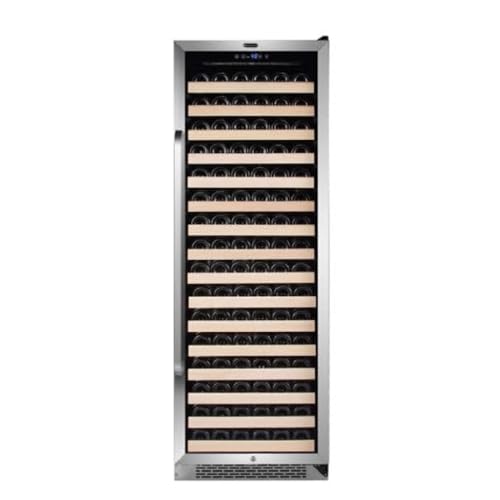
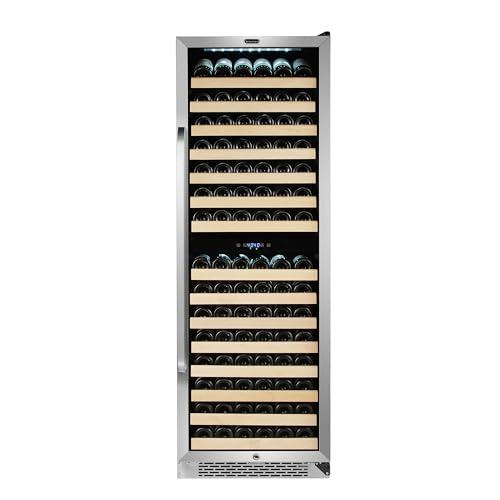
A wine column is a full-height built-in: roughly 92 bottles behind one door, but it needs an 84-inch-tall cutout and a dealer installation, and it costs several times an undercounter cabinet. An undercounter unit holds 33 to 46 bottles in a base cabinet you already have. Below about 60 bottles, the undercounter wins outright.
How this page is funded. Cork & Cool earns a commission if you buy through the Amazon links below, at no extra cost to you. It never changes the order of this list — see our editorial policy and affiliate disclosure. Prices come from Amazon and are refreshed daily; the price on Amazon when you buy is always the one that counts.
Our picks
Three undercounter cabinets first, then the three large-capacity cabinets that do a column's job without a column's cutout. No dealer-only column is listed as a pick here: they are not sold through a channel we can link you to, and we will not point you at a product whose price we cannot show.
How this page is funded. Cork & Cool earns a commission if you buy through the Amazon links below, at no extra cost to you. It never changes the order of this list — see our editorial policy and affiliate disclosure. Prices come from Amazon and are refreshed daily; the price on Amazon when you buy is always the one that counts.
#1 — The 24-inch slot
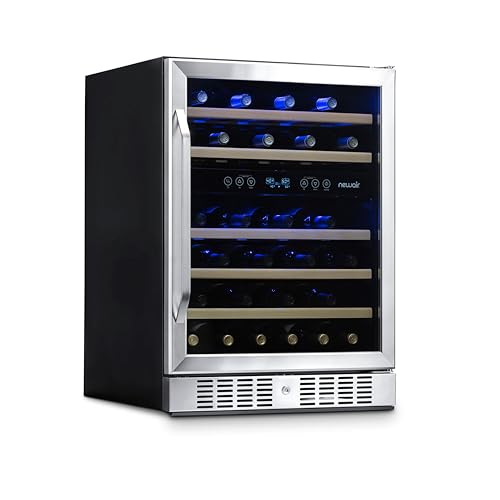
Newair AWR-460DB
Forty-six bottles across two zones in a 23.4-inch cabinet rated for built-in or freestanding use — the default answer for a standard kitchen opening.
Product photograph via Amazon.
Published specifications
Capacity
46 bottles
Zones
2
Cooling
compressor
Temperature range
40–66°F
Noise rating
Not published by the manufacturer
Installation
both
· Exterior: 23.40 in W x 22.40 in D (24.00 in with handle) x 33.00 in H
Rated for built-in installation, so the front vent is designed for an enclosed opening
23.4-inch width drops into a standard 24-inch cabinet run
Two independently set zones across the full 40-66°F span
What does not
No published dB rating, so noise cannot be compared numerically against rivals
46 bottles is the manufacturer's count using standard Bordeaux bottles — heavy Burgundy or Champagne bottles reduce it
Who should skip it. Skip it if your opening is under 24 inches, or if you need more than about four dozen bottles — stepping up to a 160-bottle cabinet costs less per bottle.
A published vibration measure, which almost nobody in this category offers
Panel-ready, so it disappears into cabinetry
Two zones in a single base cabinet
What does not
No published temperature range in the product listing
Panel-ready means you are also buying a custom door panel
Who should skip it. Skip it if the unit is going into a garage or a utility room. Panel-ready construction and vibration engineering are worth paying for in a finished kitchen and nowhere else.
Under 18 inches deep, which solves the most common undercounter fit problem
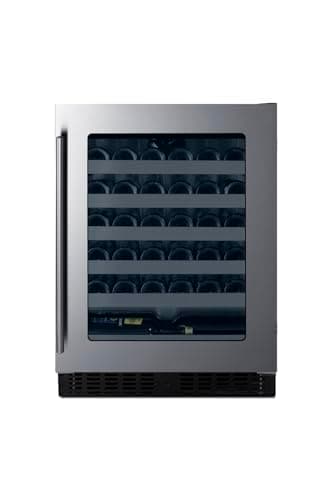
The only unit here designed around ADA counter height
Height adjusts to standard counters too, so it is not a single-use product
What does not
33 bottles is the price of the shallow depth
Summit does not publish a temperature range in this listing
Who should skip it. Skip it if your cabinet run is a standard 24 inches deep and you want the capacity — a full-depth unit in the same opening holds 13 more bottles.
Designed around long-term aging rather than service
Five-year warranty, which is unusual in this category
The capacity figure is honestly split by bottle type, which most brands do not do
What does not
Costs multiples of anything else on this page
Sold through a single US distributor, so servicing is not a local-appliance-shop matter
Who should skip it. Skip it if you are storing wine you intend to drink within a year or two. The engineering you are paying for only pays back over a decade of aging.
A wine column is a full-height refrigeration appliance built into a tall cabinet opening, in the same family as the fridge and freezer columns that sit beside it. It is not a bigger wine fridge. It is a different installation class: panel-ready in most cases, plumbed into nothing but hard-wired or cord-connected into a dedicated supply, and specified from a cutout drawing before the cabinetmaker cuts anything.
The numbers make the difference concrete. A current 24-inch column — we used the Thermador T24IW905SP, because it is the model most widely listed by US appliance dealers right now — is specified at a 92-bottle capacity in 0.75-liter Bordeaux bottles, a 5–20°C (41–68°F) range, a product width of 23 3/4 inches, a net weight of 323 pounds and a 10-amp supply. The cutout it needs is 84 inches high by 24 wide by 24 3/4 deep. Retailer copy for the same unit describes three independently controlled zones and a capacity of up to 99 bottles with an extra shelf fitted.
An undercounter wine fridge is the same 24 inches wide and roughly 34 inches tall. It goes into a base cabinet, it vents forward through its toe kick, and in most cases you can install it yourself. The best undercounter wine fridges page covers that class in detail. Everything below is about which of the two your kitchen and your collection actually justify.
The opening decides it first
Before capacity, before price, before zones: a column needs seven feet of vertical cabinetry. That is not a gap most finished kitchens have spare. It is a space that currently holds a pantry, a broom cupboard, a double oven stack or a tall fridge, and giving it up is a kitchen-design decision rather than an appliance purchase.
Installation envelope: column against undercounter (published figures)
24-inch wine column
24-inch undercounter cabinet
Opening required
84 in H x 24 in W x 24 3/4 in D cutout
Standard base cabinet, about 34 in H x 24 in W
Product width
23 3/4 in
23.4 in (Newair AWR-460DB)
Published capacity
92 bottles (99 with an extra shelf)
46 bottles (Newair AWR-460DB)
Net weight, empty
323 lb
104 lb (Newair AWR-460DB)
Electrical
10 A
Standard 115 V outlet; check the manual for a dedicated circuit
Who installs it
Dealer or cabinet installer, in practice
Usually the homeowner
Three hundred and twenty-three pounds empty is the figure people skip. Loaded with 92 bottles it is well over 400 pounds standing on a small footprint, which is a floor question in an older house and a cabinetry question in any house. An undercounter cabinet at roughly 100 pounds empty is a two-person lift and nothing more.
The electrical side is less dramatic but just as real. Both classes want a circuit that is not shared with a counter full of small appliances, and the specifics are per model rather than per category — our guide to whether a wine fridge needs a dedicated circuit works through the four registry cabinets that publish electrical figures. The one rule that does not vary: whatever you install, it has to vent the way the manufacturer says it does, which is the subject of built-in versus freestanding.
Bottles per foot of kitchen
The honest way to compare these two is not bottles, it is bottles per square foot of floor plan. Both are 24 inches wide and about two feet deep. The column simply uses the vertical space above the counter that an undercounter unit leaves to drawers.
Capacity in the same 24-inch width (manufacturer or retailer figures)
Cabinet
Bottles
Zones
Height class
Thermador T24IW905SP column
92 (99 with extra shelf)
3
Full height, 84 in cutout
Whynter BWR-1662SD
166
1
Tall freestanding/built-in cabinet
Whynter BWR-1642DZ
164
2
Tall freestanding/built-in cabinet
EuroCave Pure L
Up to 110 reds, or 60 whites
1
Tall cellar cabinet
Newair AWR-460DB
46
2
Undercounter, 33 in tall
Dacor DRW24G7500APDA
41
2
Undercounter
Summit ASDW2412
33
1
Undercounter, under 18 in deep
Read that table twice, because it contains the single most useful fact on this page: a 24-inch column at 92 bottles is beaten on raw capacity, in the same width, by a tall Whynter cabinet at 164 to 166 bottles. The column is not buying you the most wine per inch. It is buying you integration — a panel-ready front that disappears into the run, flush-fitted, with the appliance stack reading as cabinetry rather than as appliances.
The other thing the column buys is zone count. Three independently controlled zones is genuinely rare; almost everything else in this category is one or two. Whether you need three is a different question, and the argument is in single zone versus dual zone. Most households that think they need three zones actually need one zone held properly at cellar temperature and twenty minutes of planning before dinner.
What the money buys, and what it does not
We do not print dealer prices on this site, because we cannot refresh them and a stale number is worse than none. The bracket is still worth stating plainly: the 24-inch columns listed by US appliance dealers sit several times above a well-specified 24-inch undercounter cabinet, before you add the custom door panel, the cabinetry alteration and the installation. The large-capacity Whynter cabinets in the picks above sit between the two, and their current prices are live on this page.
What the premium genuinely buys, on published specification rather than on brochure language:
Integration. Panel-ready construction and a full-height front that matches the adjacent columns. Nothing else on this page can do that.
Zone count. Three separately controlled compartments in one cabinet.
Dealer service. A service network that comes to the house, which matters on an appliance you cannot carry out to a van.
Resale framing. A built-in column is sold with the house, the way a built-in oven is. That is a real difference from an appliance you take with you, and it cuts both ways.
What it does not buy: more bottles per inch, a better temperature range, or a measurably quieter cabinet. The column’s published range of 41–68°F is not wider than the 40–65°F both Whynter cabinets publish, and neither class routinely publishes a decibel rating — which is why the noise column on this site so often reads “not published,” and why what actually makes a wine fridge noisy is about installation as much as hardware.
If vibration is your reason for considering a column, note that one undercounter unit in the picks above — the Dacor DRW24G7500APDA — documents a shelf system specified to eliminate vibration, and does it in a base cabinet. Documented vibration control is not a column-only feature.
The third option almost nobody is shown
The query that brings most people to this page is a two-way choice, and the two-way framing is the problem. Between the 46-bottle base cabinet and the 92-bottle built-in column sits a whole class of tall 24-inch cabinets — freestanding or built-in rated, 160-plus bottles, no cabinetry work at all.
The Whynter BWR-1662SD is the clearest example: 166 bottles on 16 slide-out wooden shelves at one setting, 40–65°F, 140 W. Its dual-zone sibling, the BWR-1642DZ, splits 86 bottles above and 78 below with both zones covering the full range. Either one holds nearly twice a column’s capacity, stands in a space you clear rather than build, and goes with you if you move.
At the other end of that class, a EuroCave Pure L is a different proposition again: up to 110 reds in a French-built aging cabinet, sold on long-term storage engineering rather than on capacity. That is the honest competitor to a column for a collector — and the comparison worth making is not column against undercounter at all, but which cabinet actually holds wine for a decade.
The trade in the tall-cabinet class is appearance. A tall glass-fronted cabinet reads as an appliance, not as cabinetry. If the kitchen was designed around integrated fronts, that is a genuine objection and a column may be the only answer. If it was not, you are being asked to pay several times over for a door panel.
Which one is worth it
The decision, by the constraint you actually have
If this is your situation...
Buy
Why
Under about 60 bottles, kitchen already built
Undercounter cabinet
46 bottles in a base cabinet you already own, no cabinetry work, no dealer
60-160 bottles, space for a tall cabinet
Tall 24-inch cabinet
164-166 bottles for a fraction of a column, and it moves with you
Kitchen being built or gutted, integrated fronts throughout
Column
Panel-ready full height is the only way to match an appliance stack
Aging wine for a decade or more
Cellar-grade cabinet
Vibration, humidity and stability engineering beat zone count and panel fronts
Shallow or ADA-height cabinet run
Summit ASDW2412
Under 18 in deep and 32 in tall, which is the one shape a column cannot do
Renting, or moving within five years
Freestanding cabinet
A column is a fixture; you will leave it behind
The short version: a dedicated column is worth it when the kitchen is being built around it and the fronts have to match. It is not worth it as a capacity upgrade, because the capacity upgrade is cheaper, taller and already sitting in the same 24 inches. And against a freestanding cabinet as an investment, the column only wins if you are improving a house you intend to sell with the appliance in it. If the location itself is still open, settle that first — where to put a wine fridge works through what each room demands of the cabinet.
Questions people actually ask
▸ Is a dedicated wine column worth it compared with an undercounter unit?
Only when integration is the point. A 24-inch column is specified at 92 bottles against 46 for a well-specified undercounter cabinet of the same width, so you are paying several times as much for roughly double the bottles plus a panel-ready front and a third temperature zone. If the kitchen is already built and the fronts do not have to match, an undercounter cabinet or a tall freestanding one is the better buy.
▸ Is a built-in wine column or a freestanding wine cabinet the better investment?
A built-in column is a fixture: it stays with the house, so it is an improvement to the property rather than an asset you own. A freestanding cabinet moves with you and, at 164 to 166 bottles for the tall 24-inch Whynter models, holds considerably more wine per dollar. If you are renovating a home you plan to sell, the column is the stronger play. If you are furnishing a home you plan to live in, the freestanding cabinet is.
▸ How many bottles does a 24-inch wine column hold?
About 92 standard 0.75-liter Bordeaux bottles on the current Thermador 24-inch column, or up to 99 with an additional shelf fitted, according to the retailer specification listing we checked. Capacity figures in this category always assume Bordeaux bottles; Burgundy and Champagne bottles are wider and reduce every count, which is why we keep a separate page for large-format bottles.
▸ Can a wine column replace a pantry cabinet?
Dimensionally, usually yes — the 84-inch by 24-inch cutout is close to a standard tall pantry unit. Structurally, check first: the column we used as a reference weighs 323 pounds empty and over 400 loaded, on a two-foot footprint. That is a different load from shelves of dry goods, and it needs a floor and a surround that can take it.
▸ Do wine columns need a dedicated circuit?
The column we checked lists a 10-amp draw, which is more than most undercounter cabinets but still inside a standard circuit on paper. In practice the manufacturer installation sheet is the only authority for your model, and most specify a circuit that is not shared with counter appliances. Our guide to wine fridges and dedicated circuits explains what the published figures do and do not tell you.
▸ How current are the prices on this page?
Every price shown against a product here comes from Amazon’s own product data and is refreshed daily, with the date it was read printed under the button. Dealer pricing for columns is not in that pipeline, which is why this page describes it as a bracket rather than a number — a figure we cannot refresh is a figure we will not print.