Mostly the same cabinet
Almost everything a buyer worries about is identical across these two models, which is what makes the comparison a clean one. Both are 24-inch built-in cabinets. Both are compressor units, so both cool against a hot day in a way a thermoelectric cabinet cannot — the mechanism argument is in compressor against thermoelectric. Both publish a 40–65°F operating span. Both use removable wooden flat slide-out shelves. Both hold about one hundred and sixty-five bottles, which puts them in the class our 100-bottle cabinet roundup covers at the top end. Neither publishes a decibel figure, which is normal for the category and the reason our noise guide ranks on mechanism instead of numbers.
So the decision comes down to three published differences: the number of zones, the number of shelves, and the power draw. They are related, and they all follow from the same piece of engineering — a partition.
What the second zone costs
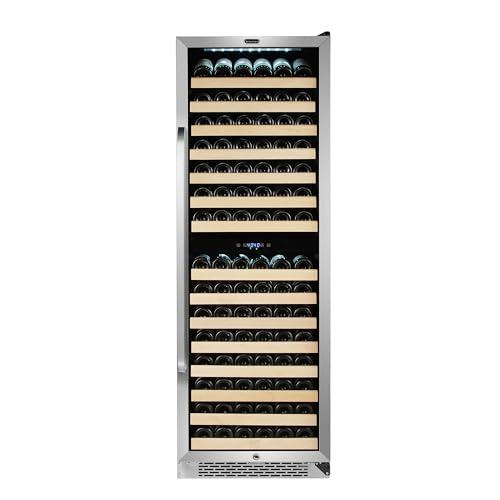
A dual-zone cabinet is one insulated box divided into two separately controlled compartments. That partition is not free, and Whynter’s own figures show the price in three places.
Twenty watts. The dual-zone model publishes 160 W against the single-zone’s 140 W. The cabinet is holding two setpoints instead of one, which raises duty cycle. Twenty watts of difference on a cabinet that is not running continuously is a small number on an annual bill — our running costs guide works through how to turn a nameplate wattage into an actual figure — but it is a real difference and it runs in only one direction.
A shelf. Fifteen shelves against sixteen plus a wire display shelf. The partition occupies the space one shelf would have used, and it fixes where the split falls.
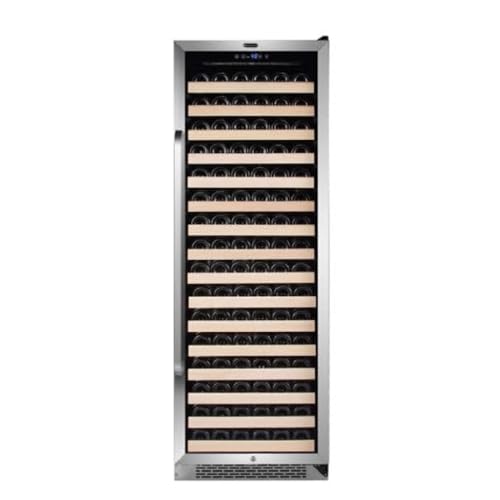
Flexibility you may actually want. This is the one people underestimate. In the single-zone cabinet the shelf spacing is uniform from top to bottom, so a tall bottle, a Champagne bottle or an awkward Burgundy shape can go anywhere. In the dual-zone cabinet, the divider sits in a fixed place and each compartment has its own run of shelves. If your collection includes large-format bottles, the uniform-spacing cabinet is the easier one to live with, which is the same point the large-format roundup makes about shelf removal in general.
What the second zone buys
One thing, and it is worth a great deal to some households and nothing at all to others: the ability to hold two temperatures at once.
The useful detail in Whynter’s specification is that both zones on the BWR-1642DZ cover the whole 40–65°F range. That is unusual. Plenty of dual-zone cabinets give you a wide upper zone and a narrow lower one, which quietly decides for you what each compartment is for. With both zones spanning the full range you can run this cabinet three different ways:
- Cellar plus service. Lower zone at roughly 55°F for storage, upper zone in the mid 40s for whites and sparkling wine you intend to open this week. This is the configuration most people buy a dual zone for, and our dual-zone settings guide covers which wine belongs at which number.
- Two cellars. Both zones at the same storage temperature, which gives you a 164-bottle single-temperature cabinet with a redundancy benefit: if one zone fails, the other is still cooling.
- Reds separated from whites at service temperature. Upper zone in the low 60s, lower zone in the mid 40s, nothing held long term. A bar rather than a cellar.
The single-zone cabinet does exactly one of those, and does it with one more shelf and less power. If every bottle in your house is destined to sit for years at one temperature, the second zone is an expense that buys you a compromise. The class-level version of this argument, with the rest of the market in view, is single zone against dual zone.
164 against 166 is not the difference
Two bottles. It is the specification people fixate on when comparing these two models, and it is noise. Both counts are Whynter’s own figures for standard 750 ml bottles laid in the cradles, and both will fall in practice for exactly the reasons how many bottles a wine fridge really holds sets out: heavier Burgundy and Champagne glass takes more room per bottle, and a shelf you remove to fit a tall bottle costs you that shelf’s worth of capacity.
The capacity figure that does matter on the dual-zone model is the split: 86 bottles above, 78 below. That ratio is fixed. If your collection is 120 bottles of red for long-term storage and 20 whites for the weekend, neither compartment is sized for the job and you will end up running both zones at the same temperature — at which point you have bought a dual-zone cabinet to use it as a single-zone one, with one less shelf and 20 W more draw.
Before you decide on either, it is worth being honest about how many bottles you will really keep. A cabinet this size run half-empty costs the same to run as a full one and gains you nothing; what size wine fridge you need is the sizing argument, and the smaller rungs are covered in the 50-bottle roundup.
Shelving, and why the count matters
Both cabinets use removable wooden flat slide-out shelves, and that specification does more work than it looks.
Slide-out shelves make a large collection retrievable. On a cabinet holding 160-plus bottles, the bottle you want is behind other bottles roughly every time. A shelf that slides out turns that into a one-handed operation instead of an excavation. It is the single feature that separates a large cabinet you use from one you resent, which is why our wooden-shelf roundup treats it as a ranking criterion rather than a nicety.
Wood does not damp vibration by itself. Neither Whynter model publishes a vibration measure, so we do not claim one for either. Where a manufacturer does document low-vibration design, we say so — the vibration and light roundup ranks only cabinets whose makers publish something substantive.
The extra shelf on the single-zone model is the wire display shelf. It holds bottles label-forward rather than flat, which is useful for the two or three you plan to open and a waste of depth for anything you are storing. Treat it as a bar feature on a cellar cabinet rather than a reason to choose the model.
Which one suits which collection
Choose the BWR-1662SD if the cabinet is a cellar. One temperature, 166 bottles, uniform shelf spacing you can rearrange freely, 16 shelves plus the display shelf, and the lower published draw of the two at 140 W. Single-zone storage is what long-term aging actually wants, which is the case our long-term storage roundup and can you age wine in a wine fridge both make: stability beats versatility once bottles are staying put for years.
Choose the BWR-1642DZ if the cabinet is also a bar. Two zones, each covering the full 40–65°F span, so whites and sparkling wine can sit ready to pour while the reds hold at a cellar setting in the other compartment. The cost is one shelf, 20 W, and a split you cannot move.
And the honest caveat on both. These are 24-inch built-in cabinets, which means a cabinet opening, a power supply and clearances that have to be right before delivery day — ventilation and clearance covers what the specification requires, and whether you need a dedicated circuit covers the electrical side. A full load of either cabinet is over 300 lb of glass and liquid, so the floor and the surrounding cabinetry are part of the purchase.
Whichever you buy, the cheapest way to find out whether it holds the number on the display is to put a logging sensor on the middle shelf of each zone; best wine fridge thermometers and hygrometers compares those on published accuracy. And if your collection includes magnums or Champagne, note that neither cabinet cradles them — racks for Champagne and magnum bottles is the cheaper home for those few bottles.