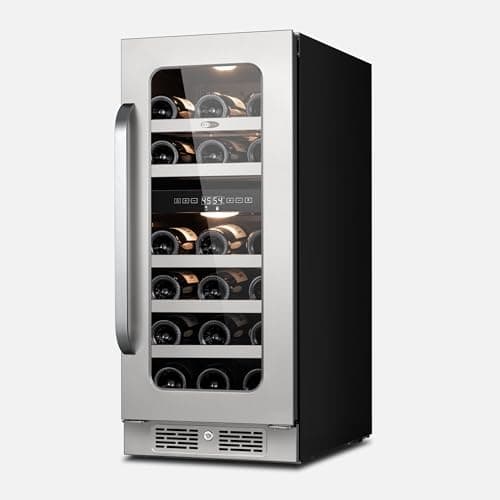
Usually yes by the manual, even though the draw is small. Summit's installation manual asks for a separate circuit serving only the wine cooler with a 15-amp fuse or breaker, and large-format units can require 20 or 30 amps. Published draws for cabinets here run 0.9 to 2.0 amps.
How this page is funded. Cork & Cool earns a commission if you buy through the Amazon links below, at no extra cost to you. It never changes the order of this list — see our editorial policy and affiliate disclosure. Prices come from Amazon and are refreshed daily; the price on Amazon when you buy is always the one that counts.
Our picks
The four cabinets in our registry whose manufacturers publish an electrical figure - volts, watts and amps - which is what makes this question answerable at all.
How this page is funded. Cork & Cool earns a commission if you buy through the Amazon links below, at no extra cost to you. It never changes the order of this list — see our editorial policy and affiliate disclosure. Prices come from Amazon and are refreshed daily; the price on Amazon when you buy is always the one that counts.
#1 — The 15-inch default
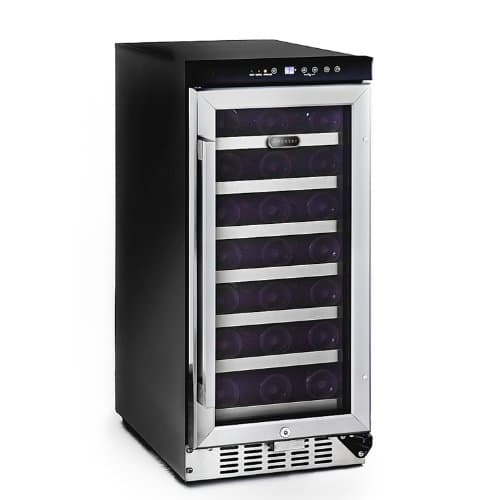
Whynter BWR-33SD
Thirty-three bottles in a 15-inch cabinet, with a published noise ceiling and seven wooden shelves — the capacity ceiling at this width, and the widest temperature band on this page.
Product photograph via Amazon.
Published specifications
Capacity
33 bottles
Zones
1
Cooling
compressor
Temperature range
40–72°F
Noise rating
42 dB
Installation
both
· Exterior: 15.0 in W x 22.5 in D (24.5 in with the handle installed) x 34.0 in H
· Capacity: 33 standard 750 ml bottles
· Noise published as "< 42 dBA" — a ceiling, not an average
Thirty-three bottles is the highest published capacity at this width
Whynter publishes a decibel ceiling, which almost nobody in this category does
Seven wooden shelves rather than the wire shelving usual at this price
40-72°F is the widest published band here, so it will also hold a bottle at room temperature
Rated for built-in or freestanding use, so an opening is optional rather than required
What does not
Single zone only — one temperature for the whole cabinet
The published figure is "< 42 dBA", a maximum rather than an average, so it cannot be compared like-for-like against a manufacturer quoting a flat number
At 15.0 inches published it is the widest cabinet in this group, which matters if your opening is tight
Depth grows to 24.5 inches once the handle is on, which is the figure that matters in a shallow run
33 bottles assumes standard Bordeaux shapes; a Burgundy-heavy collection will fit fewer
Who should skip it. Skip it if you need to serve whites cold and hold reds at cellar temperature in the same cabinet — one zone cannot do both. Skip it too if your opening measures under 15 inches, because this is the one cabinet here that needs the full module.
#ad — paid link. How this is funded. Price as of November 11, 2026; check Amazon for the current price.
#2 — Storage, not just chilling
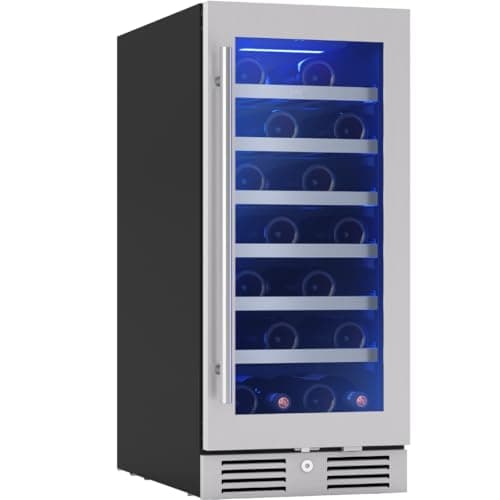
Zephyr Presrv PRW15C01CG
Twenty-seven bottles, a published 39 dBA, and the only cabinet in this width whose maker documents a vibration dampening system — you are paying for the storage conditions, not the bottle count.
Product photograph via Amazon.
Published specifications
Capacity
27 bottles
Zones
1
Cooling
compressor
Temperature range
38–65°F
Noise rating
39 dB
Installation
both
· Exterior: 15 in W x 33-7/8 in H x 23-3/8 in D
· Capacity: 27 bottles (750 ml), 3.4 cu ft
· Sound level: 39 dBA published
· Racking: six full-extension black wood racks with stainless trim
· Glass: dual-pane, Low-E, argon-filled
· Field-reversible door with concealed zero-clearance hinges, door lock, door-open alarm
· Energy Star certified; Sabbath mode; carbon-filtered air filtration
· Weight: 101 lb · Power: 115 V, 60 Hz at max 1.5 A
· Warranty: 2 years parts and labor, 5 years compressor
The only 15-inch cabinet here whose manufacturer documents vibration control at all
Publishes a flat decibel figure rather than a ceiling, so it can be compared properly
Reaches 38°F, the lowest published minimum in this group, which matters for sparkling wine
Full-extension racks mean you can reach a bottle at the back without unloading the shelf
Five-year compressor warranty against the usual one or two
What does not
Twenty-seven bottles against thirty-three for the same width — the racks take the space
23-3/8 inches deep, the deepest cabinet in this group
Costs materially more than the Whynter and Summit cabinets it sits beside
Who should skip it. Skip it if the wine is going to be drunk within a year or two. Vibration control and a 38°F floor are long-storage features, and you can have eight more bottles for less money without them.
#ad — paid link. How this is funded. Price as of November 11, 2026; check Amazon for the current price.
#4 — Two zones, either way round
Whynter BSR-029DW
Twenty-nine bottles split ten over nineteen across two zones that each cover the whole 40-65°F range — so either half can hold a red, which the other dual-zone cabinet at this width cannot.
Product photograph via Amazon.
Published specifications
Capacity
29 bottles
Zones
2
Cooling
compressor
Temperature range
40–65°F
Noise rating
38 dB
Installation
both
· Exterior: 14.8 in W x 22.4 in D x 33.9 in H
· Internal volume: 3.0 cu ft
· Capacity: 29 standard 750 ml bottles — 10 in the upper zone, 19 in the lower
· Both zones: 40-65°F / 5-18°C
· Noise published as "< 38 dB" — a ceiling, not an average
· Shelving: five removable beechwood shelves
· Door: seamless stainless-trimmed double tempered UV-resistant glass, reversible, cylinder lock with two keys
Both zones are rated across the full 40-65°F span, so the split is yours to set rather than the factory's
Whynter publishes a decibel ceiling, which the other dual-zone cabinet at this width does not
14.8 inches wide and 22.4 inches deep, the shallowest of the full-depth cabinets here
Beechwood shelves and a reversible door, so the hinge side is not decided for you
Rated for built-in or freestanding use, so an opening is optional rather than required
What does not
Twenty-nine bottles against thirty-three for the single-zone cabinets — the divider costs four
The upper zone holds only ten bottles, so the split is lopsided whichever way you use it
The published figure is "< 38 dB", a maximum rather than an average
29 bottles assumes standard Bordeaux shapes; a Burgundy-heavy collection will fit fewer
Who should skip it. Skip it if you only ever hold one temperature. The divider costs four bottles and a whole zone of shelf space, and a single-zone cabinet at this width gives both back.
#ad — paid link. How this is funded. Price as of November 11, 2026; check Amazon for the current price.
The short answer
By the manual, usually yes. By the numbers, a wine fridge is a small load that a shared kitchen circuit would carry without noticing. Those two facts pull in opposite directions, and the manual is the one that governs your warranty, so it wins.
There is no single industry answer here, and any page that gives you one is guessing. Requirements vary by model and manufacturer, from “a separate circuit is recommended” to a hard requirement for a dedicated 20 or 30-amp circuit on large-format cabinets. The only authority for your cabinet is its own installation manual and nameplate.
What these cabinets actually draw
Four cabinets in our registry publish electrical figures. Everywhere else in the category the numbers are simply absent, and we will not estimate them.
Published electrical specifications (manufacturer figures)
Cabinet
Supply
Power
Current
Bottles
Whynter BWR-33SD
115 V, 60 Hz
80 W
0.9 A
33
Whynter BSR-029DW
Not published separately
103.5 W
0.9 A
29
Zephyr Presrv PRW15C01CG
115 V, 60 Hz
Not published
Max 1.5 A
27
Whynter BWR-1662SD
Not published separately
140 W
2.0 A
166
For scale: a 15-amp circuit at 115 V carries about 1,725 watts continuously, and the largest cabinet here draws 140. Even the 166-bottle unit is using roughly 8% of a 15-amp circuit while it is actually running, and it does not run continuously — a compressor cycles. The running-cost arithmetic that follows from these figures is in do wine fridges use a lot of electricity.
What the manuals require
The picture from manufacturer documentation, with the disagreements left visible rather than averaged away:
Summit Appliance — its installation manual asks that a separate circuit, serving only the wine cooler, be provided, and that the fuse or circuit breaker be 15 amps. Summit cabinets appear across this site, including the SWC1535B and SDHW1532.
A grounded, polarized 115 V, 60 Hz, 15-amp supply is the most common requirement across manuals in this category, with adapters and extension cords prohibited.
Large-format cabinets can require more. WineMate’s manual for its larger cellar-cooling units requires a dedicated 20-amp circuit on the WM-1500 to WM-2500 range and 30 amps on the WM-3500 to WM-8500 range. These are a different class of machine from a 27-bottle undercounter cabinet, and they are the reason “a wine cooler needs 15 amps” is not a universal rule.
Some brands separate the outlet from the circuit. ZLINE’s guidance is that its units be plugged into independent circuits, and that units sharing an outlet must still have a dedicated 15-amp breaker — a distinction worth understanding before an electrician quotes the job.
None of the four Whynter or Zephyr cabinets above publishes a circuit requirement on its product page, only a draw. That is normal: the requirement lives in the installation manual, which is why downloading it before you plan the socket is worth the five minutes.
Why a separate circuit, for such a small load
Three reasons, and only the first is about current.
1. Inrush, not running current. A compressor motor draws several times its running current for a fraction of a second at start-up. On a circuit already loaded with a microwave, a toaster and a kettle, that start-up is what trips a breaker — and the trip happens at the worst moment, when the cabinet is working hardest.
2. A tripped breaker is silent. This is the real argument. If a shared kitchen circuit trips while you are out, you find out when a freezer alarms or a light fails. A wine cabinet has no alarm, with one exception in our registry — the Zephyr Presrv has a door-open alarm, which is not the same thing. A cabinet off for a weekend in summer is a collection warmed to room temperature, and the damage that follows is described in what happens to wine if it is not stored properly.
3. It is the condition on the warranty. If the manual specifies a separate circuit and the cabinet fails, the installation is the first thing anyone asks about.
The risk is highest exactly where people most often put these cabinets: a garage, where the circuit is usually shared with a door opener, a freezer and power tools, or a kitchen island whose circuit is already carrying small appliances.
The GFCI question
Several manuals in this category explicitly ask you not to connect the cabinet to a ground-fault interrupter, because a nuisance trip takes the cabinet offline without telling anybody. At the same time, modern electrical codes require GFCI protection for receptacles in several of the rooms these cabinets live in.
We are not going to resolve that for you, and nobody writing an article should. It is a question for a licensed electrician in your jurisdiction, who can weigh the manufacturer’s instruction against the code that applies to the room. What you can usefully do is bring both to the conversation: the manual’s wording and the location.
What to do in practice
Download the manual for your exact model before the socket is located. The circuit requirement and the nameplate current are both in it.
If the manual asks for a separate circuit, give it one. On a new installation this is a cheap addition while the walls are open and an expensive one afterwards.
If you are using an existing outlet, audit what else is on it. A compressor cabinet sharing a circuit with kitchen small appliances is the common nuisance trip.
Check it after a week. If the breaker has tripped once, it will trip again, and the fix is a circuit rather than a reset.
Questions people actually ask
▸ Does a wine cooler need its own circuit?
Many manuals ask for one. Summit’s installation manual asks that a separate circuit serving only the wine cooler be provided with a 15-amp fuse or breaker. Check your own model’s manual, because requirements differ.
▸ How many amps does a wine fridge use?
Of the cabinets that publish a figure: 0.9 A for the Whynter BWR-33SD and BSR-029DW, a maximum of 1.5 A for the Zephyr Presrv, and 2.0 A for the 166-bottle Whynter BWR-1662SD.
▸ Can I plug a wine fridge into a regular outlet?
Electrically it is a small load on a standard grounded 115 V outlet. Whether your model permits a shared circuit is a manual question, and no manual permits an extension cord or an adapter.
▸ Can a wine fridge go on a GFCI outlet?
Several manuals ask you not to, because a nuisance trip silently disables the cabinet. Code may require GFCI protection in that room. Put both facts to a licensed electrician rather than choosing from an article.
▸ Will a wine fridge trip my kitchen breaker?
It can, not from its running current but from compressor start-up inrush on a circuit already near capacity. If it has tripped once, treat that as a circuit problem rather than a one-off.