Heat speeds up the oxygen reactions that age wine, so a warm bottle develops sherry-like, dried-fruit and vinegar notes early. Temperature swing works the cork and lets more air in. Light strips aromatics. Dry air shrinks the cork. UC Davis stored the same wine at 50, 68 and 104°F and found all of it aged better at 50°F.
This page sits in Wine Storage Guides, where the rest of the category is compared the same way.
How this page is funded. Cork & Cool earns a commission if you buy through the Amazon links below, at no extra cost to you. It never changes the order of this list — see our editorial policy and affiliate disclosure. Prices come from Amazon and are refreshed daily; the price on Amazon when you buy is always the one that counts.
Our picks
The three cabinets in our registry that document something specific about the damage mechanisms below - a low-vibration compressor and charcoal filter, UV-protective double glazing with carbon filtration, and dual-pane Low-E argon glass.
How this page is funded. Cork & Cool earns a commission if you buy through the Amazon links below, at no extra cost to you. It never changes the order of this list — see our editorial policy and affiliate disclosure. Prices come from Amazon and are refreshed daily; the price on Amazon when you buy is always the one that counts.
#1 — Low vibration in a narrow cabinet
Liebherr WS1200
Twelve bottles, wooden grid shelves, and a compressor Liebherr specifically develops for low vibration — the small cabinet that treats wine as aging stock.
Illustrative photograph — not an image of the Liebherr WS1200.
Published specifications
Capacity
12 bottles
Zones
1
Cooling
compressor
Temperature range
Not published
Noise rating
Not published by the manufacturer
Installation
freestanding
· Exterior width: 16 3/4 in
· Capacity: 12 bottles on 3 wooden grid shelves
· Electronic touch control with digital temperature display
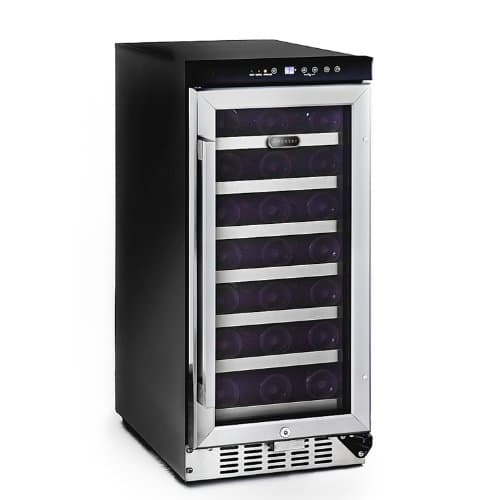
Thirty-three bottles in a 15-inch cabinet, with a published noise ceiling and seven wooden shelves — the capacity ceiling at this width, and the widest temperature band on this page.
Product photograph via Amazon.
Published specifications
Capacity
33 bottles
Zones
1
Cooling
compressor
Temperature range
40–72°F
Noise rating
42 dB
Installation
both
· Exterior: 15.0 in W x 22.5 in D (24.5 in with the handle installed) x 34.0 in H
· Capacity: 33 standard 750 ml bottles
· Noise published as "< 42 dBA" — a ceiling, not an average
Thirty-three bottles is the highest published capacity at this width
Whynter publishes a decibel ceiling, which almost nobody in this category does
Seven wooden shelves rather than the wire shelving usual at this price
40-72°F is the widest published band here, so it will also hold a bottle at room temperature
Rated for built-in or freestanding use, so an opening is optional rather than required
What does not
Single zone only — one temperature for the whole cabinet
The published figure is "< 42 dBA", a maximum rather than an average, so it cannot be compared like-for-like against a manufacturer quoting a flat number
At 15.0 inches published it is the widest cabinet in this group, which matters if your opening is tight
Depth grows to 24.5 inches once the handle is on, which is the figure that matters in a shallow run
33 bottles assumes standard Bordeaux shapes; a Burgundy-heavy collection will fit fewer
Who should skip it. Skip it if you need to serve whites cold and hold reds at cellar temperature in the same cabinet — one zone cannot do both. Skip it too if your opening measures under 15 inches, because this is the one cabinet here that needs the full module.
#ad — paid link. How this is funded. Price as of November 11, 2026; check Amazon for the current price.
#3 — Storage, not just chilling
Zephyr Presrv PRW15C01CG
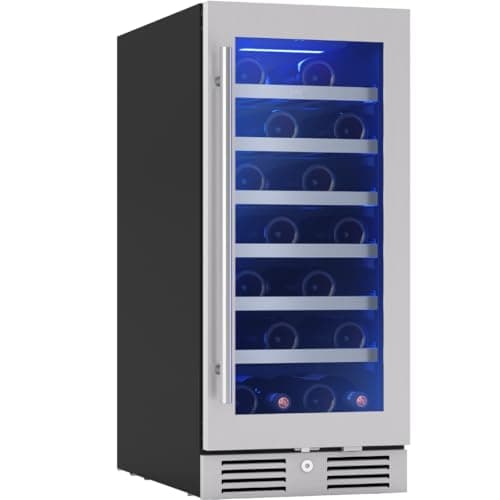
Twenty-seven bottles, a published 39 dBA, and the only cabinet in this width whose maker documents a vibration dampening system — you are paying for the storage conditions, not the bottle count.
Product photograph via Amazon.
Published specifications
Capacity
27 bottles
Zones
1
Cooling
compressor
Temperature range
38–65°F
Noise rating
39 dB
Installation
both
· Exterior: 15 in W x 33-7/8 in H x 23-3/8 in D
· Capacity: 27 bottles (750 ml), 3.4 cu ft
· Sound level: 39 dBA published
· Racking: six full-extension black wood racks with stainless trim
· Glass: dual-pane, Low-E, argon-filled
· Field-reversible door with concealed zero-clearance hinges, door lock, door-open alarm
· Energy Star certified; Sabbath mode; carbon-filtered air filtration
· Weight: 101 lb · Power: 115 V, 60 Hz at max 1.5 A
· Warranty: 2 years parts and labor, 5 years compressor
The only 15-inch cabinet here whose manufacturer documents vibration control at all
Publishes a flat decibel figure rather than a ceiling, so it can be compared properly
Reaches 38°F, the lowest published minimum in this group, which matters for sparkling wine
Full-extension racks mean you can reach a bottle at the back without unloading the shelf
Five-year compressor warranty against the usual one or two
What does not
Twenty-seven bottles against thirty-three for the same width — the racks take the space
23-3/8 inches deep, the deepest cabinet in this group
Costs materially more than the Whynter and Summit cabinets it sits beside
Who should skip it. Skip it if the wine is going to be drunk within a year or two. Vibration control and a 38°F floor are long-storage features, and you can have eight more bottles for less money without them.
#ad — paid link. How this is funded. Price as of November 11, 2026; check Amazon for the current price.
Heat: the reaction speeds up
Wine ages through slow chemical reactions, most of them involving the small amount of oxygen that reaches it. Those reactions follow temperature: warmer wine ages faster, and past a point it stops being development and becomes damage.
This is one of the few parts of wine storage with a controlled study behind it rather than folklore. UC Davis researchers stored a California chardonnay in five packaging configurations — bottles with natural cork, synthetic cork or screw cap, plus two kinds of bag-in-box — at 50°F, 68°F and 104°F. Two findings matter for a household. First: all of the wines analyzed aged better when stored at 50°F. Second, warmer storage produced the most significant changes, and the bagged wine held at 68°F and 104°F aged significantly faster than any of the bottled wine, becoming darker and developing sherry-like, dried-fruit-like and vinegar-like attributes. The work was led by Helene Hopfer with Susan Ebeler and Hildegarde Heymann and published in the Journal of Agricultural and Food Chemistry.
Note the middle temperature in that study: 68°F. Not a hot car, not a garage in August — an ordinary warm room. That is the useful takeaway. You do not need to cook a bottle to change it; you need to leave it somewhere ordinary for long enough. Note the other half too: the bottles fared better than the bag-in-box, so packaging buys you some tolerance that a cardboard-boxed wine does not have.
The practical figures that follow from this are in wine storage temperature: 55°F as the target, under 68°F as workable, and the understanding that time multiplies everything.
Swing: the cork stops sealing
The second mechanism is mechanical rather than chemical, and it is the one most people underestimate. Wine expands as it warms and contracts as it cools. In a sealed bottle that means pressure cycling against the cork: every warm spell pushes the cork outward slightly and every cool spell pulls air in past it.
Do that weekly for a few years and the seal loosens. The tells are visible before you open the bottle: a cork pushed proud of the bottle lip, or seepage dried around the capsule. Both mean the bottle has been breathing, and both mean more oxygen has reached the wine than the winemaker intended.
This is why stability matters more than the absolute number. A cellar at a steady 65°F is better storage than a room that averages 60°F but swings from 50°F to 75°F, which is a counter-intuitive conclusion and the reason an unconditioned garage is a bad idea even in a mild climate — see can a wine fridge go in a garage.
Light: the aromatics go first
Light, and ultraviolet light in particular, drives reactions in sulfur compounds that produce unpleasant aromas — the fault often called light-strike. Sparkling wine and white wine in clear or light glass are the most exposed; a dark bottle is itself a filter, which is why fine red wine comes in one.
Cabinet makers take this seriously even where they publish nothing else. In our registry the Whynter BWR-33SD uses double-pane tempered gray-smoked glass for UV protection, the Zephyr Presrv dual-pane Low-E argon-filled glass, the Liebherr WS1200 UV-resistant insulated glass, and the Koolatron WC12-35D double-pane mirrored UV-protective glass. Four brands, four different glazing descriptions, one shared assumption.
The free version of this protection is a dark cupboard. If wine is stored on an open rack, keep it out of direct sun and away from fluorescent light.
Dry air, and standing still
Dry air shrinks corks. A cork that dries out stops gripping the neck, and then the bottle breathes for the same reason as above. This is the specific problem with storing wine long-term in a kitchen refrigerator, which dehumidifies continuously as a side-effect of running at 37°F. A wine cabinet does not, because it operates at a much smaller temperature difference — wine fridge humidity covers what is and is not published about this.
Vibration disturbs settling. Over an evening it is irrelevant. Over ten years, constant agitation keeps sediment in suspension and is widely held to interfere with the slow settling that aging depends on. Two cabinets in our registry document anything about it: Liebherr states its compressors are specially developed so wine is stored in a particularly low-vibration environment, and Dacor specifies a shelf system built to eliminate vibration. Everyone else is silent, and we do not fill that silence.
Standing upright is a slower version of dry air. A cork not in contact with wine dries from the inside. Short periods are fine; years are not — store wine flat or upright.
How to tell which damage you have
The four mechanisms, their tells, and whether anything can be done
Mechanism
What you see or taste
Reversible?
Heat
Darker color; sherry-like, dried-fruit or vinegar notes; flat, cooked fruit
No
Temperature swing
Cork pushed proud, seepage around the capsule, oxidized wine
No — and the bottle is likely gone
Light
Struck-match or cabbage-like aromas, often in whites and sparkling
No
Dry air
Shrunken, crumbly cork; low fill level in an older bottle
No, but recorking stops it worsening
Vibration
Sediment in suspension, a wine that seems closed or muddled
Partly — rest the bottle upright for a few days
The uncomfortable summary: none of the serious damage is reversible. Wine storage is entirely preventative, which is the honest argument for spending money on it before rather than after.
What actually prevents it
In priority order, and the first two are free:
Pick the most stable room you have, not the coolest. Interior wall, below grade if possible — how to store wine in a basement.
Make it dark. A curtain, a board, a closed cupboard door.
Lay the bottles down, on a rack rather than on a slab.
Buy a cabinet if the room cannot hold under 68°F or swings more than about 10°F through the year. For a collection you intend to keep, cabinets for long-term storage weight stability and vibration rather than capacity, and humidity-controlled cabinets address the cork question directly.
And for the bottle you have already opened, the mechanism is the same oxygen reaction running fast — how to store opened wine and how long wine lasts cover the days rather than the years.
Two pages on either side of this one. What good storage looks like over a decade, and why an even 62°F beats a cellar that swings, is in can you age wine in a wine fridge. And one specific failure — standing water in a sealed cabinet, and odors migrating through porous corks — has its own fix in why a wine fridge smells musty.
Questions people actually ask
▸ Can wine go bad if stored at room temperature?
Over months to years, yes. UC Davis found that all the wines it analyzed aged better at 50°F than at 68°F or 104°F, and that the bag-in-box wines at those warmer temperatures turned darker and developed sherry-like, dried-fruit and vinegar-like characters.
▸ What does heat-damaged wine taste like?
Flat and cooked, often with sherry-like or dried-fruit notes and a darker color than it should have. If the cork is pushed proud or there is dried seepage around the capsule, expect it.
▸ Is temperature swing worse than a warm room?
Often, yes. A steady 65°F is better storage than a room that averages 60°F but cycles between 50 and 75°F, because every cycle works the cork and draws air in.
▸ Can heat-damaged wine be saved?
No. Heat, light and oxidation damage are permanent. The only partly recoverable problem is disturbed sediment, which settles again if the bottle rests.
▸ How long does it take for wine to be damaged?
Days in a hot car, months in a warm room, years in a room that is merely too warm. The variables are temperature, swing and time, and time multiplies the other two.