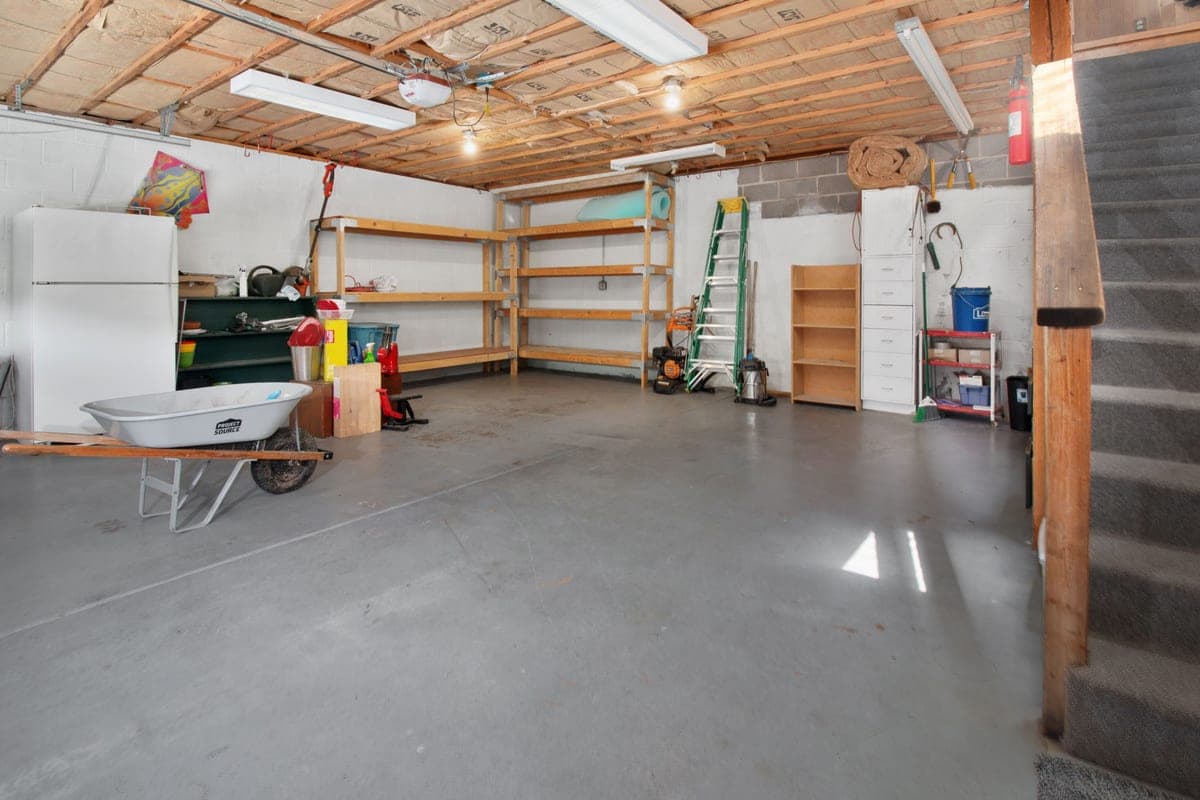
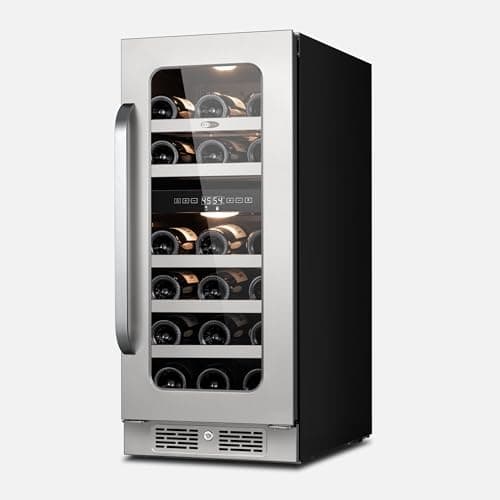
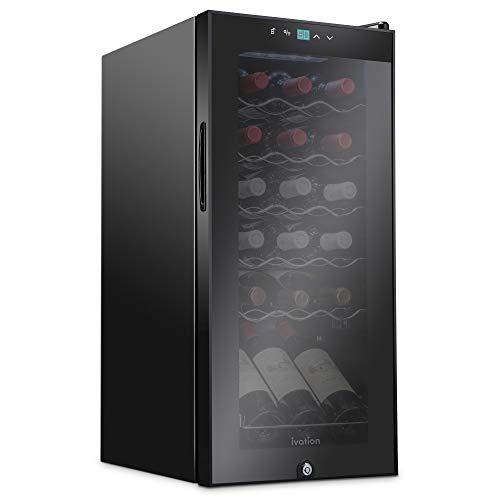
The Whynter BWR-33SD is the pick: compressor cooling and the widest published range in our registry at 40-72°F, so a warm garage in August and a cool one in March both sit inside it. The Summit SWC1535B is the hard-duty alternative, with commercial ETL-S and UL-471 listings.
This page sits in Wine Fridges, where the rest of the category is compared the same way.
How this page is funded. Cork & Cool earns a commission if you buy through the Amazon links below, at no extra cost to you. It never changes the order of this list — see our editorial policy and affiliate disclosure. Prices come from Amazon and are refreshed daily; the price on Amazon when you buy is always the one that counts.
Quick picks
Every model below, on the specifications that decide the purchase. Tap a row to jump to the full write-up.
Comparison of wine storage models by zones, capacity, cooling type, width, published noise rating and vibration.
#
Product
Best for
Zones
Bottles
Cooling
Width
Noise
Vibration
Price
1
Whynter BWR-33SDThe 15-inch default
Thirty-three bottles in a 15-inch cabinet, with a published noise ceiling and seven wooden shelves
#ad — paid link. How this is funded. Price as of November 11, 2026; check Amazon for the current price.
“Not published” means the manufacturer does not publish that figure. We do not estimate it. Prices and product photographs come from Amazon and are refreshed daily; where a model is not sold on Amazon the thumbnail is an illustrative category photograph and the link is a search.
How we compared
We compared published manufacturer specifications, official product documentation and verified owner reports across 5 models. We do not physically test these units, we have no laboratory, and we do not accept payment for placement. Where a manufacturer does not publish a figure — noise ratings, most often — this page says so rather than estimating it.
What we weighted
Compressor cooling only — thermoelectric units cool relative to the room, and all three in our registry floor at 46°F
The width of the published setpoint range, because a wide range gives the cabinet somewhere to go as the room moves
Durability listings an independent body actually issued, such as ETL-S to NSF-7 or UL-471
Insulation and glazing as published: double or triple glazing, UV protection, seal quality
Published power draw, because a cabinet in a hot room runs for longer
What is NOT published — no manufacturer here states an ambient operating range, and we do not invent one
Every model in detail
#1 — The 15-inch default
Whynter BWR-33SD
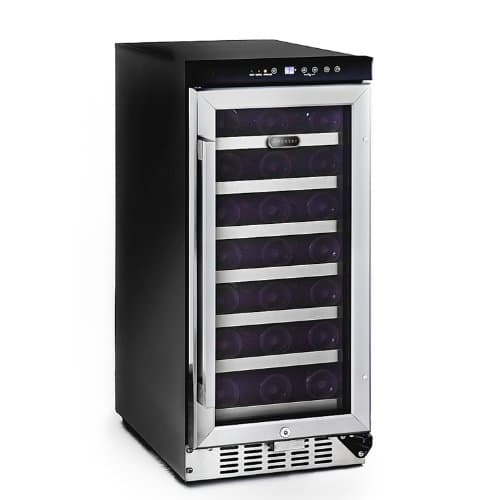
Thirty-three bottles in a 15-inch cabinet, with a published noise ceiling and seven wooden shelves — the capacity ceiling at this width, and the widest temperature band on this page.
Product photograph via Amazon.
Published specifications
Capacity
33 bottles
Zones
1
Cooling
compressor
Temperature range
40–72°F
Noise rating
42 dB
Installation
both
· Exterior: 15.0 in W x 22.5 in D (24.5 in with the handle installed) x 34.0 in H
· Capacity: 33 standard 750 ml bottles
· Noise published as "< 42 dBA" — a ceiling, not an average
Thirty-three bottles is the highest published capacity at this width
Whynter publishes a decibel ceiling, which almost nobody in this category does
Seven wooden shelves rather than the wire shelving usual at this price
40-72°F is the widest published band here, so it will also hold a bottle at room temperature
Rated for built-in or freestanding use, so an opening is optional rather than required
What does not
Single zone only — one temperature for the whole cabinet
The published figure is "< 42 dBA", a maximum rather than an average, so it cannot be compared like-for-like against a manufacturer quoting a flat number
At 15.0 inches published it is the widest cabinet in this group, which matters if your opening is tight
Depth grows to 24.5 inches once the handle is on, which is the figure that matters in a shallow run
33 bottles assumes standard Bordeaux shapes; a Burgundy-heavy collection will fit fewer
Who should skip it. Skip it if you need to serve whites cold and hold reds at cellar temperature in the same cabinet — one zone cannot do both. Skip it too if your opening measures under 15 inches, because this is the one cabinet here that needs the full module.
#ad — paid link. How this is funded. Price as of November 11, 2026; check Amazon for the current price.
#2 — Commercial-grade listings
Summit SWC1535B
Thirty-three bottles in 14.75 inches, listed to NSF-7 and UL-471 for commercial premises — the one you buy for a bar, a rental or anywhere an inspector might look.
Illustrative photograph — not an image of the Summit SWC1535B.
Published specifications
Capacity
33 bottles
Zones
1
Cooling
compressor
Temperature range
41–64°F
Noise rating
Not published by the manufacturer
Installation
both
· Exterior: 33.88 in H x 14.75 in W x 22.75 in D
· Shelving: six slide-out wooden shelves; remove alternate shelves for wider Burgundy bottles
· Door: glass with stainless steel trim, reversible, factory-installed lock
· ETL-S listed to NSF-7 standards and meets UL-471 for use in commercial establishments
· Automatic defrost
· Weight: 77 lb
· ADA-height sibling sold separately as the ALWC15
Commercial listings that no other cabinet in this width carries
Floor space takes three wider bottles, which Summit states rather than leaving you to discover
Factory-fitted lock and a reversible door as standard
Rated for built-in or freestanding use and finished on all sides
What does not
Summit does not publish a decibel rating
The published range stops at 64°F, slightly short of the 65-66°F most rivals quote
Single zone
Who should skip it. Skip it if this is going into a home kitchen and nobody will ever ask about NSF listing — you are paying for commercial certification you will not use.
Rated for built-in installation, so the front vent is designed for an enclosed opening
23.4-inch width drops into a standard 24-inch cabinet run
Two independently set zones across the full 40-66°F span
What does not
No published dB rating, so noise cannot be compared numerically against rivals
46 bottles is the manufacturer's count using standard Bordeaux bottles — heavy Burgundy or Champagne bottles reduce it
Who should skip it. Skip it if your opening is under 24 inches, or if you need more than about four dozen bottles — stepping up to a 160-bottle cabinet costs less per bottle.
#ad — paid link. How this is funded. Price as of November 11, 2026; check Amazon for the current price.
#4 — Two zones, either way round
Whynter BSR-029DW
Twenty-nine bottles split ten over nineteen across two zones that each cover the whole 40-65°F range — so either half can hold a red, which the other dual-zone cabinet at this width cannot.
Product photograph via Amazon.
Published specifications
Capacity
29 bottles
Zones
2
Cooling
compressor
Temperature range
40–65°F
Noise rating
38 dB
Installation
both
· Exterior: 14.8 in W x 22.4 in D x 33.9 in H
· Internal volume: 3.0 cu ft
· Capacity: 29 standard 750 ml bottles — 10 in the upper zone, 19 in the lower
· Both zones: 40-65°F / 5-18°C
· Noise published as "< 38 dB" — a ceiling, not an average
· Shelving: five removable beechwood shelves
· Door: seamless stainless-trimmed double tempered UV-resistant glass, reversible, cylinder lock with two keys
Both zones are rated across the full 40-65°F span, so the split is yours to set rather than the factory's
Whynter publishes a decibel ceiling, which the other dual-zone cabinet at this width does not
14.8 inches wide and 22.4 inches deep, the shallowest of the full-depth cabinets here
Beechwood shelves and a reversible door, so the hinge side is not decided for you
Rated for built-in or freestanding use, so an opening is optional rather than required
What does not
Twenty-nine bottles against thirty-three for the single-zone cabinets — the divider costs four
The upper zone holds only ten bottles, so the split is lopsided whichever way you use it
The published figure is "< 38 dB", a maximum rather than an average
29 bottles assumes standard Bordeaux shapes; a Burgundy-heavy collection will fit fewer
Who should skip it. Skip it if you only ever hold one temperature. The divider costs four bottles and a whole zone of shelf space, and a single-zone cabinet at this width gives both back.
41°F floor is cold enough for sparkling wine service
Compressor cooling holds its setting regardless of room temperature
A lock, which most units this size omit
What does not
One zone only
A compressor in a small cabinet is audible in a quiet room
Who should skip it. Skip it if the unit will sit in a bedroom or a quiet home office. At this size the compressor is close to you and there is no published dB figure to reassure you.
#ad — paid link. How this is funded. Price as of November 11, 2026; check Amazon for the current price.
The honest answer about garage ratings
In refrigerators and freezers, “garage ready” is a manufacturer claim with a number behind it: a stated ambient operating range, often 0°F to 110°F. In wine cabinets it is mostly a phrase used by retailers. Not one of the 26 wine cabinets in our registry publishes an ambient operating range — we looked, on every manufacturer page and specification sheet listed in our sources, and the figure is not there.
So this page cannot rank cabinets by a garage rating, because the rating does not exist. What it can do is rank them on the specifications that genuinely bear on an unconditioned room, say which ones they are, and be explicit that the gap is the manufacturer’s and not ours. If a retailer tells you a wine fridge is garage rated, ask them which manufacturer document says so.
A thermoelectric cooler moves heat relative to the surrounding air. It can pull the interior some distance below the room and no further, which is why every thermoelectric cabinet in our registry that publishes a floor — the Whynter WC-201TD, the Ivation 18-bottle dual-zone, the Koolatron WC12-35D and the Schmécké 12-bottle — publishes 46°F. On a 95°F August afternoon in a closed garage, a thermoelectric cabinet is not holding 55°F. It is not a weak example of the type; it is the type.
A compressor cabinet moves heat absolutely, the way a kitchen refrigerator does. It will still work harder in a hot room, and it will still run longer and cost more to run, but it is capable of reaching its setpoint. Every cabinet on this page is therefore compressor-cooled. The mechanism is explained properly in compressor versus thermoelectric and the broader list is best compressor wine fridges.
What each cabinet publishes
Published specifications relevant to an unconditioned room
Cabinet
Published range
Independent listing
Power
Glazing
Whynter BWR-33SD
40–72°F
Not published
80 W / 0.9 A at 115 V
Double-pane tempered, UV-protective
Summit SWC1535B
41–64°F
ETL-S to NSF-7; meets UL-471 for commercial use
Not published
Glass with stainless trim
Newair AWR-460DB
40–66°F
Not published
Not published
Double-tempered, UV-protected, insulated
Whynter BSR-029DW
40–65°F, both zones
Not published
103.5 W / 0.9 A
Double tempered, UV-resistant
Ivation 18-bottle compressor
41–64°F
Not published
Not published
Not published
The Whynter BWR-33SD leads on one specification that is easy to overlook: its range runs to 72°F, the highest top end in the registry. In a garage that matters in winter rather than summer. A cabinet whose range stops at 64°F has nowhere to go if you want to keep the interior above a cold room — and a garage in February is often colder than wine wants, not warmer.
The Summit SWC1535B leads on the only independent durability evidence available here. ETL-S listing to NSF-7 and UL-471 compliance are commercial-premises standards: they are about construction and sanitation for continuous service, not about garages, and we are not going to pretend otherwise. They are still the only third-party listings any cabinet on this page carries.
The three risks a spec sheet will not fix
1. Winter, not summer. Most people worry about heat. The commoner failure in an unheated garage is cold: the cabinet stops cooling because the room is already below setpoint, the interior tracks the room down, and wine that freezes pushes its cork out. Nothing on this page prevents that. If your garage goes below freezing, the answer is a different room.
2. Swing, not average. Wine tolerates a steady 65°F far better than it tolerates 50°F to 85°F every week. Repeated expansion and contraction works the cork, and a cabinet in a hot room spends its life cycling. The damage mechanism is described in what happens to wine if it is not stored properly.
3. Power. A compressor in a hot room runs for longer, which raises both the running cost and the load on the circuit. The Whynter BSR-029DW draws 103.5 W, the BWR-33SD 80 W at 0.9 A. Garages often sit on a shared circuit with door openers, freezers and power tools — see does a wine fridge need its own circuit, and wine fridge running costs for the arithmetic.
Choosing between the five
A garage that gets cold as well as hot: Whynter BWR-33SD, for the 40–72°F range and published power figures.
Hard duty and third-party listings: Summit SWC1535B.
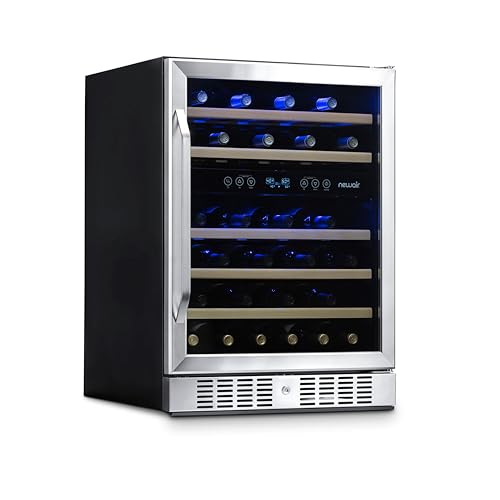
A 24-inch run and 46 bottles: Newair AWR-460DB, with two zones and insulated UV-protected glass.
Two zones in a narrow gap: Whynter BSR-029DW, both zones 40–65°F.
A small cabinet you are willing to risk: Ivation 18-bottle compressor, which also locks — useful in a garage that is not always locked itself.
And the alternative worth considering: if the garage is the only space you have, a rack in a cooler room indoors plus a small cabinet often protects the wine better than a large cabinet in a hostile room. It is also cheaper.
Questions people actually ask
▸ Are any wine fridges actually rated for a garage?
None of the 26 cabinets in our registry publishes an ambient operating range, so none can be shown to be garage rated. Check your specific model’s manual — some manufacturers state a minimum and maximum room temperature there even when the marketing page does not.
▸ Will a thermoelectric wine cooler work in a garage?
Not reliably. Thermoelectric cooling works relative to the room, and every unit in our registry that publishes a floor publishes 46°F. In a hot garage the interior tracks the room upward.
▸ What happens if a garage drops below freezing?
The cabinet stops cooling, the interior follows the room down, and wine that freezes expands and can push its cork out. A cabinet cannot heat a cold room, which is why an unheated garage in a cold climate is the wrong place for wine.
▸ Does a garage wine fridge need its own circuit?
Several manufacturers ask for a separate 15-amp circuit, and garage circuits are often already shared with openers and freezers. The detail is in does a wine fridge need its own circuit.
▸ Is a garage worse than a basement for wine?
Usually, yes. A basement is cooler, more stable and darker, which is most of what wine storage asks for — see how to store wine in a basement.