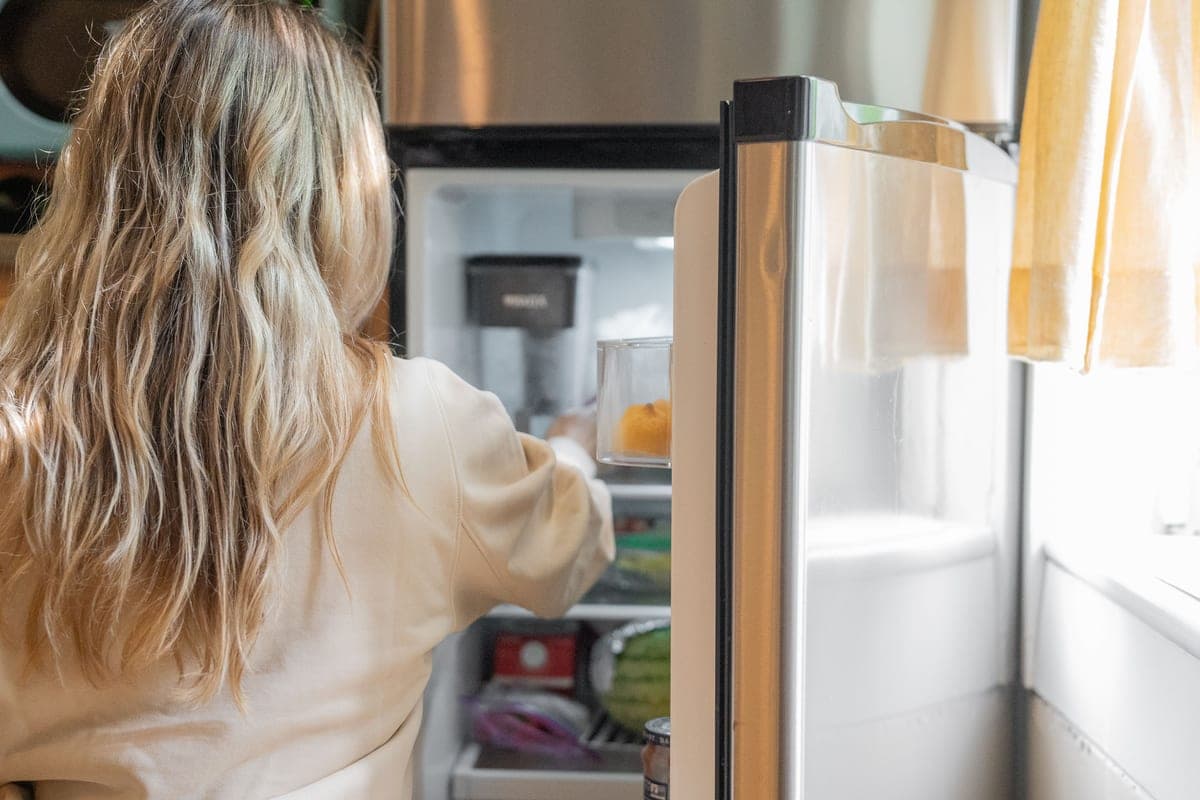
A kitchen refrigerator runs at 37-40°F to keep food safe, which is roughly 15 degrees colder than wine wants for storage. It is also drier, brighter, and vibrates more from frequent door openings. For a bottle you will drink this week, it is fine. For anything you are keeping, it is not.
This page sits in Wine Storage Guides, where the rest of the category is compared the same way.
How this page is funded. Cork & Cool earns a commission if you buy through the Amazon links below, at no extra cost to you. It never changes the order of this list — see our editorial policy and affiliate disclosure. We do not publish prices, because a stale number helps nobody.
Our picks
If the conclusion is that a kitchen fridge is not the right home for your wine, these are the two shapes the alternative takes: a 46-bottle cabinet for a standard opening, or a 166-bottle column for a real collection.
How this page is funded. Cork & Cool earns a commission if you buy through the Amazon links below, at no extra cost to you. It never changes the order of this list — see our editorial policy and affiliate disclosure. We do not publish prices, because a stale number helps nobody.
#1 — The 24-inch slot
Newair AWR-460DB
Forty-six bottles across two zones in a 23.4-inch cabinet rated for built-in or freestanding use — the default answer for a standard kitchen opening.
Illustrative photograph — not an image of the Newair AWR-460DB.
Published specifications
Capacity
46 bottles
Zones
2
Cooling
compressor
Temperature range
40–66°F
Noise rating
Not published by the manufacturer
Installation
both
· Exterior: 23.40 in W x 22.40 in D (24.00 in with handle) x 33.00 in H
Rated for built-in installation, so the front vent is designed for an enclosed opening
23.4-inch width drops into a standard 24-inch cabinet run
Two independently set zones across the full 40-66°F span
What does not
No published dB rating, so noise cannot be compared numerically against rivals
46 bottles is the manufacturer's count using standard Bordeaux bottles — heavy Burgundy or Champagne bottles reduce it
Who should skip it. Skip it if your opening is under 24 inches, or if you need more than about four dozen bottles — stepping up to a 160-bottle cabinet costs less per bottle.
This is the whole story, and everything else is secondary.
A kitchen refrigerator runs at roughly 37–40°F, because that is the range that keeps food safe — USDA guidance is to keep a refrigerator at or below 40°F to slow bacterial growth. That is not a design preference, it is a food-safety requirement, and it is not adjustable upward without compromising the appliance’s actual job.
Wine storage wants roughly 55°F. So a kitchen refrigerator is about fifteen degrees colder than a wine cabinet, permanently.
What that does over time: development effectively stalls. Wine kept at 38°F does not age so much as sit, and the aromatic complexity that aging is supposed to produce does not arrive. It is not the dramatic damage that heat does — cold is far more forgiving than warmth — but a bottle you were keeping for five years will not have become what it should. It also means everything you pour needs warming up first, which is a nuisance for whites and genuinely wrong for reds (serving temperatures).
Three more differences
Humidity
Kitchen refrigerators actively remove moisture — a drier interior keeps food fresher and prevents frost. Over years, dry air lets a natural cork dry, harden and shrink, and a shrunken cork stops sealing (humidity). Irrelevant over weeks, a genuine risk over years, and irrelevant again for screw caps.
Vibration and door openings
A kitchen fridge is opened many times a day, and each opening exchanges cold air for room air and moves the bottles. Wine cabinets are opened rarely, and the better ones are specifically engineered against vibration — Liebherr and Dacor both document design work on it. Agitation disturbs the slow settling that aging depends on.
Light and shelving
Refrigerator interior lights come on every time the door opens, and light degrades wine. Wine cabinets use tinted or UV-treated glass and lights you can switch off. And refrigerator shelves hold bottles upright, which is the wrong orientation for cork-sealed bottles kept long term (flat or upright).
One thing a kitchen fridge does better: it costs you nothing, because you already own it.
When a regular fridge is fine
Genuinely fine, not a grudging compromise:
An opened bottle. Here the kitchen fridge is the correct answer. Once wine is exposed to air you are slowing oxidation, and colder is better — 38°F beats 55°F for a half-finished bottle (storing opened wine).
Chilling whites and sparkling before serving. Exactly what it is for.
Anything you will drink within a few weeks. Neither the cork nor the aging matters on that horizon.
Screw-cap bottles short term. No cork to dry out.
Where it is not fine: cork-sealed bottles kept months or years, anything you are deliberately aging, and reds you want at serving temperature without planning an hour ahead.
The verdict
Which appliance, by what you are doing
What you are doing
Use
Why
Storing wine for months or years
Wine fridge
55°F steady, humidity buffered, dark, still, bottles on their side
Keeping an opened bottle
Kitchen fridge
Colder is better once oxidation has started
Chilling a white before dinner
Kitchen fridge
It is exactly the right tool
Serving reds at 60–65°F
Wine fridge
A kitchen fridge cannot hold that temperature at all
A dozen bottles drunk within weeks
Either
Too short a horizon for the differences to matter
Aging anything worth aging
Wine fridge
Cold stalls development; a cork in dry air eventually fails
The honest summary: if your wine is drunk within weeks, your kitchen fridge and a rack cover it. A wine cabinet earns its place when you start keeping bottles — and if your room is cool and stable, a rack may do that job too (rack vs fridge).
Questions people actually ask
▸ Can I store wine in a regular fridge?
Short term, yes. Long term, no — a kitchen fridge runs around 37–40°F for food safety, about 15 degrees colder than wine storage wants, and its dry air can dry a natural cork over years.
▸ Is a regular fridge too cold for wine?
For storage, yes. Development effectively stalls at 38°F, so a bottle you were aging will not become what it should. Cold is far more forgiving than heat, but it is still the wrong temperature.
▸ Where should I keep an opened bottle of wine?
The kitchen fridge, resealed and standing upright — including reds. Once air has reached the wine, colder genuinely is better, and a red comes back to serving temperature in half an hour out of the fridge.
▸ Why can't I just turn my fridge up to 55°F?
Because it also has to keep food safe, and USDA guidance is at or below 40°F. Most kitchen refrigerators will not go that high, and using one that does for wine would leave your food in an unsafe range.