Only for foods that do not need refrigeration temperatures. A wine fridge typically runs between 40 and 65°F, while food safety requires 40°F or below, so perishables such as meat, fish, dairy and leftovers must never be stored in one. Cheese, cured charcuterie, chocolate, coffee and some produce do well in it.
This page sits in Wine Storage Guides, where the rest of the category is compared the same way.
How this page is funded. Cork & Cool earns a commission if you buy through the Amazon links below, at no extra cost to you. It never changes the order of this list — see our editorial policy and affiliate disclosure. Prices come from Amazon and are refreshed daily; the price on Amazon when you buy is always the one that counts.
Our picks
If the plan is a cabinet that does double duty, three things matter: a wide published range so you can choose your temperature, a lock or commercial listing if it is going somewhere shared, and shelving you can take out. These three cover those cases.
How this page is funded. Cork & Cool earns a commission if you buy through the Amazon links below, at no extra cost to you. It never changes the order of this list — see our editorial policy and affiliate disclosure. Prices come from Amazon and are refreshed daily; the price on Amazon when you buy is always the one that counts.
#1 — The 15-inch default
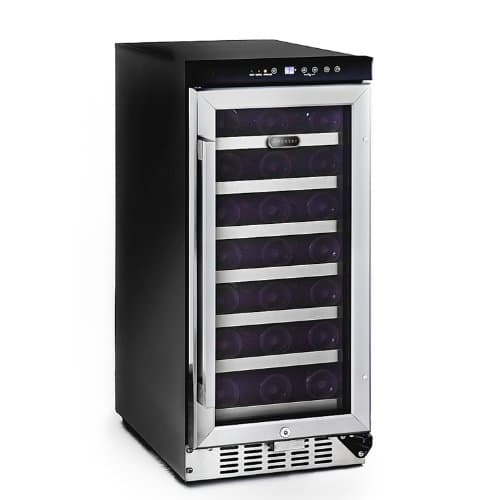
Whynter BWR-33SD
Thirty-three bottles in a 15-inch cabinet, with a published noise ceiling and seven wooden shelves — the capacity ceiling at this width, and the widest temperature band on this page.
Product photograph via Amazon.
Published specifications
Capacity
33 bottles
Zones
1
Cooling
compressor
Temperature range
40–72°F
Noise rating
42 dB
Installation
both
· Exterior: 15.0 in W x 22.5 in D (24.5 in with the handle installed) x 34.0 in H
· Capacity: 33 standard 750 ml bottles
· Noise published as "< 42 dBA" — a ceiling, not an average
Thirty-three bottles is the highest published capacity at this width
Whynter publishes a decibel ceiling, which almost nobody in this category does
Seven wooden shelves rather than the wire shelving usual at this price
40-72°F is the widest published band here, so it will also hold a bottle at room temperature
Rated for built-in or freestanding use, so an opening is optional rather than required
What does not
Single zone only — one temperature for the whole cabinet
The published figure is "< 42 dBA", a maximum rather than an average, so it cannot be compared like-for-like against a manufacturer quoting a flat number
At 15.0 inches published it is the widest cabinet in this group, which matters if your opening is tight
Depth grows to 24.5 inches once the handle is on, which is the figure that matters in a shallow run
33 bottles assumes standard Bordeaux shapes; a Burgundy-heavy collection will fit fewer
Who should skip it. Skip it if you need to serve whites cold and hold reds at cellar temperature in the same cabinet — one zone cannot do both. Skip it too if your opening measures under 15 inches, because this is the one cabinet here that needs the full module.
#ad — paid link. How this is funded. Price as of November 11, 2026; check Amazon for the current price.
#2 — Commercial-grade listings
Summit SWC1535B
Thirty-three bottles in 14.75 inches, listed to NSF-7 and UL-471 for commercial premises — the one you buy for a bar, a rental or anywhere an inspector might look.
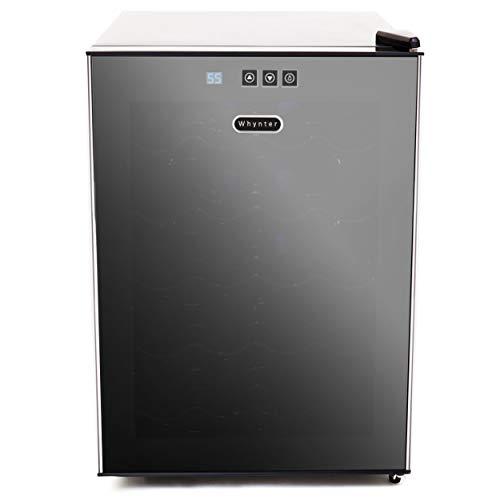
Illustrative photograph — not an image of the Summit SWC1535B.
Published specifications
Capacity
33 bottles
Zones
1
Cooling
compressor
Temperature range
41–64°F
Noise rating
Not published by the manufacturer
Installation
both
· Exterior: 33.88 in H x 14.75 in W x 22.75 in D
· Shelving: six slide-out wooden shelves; remove alternate shelves for wider Burgundy bottles
· Door: glass with stainless steel trim, reversible, factory-installed lock
· ETL-S listed to NSF-7 standards and meets UL-471 for use in commercial establishments
· Automatic defrost
· Weight: 77 lb
· ADA-height sibling sold separately as the ALWC15
Commercial listings that no other cabinet in this width carries
Floor space takes three wider bottles, which Summit states rather than leaving you to discover
Factory-fitted lock and a reversible door as standard
Rated for built-in or freestanding use and finished on all sides
What does not
Summit does not publish a decibel rating
The published range stops at 64°F, slightly short of the 65-66°F most rivals quote
Single zone
Who should skip it. Skip it if this is going into a home kitchen and nobody will ever ask about NSF listing — you are paying for commercial certification you will not use.
No compressor means no start-up thump and no vibration path into the wine
65 W is a fraction of a compressor cabinet's draw
46°F floor is cold enough for sparkling service
What does not
Thermoelectric cooling works against ambient temperature, so a warm room raises the achievable minimum
Freestanding only — it must not be enclosed
Who should skip it. Skip it if the unit will live anywhere that gets hot: a garage, a conservatory, or a cabinet run with no air gap. Thermoelectric units lose the argument above roughly 77°F ambient.
#ad — paid link. How this is funded. Price as of November 11, 2026; check Amazon for the current price.
The safety line, stated plainly
This is a food safety question before it is a convenience question, so the number comes first. US food safety guidance puts refrigerated storage at 40°F or below. A wine fridge is designed around a band that starts at 38 to 46°F depending on the model and runs up into the 60s, because that is what wine wants.
Almost no wine fridge can hold 40°F or below with any margin. In our registry only the Zephyr Presrv publishes a 38°F floor; most compressor cabinets publish 40 or 41°F, and thermoelectric cabinets publish 46°F. Running a cabinet at the very bottom of its range, with the door opening regularly, is not a safe refrigerator and no amount of careful use makes it one.
So the rule is simple and it is not negotiable: nothing that requires refrigeration goes in a wine fridge. No raw meat, no fish, no shellfish, no milk or cream, no soft fresh cheese, no leftovers, no cooked rice, no cut fruit, no anything whose label says keep refrigerated. The exact floor your model publishes is in how cold does a wine fridge get.
What a wine fridge stores well
With that line drawn, there is a real list of things a wine fridge handles better than a kitchen refrigerator does, precisely because it is warmer and gentler.
Hard and semi-hard cheese. Aged cheddar, Comte, Manchego and similar keep well in the 50s and taste considerably better than they do straight out of a cold refrigerator. Wrap them properly; see the smell section below. Soft fresh cheeses are a different matter and belong in the refrigerator.
Whole cured charcuterie. A whole salami or a sealed piece of cured ham is shelf-stable by design and is comfortable in a cool cabinet. Sliced, opened or vacuum-packed-and-opened charcuterie is not — once cut, it needs refrigeration.
Chocolate. One of the best uses. Chocolate hates both heat and a cold refrigerator, which makes it sweat and bloom. The 55 to 65°F band is genuinely close to ideal.
Coffee beans, in a sealed container. Cool and dark is better than a warm counter, provided the container is airtight so the beans take up no moisture or odor.
Produce that dislikes the refrigerator. Tomatoes, avocados and some stone fruit lose flavor and texture in a cold refrigerator and sit comfortably in the 50s.
Olive oil, nuts and spices. All go rancid or stale faster in a warm kitchen. A cool dark cabinet slows that down.
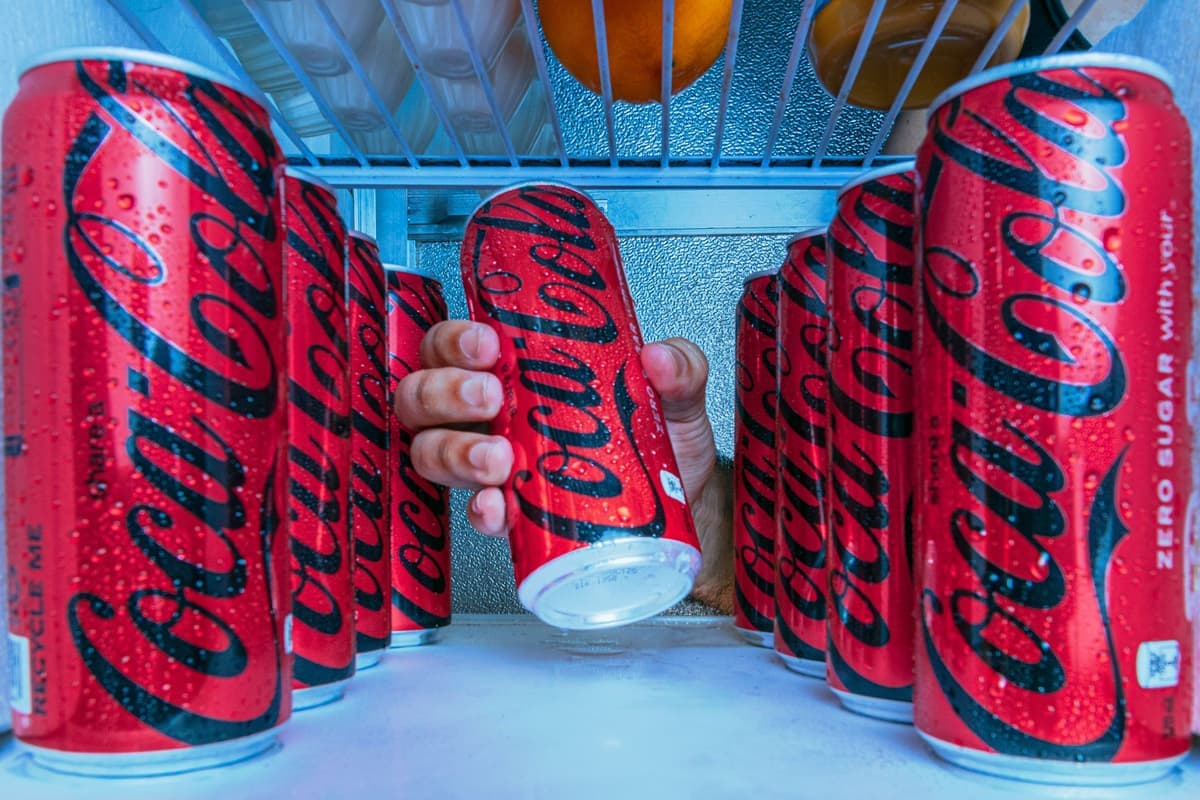
There is one more category worth mentioning because it is the most common real reason people ask: drinks. Beer, soda, water and mixers all store fine, with the caveat that a wine fridge serves them warmer than a drinks fridge does and its shelving is shaped for bottles lying down. Using a wine fridge for beer and soda covers the shelving arithmetic.
What must never go in one
Food categories and whether a wine fridge can hold them
Item
In a wine fridge?
Why
Raw meat, poultry, fish, shellfish
Never
Requires 40°F or below; a wine fridge cannot hold it with any margin
Milk, cream, yogurt, soft fresh cheese
Never
Perishable dairy needs refrigeration temperatures
Leftovers, cooked rice, cut fruit, deli salads
Never
All require refrigeration once prepared or cut
Hard and semi-hard cheese
Yes, wrapped
Keeps and tastes better in the 50s than in a cold refrigerator
Whole cured salami and sealed cured ham
Yes, uncut
Shelf-stable by design; refrigerate once cut
Chocolate
Yes
Avoids both heat damage and refrigerator bloom
Coffee beans, sealed
Yes
Cool and dark, provided the container is airtight
Tomatoes, avocados, stone fruit
Yes
They lose flavor and texture in a cold refrigerator
The problem nobody mentions: smell
Even for the foods that are perfectly safe, there is a second consideration that matters more to the wine than to the food. A wine fridge is a sealed, cool, low-airflow box, and corks are slowly permeable. Strong smells in that environment have a long time to work on the bottles sharing it.
A wedge of washed-rind cheese left unwrapped in a wine cabinet for a fortnight is a smell you will subsequently find in the cabinet, and eventually in the wine. Three practical rules:
Wrap or seal anything aromatic. Cheese paper then a box; coffee in an airtight container; charcuterie wrapped.
Use the carbon filter if the cabinet has one. Several cabinets ship with an activated carbon filter — the Whynter BWR-33SD and BSR-029DW both publish one fitted — and it is there for exactly this. Replace it on schedule.
Keep food and wine on separate shelves, food low where spills cannot run down onto labels.
Plenty of people genuinely want one appliance for wine, cheese and drinks. That is a reasonable goal, and three specifications make it work better.
A wide published range. The more of the 40s-to-60s band the cabinet covers, the more freedom you have to pick a compromise temperature. The Whynter BWR-33SD publishes 40–72°F, the widest span in our registry.
Removable shelves. Wine shelves are cradled for bottles lying down and waste space for anything else. Shelves that come out let you make a usable flat area. The Summit SWC1535B publishes six slide-out wooden shelves and states that removing alternate shelves makes room for wider bottles — the same move makes room for a cheese box.
Two zones, if the budget allows. The cleanest solution to a compromise temperature is not to compromise: hold the wine zone where the wine wants it and run the other zone warmer for cheese and chocolate. Dual-zone cabinets covers the class, and dual-zone temperature settings covers configuring one.
And if what you actually need is a cold drinks fridge that also takes a few bottles, you are shopping for a different appliance — wine fridge versus beverage fridge is that comparison.
Questions people actually ask
▸ Can you store food in a wine fridge?
Only food that does not require refrigeration. A wine fridge runs roughly 40 to 65°F while food safety guidance requires 40°F or below, so perishables are out. Hard cheese, whole cured charcuterie, chocolate, sealed coffee and produce that dislikes the refrigerator all do well in one.
▸ Can you keep cheese in a wine fridge?
Hard and semi-hard cheeses, yes, and they taste better for it than they do straight from a cold refrigerator. Wrap them properly, because a sealed low-airflow cabinet will carry strong smells to the corks sharing it. Soft fresh cheeses need refrigeration and should not go in.
▸ Is a wine fridge cold enough to store milk or meat?
No, and this is the one hard rule on the page. Those foods require 40°F or below, and no cabinet in our registry holds that with any margin in normal use. Use the kitchen refrigerator.
▸ Will food make my wine smell?
It can. Corks are slowly permeable and a wine cabinet is a sealed, low-airflow box, so strong aromas have a long time to work. Wrap or seal anything aromatic, use the carbon filter if the cabinet has one, and keep food on lower shelves than the wine.
▸ Can I use a wine fridge as a cheese fridge?
It is one of the better alternative uses, since the 50s suit most aged cheeses. Choose a cabinet with a wide published range and removable shelves, wrap everything, and ideally run cheese in a separate zone from the wine so neither has to compromise.