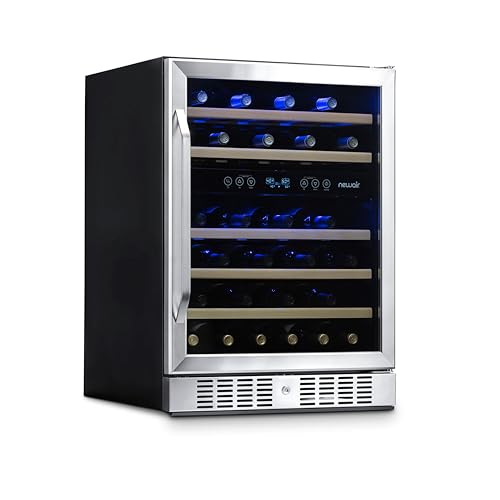
The Newair AWR-460DB is the best 46-bottle wine fridge for most kitchens: 46 bottles across two independently set zones in a 23.4-inch cabinet rated for built-in or freestanding use, with removable beechwood shelving and UV-protected insulated glass. If you want beech shelving for less, the Kalamera KRC-46DZB is the same idea at 24 inches.
This page sits in Wine Fridges, where the rest of the category is compared the same way.
How this page is funded. Cork & Cool earns a commission if you buy through the Amazon links below, at no extra cost to you. It never changes the order of this list — see our editorial policy and affiliate disclosure. Prices come from Amazon and are refreshed daily; the price on Amazon when you buy is always the one that counts.
Quick picks
Every model below, on the specifications that decide the purchase. Tap a row to jump to the full write-up.
Comparison of wine storage models by zones, capacity, cooling type, width, published noise rating and vibration.
#
Product
Best for
Zones
Bottles
Cooling
Width
Noise
Vibration
Price
1
Newair AWR-460DBThe 24-inch slot
Forty-six bottles across two zones in a 23.4-inch cabinet rated for built-in or freestanding use
“Not published” means the manufacturer does not publish that figure. We do not estimate it. Prices and product photographs come from Amazon and are refreshed daily; where a model is not sold on Amazon the thumbnail is an illustrative category photograph and the link is a search.
How we compared
We compared published manufacturer specifications, official product documentation and verified owner reports across 5 models. We do not physically test these units, we have no laboratory, and we do not accept payment for placement. Where a manufacturer does not publish a figure — noise ratings, most often — this page says so rather than estimating it.
What we weighted
Published exterior width and depth, because this class exists to fit a 24-inch opening and the handle often decides it
Installation rating: built-in, freestanding, or both — an enclosed opening makes this non-negotiable
Zone count and whether both zones span a useful range
Shelving material, since beech and wire behave very differently when a shelf is loaded
What the maker publishes about temperature range, with an explicit note where nothing is published
Service and parts availability, which separates a mainstream brand from a direct-import one
Every model in detail
Four cabinets in the 41-to-46-bottle class, ranked on what the maker publishes, plus the obvious step up for anyone who already knows 46 will not be enough.
#1 — The 24-inch slot
Newair AWR-460DB
Forty-six bottles across two zones in a 23.4-inch cabinet rated for built-in or freestanding use — the default answer for a standard kitchen opening.
Product photograph via Amazon.
Published specifications
Capacity
46 bottles
Zones
2
Cooling
compressor
Temperature range
40–66°F
Noise rating
Not published by the manufacturer
Installation
both
· Exterior: 23.40 in W x 22.40 in D (24.00 in with handle) x 33.00 in H
Rated for built-in installation, so the front vent is designed for an enclosed opening
23.4-inch width drops into a standard 24-inch cabinet run
Two independently set zones across the full 40-66°F span
What does not
No published dB rating, so noise cannot be compared numerically against rivals
46 bottles is the manufacturer's count using standard Bordeaux bottles — heavy Burgundy or Champagne bottles reduce it
Who should skip it. Skip it if your opening is under 24 inches, or if you need more than about four dozen bottles — stepping up to a 160-bottle cabinet costs less per bottle.
Beech shelving at this price point is unusual — most rivals use wire
Reversible door helps in a tight galley kitchen
Dual installation rating gives you options if the kitchen changes
What does not
Kalamera does not publish a temperature range for this model in the listing, so the achievable span is unconfirmed
No published dB rating
Who should skip it. Skip it if you need a documented temperature range before you buy — the published listing does not give one, and we will not estimate it for you.
A published vibration measure, which almost nobody in this category offers
Panel-ready, so it disappears into cabinetry
Two zones in a single base cabinet
What does not
No published temperature range in the product listing
Panel-ready means you are also buying a custom door panel
Who should skip it. Skip it if the unit is going into a garage or a utility room. Panel-ready construction and vibration engineering are worth paying for in a finished kitchen and nowhere else.
Twenty extra bottles over the common 46-bottle format without moving up to a full-height cabinet
Two zones, so reds and whites can be held separately
What does not
Neither the exterior width nor the temperature range is published in the retail listing
No published dB rating
Who should skip it. Skip it if you are planning a cabinet cut-out — without a published exterior width you cannot confirm the opening before it arrives.
Forty-six bottles looks arbitrary until you look at a kitchen. The standard American base cabinet opening is 24 inches wide and roughly 34 inches to the underside of the counter, and 46 standard Bordeaux bottles is about what a cabinet of that size holds once you allow for the compressor compartment, the shelves and the door seal. It is a manufacturing constraint expressed as a marketing number, which is why so many different brands land on the same figure.
That makes the class unusually easy to shop: the capacity is effectively fixed, so you are choosing on fit, zones, shelving and who will service the thing. It also makes it the class where the specification sheet matters most, because almost every meaningful difference between these cabinets is a published number rather than a feeling.
The two measurements that decide it
Width and depth, and both of them have a trap.
Width. A 24-inch opening does not take a 24-inch cabinet. The Newair AWR-460DB publishes 23.40 inches wide precisely so that it drops into that opening with clearance; the Kalamera KRC-46DZB is published at a nominal 24 inches, which is fine freestanding and tight in a cut-out. Measure the opening front, middle and back — older cabinet runs are rarely square.
Depth. This is where people get caught. Newair publishes the AWR-460DB at 22.40 inches deep, and 24.00 inches with the handle fitted. The second number is the one that decides whether the door front sits flush with your cabinet fronts or proud of them. If a listing gives you only one depth figure, assume it excludes the handle and ask.
Then there is the question that is not a measurement at all: whether the cabinet is rated for built-in installation. A freestanding unit vents through its back or sides. Build one into a sealed opening and it recirculates its own exhaust until the compressor fails, and manufacturers exclude that damage from the warranty. The Newair and the Kalamera are both rated for either; the Whirlpool and the Dacor are built-in units. Built-in versus freestanding explains how to read the rating off a spec sheet.
The 46-bottle class at a glance
Published specifications for the 41-66 bottle cabinets on this page
Model
Bottles
Zones
Published width
Installation
Newair AWR-460DB
46
2
23.40 in W, 22.40 in D (24.00 in with handle)
Built-in or freestanding
Kalamera KRC-46DZB
46
2
24 in
Built-in or freestanding
Whirlpool WUW55X24HS
46
Not published
24 in
Built-in (undercounter)
Dacor DRW24G7500APDA
41
2
24 in
Built-in (panel-ready)
Kalamera KMER1018
66
2
Not published
Built-in
Three of the five publish no temperature range at all. Newair publishes 40–66°F across both zones, which is the full useful span from sparkling service to red cellaring, and it is the main reason it leads this page.
What 46 bottles actually means
It means 46 standard Bordeaux bottles: the straight-sided shape with high shoulders, laid flat on the shelves in the pattern the manufacturer designed. Every published capacity in this category is measured that way, and the number drops as soon as your collection is not.
Burgundy and Pinot Noir bottles are wider and have sloping shoulders. They do not nest, and a shelf designed for six Bordeaux may take four.
Champagne bottles are wider again and heavier, and on some cabinets they only fit if you remove an entire shelf.
Magnums rarely fit at all without removing shelves, which costs you the capacity of the shelf you removed.
If a meaningful share of your collection is Burgundy-shaped, plan on roughly a third fewer bottles than the badge and read the large-format bottle roundup, which ranks cabinets on how easily shelves come out. The same arithmetic is in what size wine fridge do I need.
When 46 is the wrong answer
Two situations. The first is a collection that is already growing: if you buy by the case, 46 bottles is roughly four cases and you will be full within a year. The Kalamera KMER1018 is the sensible next rung at 66 bottles, and above that you are into full-height cabinets where the cost per bottle stored drops sharply — the 100-bottle class is where that becomes obvious.
The second is a narrow opening. If the gap is 15 inches rather than 24, nothing on this page fits and the whole decision changes; 15-inch wine coolers covers that class, where the capacity ceiling is about 33 bottles. And if you have the width but not the depth, the shallow-depth cabinets in the undercounter roundup are the answer instead.
One last note on the Whirlpool. It is here because its parts and service network is the widest of anything on this page, and in an appliance you expect to own for a decade that is a genuine specification. What it is not is a well-documented one: Whirlpool’s product page for this model states neither a zone count nor a temperature range, and we will not fill those in for them.
Questions people actually ask
▸ Will a 46-bottle wine fridge fit a standard 24-inch cabinet opening?
That is exactly what the class is designed for, but check two numbers first: the cabinet’s published width (the Newair AWR-460DB is 23.40 inches, not 24) and its depth with the handle fitted (24.00 inches on the same model, against 22.40 inches without). Also confirm the unit is rated for built-in installation before putting it in an enclosed opening.
▸ Is 46 bottles enough?
It is roughly four cases, which suits a household that drinks what it buys and keeps a standing selection. If you buy by the case or age bottles for years, you will fill it within a year or two, and the cost per bottle stored is better in a larger cabinet.
▸ Do I need two zones in a 46-bottle wine fridge?
Only if you serve both reds and whites straight from the cabinet. Two zones let you hold whites at service temperature and reds at cellar temperature at once; a single zone is the correct configuration for storage, and it gives you uniform shelf spacing with no internal partition. Single zone versus dual zone works through the decision.
▸ Why do so many wine fridges hold exactly 46 bottles?
Because they are all built to drop into the same 24-inch base cabinet opening at standard counter height. Once you subtract the compressor compartment, the shelves and the door, 46 standard Bordeaux bottles is about what the remaining volume holds. The figure is a consequence of kitchen dimensions, not a coincidence.
▸ Can a 46-bottle wine fridge go under a counter?
Only if it is rated for built-in installation. A freestanding cabinet vents through the back or sides, and enclosing it causes it to recirculate hot air until the compressor fails — damage most warranties exclude. The Newair AWR-460DB and Kalamera KRC-46DZB are rated for both; see our full answer on freestanding units under counters.