The short answer, and the reason behind it
No — not if the manufacturer rates the unit as freestanding only. This is not a cautious recommendation or a best-practice preference. It is a description of how the appliance works, and the failure it produces is predictable, slow and expensive.
The confusion is understandable, because nothing about the cabinet looks like it objects. A freestanding wine fridge is the same height as a base cabinet, the same sort of width, and has a flat finished front. Slide it into a gap in a counter run and it looks exactly right. It will also cool, at first, which is the part that fools people. The problem shows up in the second summer.
Where the heat actually goes
A wine fridge does not destroy heat. It moves heat from inside the box to outside the box, and then has to get rid of it. Where that happens is the entire difference between the two classes of cabinet.
- A freestanding unit has its condenser coil and its exhaust path at the back, or at the back and sides. It needs open air behind it and clear space on either side. The manufacturer publishes a clearance figure for exactly this.
- A built-in unit moves the whole thermal arrangement to the front. The condenser breathes through a grille in the toe kick, under the door, which is the one surface still exposed when the cabinet is boxed in on five sides.
Enclose a freestanding cabinet and the heat it rejects has nowhere to go. It collects in the cavity, the air around the condenser gets warmer, the condenser gets less effective, so the compressor runs longer, which rejects more heat into the same cavity. That is a positive feedback loop, and it ends in one of two places: a cabinet that never reaches its set temperature, or a compressor that fails early. Usually both, in that order.
The mechanism is covered in full in how a wine fridge works, and the clearance figures that go with each class are in the ventilation and clearance guide.
How to tell from the spec sheet
Product photography is useless here — freestanding cabinets are routinely photographed slotted into kitchen runs. The rating is a written specification, and it appears under one of a few names.
Two secondary tells, when a listing is vague. A unit described as finished on all sides is usually at least capable of standing in the open, which says nothing about enclosure. And a published front toe-grille or kickplate is a strong indicator of a forward-venting design; a bare back panel with exposed coil is a definitive indicator of the opposite.
What the warranty says about it
This is the part that turns a technical argument into a financial one. Manufacturers write installation requirements into the warranty, and an overheating failure in an enclosure the manual prohibited is the clearest exclusion a service technician will ever see. The cabinet does not need to be inspected forensically — the installation itself is the evidence.
So the real cost of boxing in a freestanding unit is not the risk of early failure. It is early failure with nobody to send the bill to, in an appliance that will also have been running warm — and therefore aging your wine badly — for however long it took to die. What happens to wine if it is not stored properly covers the second half of that cost.
Three ways out if the unit is already bought
Plenty of people read this page with a freestanding cabinet already in the kitchen and a gap already cut. There are three honest options and one that does not work.
- Leave it out and make it look deliberate. At the end of a run, beside an island, or in an alcove with air behind it, a freestanding cabinet reads as a piece of furniture rather than a mistake. How to make a wine fridge look built in covers the cabinetry tricks that get most of the integrated look without enclosing anything.
- Open the enclosure up. If the opening can lose its back panel into a void, or gain a vent grille in the plinth and another in the counter upstand, you may be able to create a genuine air path. This is a carpentry job and it has to be done to the manufacturer’s clearance figures, not to a rule of thumb. It is a real option, not a fudge, but only where there is somewhere for the air to go.
- Sell it and buy a built-in-rated cabinet. Unsatisfying and usually correct, particularly if the opening is in the middle of a run with solid cabinetry on both sides and a stone counter above. The three cabinets below are the common answers at shallow, standard and narrow widths. If the cabinet you are replacing is a thermoelectric one, read built-in thermoelectric wine coolers first — there is no like-for-like built-in version of it to buy, and the replacement is a compressor cabinet that publishes a decibel figure.
The cabinets rated for either
The cheapest insurance against this whole problem is buying a cabinet rated both ways in the first place. Several are, and they cost very little more than the freestanding-only units they sit beside.
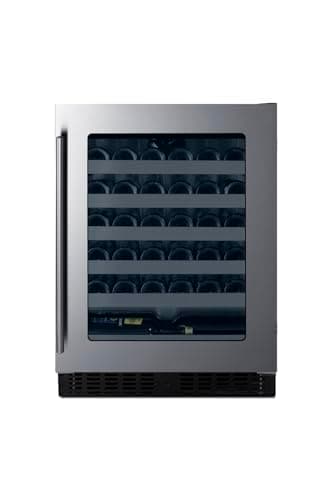
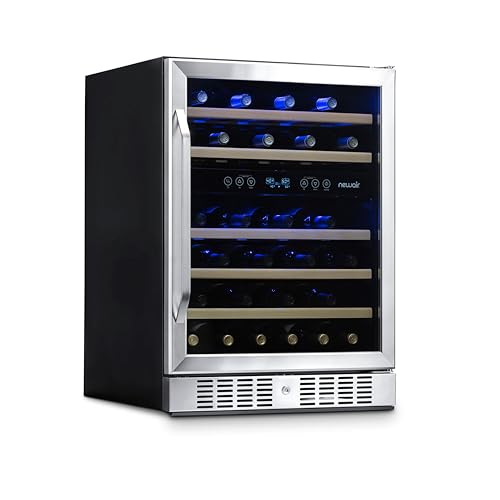
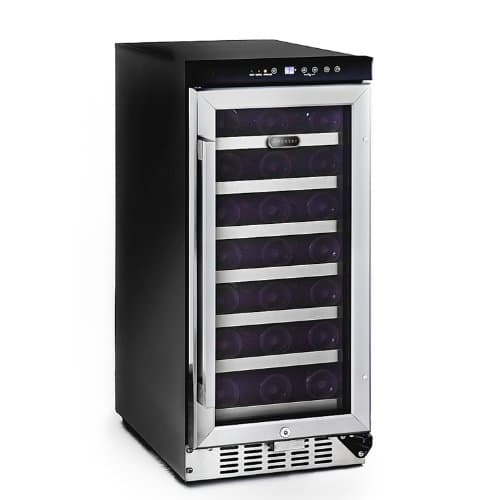
The Newair AWR-460DB is rated for built-in or freestanding use and publishes 23.40 inches wide against the standard 24-inch opening, with 46 bottles across two zones. The Whynter BWR-33SD does the same job at 15 inches with 33 bottles and seven wooden shelves. And where the carcass is shallow, the Summit ASDW2412 is built-in rated at under 18 inches deep, with adjustable legs and a kickplate cover that take it from a 32-inch ADA counter height to a standard 34.
Buying a cabinet rated for both also keeps your options open if the kitchen changes, which is worth more than it sounds — a freestanding-only cabinet is permanently excluded from every future layout that involves an opening. Built-in versus freestanding is the full comparison, and how to install a wine fridge under a counter is the sequence once you have the right unit.