The bottles that do not fit
A published bottle count is a measurement of one bottle shape: the standard 750 ml Bordeaux bottle, straight-sided with high shoulders, roughly three inches across. Shelf pitch is set to that shape, which is why the following bottles cause trouble.
- Burgundy and Pinot Noir bottles. Noticeably wider with sloping shoulders. The commonest problem by far, because the extra diameter means the bottle will not sit in the cradle the shelf provides.
- Champagne and sparkling bottles. Wider, heavier and often taller, with thick glass. If sparkling is your priority rather than large format, the cabinets in best wine fridges for Champagne are ranked on temperature floor too.
- Tall Rhone, Riesling and dessert-wine bottles. A height problem rather than a width one, and height is the harder of the two to solve because shelf spacing above a bottle is fixed by the shelf above it.
- Magnums (1.5 L) and larger. Roughly double volume, much greater diameter and considerably taller. Most cabinets cannot take them at all without removing two shelves.
Removable shelves are the whole answer
There is no clever feature here. The only thing that makes room for a fat bottle is taking a shelf out, which means the specification to shop on is whether the shelves are removable and how many there are. A cabinet with six fixed shelves cannot be adapted; a cabinet with sixteen removable ones can be adapted repeatedly.
Summit is the only manufacturer in our registry that publishes the move explicitly: on the SWC1535B, you remove alternate shelves to take wider Burgundy bottles. That single line is worth more than any amount of marketing copy about capacity, because it tells you the cabinet was designed expecting you to do it.
The arithmetic of pulling shelves is simple and worth doing before you buy. Six slide-out shelves on the Summit, remove three, and you have three double-height bays. You lose the bottles that lived on the removed shelves and gain room for fatter ones, so capacity drops by roughly a third while usable capacity for your actual collection goes up. That is the trade, and it is a good one if half your bottles are Burgundian.
What each cabinet gives you
Summit SWC1535B is the pick for one household with a mixed collection. It is 14.75 inches wide and 33 bottles rated, so it is not a collector’s cabinet — but it is the one that documents the adaptation, it has a factory-installed lock, and it carries ETL-S listing to NSF-7 and UL-471 compliance for commercial premises.
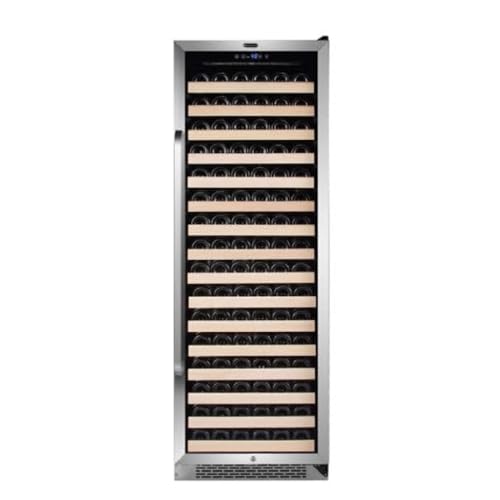
Whynter BWR-1662SD is the pick for a real collection stored at one temperature. Sixteen removable slide-out wooden shelves is the highest shelf count in the registry, which means the most ways to reconfigure. It is a single zone, 40–65°F, 140 W, in a 24-inch built-in body.
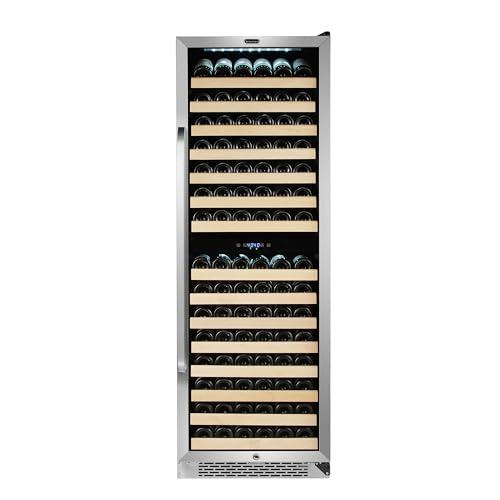
Whynter BWR-1642DZ is the same cabinet split into two zones, 86 bottles up and 78 down, with both zones running the full 40–65°F. Fifteen removable shelves rather than sixteen. Choose it over the 1662SD only if you are serving from the cabinet as well as storing in it.
EuroCave Pure L is the only cabinet here that publishes capacity by bottle type — up to 110 reds, or up to 60 whites. Nobody should have to infer the number from a photograph, and this is the brand that does not make you. It is French-made with a five-year warranty and it is the most expensive route on this page by a wide margin; see best luxury wine fridges.
Magnums, jeroboams and the rack alternative
Be honest about the scale of the problem. If you own two magnums, do not buy a cabinet for them — pull a shelf in whatever cabinet you have and accept the lost capacity. If you own a dozen large-format bottles, a cabinet is the wrong tool entirely: shelf pitch works against you at every level, and you will spend cabinet capacity you paid for on air.
The better answer for large format is an open rack in a cool, dark room. A floor-standing rack has no shelf pitch to fight, takes any bottle diameter, and costs a fraction of cabinet space per bottle. The trade-off is that a rack does not control temperature, so the room has to — rack versus fridge sets out when that is acceptable, and how to store wine in a basement covers the room most people actually have.
Choosing between the four
- A mixed household collection, documented adaptation: Summit SWC1535B.
- A collection at one temperature: Whynter BWR-1662SD, 166 rated, 16 removable shelves.
- A collection you also serve from: Whynter BWR-1642DZ.
- Honest capacity figures and French build: EuroCave Pure L.
Whichever you choose, size it with the discount applied rather than from the number on the box — what size wine fridge do I need has the method, and how to arrange bottles in a wine fridge covers which bottles to put where once it arrives.