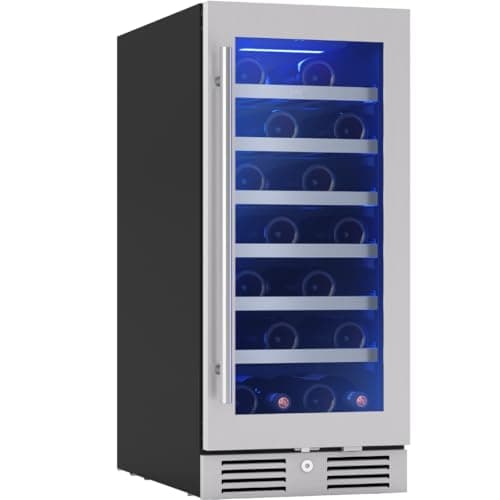
A kitchen cabinet is the hardest place to put a wine fridge and the most common: the opening is fixed, the counter overhangs, and you can hear the compressor from the table.
The Newair AWR-460DB is the best wine fridge for a kitchen: 46 bottles across two zones in a 23.4-inch body that drops into the standard 24-inch run, front-vented and rated for an enclosed opening, at 24.0 inches deep with the handle. For a 15-inch gap, the Whynter BWR-33SD with 33 bottles and a published noise ceiling. The budget pick is the EUHOMY BC-90CU-E.
This page sits in Wine Fridges, where the rest of the category is compared the same way.
How this page is funded. Cork & Cool earns a commission if you buy through the Amazon links below, at no extra cost to you. It never changes the order of this list — see our editorial policy and affiliate disclosure. Prices come from Amazon and are refreshed daily; the price on Amazon when you buy is always the one that counts.
Quick picks
Every model below, on the specifications that decide the purchase. Tap a row to jump to the full write-up.
Comparison of wine storage models by zones, capacity, cooling type, width, published noise rating and vibration.
#
Product
Best for
Zones
Bottles
Cooling
Width
Noise
Vibration
Price
1
Newair AWR-460DBThe 24-inch slot
Forty-six bottles across two zones in a 23.4-inch cabinet rated for built-in or freestanding use
#ad — paid link. How this is funded. Price as of November 28, 2026; check Amazon for the current price.
“Not published” means the manufacturer does not publish that figure. We do not estimate it. Prices and product photographs come from Amazon and are refreshed daily.
How we compared
We compared published manufacturer specifications, official product documentation and verified owner reports across 5 models. We do not physically test these units, we have no laboratory, and we do not accept payment for placement. Where a manufacturer does not publish a figure — noise ratings, most often — this page says so rather than estimating it.
What we weighted
A built-in rating with front venting, because a kitchen cabinet is an enclosed opening and a freestanding cabinet will recirculate its own heat there
Published width against the 15-inch and 24-inch openings kitchens actually have
Published depth WITH the handle fitted, because a counter overhangs by about an inch and that is where cabinets stand proud
Published height against a 34-inch undercounter opening, including whether legs or a kickplate adjust it
A published decibel figure, which matters more in a kitchen than anywhere else in the house
A lock, if the kitchen is a through route in a family house
Capacity, and whether a 15-inch gap can be made to hold enough
Whether the cabinet may also stand free, so the purchase survives a change of plan
Every model in detail
Five cabinets, every one rated for an enclosed opening and sized to cabinetry rather than to a corner of a room. The fit numbers below are the manufacturers' published figures, including the depth-with-handle measurement most listings bury.
#1 — The 24-inch slot
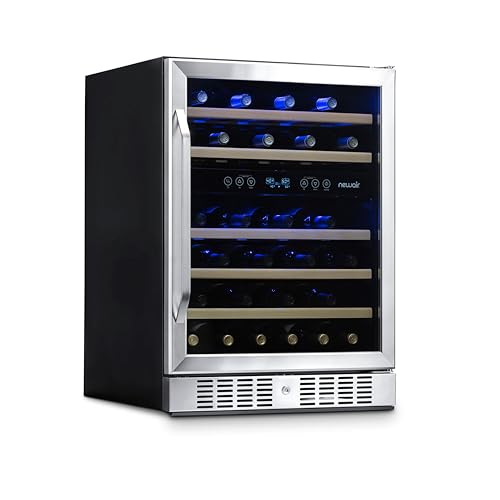
Newair AWR-460DB
Forty-six bottles across two zones in a 23.4-inch cabinet rated for built-in or freestanding use — the default answer for a standard kitchen opening.
Product photograph via Amazon.
Published specifications
Capacity
46 bottles
Zones
2
Cooling
compressor
Temperature range
40–66°F
Noise rating
Not published by the manufacturer
Installation
both
· Exterior: 23.40 in W x 22.40 in D (24.00 in with handle) x 33.00 in H
Rated for built-in installation, so the front vent is designed for an enclosed opening
23.4-inch width drops into a standard 24-inch cabinet run
Two independently set zones across the full 40-66°F span
What does not
No published dB rating, so noise cannot be compared numerically against rivals
46 bottles is the manufacturer's count using standard Bordeaux bottles — heavy Burgundy or Champagne bottles reduce it
Who should skip it. Skip it if your opening is under 24 inches, or if you need more than about four dozen bottles — stepping up to a 160-bottle cabinet costs less per bottle.
#ad — paid link. How this is funded. Price as of November 28, 2026; check Amazon for the current price.
#2 — The 15-inch default
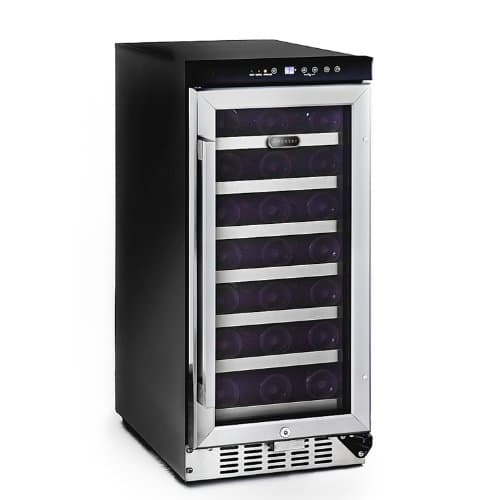
Whynter BWR-33SD
Thirty-three bottles in a 15-inch cabinet, with a published noise ceiling and seven wooden shelves — the capacity ceiling at this width, and the widest temperature band on this page.
Product photograph via Amazon.
Published specifications
Capacity
33 bottles
Zones
1
Cooling
compressor
Temperature range
40–72°F
Noise rating
42 dB
Installation
both
· Exterior: 15.0 in W x 22.5 in D (24.5 in with the handle installed) x 34.0 in H
· Capacity: 33 standard 750 ml bottles
· Noise published as "< 42 dBA" — a ceiling, not an average
Thirty-three bottles is the highest published capacity at this width
Whynter publishes a decibel ceiling, which almost nobody in this category does
Seven wooden shelves rather than the wire shelving usual at this price
40-72°F is the widest published band here, so it will also hold a bottle at room temperature
Rated for built-in or freestanding use, so an opening is optional rather than required
What does not
Single zone only — one temperature for the whole cabinet
The published figure is "< 42 dBA", a maximum rather than an average, so it cannot be compared like-for-like against a manufacturer quoting a flat number
At 15.0 inches published it is the widest cabinet in this group, which matters if your opening is tight
Depth grows to 24.5 inches once the handle is on, which is the figure that matters in a shallow run
33 bottles assumes standard Bordeaux shapes; a Burgundy-heavy collection will fit fewer
Who should skip it. Skip it if you need to serve whites cold and hold reds at cellar temperature in the same cabinet — one zone cannot do both. Skip it too if your opening measures under 15 inches, because this is the one cabinet here that needs the full module.
#ad — paid link. How this is funded. Price as of November 28, 2026; check Amazon for the current price.
#3 — Two zones in a 15-inch gap
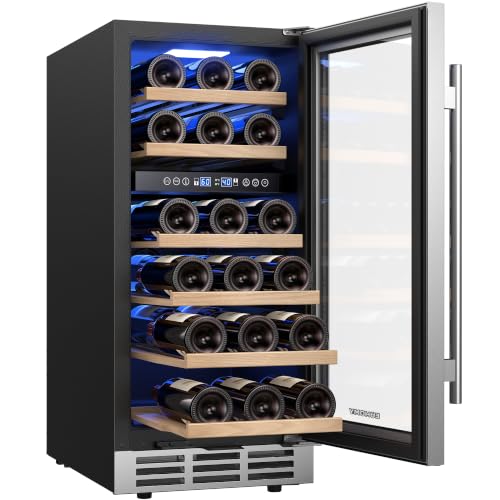
EUHOMY BC-90CU-E
Thirty-three bottles across two independently controlled zones in a 15-inch opening, with a published noise ceiling, a reversible door and a lock — the service specification rather than the storage one.
Product photograph via Amazon.
Published specifications
Capacity
33 bottles
Zones
2
Cooling
compressor
Temperature range
40–65°F
Noise rating
38 dB
Installation
both
· Exterior: 14.9 in W x 23 in D x 34.25 in H
· Capacity: 33 standard 750 ml bottles; no per-zone bottle count published
· Upper zone 40-55°F, lower zone 55-65°F, each independently controlled
· Noise published as "< 38 dB" — a ceiling, not an average
· Shelving: six removable wooden shelves, specified to reduce vibration
· Door: double-pane UV-protective glass in a stainless steel frame, reversible
· Security: lock with two keys
· Front-vented, so it is rated for a built-in opening or freestanding use
A published decibel ceiling, which most cabinets at this width do not give you
Reversible door, so the hinge side is not decided for you
A lock with two keys, which matters more in a bar than in a cellar
The upper zone reaches 40°F, cold enough for sparkling service
Front-vented and rated both ways, so an opening is optional rather than required
What does not
The zones are split at the factory — 40-55°F above, 55-65°F below — so the cold half is always the top one
No per-zone bottle count published, so how the 33 divides is unknown until it arrives
The published figure is "< 38 dB", a maximum rather than an average
EUHOMY publishes no wattage, amperage or net weight for this model
23 inches deep, which is deeper than the 22.4-inch cabinets at the same width
Who should skip it. Skip it if you only ever hold one temperature: the single-zone Whynter BWR-33SD at the same width holds the same 33 bottles on seven wooden shelves across a wider 40-72°F span. And skip it if you need the cold half at the bottom, because this split is fixed.
Under 18 inches deep, which solves the most common undercounter fit problem
The only unit here designed around ADA counter height
Height adjusts to standard counters too, so it is not a single-use product
What does not
33 bottles is the price of the shallow depth
Summit does not publish a temperature range in this listing
Who should skip it. Skip it if your cabinet run is a standard 24 inches deep and you want the capacity — a full-depth unit in the same opening holds 13 more bottles.
#ad — paid link. How this is funded. Price as of November 28, 2026; check Amazon for the current price.
#5 — Storage, not just chilling
Zephyr Presrv PRW15C01CG
Twenty-seven bottles, a published 39 dBA, and the only cabinet in this width whose maker documents a vibration dampening system — you are paying for the storage conditions, not the bottle count.
Product photograph via Amazon.
Published specifications
Capacity
27 bottles
Zones
1
Cooling
compressor
Temperature range
38–65°F
Noise rating
39 dB
Installation
both
· Exterior: 15 in W x 33-7/8 in H x 23-3/8 in D
· Capacity: 27 bottles (750 ml), 3.4 cu ft
· Sound level: 39 dBA published
· Racking: six full-extension black wood racks with stainless trim
· Glass: dual-pane, Low-E, argon-filled
· Field-reversible door with concealed zero-clearance hinges, door lock, door-open alarm
· Energy Star certified; Sabbath mode; carbon-filtered air filtration
· Weight: 101 lb · Power: 115 V, 60 Hz at max 1.5 A
· Warranty: 2 years parts and labor, 5 years compressor
The only 15-inch cabinet here whose manufacturer documents vibration control at all
Publishes a flat decibel figure rather than a ceiling, so it can be compared properly
Reaches 38°F, the lowest published minimum in this group, which matters for sparkling wine
Full-extension racks mean you can reach a bottle at the back without unloading the shelf
Five-year compressor warranty against the usual one or two
What does not
Twenty-seven bottles against thirty-three for the same width — the racks take the space
23-3/8 inches deep, the deepest cabinet in this group
Costs materially more than the Whynter and Summit cabinets it sits beside
Who should skip it. Skip it if the wine is going to be drunk within a year or two. Vibration control and a 38°F floor are long-storage features, and you can have eight more bottles for less money without them.
#ad — paid link. How this is funded. Price as of November 28, 2026; check Amazon for the current price.
Four places a wine fridge goes in a kitchen
Into a base cabinet run. The commonest and the one this page is ranked for: a 15-inch or 24-inch opening at counter height, with the cabinet front flush to the run. It needs a built-in rating and it needs the depth to work with a counter overhang.
Into an island or peninsula. Same fit problem, with two extra constraints: islands are often shallower than a base run, and the door has to open into circulation space. That has its own page in best wine fridges for a kitchen island.
On the counter. A twelve- to twenty-bottle unit beside the kettle. It needs no cabinetry and no rating; it needs to be quiet and to not look like an appliance. Those are in best countertop wine fridges.
In the pantry. An enclosed cupboard off the kitchen, which is a different ventilation problem again — see best wine fridges for a pantry.
Published fit and noise, every pick for a kitchen
Cabinet
Width
Depth with handle
Height
Published noise
Bottles
Newair AWR-460DB
23.4 in
24.0 in
33.0 in
Not published
46
Whynter BWR-33SD
15.0 in
24.5 in
34.0 in
Under 42 dBA
33
EUHOMY BC-90CU-E
14.9 in
23 in
34.25 in
Under 38 dB
33
Summit ASDW2412
24 in
Under 18 in deep
32 in (34 in on legs)
Not published
33
Zephyr Presrv PRW15C01CG
15 in
23-3/8 in
33-7/8 in
39 dBA
27
The three fit numbers, and the one that catches people
Width is decided for you. Base cabinets come in 15-inch and 24-inch modules, and the cabinet either fits or it does not. Measure the opening, not the old appliance.
Height is usually 34 inches to the underside of the counter. The Newair AWR-460DB at 33.0 inches and the Zephyr at 33-7/8 inches have slack; the EUHOMY at 34.25 inches does not, and the Summit ASDW2412 is 32 inches with legs and a sliding kickplate cover that raise it to 34 — which makes it the only pick here that suits an ADA counter as well as a standard one.
Depth with the handle fitted is the number that catches people. The Whynter BWR-33SD is 22.5 inches deep as a body and 24.5 inches with the handle on; the Newair AWR-290DB does the same thing. A standard base cabinet is 24 inches deep with the counter overhanging by roughly an inch, so a 24.5-inch cabinet stands proud of the cabinetry. Sometimes that looks deliberate. Usually it looks like a mistake. And if the run is shallow to begin with — a peninsula, a galley, a retrofitted island — the Summit ASDW2412 at under 18 inches deep is the cabinet that exists for that problem. The whole measuring sequence is in the wine fridge dimensions guide.
Venting: the expensive mistake
A kitchen cabinet is a sealed box. A freestanding wine fridge vents from its back or sides and needs air around it; put one in a cabinet and it breathes its own exhaust, runs continuously, fails to hold temperature and dies early. A built-in-rated cabinet draws air in and expels it through the front plinth, which is why all five picks here publish that rating.
A kitchen is the worst place in a house to put an unmeasured compressor, because hard surfaces reflect rather than absorb and most kitchens open onto somewhere people sit. Three of these five publish a figure: the Zephyr a flat 39 dBA, the EUHOMY a ceiling of under 38 dB, the Whynter BWR-33SD a ceiling of under 42 dBA. A ceiling is a maximum rather than an average and cannot be compared like-for-like with a flat number — both Whynter and EUHOMY are explicit about that, and we repeat it rather than flattening the two into one league table.
Two of the five publish nothing at all, which is the category norm. What the numbers mean once the cabinet is in a room is in wine fridge noise explained, and if quiet is the overriding priority the thermoelectric cabinets in best quiet wine fridges have no compressor to hear — at the cost of a warmer floor and no built-in rating.
Capacity at each width
At 24 inches you get 46 bottles in two zones (Newair AWR-460DB) or 33 in one zone with shallow depth (Summit ASDW2412). At 15 inches the ceiling is 33 bottles — the Whynter BWR-33SD at one temperature across a published 40–72°F, or the EUHOMY across two fixed zones with a lock and a reversible door. The Zephyr trades six of those bottles for full-extension racking, Low-E glass, Energy Star certification and a documented vibration dampening system.
For a standard 24-inch opening, the Newair AWR-460DB — most capacity, two usable zones, and a depth that works with a counter overhang. For a 15-inch gap and maximum bottles, the Whynter BWR-33SD. For a 15-inch gap on a budget, the EUHOMY BC-90CU-E, which is the cheapest cabinet here and the quietest on paper. For a shallow run or an ADA counter, the Summit ASDW2412. And for the best storage conditions in a kitchen at any width, the Zephyr Presrv PRW15C01CG.
Questions people actually ask
▸ Can I put a wine fridge in a kitchen cabinet?
Only if the cabinet is rated for built-in installation and vents through the front. A freestanding unit in a sealed opening overheats; all five picks here publish the built-in rating.
▸ How much clearance does a built-in wine fridge need in a kitchen?
Front-vented cabinets need the plinth gap kept clear rather than air around the body, but the exact figures are per model and some makers still ask for a small top or rear allowance. The published numbers are collected in wine fridge ventilation clearance.