A pantry is a warm, dark, badly ventilated box — which makes it the best place in the house for light and the worst place for a cabinet that vents out of its back.
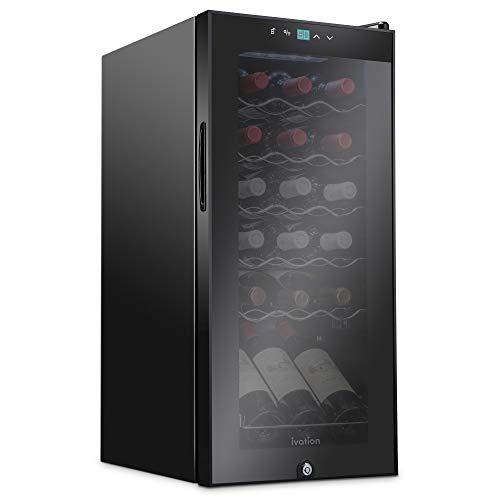
The Whynter BWR-33SD is the best wine fridge for a pantry: 33 bottles in a 15-inch front-vented body rated for an enclosed opening, compressor-cooled across a published 40-72°F, under 42 dBA, with a lock and an activated carbon filter. For a whole pantry wall, the 166-bottle Whynter BWR-1662SD. The budget pick is the Ivation 18-Bottle Compressor, the cheapest compressor cabinet here.
This page sits in Wine Fridges, where the rest of the category is compared the same way.
How this page is funded. Cork & Cool earns a commission if you buy through the Amazon links below, at no extra cost to you. It never changes the order of this list — see our editorial policy and affiliate disclosure. Prices come from Amazon and are refreshed daily; the price on Amazon when you buy is always the one that counts.
Quick picks
Every model below, on the specifications that decide the purchase. Tap a row to jump to the full write-up.
Comparison of wine storage models by zones, capacity, cooling type, width, published noise rating and vibration.
#
Product
Best for
Zones
Bottles
Cooling
Width
Noise
Vibration
Price
1
Whynter BWR-33SDThe 15-inch default
Thirty-three bottles in a 15-inch cabinet, with a published noise ceiling and seven wooden shelves
#ad — paid link. How this is funded. Price as of November 28, 2026; check Amazon for the current price.
“Not published” means the manufacturer does not publish that figure. We do not estimate it. Prices and product photographs come from Amazon and are refreshed daily.
How we compared
We compared published manufacturer specifications, official product documentation and verified owner reports across 5 models. We do not physically test these units, we have no laboratory, and we do not accept payment for placement. Where a manufacturer does not publish a figure — noise ratings, most often — this page says so rather than estimating it.
What we weighted
Venting direction, which in an enclosed cupboard is the whole decision: a front-vented, built-in-rated cabinet works, a rear-vented freestanding one slowly cooks itself
Compressor cooling rather than thermoelectric, because a closed pantry runs warmer than the room and a thermoelectric minimum rises with ambient temperature
Published temperature range, so the cabinet can still reach cellar temperature when the cupboard is warm
A published decibel figure, because a pantry door muffles a cabinet but a pantry is often off a kitchen or a hallway
A lock, since a pantry is usually the least supervised room in a house
Width, because a pantry opening is a shelf bay rather than a cabinetry module
Air filtration, where the maker publishes it — a closed cupboard holds smells that an open kitchen does not
Capacity, since a pantry is one of the few places in a house with room for a tall cabinet
Every model in detail
Five cabinets, four of them rated by their makers for an enclosed opening and all five compressor-cooled. Nothing thermoelectric is on this page, for a reason the first section explains.
#1 — The 15-inch default
Whynter BWR-33SD
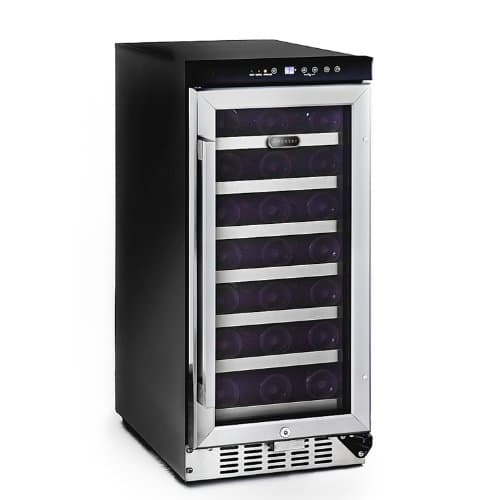
Thirty-three bottles in a 15-inch cabinet, with a published noise ceiling and seven wooden shelves — the capacity ceiling at this width, and the widest temperature band on this page.
Product photograph via Amazon.
Published specifications
Capacity
33 bottles
Zones
1
Cooling
compressor
Temperature range
40–72°F
Noise rating
42 dB
Installation
both
· Exterior: 15.0 in W x 22.5 in D (24.5 in with the handle installed) x 34.0 in H
· Capacity: 33 standard 750 ml bottles
· Noise published as "< 42 dBA" — a ceiling, not an average
Thirty-three bottles is the highest published capacity at this width
Whynter publishes a decibel ceiling, which almost nobody in this category does
Seven wooden shelves rather than the wire shelving usual at this price
40-72°F is the widest published band here, so it will also hold a bottle at room temperature
Rated for built-in or freestanding use, so an opening is optional rather than required
What does not
Single zone only — one temperature for the whole cabinet
The published figure is "< 42 dBA", a maximum rather than an average, so it cannot be compared like-for-like against a manufacturer quoting a flat number
At 15.0 inches published it is the widest cabinet in this group, which matters if your opening is tight
Depth grows to 24.5 inches once the handle is on, which is the figure that matters in a shallow run
33 bottles assumes standard Bordeaux shapes; a Burgundy-heavy collection will fit fewer
Who should skip it. Skip it if you need to serve whites cold and hold reds at cellar temperature in the same cabinet — one zone cannot do both. Skip it too if your opening measures under 15 inches, because this is the one cabinet here that needs the full module.
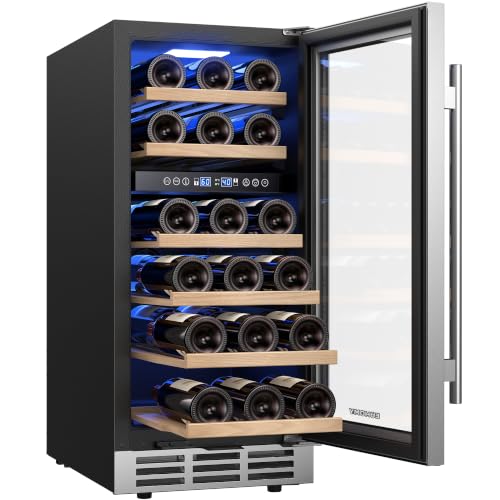
Thirty-three bottles across two independently controlled zones in a 15-inch opening, with a published noise ceiling, a reversible door and a lock — the service specification rather than the storage one.
Product photograph via Amazon.
Published specifications
Capacity
33 bottles
Zones
2
Cooling
compressor
Temperature range
40–65°F
Noise rating
38 dB
Installation
both
· Exterior: 14.9 in W x 23 in D x 34.25 in H
· Capacity: 33 standard 750 ml bottles; no per-zone bottle count published
· Upper zone 40-55°F, lower zone 55-65°F, each independently controlled
· Noise published as "< 38 dB" — a ceiling, not an average
· Shelving: six removable wooden shelves, specified to reduce vibration
· Door: double-pane UV-protective glass in a stainless steel frame, reversible
· Security: lock with two keys
· Front-vented, so it is rated for a built-in opening or freestanding use
A published decibel ceiling, which most cabinets at this width do not give you
Reversible door, so the hinge side is not decided for you
A lock with two keys, which matters more in a bar than in a cellar
The upper zone reaches 40°F, cold enough for sparkling service
Front-vented and rated both ways, so an opening is optional rather than required
What does not
The zones are split at the factory — 40-55°F above, 55-65°F below — so the cold half is always the top one
No per-zone bottle count published, so how the 33 divides is unknown until it arrives
The published figure is "< 38 dB", a maximum rather than an average
EUHOMY publishes no wattage, amperage or net weight for this model
23 inches deep, which is deeper than the 22.4-inch cabinets at the same width
Who should skip it. Skip it if you only ever hold one temperature: the single-zone Whynter BWR-33SD at the same width holds the same 33 bottles on seven wooden shelves across a wider 40-72°F span. And skip it if you need the cold half at the bottom, because this split is fixed.
Rated for built-in installation, so the front vent is designed for an enclosed opening
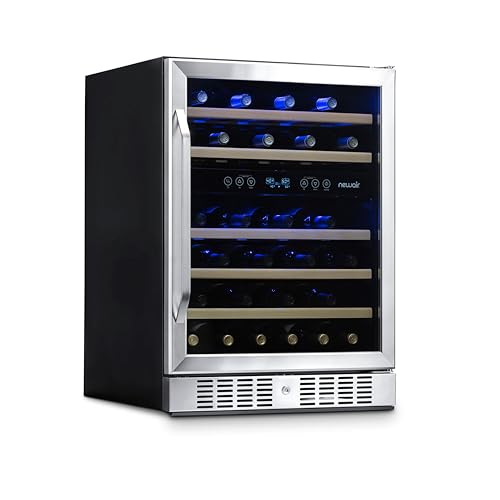
23.4-inch width drops into a standard 24-inch cabinet run
Two independently set zones across the full 40-66°F span
What does not
No published dB rating, so noise cannot be compared numerically against rivals
46 bottles is the manufacturer's count using standard Bordeaux bottles — heavy Burgundy or Champagne bottles reduce it
Who should skip it. Skip it if your opening is under 24 inches, or if you need more than about four dozen bottles — stepping up to a 160-bottle cabinet costs less per bottle.
41°F floor is cold enough for sparkling wine service
Compressor cooling holds its setting regardless of room temperature
A lock, which most units this size omit
What does not
One zone only
A compressor in a small cabinet is audible in a quiet room
Who should skip it. Skip it if the unit will sit in a bedroom or a quiet home office. At this size the compressor is close to you and there is no published dB figure to reassure you.
#ad — paid link. How this is funded. Price as of November 28, 2026; check Amazon for the current price.
Why a pantry is a hard place for a wine fridge
A pantry looks ideal for wine and mostly is: dark, out of the way, no daylight at all, and usually cooler than the kitchen it opens off. Ultraviolet light is one of the four things that damage stored wine, and a pantry removes it entirely.
The problem is air. A pantry is a closed box with one door, and every wine fridge is a heat pump: it moves heat out of the cabinet and into the room it stands in. In an open kitchen that heat disperses. In a closed cupboard it accumulates, the ambient temperature climbs, and the cabinet has to work harder against a warmer room — which is the same failure mode as building a freestanding cabinet into joinery, just slower. That is why this page is ranked on venting and cooling type rather than on finish.
Published venting, cooling and noise, every pick for a pantry
Cabinet
Install rating
Cooling
Published range
Published noise
Lock
Whynter BWR-33SD
Built-in or freestanding, front-vented
Compressor
40–72°F
Under 42 dBA
Yes, key lock
Whynter BWR-1662SD
Built-in
Compressor
40–65°F
Not published
Not published
EUHOMY BC-90CU-E
Built-in or freestanding, front-vented
Compressor
40–65°F, two zones
Under 38 dB
Yes, two keys
Newair AWR-460DB
Built-in or freestanding
Compressor
40–66°F, two zones
Not published
Not published
Ivation 18-Bottle Compressor
Freestanding
Compressor
41–64°F
Not published
Yes
Venting: front or nothing
Four of these five cabinets are rated by their makers for installation in an enclosed opening, which means they draw air in and push it out through the front plinth. In a pantry that is exactly the behaviour you want, because the exhaust leaves at floor level and under the door rather than into the back of a shelf bay.
The Ivation 18-Bottle Compressor is the exception and is on this page as the budget pick with a condition attached: it is published as freestanding, so it needs real air around it. In a walk-in pantry with the door open much of the day and a few inches on every side, that is fine. In a shallow cupboard with the door shut, it is not. The physics, and the honest list of workarounds, is in can you put a freestanding wine fridge under a counter and the published clearances are collected in wine fridge ventilation clearance.
One more pantry-specific point: leave the pantry door open for an hour after you load a warm case of wine. Twelve bottles at room temperature is a real heat load, and a closed cupboard gives the cabinet nowhere to put it.
Why no thermoelectric cabinet is on this page
Every pick here is compressor-cooled, and that is deliberate. Thermoelectric cooling pumps heat against the ambient temperature, so the minimum it can actually reach rises as the room warms — and a closed pantry is, by construction, warmer than the room it opens off. Every thermoelectric cabinet on this site publishes a 46°F floor in reasonable conditions, and those conditions are precisely what a pantry does not supply.
Thermoelectric cabinets are also freestanding-only across the board, which compounds the problem. They are the right answer in a bedroom or a studio apartment, where silence matters and the room is open — see best thermoelectric wine coolers and compressor against thermoelectric. They are the wrong answer in a cupboard.
Smells, air filtration and a closed door
Pantries hold onions, spices, cleaning products and sometimes damp. Wine stored in a cabinet is behind a gasket, so the risk is less about the wine and more about the cabinet interior holding a smell of its own — a problem the troubleshooting page wine fridge smells musty deals with in detail.
Two cabinets here publish filtration. The Whynter BWR-33SD is fitted with an activated carbon filter, and among the premium freestanding units the Liebherr WS1200 uses a user-replaceable activated charcoal fresh-air filter. A filter is not a humidity control and it is not a cure for a wet cupboard; it is a way of keeping the air inside the cabinet from going stale. If the pantry itself is damp, deal with that first — the reasoning is in humidity-controlled wine storage.
Using the one advantage a pantry has
A pantry is one of the few places in a house with vertical room. You are not fitting under a counter, so you are not limited to 34 inches, which makes a full-height column viable where it would be impossible in a kitchen run.
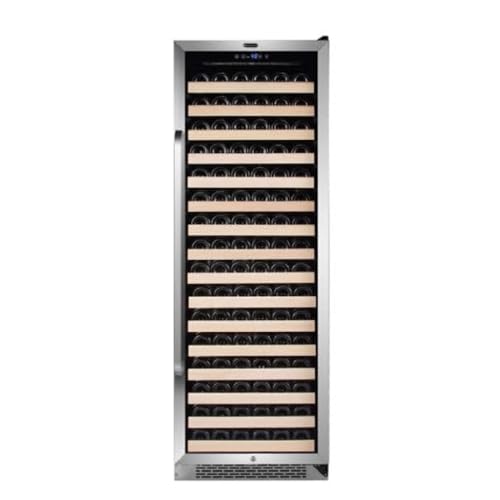
That is why the Whynter BWR-1662SD is on this page: 166 bottles on 16 removable wooden slide-out shelves plus a wire display shelf, one zone across 40–65°F, 140 W, in a 24-inch built-in-rated column. It will not go under a counter and it does not need to. A full load is a great deal of glass, so check the floor and the shelf structure around it before you order — and if two temperatures matter more than the uniform shelf spacing a single zone gives, the dual-zone version of the same cabinet is argued against it in the BWR-1642DZ against the BWR-1662SD.
For a narrower bay, the Whynter BWR-33SD at 15 inches and the EUHOMY BC-90CU-E at 14.9 inches both fit a standard shelf width, and both publish a decibel ceiling and a lock. At 24 inches the Newair AWR-460DB brings 46 bottles and two zones each specified across 40–66°F.
Which one to buy
Buy the Whynter BWR-33SD for most pantries: front-vented, 33 bottles at 15 inches, a published noise ceiling, a lock and a carbon filter is the right combination for an enclosed cupboard. Buy the Whynter BWR-1662SD if the pantry has a whole bay to give and the collection is large. Buy the EUHOMY BC-90CU-E if you want two zones in the same 15-inch space. Buy the Newair AWR-460DB if the bay is 24 inches wide. And buy the Ivation 18-Bottle Compressor only for a walk-in pantry where the cabinet can stand clear on all sides.
Questions people actually ask
▸ Is a pantry a good place for a wine fridge?
It is good for light and bad for air. A front-vented, built-in-rated cabinet solves the air problem; a rear-vented freestanding one does not. Where else in a house works is covered in where to put a wine fridge.
▸ Will a pantry wine fridge make the pantry hot?
It will add heat, because that is what a heat pump does. With the door closed the cupboard runs warmer than the room, which is why compressor cooling and front venting matter here and thermoelectric cooling does not work.