A cabinet that runs twenty-four hours a day for ten years costs more to run than to buy. Only a handful of makers publish the figure that tells you how much.
The Summit ALWC532PNR is the best wine fridge for low running costs: 46 bottles across two zones drawing a published 1.25 A at 115 V, with a flat 34 dB, CARB compliance, an ETL-S listing to NSF-7 and a five-year compressor warranty. The KoolMore KM-CW46DZ-BPR is the only cabinet here that publishes an annual consumption figure — 180 kWh a year. The budget pick is the Whynter BWR-1662SD, at the lowest live price here.
This page sits in Wine Fridges, where the rest of the category is compared the same way.
How this page is funded. Cork & Cool earns a commission if you buy through the Amazon links below, at no extra cost to you. It never changes the order of this list — see our editorial policy and affiliate disclosure. Prices come from Amazon and are refreshed daily; the price on Amazon when you buy is always the one that counts.
Quick picks
Every model below, on the specifications that decide the purchase. Tap a row to jump to the full write-up.
Comparison of wine storage models by zones, capacity, cooling type, width, published noise rating and vibration.
#
Product
Best for
Zones
Bottles
Cooling
Width
Noise
Vibration
Price
1
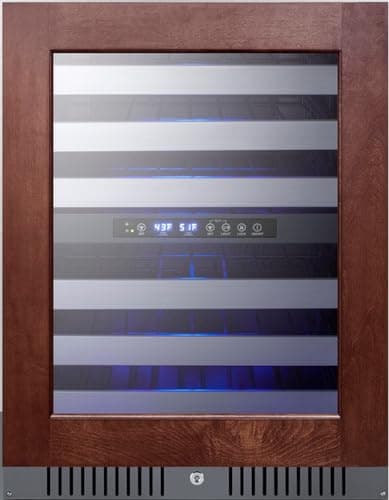
Summit ALWC532PNRTwo zones behind a published panel
Forty-six bottles across two zones in a 24-inch panel-ready cabinet, with the recommended panel printed to the eighth of an inch and the viewable aperture published alongside it
#ad — paid link. How this is funded. Price as of November 28, 2026; check Amazon for the current price.
2
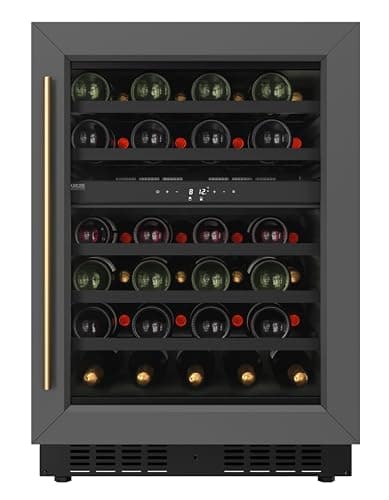
KoolMore Reserve KM-CW46DZ-BPRBeech shelving behind a panel
Forty-five bottles, two zones and beech shelving behind a panel-ready door, with a three-year parts-and-labor warranty that the rest of this class does not offer.
#ad — paid link. How this is funded. Price as of November 28, 2026; check Amazon for the current price.
“Not published” means the manufacturer does not publish that figure. We do not estimate it. Prices and product photographs come from Amazon and are refreshed daily.
How we compared
We compared published manufacturer specifications, official product documentation and verified owner reports across 5 models. We do not physically test these units, we have no laboratory, and we do not accept payment for placement. Where a manufacturer does not publish a figure — noise ratings, most often — this page says so rather than estimating it.
What we weighted
A published electrical figure of some kind — wattage, amperage or annual kWh. A cabinet that publishes nothing cannot be on this page, however efficient it looks
Annual kWh where the maker publishes it, because that is the only figure that converts directly into money
Energy Star certification where it exists, which is a third-party test rather than a manufacturer claim
Capacity per watt, because a cabinet holding 166 bottles on 140 W is cheaper per bottle than one holding 20 on 65 W
Published ambient operating range, since a cabinet working against a hot room draws more and cycles longer
Compressor warranty length, which is the real cost of ownership if the expensive part fails in year three
Insulation and glazing specification where published, because that is what decides how hard the compressor works
Door alarms, which prevent the single most expensive failure mode: a cabinet cooling an open door all night
Every model in detail
Five cabinets, every one of which publishes a real electrical figure. This page deliberately excludes cabinets whose makers publish nothing, which rules out several otherwise excellent units.
#1 — Two zones behind a published panel
Summit ALWC532PNR
Forty-six bottles across two zones in a 24-inch panel-ready cabinet, with the recommended panel printed to the eighth of an inch and the viewable aperture published alongside it — which is what a cabinetmaker actually needs before quoting the door.
Product photograph via Amazon.
Published specifications
Capacity
46 bottles
Zones
2
Cooling
compressor
Temperature range
41–64°F
Noise rating
34 dB
Installation
built-in
· Exterior: 23.38 in W x 23.5 in D (24.25 in with the panel fitted) x 32.0 in H
· Depth with the door open at 90 degrees: 47.38 in
· Capacity: 46 bottles, or 30 Bordeaux and 16 wider Burgundy bottles
· Two zones: upper 41-50°F for whites and sparkling, lower 50-64°F for reds
· Shelving: 6 full-extension black wire shelves with stainless steel front trim
· Door: double-pane tempered glass in a panel-ready trim, reversible, right-hand swing as standard (Summit sells a dedicated left-hand model, ALWC532PNRLHD)
· Recommended panel: 3/4 in thick at 29 1/4 in H x 23 1/8 in W, with a 22 3/8 in H x 17 3/4 in W viewable area
· Sound level: 34 dB published
· Power: 1.25 A at 115 V AC / 60 Hz
· Weight: 113 lb
· Factory-installed lock with 2 keys; recessed LED lighting in both compartments
· Front-breathing with interior and exterior fans; automatic defrost
· ADA compliant at just under 32 in high
· ETL and ETL-C listed; ETL-S listed to NSF-7 for commercial establishments; CARB compliant
· Warranty: 1 year parts and labor, 5 years compressor
Two independently set zones behind a panel-ready door at a 24-inch width
Summit publishes the recommended panel size and thickness AND the viewable aperture, so the door can be quoted off a drawing before delivery
Six full-extension shelves rather than the flat half-depth shelves usual in this class
Reversible door, so the hinge side is not a purchasing decision you are stuck with
ETL-S listed to NSF-7, which is a commercial listing most domestic cabinets do not carry
ADA compliant at just under 32 inches, so it fits a lowered counter as well as a standard run
Factory-installed lock with two keys as standard
What does not
The 64°F ceiling is low for a red served warm, and the upper zone stops at 50°F — neither half covers the full span
At 23.5 in deep (24.25 in with the panel) it is a standard-depth cabinet, not one of Summit's shallow ones
Wire shelves, not wood
No handle, and no panel, included — both are separate joinery costs
Summit publishes no cubic-foot or litre figure for this model, only the bottle counts
34 dB is quiet but not the quietest published figure in this registry
Who should skip it. Skip it if your cabinet run is shallower than about 24 inches — this is a full-depth cabinet and the panel adds another three quarters of an inch in front of it. Skip it too if you serve reds above 64°F, because that is the top of the lower zone.
#ad — paid link. How this is funded. Price as of November 28, 2026; check Amazon for the current price.
#2 — Beech shelving behind a panel
KoolMore Reserve KM-CW46DZ-BPR
Forty-five bottles, two zones and beech shelving behind a panel-ready door, with a three-year parts-and-labor warranty that the rest of this class does not offer.
Product photograph via Amazon.
Published specifications
Capacity
45 bottles
Zones
2
Cooling
compressor
Temperature range
41–68°F
Noise rating
45 dB
Installation
both
· Exterior: 23.4 in W x 22.6 in D excluding handles x 34.0 in H
· Interior: 20.1 in x 17.5 in x 25.4 in; 5.19 cu ft gross, 4.51 cu ft net
· Capacity: 45 bottles
· Two zones, 41°F to 68°F; ambient operating range 60-90°F
· Shelving: 5 black beech wood shelves, 3.6 in between shelves
· Door: panel-ready, reversible, self-closing, articulated hinge — handle NOT included
· Ventilation: front plinth; minimum clearance 0.25 in at sides and back
· Power: 100 W / 1.0 A at 115 V, 60 Hz; 180 kWh/year
· Weight: 106 lb
· Noise: 45 dB published
· Door-ajar and high-temperature alarms; digital control inside the cabinet
· ETL listed; warranty 3 years parts and labor, 5 years compressor
Beech wood shelving behind a panel-ready door, where the Summit panel-ready cabinets all use steel or wire
Beech wood shelving rather than steel
Three-year parts-and-labor warranty against the one year that is standard here
Front plinth ventilation and a quarter-inch clearance requirement, so it genuinely suits a tight cabinetry opening
Self-closing articulated hinge is designed for the extra weight of a custom door panel
What does not
KoolMore does not publish the panel size or thickness the door frame accepts, so your cabinetmaker has to measure the unit itself
45 dB published, the loudest of the panel-ready cabinets here
No handle included, and no lock listed in the specification
The digital control sits inside the cabinet, so you open the door to change the temperature
Who should skip it. Skip it if your cabinetmaker needs a drawing before quoting. Summit publishes exact panel dimensions and KoolMore does not, and that difference is paid for in joinery hours.
#ad — paid link. How this is funded. Price as of November 28, 2026; check Amazon for the current price.
#3 — The best-documented combination cabinet
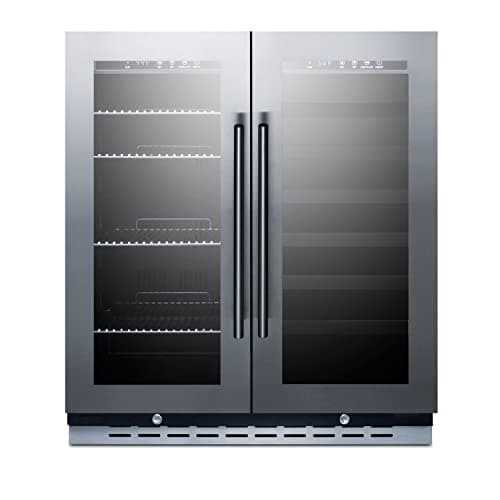
Summit SWBV3067B
Thirty-three bottles across six wood shelves and four wire shelves, two keyed zones, 34.6 dB published, and an NSF-7 commercial listing — the specification sheet is the reason to buy it.
Product photograph via Amazon.
Published specifications
Capacity
33 bottles
Zones
2
Cooling
compressor
Temperature range
41–64°F
Noise rating
34.6 dB
Installation
both
· Exterior: 29.5 in W x 22.5 in D (24.25 in with handle) x 34.38 in H
· Capacity: 5.8 cu ft (164 L), stated as 33 bottles
· Two independent zones, each with its own digital thermostat
· Temperature range: 41 to 64°F
· Shelving: 10 adjustable shelves — 6 wooden for bottles, 4 chrome wire for cans or bottles
· Door: French-swing glass doors with seamless stainless steel trim, black cabinet
· Sound level: 34.6 dB published
· Power: 1.25 A at 115 V AC / 60 Hz
· Weight: 132 lb
· Factory-installed keyed locks on BOTH zones
· ETL, ETL-C and ETL-S listed to ANSI-NSF Standard 7 for commercial use; CARB compliant
· Warranty: 1 year parts and labor, 5 years compressor
Publishes a flat 34.6 dB figure rather than a ceiling, the quietest published number of any cabinet in this group
Keyed locks on both zones, not just one
NSF-7 commercial listing means it is built to be loaded and unloaded all day
Ten shelves, six of them wood, so the bottle side is properly racked
Five-year compressor warranty
What does not
The 41°F floor is warm for cans — a beverage fridge reaching the mid-30s will chill a lager harder
Thirty inches wide, so it needs a dedicated opening
Summit does not publish a can count, only the bottle figure and the shelf mix
132 lb empty, the heaviest cabinet here
Who should skip it. Skip it if the beverage half is mostly beer you want ice-cold. It floors at 41°F, which is a wine temperature being asked to do a soda's job.
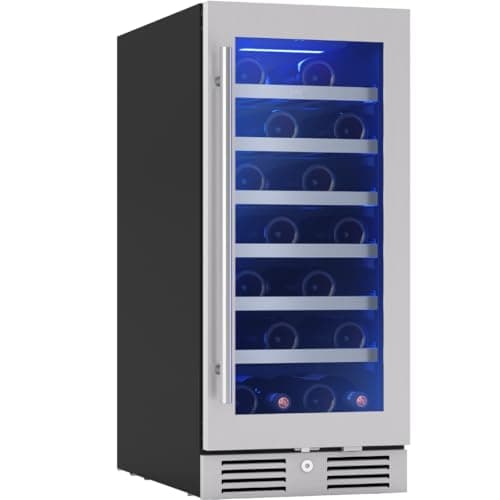
Twenty-seven bottles, a published 39 dBA, and the only cabinet in this width whose maker documents a vibration dampening system — you are paying for the storage conditions, not the bottle count.
Product photograph via Amazon.
Published specifications
Capacity
27 bottles
Zones
1
Cooling
compressor
Temperature range
38–65°F
Noise rating
39 dB
Installation
both
· Exterior: 15 in W x 33-7/8 in H x 23-3/8 in D
· Capacity: 27 bottles (750 ml), 3.4 cu ft
· Sound level: 39 dBA published
· Racking: six full-extension black wood racks with stainless trim
· Glass: dual-pane, Low-E, argon-filled
· Field-reversible door with concealed zero-clearance hinges, door lock, door-open alarm
· Energy Star certified; Sabbath mode; carbon-filtered air filtration
· Weight: 101 lb · Power: 115 V, 60 Hz at max 1.5 A
· Warranty: 2 years parts and labor, 5 years compressor
The only 15-inch cabinet here whose manufacturer documents vibration control at all
Publishes a flat decibel figure rather than a ceiling, so it can be compared properly
Reaches 38°F, the lowest published minimum in this group, which matters for sparkling wine
Full-extension racks mean you can reach a bottle at the back without unloading the shelf
Five-year compressor warranty against the usual one or two
What does not
Twenty-seven bottles against thirty-three for the same width — the racks take the space
23-3/8 inches deep, the deepest cabinet in this group
Costs materially more than the Whynter and Summit cabinets it sits beside
Who should skip it. Skip it if the wine is going to be drunk within a year or two. Vibration control and a 38°F floor are long-storage features, and you can have eight more bottles for less money without them.
#ad — paid link. How this is funded. Price as of November 28, 2026; check Amazon for the current price.
The arithmetic nobody does before buying
A wine cabinet is one of the few appliances in a building that never switches off. Over a ten-year life a cabinet running continuously can cost more in electricity than it cost to buy, which makes the published draw a purchase criterion rather than a footnote — and it is the one specification that matters more in a commercial setting than a domestic one, because a restaurant or a tasting room is paying a business tariff on a cabinet that is opened a hundred times a day.
The honest caveat first: a compressor cabinet does not draw its rated wattage continuously. It cycles. A rated figure is an upper bound, and the real consumption depends on the room, the door discipline and the set point. That is exactly why an annual kWh figure — which assumes a test protocol rather than a worst case — is worth more than a wattage, and why only one cabinet on this site publishes one. How to turn either number into money is in wine fridge running costs.
Published electrical specification, every pick
Cabinet
Published draw
Annual kWh
Energy Star
Bottles
Zones
Summit ALWC532PNR
1.25 A at 115 V
Not published
Not published; CARB compliant
46
2
KoolMore KM-CW46DZ-BPR
100 W / 1.0 A
180 kWh/year (published)
Not published
45
2
Summit SWBV3067B
1.25 A at 115 V
Not published
Not published; CARB compliant
33
2
Whynter BWR-1662SD
140 W / 2.0 A
Not published
Not published
166
1
Zephyr Presrv PRW15C01CG
Max 1.5 A at 115 V
Not published
Energy Star certified
27
1
What each maker actually publishes
KoolMore is the only maker on this site to publish an annual figure: 180 kWh a year for the KM-CW46DZ-BPR, alongside 100 W / 1.0 A, a 60–90°F ambient operating range, five black beech shelves, a panel-ready self-closing door on an articulated hinge, door-ajar and high-temperature alarms, front plinth ventilation with a quarter-inch clearance requirement, a published 45 dB and a three-year parts-and-labour warranty against the one year that is standard in this class. That annual figure is the most useful number on this page.
Summit publishes amperage rather than wattage — 1.25 A at 115 V for both the ALWC532PNR and the SWBV3067B — and publishes CARB compliance, which is a regulatory statement rather than an efficiency one. Both also publish a flat decibel figure (34 dB and 34.6 dB), the two lowest on this site, and both carry five-year compressor warranties and ETL-S listings to NSF-7 for commercial use. The SWBV3067B adds keyed locks on both zones, which almost nothing else does.
Zephyr is the only cabinet here with Energy Star certification, which is a third-party test rather than a maker’s claim, drawing a maximum 1.5 A with dual-pane Low-E argon-filled glazing — the insulation specification that explains the certification. Whynter publishes 140 W / 2.0 A for the BWR-1662SD, the highest absolute draw here and, as the next section shows, the lowest per bottle.
Watts per bottle, which is the honest ratio
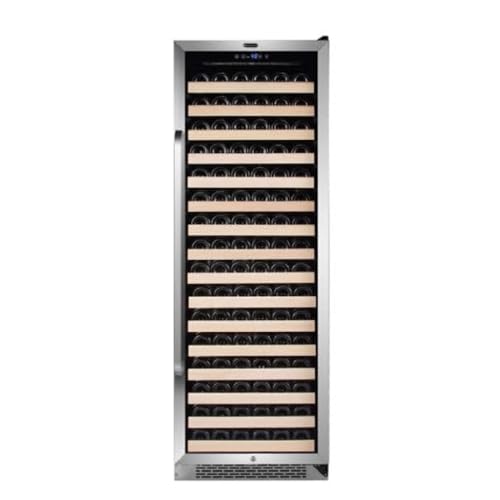
Absolute wattage is the wrong comparison between cabinets of different sizes, and this page would be misleading without the ratio. Work it from the published figures above: the Whynter BWR-1662SD draws 140 W for 166 bottles, which is under one watt per bottle of capacity. The KoolMore draws 100 W for 45 bottles, a little over two. The Zephyr draws a maximum 1.5 A — roughly 170 W at 115 V at full load — for 27 bottles.
In other words the big single-zone column is the cheapest cabinet here to run per bottle stored, and the small heavily specified cabinet is the most expensive. That is not a fault in the Zephyr: you are buying Energy Star insulation, documented vibration control and a 39 dBA noise figure, none of which is free. But if the job is storing a lot of wine for as little electricity as possible, one large single-zone cabinet beats three small ones, every time. The small-cabinet end of the market is ranked on its own terms in best energy-efficient wine fridges, which ranks absolute consumption rather than consumption per bottle.
The room is half the bill
A cabinet pumps heat out of itself and into the room. The warmer the room, the smaller the temperature difference the compressor can achieve per cycle, and the longer it runs. That makes the room a bigger variable than the model for most installations.
KoolMore is the only maker here to publish an ambient operating range — 60–90°F — which is a genuinely useful number because it tells you where the cabinet stops being able to do its job. Three practical consequences: do not put the cabinet beside an oven or a dishwasher; keep the front plinth vent clear, since a blocked vent recirculates the cabinet’s own exhaust and is the single most common cause of a cabinet running continuously; and in a hot climate a garage installation will cost materially more to run than the same cabinet indoors — see wine fridge in a garage and wine fridge ventilation clearance.
The failure modes that cost the most
Three things cost more than the difference between any two cabinets on this page.
A door left ajar. A cabinet cooling an open door runs continuously and holds nothing. The KoolMore and the Zephyr both publish a door-ajar or door-open alarm; this is the cheapest efficiency feature in the category.
A compressor failure out of warranty. Summit and Zephyr publish five-year compressor warranties and KoolMore a three-year parts-and-labour warranty. A cabinet whose compressor fails in year three with a one-year warranty costs more than a decade of the electricity difference.
Dirt. A dusty condenser and a tired gasket make an efficient cabinet an inefficient one, and both are user-serviceable — the routine is in wine fridge maintenance.
Which one to buy
Buy the Summit ALWC532PNR if the cabinet is going into a business: 1.25 A, 34 dB, a lock with two keys, CARB compliance, NSF-7 and a five-year compressor warranty is the lowest total cost of ownership here. Buy the KoolMore KM-CW46DZ-BPR if you want the one published annual figure and a three-year parts-and-labour warranty. Buy the Summit SWBV3067B if you need two separately locked zones in a service environment. Buy the Whynter BWR-1662SD if the goal is the lowest cost per bottle stored — nothing else here comes close. And buy the Zephyr if Energy Star certification and the best-insulated glazing matter more than the ratio.
Questions people actually ask
▸ How much does a wine fridge cost to run per year?
On the one published annual figure in our registry — KoolMore’s 180 kWh a year — multiply by your tariff. Everything else here publishes wattage or amperage only, which is an upper bound because compressors cycle. The method is in wine fridge running costs.
▸ Are thermoelectric coolers cheaper to run?
Per cabinet, usually yes — they are small and draw 65 W or so. Per bottle stored, no: a 20-bottle thermoelectric unit at 65 W is more watts per bottle than a 166-bottle compressor column at 140 W, and it cannot hold cellar temperature in a warm room at all.