
The four jobs
A wine fridge has almost no serviceable parts, which is why the maintenance list is short and why neglecting it is so effective at killing one. Everything below is unskilled work with a vacuum cleaner, a cloth and a sheet of paper.
Unplug the cabinet before any of it. That is not a formality on an appliance with a fan and a compressor that can start without warning.
1. The condenser, which is what actually kills cabinets
If you only ever do one of these, do this one. A compressor cabinet works by moving heat out of the box and dumping it into the room through the condenser coil. Blanket that coil in dust and the heat has nowhere to go, so the compressor runs longer and hotter for the same result. It does not fail that week. It fails in year six instead of year twelve.
The job: unplug the cabinet, find the coil — behind the lower front grille on a built-in cabinet, at the back on a freestanding one — and vacuum it with a brush attachment. Do the grille too, from both sides if you can reach. Do not bend the fins and do not poke anything metal between them.
Two things make dust worse and are worth knowing. A cabinet in a kitchen gathers grease with the dust, which mats it into something a vacuum will not lift — so do it before it gets to that, not after. And a built-in cabinet breathes entirely through its front grille, so a grille that is blocked by a kickboard, a rug or a stack of something is the same problem as a dirty coil. See ventilation and clearance.
A thermoelectric cabinet has a heatsink and a fan instead of a condenser and compressor, and the same logic applies: the fins collect dust, the fan has to shift more air, and the cabinet quietly loses the few degrees of headroom it had. Vacuum the vents.
2. The door seal, and the paper test
A perished or distorted door gasket is the second most common reason a cabinet runs constantly and still has a warm shelf, and it is the easiest fault in the house to test for.
The paper test. Close the door on a sheet of paper so half is inside and half out, then pull. You should feel real resistance. Do it at six or eight points around the whole door — top corners, both sides, along the bottom. Anywhere the paper slides out freely is a gap, and a gap at the hinge side usually means the door is sagging rather than the gasket failing.
The fixes, in order of effort. Clean the gasket with warm water and dry it, because sticky residue stops it seating. Check the cabinet is level, because an unlevelled cabinet twists its own door frame. Warm a distorted section gently with a hair dryer on low and press it back into shape. If a section is split or has lost its spring, the gasket is a replaceable part — order it by model number.
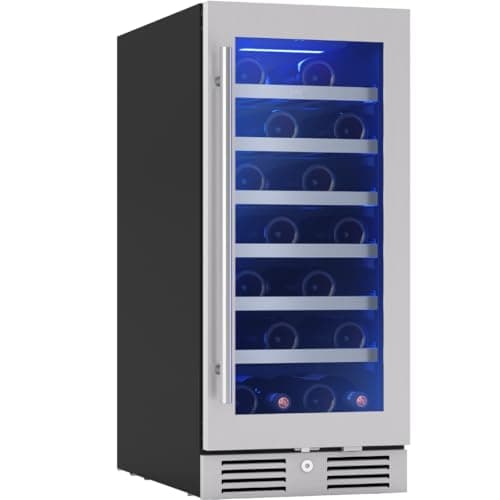
A failing seal shows up as three symptoms you might otherwise chase separately: a cabinet that never stops running, condensation on the glass or a shelf, and ice forming near the leak. The condensation version is in wine fridge condensation. Note also that the single most useful published feature for seal health is a door-open alarm — the Zephyr PRW15C01CG publishes one — because a door left ajar is the acute version of the same problem. If the paper slides free along one whole edge rather than at a point, squaring the door on its hinges is the next step after levelling, and it is a quarter-turn adjustment rather than a repositioning.
3. The drain and the drip tray
Every compressor cabinet produces condensate: moisture from the cabinet air condenses onto the cold evaporator, runs down and leaves via a drain hole to a tray where it evaporates with the compressor’s own heat. The system is passive and it blocks.
When it blocks, water backs up into the cabinet. That is how you get a puddle on a shelf, a stained and eventually warped wooden shelf, and the standing damp that produces the smell in why a wine fridge smells musty.
The job: find the drain hole — usually a small recess at the back of the cabinet floor or below the evaporator panel — and clear it gently with warm water and something soft. Nothing sharp, nothing metal, no wire down the channel. Then find the tray (usually above or behind the compressor at the back), empty it, and wipe it out. A tray with standing water that never evaporates is often a levelling problem rather than a drain problem.
One judgment call: if the drain blocks repeatedly, something upstream is wrong — commonly a door seal letting warm humid air in continuously, which means far more condensate than the system was designed to shed.
4. The carbon filter, if you have one
A fitted activated carbon or charcoal filter keeps the cabinet’s air from going stale and stops odors transferring onto corks over long storage. It is a consumable and almost nobody replaces it.
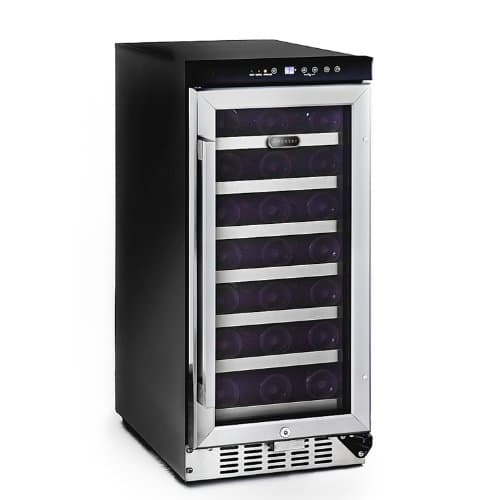
Who publishes one: the Whynter BWR-33SD (“activated carbon filter fitted”), the Whynter BSR-029DW (same), the Zephyr PRW15C01CG (“carbon-filtered air filtration”), and the Liebherr WS1200, which publishes an activated charcoal fresh-air filter described as user-replaceable — the strongest form of the claim, because it tells you the part is meant to be maintained rather than merely present.
Replacement interval comes from your manual; annually is a common figure. If your cabinet does not publish a filter, it does not have one, and that is not a fault — it just means cabinet air quality depends entirely on not storing anything smelly in there. The humidity-and-air-quality picture is in humidity-controlled wine storage.
Cleaning the inside without wrecking the shelves
Interior cleaning is the job most likely to do damage, because the instinct is to use something that smells clean.
- Unplug it and take the shelves out. Most cabinets here publish removable shelves — see wine fridge shelf types.
- Warm water, a little mild dish soap, a soft cloth. No bleach, no ammonia, no solvent, no scented cleaner. A sealed cabinet holds a smell for months and corks are porous.
- Wooden shelves: barely damp, then dry them. No soaking, no dishwasher. Let them air-dry fully before they go back in.
- For a lingering smell, use baking soda. An open box in the cabinet for a week, with the cabinet running and empty. It works and it leaves nothing behind.
- Glass: a plain damp cloth on the inside. Low-E and UV-protective coatings do not need glass cleaner, and the Zephyr’s dual-pane Low-E argon-filled unit is not something to experiment on.
A schedule you will actually keep
Two calendar entries, six months apart, twenty minutes each: condenser, seal, drain, filter. Attach them to something you already do — the clock change is the usual trick — because a maintenance schedule you have to remember is a maintenance schedule you will not do.
Then one passive habit worth more than all of it. Put a cheap min/max thermometer on a middle shelf and glance at it when you walk past. A cabinet drifting warm gives no warning at all, and the difference between noticing in a week and noticing in six months is the difference between an annoyance and losing the collection — the mechanism is in what happens to wine if it is not stored properly.
When something does go wrong, start at wine fridge not cooling for temperature faults and wine fridge noise explained for sounds. Realistic service life, and when repair stops being worth it, is in how long do wine fridges last.