What commercial means on a wine cabinet
Almost every wine cabinet sold with the word commercial in its title is a household cabinet in a stainless finish. That is not a scandal — most buyers who search for a commercial wine fridge want a cabinet that looks and lasts like one — but if you are fitting out a restaurant, a tasting room, a salon or a licensed bar, the word has a specific meaning and it is checkable.
The specification that carries it is a sanitation listing: an ETL-Sanitation mark issued against ANSI/NSF Standard 7, the standard that covers refrigerated food and beverage storage equipment in commercial rooms. In a licensed room, that listing on the nameplate is generally what a health inspector is looking for, and it is issued under Intertek’s ETL-Sanitation scheme rather than by the maker. A cabinet without it may be a better wine cabinet in every other respect and still be the wrong purchase for a regulated room.
Three cabinets in our registry publish that listing. Two more are on this page for real jobs — shallow-depth ADA installations and hot service areas — and they are ranked below the three that publish it, which is the honest order even though one of them is a more capable wine cabinet than the cheapest listed unit.
Two things this page is not. It is not a merchandiser roundup: if you need a 150-bottle glass-door display cabinet for a retail floor, that class is a foodservice-dealer purchase and the section below says so plainly. And it is not a substitute for checking your own jurisdiction — local health codes differ, and the listing a cabinet carries is the start of that conversation rather than the end of it.
The listing, and who publishes it
Read the certification lines carefully, because three different marks get used interchangeably in listings and they do not mean the same thing.
ETL and ETL-C are electrical safety listings for the United States and Canada. Nearly everything reputable carries them, including every cabinet on this page and most cabinets in our registry. They say nothing about commercial use.
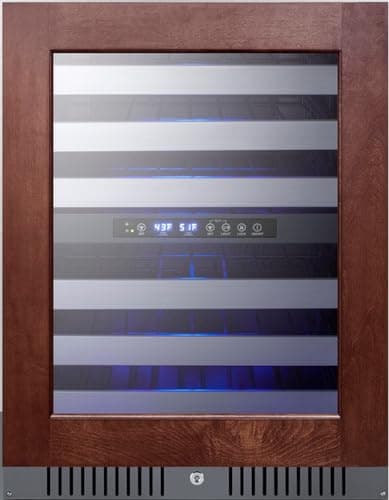
ETL-S, or ETL-Sanitation, is the one that matters here. Summit publishes it to NSF-7 on the ALWC532PNR — its own documentation words it as listed “for commercial establishments” — and on the SWBV3067B and the outdoor SPR624OS. Those three are the commercially listed cabinets in our registry.
STAR-K and CARB are a kosher certification and a California emissions compliance mark respectively. Both appear across Summit’s range, including on cabinets with no sanitation listing, which is exactly why a certification list has to be read item by item rather than counted.
The pattern in the registry is worth stating because it shapes this page: the cabinets that publish a sanitation listing are overwhelmingly from one maker. Summit Appliance builds for the foodservice channel and publishes to it, which is why four of five picks here carry its badge. The KoolMore Reserve is ETL listed and publishes no NSF-7 mark, and the mainstream consumer brands — Newair, Whynter, EUHOMY, Kalamera — publish none either. Our brand-by-brand read on who publishes what is in wine fridge brands compared.
Wine temperature against beverage temperature
The most consequential difference on this page has nothing to do with certification. It is that one of these cabinets cannot store wine properly, and it is the cheapest one.
The Summit SPR624OS publishes a range of 36–43°F. That is a beverage cabinet temperature: cold enough for bottled beer, soft drinks and mixers, and too cold to hold wine. Long-term storage wants somewhere around 55°F and service temperatures for most whites sit in the high 40s — wine storage temperature sets out the numbers and why they matter. The SPR624OS is on this page because it is weatherproof, commercially listed and the cheapest listed cabinet here, which makes it the right answer for an outdoor service bar handing out bottled drinks. It is the wrong answer for wine, and we would rather say that in the heading than bury it in a footnote. The same honesty problem across the whole outdoor class is worked through in outdoor wine fridges.
The three genuinely wine-capable cabinets here publish ranges that reach cellar temperature: Summit’s ALWC532PNR at 41–50°F above and 50–64°F below, the SWBV3067B at 41–64°F in both zones, and the KoolMore at 41–68°F. Summit does not publish a temperature range for the ASDW2412 in the specification we have on file, which is a real gap on an otherwise well-documented cabinet and is why it is not our top pick despite fitting places nothing else fits.
If the room needs both — wine at cellar temperature and bottled beer genuinely cold — that is a two-zone combination cabinet, and the class is ranked in best wine and beverage refrigerators. The practical limits of asking one cabinet to do both are in using a wine fridge for beer and soda.
ADA height, depth and the bar run
A commercial installation constrains the body of the cabinet more than a domestic one does, in three ways that are easy to check and expensive to miss.
ADA counter height. An accessible counter is lower than a standard one, and three cabinets here publish 32.00 inches specifically for it — the ALWC532PNR, the SPR624OS and the ASDW2412. The ASDW2412 and the SPR624OS also publish adjustable legs and, on the ASDW2412, a sliding kickplate cover that raises the cabinet to a standard 34 inches, so neither is a single-use body. The SWBV3067B at 34.38 inches and the KoolMore at 34.00 are standard-counter cabinets only.
Depth, including the door. The ASDW2412 is published at under 18 inches deep, which is the single most useful number on this page for a retrofit: it goes into a bar run with plumbing behind it, where a full-depth cabinet will not. Summit publishes something for the ALWC532PNR that almost nobody else prints — 47.38 inches of depth with the door open at 90 degrees — which is the figure that decides whether the door clears a service aisle. The general method is in the dimensions guide.
Front-breathing, because a bar run has no back. Every cabinet here vents forward; Summit publishes interior and exterior fans and automatic defrost on the ALWC532PNR, and KoolMore publishes a front plinth vent with a minimum clearance of 0.25 inches at the sides and back. Keep the plinth clear whatever the finish carpentry wants — ventilation and clearance is what each class actually needs, and built-in against freestanding is why the rating is not negotiable.
Two of these cabinets are panel-ready, which in a fitted bar is usually the point rather than a complication: the ALWC532PNR publishes a recommended panel of 3/4-inch material at 29 1/4 by 23 1/8 inches with a 22 3/8 by 17 3/4 inch viewable area, and the KoolMore ships panel-ready with no handle in the box. Both need a joiner. Best panel-ready wine fridges ranks the registry on whether the maker publishes the dimensions that joiner needs. And if the installation is a home bar rather than a licensed room, best wine fridges for a home bar is the version of this page without the certification constraint.
Locks, alarms, noise and warranty
The operational specifications are where commercial-channel cabinets separate themselves most clearly from retail ones, and they are the specifications domestic buyers ignore.
Locks. Every cabinet on this page has a factory-installed lock. The SWBV3067B is the only one with keyed locks on both zones, which in a staffed room means the wine can be secured while the beverage side stays open. The SPR624OS adds a control-panel child lock, so a guest cannot change the setting. In a room where staff turn over, that is inventory control. Best lockable wine fridges ranks the whole registry on it.
Alarms. Only the KoolMore publishes them — door-ajar and high-temperature — and in a busy service area an unnoticed open door is the most likely way to lose a shelf of wine. It is a genuine point in its favor and the main reason an ETL-only cabinet appears on a page ranked by sanitation listing.
Noise. Three figures are published: 34 dB on the ALWC532PNR, 34.6 dB on the SWBV3067B and 45 dB on the KoolMore. The first two are among the lowest published numbers in our entire registry, which matters if the cabinet is in a dining room rather than behind a service door. The KoolMore’s 45 dB is the highest, and publishing it honestly is better than the silence from most of this category — see the noise guide for what these numbers do and do not tell you, and best quiet wine fridges for the registry ranked on the figure.
Ambient range and warranty. KoolMore publishes an ambient operating range of 60–90°F, which is the only figure on this page that speaks directly to a hot service area behind a bar, and the longest cover here: three years parts and labor plus five on the compressor. Summit publishes one year parts and labor plus five on the compressor across its range. Draw is modest on all of them — 1.0 to 1.25 A at 115 V, and 180 kWh a year on the KoolMore — but a commercial room should still give the cabinet a circuit of its own, for which does a wine fridge need a dedicated circuit has the reasoning.
What this class does not include
We ran a live catalog check for this page rather than assuming, and the result is worth publishing because it reframes the question.
Searching the Amazon catalog for commercial wine refrigeration returns, overwhelmingly, glass-door beverage merchandisers — upright display coolers of six to seventeen cubic feet, built for cans and bottles on wire shelves at drinks temperature, several of them genuinely ETL and NSF certified. They are good at that job. They are not wine cabinets: they run too cold, they light the shelves hard, they vibrate, and they hold bottles upright on wire. If what you actually need is a drinks merchandiser, buy one of those and do not pay a wine premium.
What the catalog does not return is the thing a sommelier pictures: a 150- to 300-bottle commercial wine merchandiser with glass doors and per-shelf racking. That class exists, it is sold through foodservice dealers and refrigeration suppliers, and it is priced accordingly. We do not rank cabinets we cannot verify a live listing for, so it is not on this page — and the honest alternative inside the consumer channel is a large domestic cabinet: our 100-plus-bottle picks are in best 100-bottle wine fridges, one of which holds 166 bottles in a 24-inch column.
Summit also sells 6- and 12-bottle countertop cellars whose listings describe them as commercially approved. We have not ranked them here: at that capacity they are service accessories rather than storage, and our specification file does not cover them, so there is nothing we could honestly say about their shelving or their temperature control.
Which one to buy
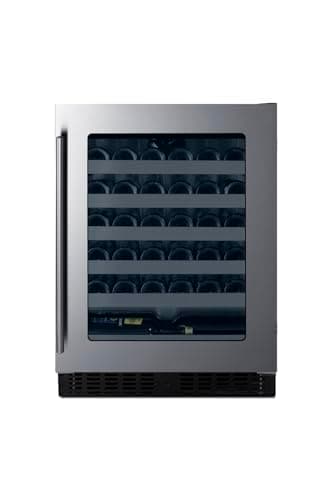
Buy the Summit ALWC532PNR for a licensed room. It is the most thoroughly documented cabinet on this site: 46 bottles broken out as 30 Bordeaux and 16 Burgundy, two zones at 41–50°F and 50–64°F, 34 dB published, ADA height at 32.00 inches, front-breathing with interior and exterior fans, automatic defrost, a lock with two keys, LED lighting in both compartments, an ETL-Sanitation listing to NSF-7, CARB compliance and five years on the compressor. The costs are real: the zones are fixed rather than freely settable, the six shelves are full-extension wire rather than wood, it arrives without a door front, and Summit sells the left-hand-swing version as a separate model.
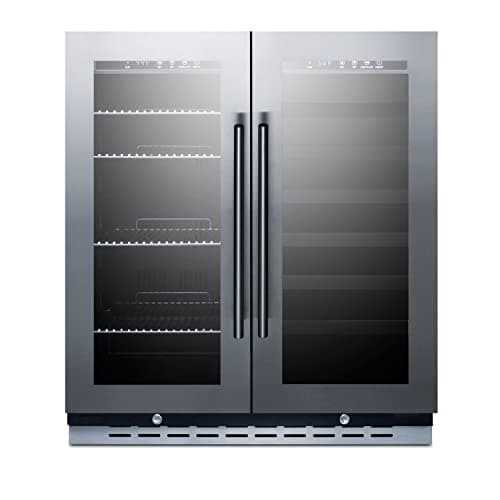
Buy the Summit SWBV3067B for a back bar serving wine and bottled beer. Two independent zones, each with its own digital thermostat, across 41–64°F; 33 bottles on six wooden shelves plus four chrome wire shelves for cans; French-swing glass doors; keyed locks on both zones; 34.6 dB; the same ETL-Sanitation listing to ANSI-NSF 7. It needs 29.5 inches of width and 34.38 inches of height, which rules out a standard 24-inch module and most accessible counters, and the French doors mean the swing is fixed.
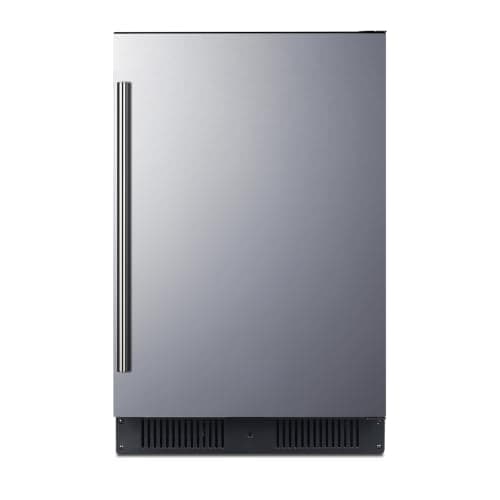
Buy the Summit SPR624OS only for drinks, and preferably outdoors. The cheapest commercially listed cabinet here: weatherproof with a sealed back and no exposed coils, a 304-grade stainless door, three cantilevered glass shelves, a keyed lock in the kickplate plus a control-panel child lock, ADA height with legs that raise it to 34 1/2 inches, and an ETL-S listing to NSF-7. Its range is 36–43°F, so it is a beverage cabinet: it cannot hold wine at cellar temperature, and no setting will make it.
Buy the Summit ASDW2412 when the depth decides it. Under 18 inches deep, 24 inches wide, 33 bottles, built-in rated, 32 inches tall for an accessible counter with legs and a sliding kickplate cover to reach 34. For a retrofit into an existing bar run with services behind it, nothing else here fits. Ranked fourth because Summit publishes no sanitation listing and no temperature range for it in the specification we hold — two gaps that matter in a regulated room, and the second of which matters anywhere.
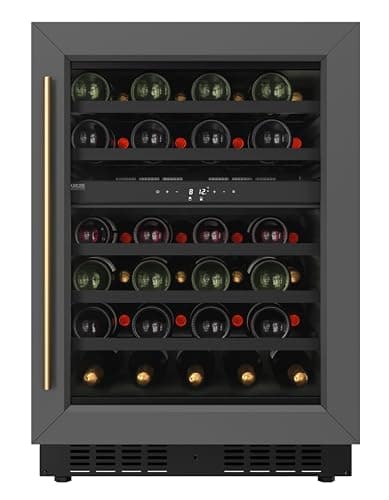
Buy the KoolMore KM-CW46DZ-BPR for a hot service area. Forty-five bottles across two zones at 41–68°F, five beech shelves with a published 3.6-inch gap, a published 60–90°F ambient range, door-ajar and high-temperature alarms, a reversible self-closing door and three years of parts and labor. It is ETL listed with no NSF-7 mark, so it is not the cabinet for an inspected room; it publishes 45 dB, the loudest here; its control panel is inside the cabinet; and no handle is included.
A closing note on channel, because it is the thing most small operators get wrong. Every cabinet above is bought at retail, and retail cabinets carry retail warranties: one to three years of parts and labor, and a service path that assumes a house rather than a kitchen that cannot close. If the cabinet is load-bearing for your business, price a service contract alongside it, and keep a logging thermometer in each zone so you can prove what the wine actually sat at — best wine fridge thermometers and hygrometers ranks those on published accuracy and logging. If the budget will not reach this class at all, best wine fridges under $1,000 is the honest consumer-grade alternative, with none of the certification above.