The Dacor DRW24G7500APDA protects bottles best overall, because Dacor is one of the only makers that documents a shelf system built to eliminate vibration. If you want both faults solved in one cabinet, the Zephyr Presrv PRW15C01CG pairs a specified vibration dampening system with dual-pane Low-E argon-filled glass.
This page sits in Wine Fridges, where the rest of the category is compared the same way.
How this page is funded. Cork & Cool earns a commission if you buy through the Amazon links below, at no extra cost to you. It never changes the order of this list — see our editorial policy and affiliate disclosure. Prices come from Amazon and are refreshed daily; the price on Amazon when you buy is always the one that counts.
Quick picks
Every model below, on the specifications that decide the purchase. Tap a row to jump to the full write-up.
Comparison of wine storage models by zones, capacity, cooling type, width, published noise rating and vibration.
#
Product
Best for
Zones
Bottles
Cooling
Width
Noise
Vibration
Price
1
Dacor DRW24G7500APDADocumented vibration control
Forty-one bottles, dual zone, panel-ready, and the only unit here whose manufacturer documents a shelf system built to eliminate vibration.
2
41
compressor
24"
Not published
Dacor documents a GlideRack shelf system specified to eliminate vibration.
#ad — paid link. How this is funded. Price as of November 11, 2026; check Amazon for the current price.
“Not published” means the manufacturer does not publish that figure. We do not estimate it. Prices and product photographs come from Amazon and are refreshed daily; where a model is not sold on Amazon the thumbnail is an illustrative category photograph and the link is a search.
How we compared
We compared published manufacturer specifications, official product documentation and verified owner reports across 5 models. We do not physically test these units, we have no laboratory, and we do not accept payment for placement. Where a manufacturer does not publish a figure — noise ratings, most often — this page says so rather than estimating it.
What we weighted
Whether the manufacturer documents a vibration measure at all — a named shelf system, a low-vibration compressor, or no compressor
What the door glazing is specified as: UV-protective, Low-E, argon-filled, mirrored or merely tempered
Whether the interior lighting can be switched off, since an always-on LED is a light source inside the cabinet
Published temperature range, because a cabinet that cannot hold a steady cellar temperature undoes both protections
Shelf construction, since wood damps where bare wire transmits
Published decibel figures where they exist — and an explicit note where they do not, rather than a substituted number
Every model in detail
Ranked by how much the manufacturer actually publishes about vibration and light, not by price. Two of these five are here because they have no compressor at all, which is the only vibration claim that needs no trust.
#1 — Documented vibration control
Dacor DRW24G7500APDA
Forty-one bottles, dual zone, panel-ready, and the only unit here whose manufacturer documents a shelf system built to eliminate vibration.
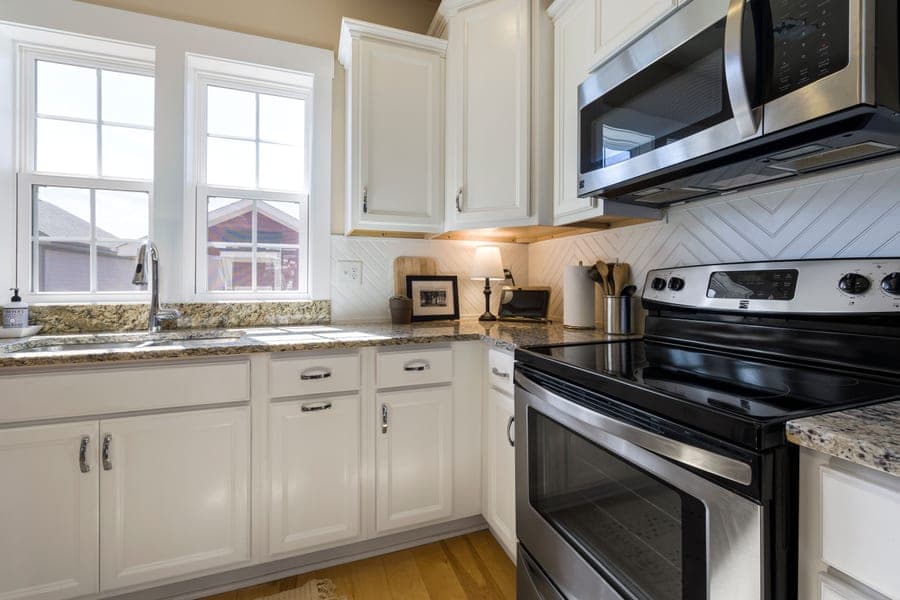
Illustrative photograph — not an image of the Dacor DRW24G7500APDA.
Published specifications
Capacity
41 bottles
Zones
2
Cooling
compressor
Temperature range
Not published
Noise rating
Not published by the manufacturer
Installation
built-in
· 24-inch undercounter wine cellar
· Capacity: up to 41 bottles
· Dual temperature zones with customizable settings
· GlideRack shelf system specified to eliminate vibration
A published vibration measure, which almost nobody in this category offers
Panel-ready, so it disappears into cabinetry
Two zones in a single base cabinet
What does not
No published temperature range in the product listing
Panel-ready means you are also buying a custom door panel
Who should skip it. Skip it if the unit is going into a garage or a utility room. Panel-ready construction and vibration engineering are worth paying for in a finished kitchen and nowhere else.
Twenty-seven bottles, a published 39 dBA, and the only cabinet in this width whose maker documents a vibration dampening system — you are paying for the storage conditions, not the bottle count.
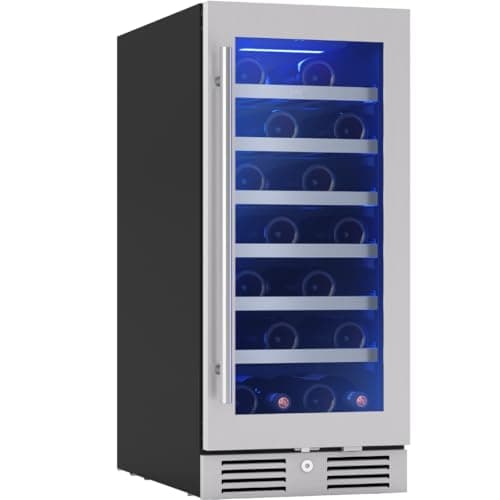
Product photograph via Amazon.
Published specifications
Capacity
27 bottles
Zones
1
Cooling
compressor
Temperature range
38–65°F
Noise rating
39 dB
Installation
both
· Exterior: 15 in W x 33-7/8 in H x 23-3/8 in D
· Capacity: 27 bottles (750 ml), 3.4 cu ft
· Sound level: 39 dBA published
· Racking: six full-extension black wood racks with stainless trim
· Glass: dual-pane, Low-E, argon-filled
· Field-reversible door with concealed zero-clearance hinges, door lock, door-open alarm
· Energy Star certified; Sabbath mode; carbon-filtered air filtration
· Weight: 101 lb · Power: 115 V, 60 Hz at max 1.5 A
· Warranty: 2 years parts and labor, 5 years compressor
The only 15-inch cabinet here whose manufacturer documents vibration control at all
Publishes a flat decibel figure rather than a ceiling, so it can be compared properly
Reaches 38°F, the lowest published minimum in this group, which matters for sparkling wine
Full-extension racks mean you can reach a bottle at the back without unloading the shelf
Five-year compressor warranty against the usual one or two
What does not
Twenty-seven bottles against thirty-three for the same width — the racks take the space
23-3/8 inches deep, the deepest cabinet in this group
Costs materially more than the Whynter and Summit cabinets it sits beside
Who should skip it. Skip it if the wine is going to be drunk within a year or two. Vibration control and a 38°F floor are long-storage features, and you can have eight more bottles for less money without them.
#ad — paid link. How this is funded. Price as of November 11, 2026; check Amazon for the current price.
#3 — Low vibration in a narrow cabinet
Liebherr WS1200
Twelve bottles, wooden grid shelves, and a compressor Liebherr specifically develops for low vibration — the small cabinet that treats wine as aging stock.
Illustrative photograph — not an image of the Liebherr WS1200.
Published specifications
Capacity
12 bottles
Zones
1
Cooling
compressor
Temperature range
Not published
Noise rating
Not published by the manufacturer
Installation
freestanding
· Exterior width: 16 3/4 in
· Capacity: 12 bottles on 3 wooden grid shelves
· Electronic touch control with digital temperature display
No compressor means no start-up thump and no vibration path into the wine
65 W is a fraction of a compressor cabinet's draw
46°F floor is cold enough for sparkling service
What does not
Thermoelectric cooling works against ambient temperature, so a warm room raises the achievable minimum
Freestanding only — it must not be enclosed
Who should skip it. Skip it if the unit will live anywhere that gets hot: a garage, a conservatory, or a cabinet run with no air gap. Thermoelectric units lose the argument above roughly 77°F ambient.
#ad — paid link. How this is funded. Price as of November 11, 2026; check Amazon for the current price.
Why vibration and light travel together
Ask which wine refrigerator protects bottles best and you are really asking about four faults: heat, temperature swing, vibration and light. The first two are on every spec sheet in the category. The last two are barely on any of them, which is exactly why they are worth a page.
They travel together because they are both long-horizon faults. Neither ruins a bottle this week. Both matter if the bottle is still in the cabinet in five years, which is the only reason to own a wine fridge rather than a shelf in a cool cupboard. And both are decided at purchase: you can move a cabinet out of the sun, but you cannot retrofit a low-vibration compressor or swap plain tempered glass for a Low-E argon-filled pane.
The honest starting point is that most of this category publishes nothing. Of the cabinets in our registry, three manufacturers document a vibration measure and the rest are silent. We will not read silence as a claim in either direction, and we will not invent a figure to fill a column. What follows is the published evidence and nothing else.
What vibration does, and what is measurable
A compressor is a motor that starts, runs and stops. Every one of those events puts energy into the cabinet shell, the shelves and the bottles sitting on them. Over a long storage period the concern is that constant low-level agitation keeps sediment in suspension and disturbs a wine that is supposed to be resting. This is why serious storage cabinets advertise vibration control and serving fridges do not.
There are exactly three kinds of claim you can verify before buying:
No compressor at all. A thermoelectric cabinet has a solid-state heat pump and a small fan. Nothing starts, nothing stops, nothing thumps. The Whynter WC-201TD and the Koolatron WC12-35D are both in this group, and this is the only vibration claim in the category that requires no trust whatsoever.
A named shelf system. Dacor documents a GlideRack shelf system specified to eliminate vibration on the DRW24G7500APDA. That is a manufacturer statement about a named component, which is as close to a specification as this category gets.
A compressor developed for the job. Liebherr states that its compressors are specially developed to store wine in a particularly low-vibration environment. Zephyr specifies a vibration dampening system on the Presrv intended to minimize wine disturbance. Both are claims about engineering rather than measured numbers, and both are more than the rest of the field offers.
Everything else is installation, and installation is free. A cabinet that rocks on an uneven floor is a vibration source no matter what the brochure says; a cabinet pressed flat against a stud wall uses the wall as a soundboard. Our guide to why wine fridges make noise covers the leveling and clearance fixes that cost nothing, and they are worth doing before you spend money on hardware.
Light: the fault you can see coming
Light damage in wine is well understood and it is fast compared with the other faults. Ultraviolet light drives reactions with sulfur compounds in the wine that produce the aromas usually described as lightstrike — wet wool, cooked cabbage, struck match. Whites, roses and sparkling wines in clear or pale glass are the most exposed, because the bottle itself is doing none of the filtering. A dark Bordeaux bottle is already a reasonable UV filter; a clear Provence rose bottle is a window.
A glass-fronted wine fridge is a deliberate compromise. You want to see the bottles, so the maker puts a window in the cold box, and then has to engineer the window back into something that does not cook the contents. The three things that make the difference:
UV-treated or tinted glass. The Whynter BWR-33SD uses gray-smoked double-pane tempered glass for UV protection; the Koolatron WC12-35D uses a double-pane mirrored UV-protective door, which is the most aggressive treatment in our registry at that size.
Low-E coating and gas fill. The Zephyr Presrv specifies dual-pane, Low-E, argon-filled glass. That is an insulated-glazing specification borrowed from architectural windows, and it addresses heat gain through the door as well as light.
An interior light you can switch off. The Koolatron publishes an interior LED with on/off control. A cabinet whose light comes on with the door and stays off otherwise is doing the right thing; a display-mode LED that burns around the clock is a light source you installed yourself.
And there is a free option that beats every pane of glass: do not put the cabinet in the sun. Direct sunlight through a glass door is a heat load and a light load at the same time, and UV glazing addresses only one of them. Where to put a wine fridge works through the placements that create this problem and the ones that avoid it.
Reading a glazing specification
Door glass is described in three overlapping ways and the words are not interchangeable. This is what each one is actually telling you.
What the glazing words on a wine fridge listing mean
What the listing says
What it tells you
Tempered glass
A safety specification about how the glass breaks. It says nothing at all about UV or heat.
Double-pane / dual-pane
Two sheets with a gap, which is an insulation step. Heat gain drops; light transmission barely changes.
UV-protected / UV-resistant
A coating or a tint intended to cut ultraviolet transmission. The manufacturer rarely publishes a percentage, so treat it as a yes or no.
Smoked, tinted or mirrored
Visible-light reduction you can see. Mirrored is the strongest of the three and also the hardest to see your bottles through.
Low-E, argon-filled
An architectural insulated-glazing specification: a low-emissivity coating plus an inert gas fill. The most complete answer available in this category.
Note which column the numbers are missing from. Nobody in this category publishes a percentage of UV blocked, so a cabinet claiming UV protection and a cabinet claiming nothing are not separated by a measurement — only by whether the maker was willing to put the claim in writing.
Choosing between the five
If the cabinet is going into a finished kitchen and the bottles are genuinely being aged, the Dacor is the answer: a documented vibration-control shelf system, two zones and a panel-ready front. If you want one cabinet that addresses both faults and fits a 15-inch opening, the Zephyr Presrv is the most completely specified unit in our registry on this question, and it reaches 38°F, the lowest published floor in its class.
If the collection is small and precious, the Liebherr WS1200 puts a low-vibration compressor, UV-resistant insulated glass and wooden grid shelves into 16 and three quarter inches. And if you simply want the vibration question closed with no engineering claim to evaluate, buy a thermoelectric cabinet: the Whynter WC-201TD or the Koolatron WC12-35D have no compressor to vibrate, at the cost of a higher temperature floor and a hard dependence on room temperature, which compressor versus thermoelectric sets out in full.
One warning before you spend extra on either feature. Vibration control and UV glazing are long-storage features and they only pay back over long storage. If the wine in the cabinet is drunk within a year or two, the money is better spent on capacity and on a cabinet that holds its set temperature. That argument is in the long-term storage roundup.
Questions people actually ask
▸ Which wine refrigerator protects bottles best from vibration and light?
On published evidence, the Dacor DRW24G7500APDA for vibration and the Zephyr Presrv PRW15C01CG for both faults together. Dacor documents a GlideRack shelf system specified to eliminate vibration; Zephyr specifies a vibration dampening system plus dual-pane Low-E argon-filled glass. A thermoelectric cabinet such as the Whynter WC-201TD removes the vibration question entirely by having no compressor, but gives up temperature range to do it.
▸ Does vibration really damage wine?
It is a long-horizon concern rather than a next-week one. The argument is that constant low-level agitation keeps sediment in suspension and disturbs wine that should be resting, which is why storage-focused cabinets advertise vibration control and serving fridges do not. If the bottles are drunk within a year or two, it is not a specification worth paying extra for.
▸ Is UV glass on a wine fridge worth paying for?
Yes if the cabinet will sit anywhere with daylight, and especially if you store whites, roses or sparkling wine in pale glass — those bottles do none of the filtering themselves. It is worth much less in a windowless pantry or basement. No manufacturer in this category publishes a percentage of UV blocked, so treat the claim as a yes or no rather than a measurement.
▸ Are thermoelectric wine fridges vibration-free?
They have no compressor, which removes the largest vibration source by construction rather than by engineering. A small circulation fan remains. The trade is real: a thermoelectric unit cools relative to the room, so it cannot hold a low set temperature in a warm space, and it must never be enclosed in cabinetry.
▸ Should I turn off the interior light in my wine fridge?
If it has a display mode that keeps the LED on continuously, yes — leave it on door-activated instead. An always-on light inside a sealed box is a light source you chose to install. The Koolatron WC12-35D publishes an interior LED with on/off control; several cabinets do not state whether theirs can be switched.