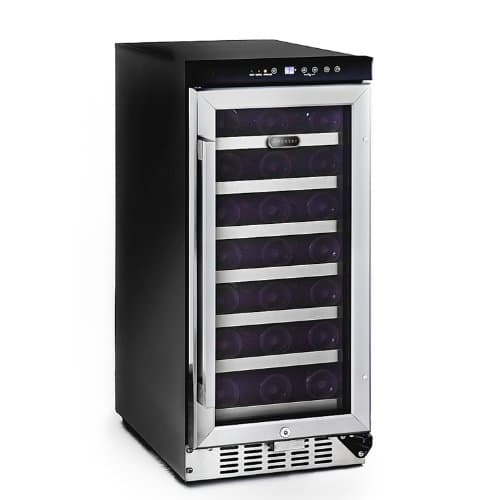
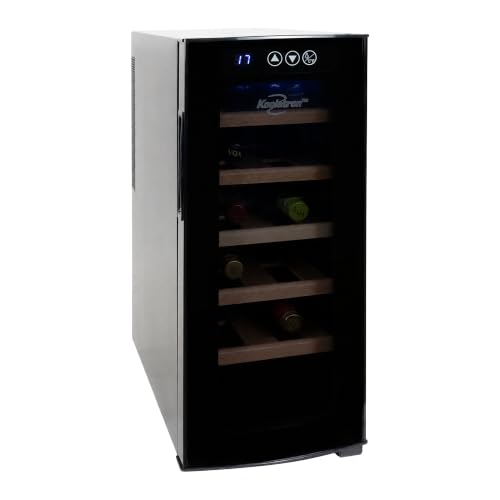
Put a wine fridge wherever the ambient temperature is stable and the cabinet can vent the way its manufacturer specifies. A kitchen base cabinet needs a built-in-rated, forward-venting unit. A living or dining room needs a quiet one, which usually means thermoelectric. A garage needs a cabinet rated for the ambient swing. A sealed cupboard needs nothing, because nothing belongs there.
This page sits in Wine Storage Guides, where the rest of the category is compared the same way.
How this page is funded. Cork & Cool earns a commission if you buy through the Amazon links below, at no extra cost to you. It never changes the order of this list — see our editorial policy and affiliate disclosure. Prices come from Amazon and are refreshed daily; the price on Amazon when you buy is always the one that counts.
Our picks
One cabinet per situation rather than a ranking: the kitchen slot, the shallow run, the silent room, the low-vibration corner, the narrow gap and the countertop. Each is the unit whose published specification matches the location, not the one with the best price.
How this page is funded. Cork & Cool earns a commission if you buy through the Amazon links below, at no extra cost to you. It never changes the order of this list — see our editorial policy and affiliate disclosure. Prices come from Amazon and are refreshed daily; the price on Amazon when you buy is always the one that counts.
#1 — The 24-inch slot
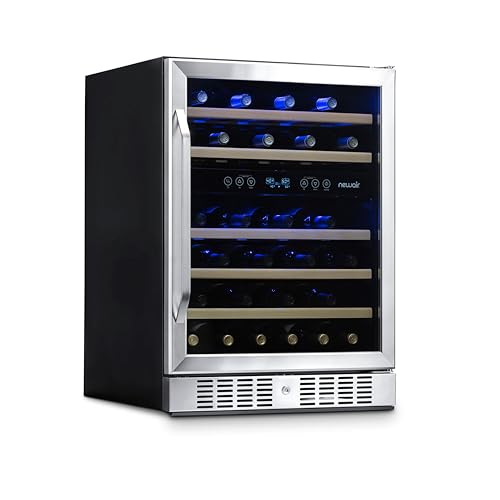
Newair AWR-460DB
Forty-six bottles across two zones in a 23.4-inch cabinet rated for built-in or freestanding use — the default answer for a standard kitchen opening.
Product photograph via Amazon.
Published specifications
Capacity
46 bottles
Zones
2
Cooling
compressor
Temperature range
40–66°F
Noise rating
Not published by the manufacturer
Installation
both
· Exterior: 23.40 in W x 22.40 in D (24.00 in with handle) x 33.00 in H
Rated for built-in installation, so the front vent is designed for an enclosed opening
23.4-inch width drops into a standard 24-inch cabinet run
Two independently set zones across the full 40-66°F span
What does not
No published dB rating, so noise cannot be compared numerically against rivals
46 bottles is the manufacturer's count using standard Bordeaux bottles — heavy Burgundy or Champagne bottles reduce it
Who should skip it. Skip it if your opening is under 24 inches, or if you need more than about four dozen bottles — stepping up to a 160-bottle cabinet costs less per bottle.
Under 18 inches deep, which solves the most common undercounter fit problem
The only unit here designed around ADA counter height
Height adjusts to standard counters too, so it is not a single-use product
What does not
33 bottles is the price of the shallow depth
Summit does not publish a temperature range in this listing
Who should skip it. Skip it if your cabinet run is a standard 24 inches deep and you want the capacity — a full-depth unit in the same opening holds 13 more bottles.
No compressor means no start-up thump and no vibration path into the wine
65 W is a fraction of a compressor cabinet's draw
46°F floor is cold enough for sparkling service
What does not
Thermoelectric cooling works against ambient temperature, so a warm room raises the achievable minimum
Freestanding only — it must not be enclosed
Who should skip it. Skip it if the unit will live anywhere that gets hot: a garage, a conservatory, or a cabinet run with no air gap. Thermoelectric units lose the argument above roughly 77°F ambient.
#ad — paid link. How this is funded. Price as of November 11, 2026; check Amazon for the current price.
#4 — Low vibration in a narrow cabinet
Liebherr WS1200
Twelve bottles, wooden grid shelves, and a compressor Liebherr specifically develops for low vibration — the small cabinet that treats wine as aging stock.
Illustrative photograph — not an image of the Liebherr WS1200.
Published specifications
Capacity
12 bottles
Zones
1
Cooling
compressor
Temperature range
Not published
Noise rating
Not published by the manufacturer
Installation
freestanding
· Exterior width: 16 3/4 in
· Capacity: 12 bottles on 3 wooden grid shelves
· Electronic touch control with digital temperature display
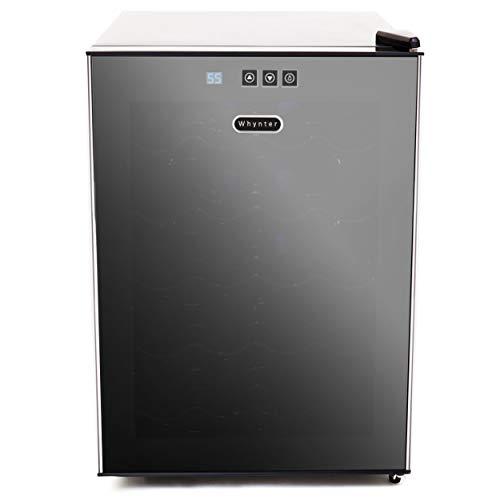
Thirty-three bottles in a 15-inch cabinet, with a published noise ceiling and seven wooden shelves — the capacity ceiling at this width, and the widest temperature band on this page.
Product photograph via Amazon.
Published specifications
Capacity
33 bottles
Zones
1
Cooling
compressor
Temperature range
40–72°F
Noise rating
42 dB
Installation
both
· Exterior: 15.0 in W x 22.5 in D (24.5 in with the handle installed) x 34.0 in H
· Capacity: 33 standard 750 ml bottles
· Noise published as "< 42 dBA" — a ceiling, not an average
Thirty-three bottles is the highest published capacity at this width
Whynter publishes a decibel ceiling, which almost nobody in this category does
Seven wooden shelves rather than the wire shelving usual at this price
40-72°F is the widest published band here, so it will also hold a bottle at room temperature
Rated for built-in or freestanding use, so an opening is optional rather than required
What does not
Single zone only — one temperature for the whole cabinet
The published figure is "< 42 dBA", a maximum rather than an average, so it cannot be compared like-for-like against a manufacturer quoting a flat number
At 15.0 inches published it is the widest cabinet in this group, which matters if your opening is tight
Depth grows to 24.5 inches once the handle is on, which is the figure that matters in a shallow run
33 bottles assumes standard Bordeaux shapes; a Burgundy-heavy collection will fit fewer
Who should skip it. Skip it if you need to serve whites cold and hold reds at cellar temperature in the same cabinet — one zone cannot do both. Skip it too if your opening measures under 15 inches, because this is the one cabinet here that needs the full module.
#ad — paid link. How this is funded. Price as of November 11, 2026; check Amazon for the current price.
The three things a location has to supply
Every placement question reduces to three requirements, and a spot that fails any one of them is not a spot, however good it looks.
A way for heat to leave. A compressor cabinet does not destroy heat, it moves it out of the box and into the room. If that heat cannot get away from the cabinet, the compressor runs continuously and never reaches the set temperature.
A stable ambient temperature. The further the room drifts from ordinary room temperature, the harder the cabinet works — and every manufacturer states an ambient range in the manual that almost nobody reads.
Power you are not sharing with a kettle. An outlet the cabinet can reach without an extension lead, ideally on a circuit that is not also carrying the counter appliances.
The first requirement is the one that costs people money, because it is a property of the cabinet as well as the room. A freestanding unit vents through its back or sides; a built-in unit vents forward through the toe kick. Put a freestanding cabinet in an enclosed opening and it recirculates its own exhaust until the compressor fails, and manufacturers exclude that damage from the warranty. The full argument, with the tell-tale signs on a spec sheet, is in built-in versus freestanding.
The kitchen, and its one expensive trap
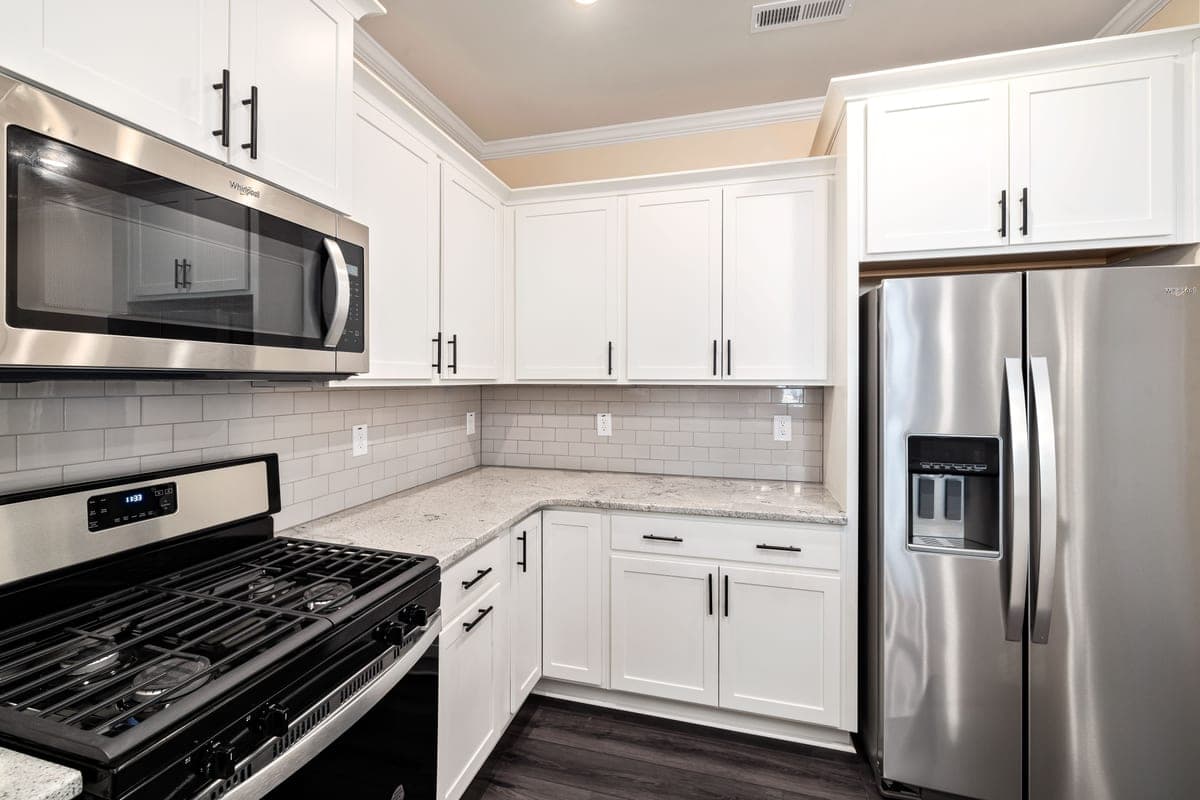
The kitchen is the default answer and usually the right one: stable temperature, an outlet, and the wine is where the glasses are. The trap is which gap you pick.
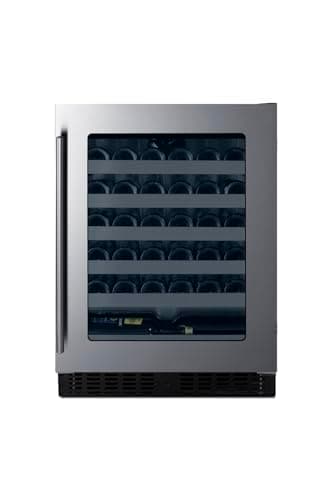
An enclosed base cabinet requires a built-in-rated unit, full stop. The Newair AWR-460DB is the standard answer for a 24-inch opening — 23.4 inches wide, 46 bottles, two zones across 40–66°F, rated for built-in or freestanding use. If the opening is narrower, the 15-inch class covers it and the Whynter BWR-33SD takes 33 bottles into a nominal 15 inches. If the run is shallow, the Summit ASDW2412 is under 18 inches deep and 32 inches tall, which is the shape that solves an ADA-height counter or an older kitchen with a gas line eating the back of the cabinet.
Three kitchen placements are worse than they look:
Beside the oven or the dishwasher. Both dump heat and moisture into the cabinet next door. The cabinet will cope; it will also run far more than it needs to.
Under a south-facing window. Direct sun through a glass door is a heat load and a light load at once. UV-treated glass reduces the second problem, not the first.
In the island, with no toe-kick gap. Islands are often built as sealed boxes. Measure the gap under the cabinet front before you assume a forward-venting unit can breathe.
If the kitchen is being rebuilt rather than worked around, the question stops being where the gap is and becomes which class of appliance you are buying — that is wine column versus undercounter, and the answer is usually not the column.
Living and dining rooms: noise decides
A wine fridge in the room where people sit is a different purchase, because the specification that matters is the one almost nobody publishes. A compressor cycles: it is near-silent for twenty minutes and then audible for ten, and in a kitchen nobody notices while in a quiet living room at eleven at night everybody does.
There are two honest answers. The first is thermoelectric. The Whynter WC-201TD cools 20 bottles with no compressor at all, which means nothing cycles and nothing vibrates; the trade is that thermoelectric cooling works against the room temperature rather than independently of it, which is why it belongs indoors and nowhere near a garage. The mechanism trade-off is laid out in compressor versus thermoelectric.
The second is a compressor cabinet engineered for quiet and stillness. The Liebherr WS1200 is the example in our registry: 12 bottles, wooden grid shelves, and a compressor Liebherr states is specially developed to store wine in a particularly low-vibration environment. It is a small cabinet for bottles you care about rather than a working supply.
Whatever you choose, the installation decides as much as the hardware. A cabinet on an uneven floor transmits buzz into the structure; one pressed against a plasterboard wall uses the wall as a soundboard. Why wine fridges make noise walks through the fixes that cost nothing, and the quietest cabinets ranks this class properly.
Basements, pantries and under the stairs
A basement is the best wine storage most houses already own: cool, dark, and stable through the year in a way no room upstairs is. That stability is exactly what lets a cabinet idle instead of working, and it is why a basement cabinet tends to be quieter and cheaper to run than the same cabinet in a kitchen.
Two things to check before you carry anything downstairs. Damp is the first: a cabinet is fine, but cardboard cases on a cold slab are not, and the room may need a dehumidifier running to a sensible level rather than the driest it can reach. Our guide to storing wine in a basement covers the slab, the humidity and the racking, and basement racks handles the bottles a cabinet cannot hold.
Under the stairs and in a pantry, the constraint flips from damp to air. These are enclosed volumes with one small opening, and the heat a cabinet rejects has nowhere to go. A built-in-rated, forward-venting unit is the minimum; a door left ajar or a vent grille cut into the surround is often the difference between a cabinet that holds 55°F and one that never gets there. The required clearances are per model, and the ventilation and clearance guide explains what each figure is protecting.
Garages, utility rooms and porches
A garage solves the space problem and creates a temperature problem. An uninsulated garage in July is well above the ambient range most cabinets are specified for, and in January in a cold climate it can fall below the point at which a cabinet’s thermostat stops asking for cooling at all — so the wine simply tracks the garage.
That does not make a garage impossible, it makes it a specification problem. A compressor cabinet rated for the ambient swing is the only candidate; a thermoelectric unit is categorically the wrong choice, because it can only pull the interior a fixed number of degrees below whatever the room is doing. We keep two pages on exactly this: can you put a wine fridge in a garage for the conditions, and the garage-ready cabinets for the units whose published ratings survive it.
A heated utility room, a laundry or a conditioned mudroom is a much better version of the same idea: out of the way, stable, and nobody is sitting next to the compressor. A covered porch is not — outdoor humidity and temperature swings are a garage problem without the roof.
Four places that never work
Placements to rule out before you measure anything
Location
Why it fails
A sealed cupboard with a freestanding unit
Rear-vented heat recirculates, the cabinet never reaches temperature, and the warranty excludes the resulting compressor damage
Directly beside an oven or a dishwasher
A constant external heat and moisture load that the cabinet pays for every day of its life
In direct sunlight
UV-treated glass handles the light, not the heat gain; the cabinet runs continuously through the afternoon
An unheated outbuilding or uninsulated garage, with a thermoelectric unit
Thermoelectric cooling is relative to ambient, so it cannot hold a set temperature in a room that swings
There is a fifth that is situational rather than absolute: a bedroom. A thermoelectric cabinet is genuinely silent enough; a compressor cabinet in a quiet bedroom will wake light sleepers when it cycles, no matter what the box says.
The measure-before-you-order checklist
Work through this in the actual spot, with a tape measure, before anything is ordered.
Placement checklist
Check
What good looks like
Width of the opening, measured front, middle and back
Cabinet exterior width plus the manufacturer's side clearance
Depth to the front edge of the counter
Use the manufacturer's with-handle depth figure if the unit must sit flush
Venting direction of the unit you are buying
Forward-venting and built-in rated for any enclosed opening
Door swing and what it opens into
A reversible door solves a corner; shelves still need to slide out past the opening
Outlet position and circuit
Reachable without an extension lead; not shared with counter appliances
Floor level and floor strength
Level enough that the cabinet does not rock; a loaded large cabinet is several hundred pounds
Room temperature range across the year
Inside the ambient range the manual states for that model
If the spot passes all seven, the location is settled and you can go back to choosing on capacity and zones — what size do I need is the next question, and setting up a new cabinet covers the first 24 hours after it arrives.
Questions people actually ask
▸ Can you put a wine fridge in a cupboard?
Only if the unit is rated for built-in installation, which means it vents forward through the toe kick rather than out of the back or sides. A freestanding cabinet in an enclosed cupboard recirculates its own hot air, runs continuously, never reaches temperature and eventually fails — and manufacturers exclude that damage from the warranty. Check the rating on the specific model, not the category.
▸ Can a wine fridge go next to an oven?
It will work, but it will work harder every day. An oven puts a repeated external heat load on the cabinet next to it, which means longer compressor runs, more noise and higher running costs for the life of the unit. If the layout gives you any other gap of the same size, use it. If it does not, a built-in-rated cabinet with the full manufacturer clearance is the minimum.
▸ Is it safe to keep a wine fridge in a garage?
It depends entirely on the garage and the cabinet. An insulated, conditioned garage is fine for a compressor unit rated for the ambient range; an uninsulated one swings outside what most cabinets are specified for, in both directions. A thermoelectric cabinet should never go in a garage, because it cools relative to the surrounding air. See our full answer on garages before committing.
▸ Can you put a wine fridge in a bedroom?
A thermoelectric cabinet, yes — there is no compressor to cycle and nothing to vibrate. A compressor cabinet is a harder sell: it is quiet for most of the hour and audible for the rest, and in a silent room that is what people notice at night. If it has to be a compressor unit, put it on a solid floor away from the bed wall.
▸ How much clearance does a wine fridge need?
It is published per model and it varies more than people expect, which is why we will not print one number here. Read the figure in the manual for your unit, add it to the exterior width and depth, and measure the opening against that total. Our ventilation and clearance guide explains which clearance protects what, so you know which one you cannot negotiate.
▸ Does a wine fridge need to be on a dedicated circuit?
Most do not require one on paper, but most manuals ask that the unit not share a circuit with heavy counter appliances, and a nuisance trip on a wine cabinet is a spoiled collection rather than a reset button. Our guide to dedicated circuits works through the registry cabinets that publish electrical figures.