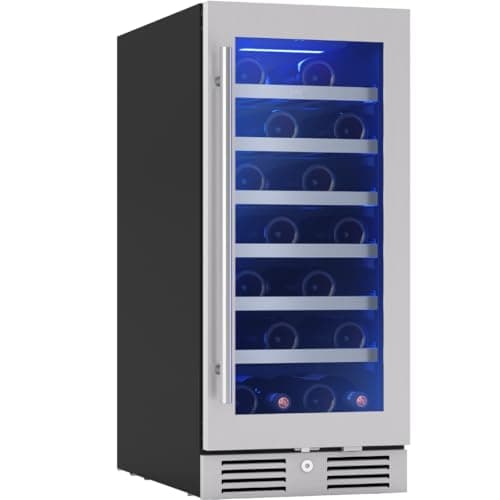
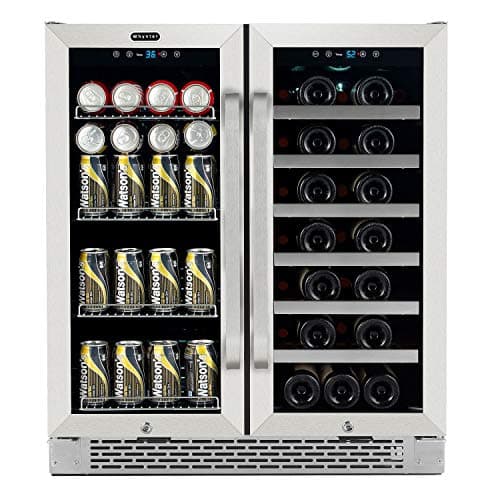
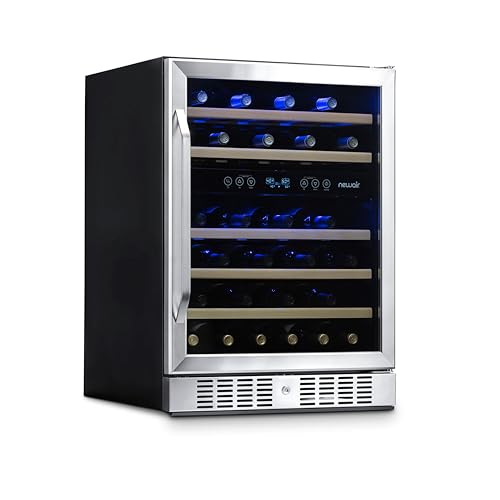
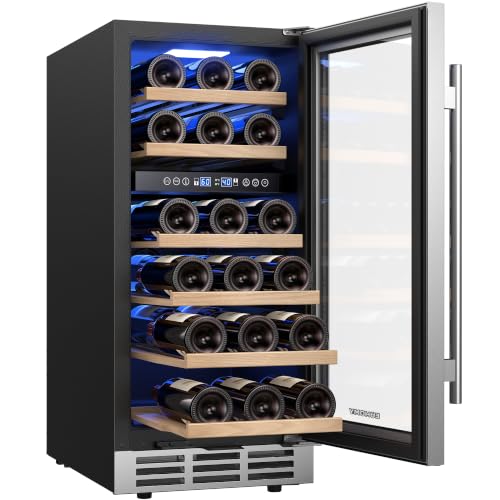
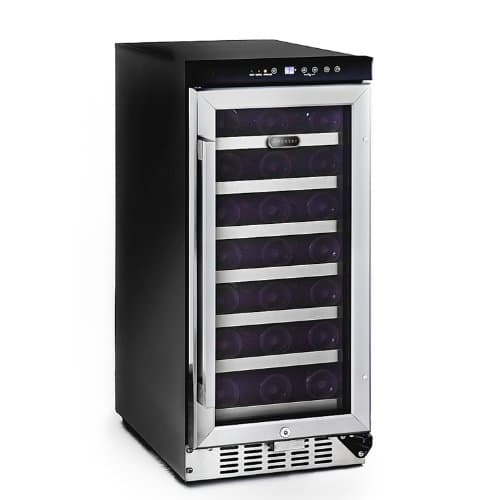
The Zephyr Presrv PRW15C01CG is the best wine fridge for white wine: a published 38°F floor, the lowest of any single cabinet here, with 39 dBA, Low-E argon-filled glazing and documented vibration control. For whites and reds at once, the Newair AWR-460DB, whose two zones each cover the full 40-66°F span. The budget pick is the EUHOMY BC-90CU-E, whose upper zone reaches 40°F.
This page sits in Wine Fridges, where the rest of the category is compared the same way.
How this page is funded. Cork & Cool earns a commission if you buy through the Amazon links below, at no extra cost to you. It never changes the order of this list — see our editorial policy and affiliate disclosure. Prices come from Amazon and are refreshed daily; the price on Amazon when you buy is always the one that counts.
Quick picks
Every model below, on the specifications that decide the purchase. Tap a row to jump to the full write-up.
Comparison of wine storage models by zones, capacity, cooling type, width, published noise rating and vibration.
#
Product
Best for
Zones
Bottles
Cooling
Width
Noise
Vibration
Price
1
Zephyr Presrv PRW15C01CGStorage, not just chilling
Twenty-seven bottles, a published 39 dBA, and the only cabinet in this width whose maker documents a vibration dampening system
1
27
compressor
15"
39 dB
Zephyr specifies a vibration dampening system intended to minimize wine disturbance
#ad — paid link. How this is funded. Price as of November 28, 2026; check Amazon for the current price.
“Not published” means the manufacturer does not publish that figure. We do not estimate it. Prices and product photographs come from Amazon and are refreshed daily.
How we compared
We compared published manufacturer specifications, official product documentation and verified owner reports across 5 models. We do not physically test these units, we have no laboratory, and we do not accept payment for placement. Where a manufacturer does not publish a figure — noise ratings, most often — this page says so rather than estimating it.
What we weighted
The published temperature FLOOR, because white wine is served near 45-50°F and sparkling nearer 40°F, and a cabinet that stops at 46°F cannot do the second job
Whether the floor is achieved by a compressor or a thermoelectric module, since a thermoelectric minimum rises with the room and is therefore conditional
On a two-zone cabinet, what the COLD compartment can reach — not what the cabinet as a whole is rated for
UV treatment on the glazing, because white wine in clear or lightly tinted glass is the most light-sensitive thing you will store
A published decibel figure where it exists, since whites get taken in and out far more often than reds and the cabinet usually lives in a living space
Shelving that comes out, because Champagne bottles are wider than the Bordeaux shapes the capacity figure assumes
Capacity, ranked last on purpose: a service cabinet is emptied and refilled, not filled once
Every model in detail
Five cabinets, ranked by the coldest temperature their own manufacturers publish. Every figure below is the maker's published range as recorded in our registry, and every card carries the source it came from.
#1 — Storage, not just chilling
Zephyr Presrv PRW15C01CG
Twenty-seven bottles, a published 39 dBA, and the only cabinet in this width whose maker documents a vibration dampening system — you are paying for the storage conditions, not the bottle count.
Product photograph via Amazon.
Published specifications
Capacity
27 bottles
Zones
1
Cooling
compressor
Temperature range
38–65°F
Noise rating
39 dB
Installation
both
· Exterior: 15 in W x 33-7/8 in H x 23-3/8 in D
· Capacity: 27 bottles (750 ml), 3.4 cu ft
· Sound level: 39 dBA published
· Racking: six full-extension black wood racks with stainless trim
· Glass: dual-pane, Low-E, argon-filled
· Field-reversible door with concealed zero-clearance hinges, door lock, door-open alarm
· Energy Star certified; Sabbath mode; carbon-filtered air filtration
· Weight: 101 lb · Power: 115 V, 60 Hz at max 1.5 A
· Warranty: 2 years parts and labor, 5 years compressor
The only 15-inch cabinet here whose manufacturer documents vibration control at all
Publishes a flat decibel figure rather than a ceiling, so it can be compared properly
Reaches 38°F, the lowest published minimum in this group, which matters for sparkling wine
Full-extension racks mean you can reach a bottle at the back without unloading the shelf
Five-year compressor warranty against the usual one or two
What does not
Twenty-seven bottles against thirty-three for the same width — the racks take the space
23-3/8 inches deep, the deepest cabinet in this group
Costs materially more than the Whynter and Summit cabinets it sits beside
Who should skip it. Skip it if the wine is going to be drunk within a year or two. Vibration control and a 38°F floor are long-storage features, and you can have eight more bottles for less money without them.
#ad — paid link. How this is funded. Price as of November 28, 2026; check Amazon for the current price.
#2 — Wine and cans, equally
Whynter BWB-3388FDS
Thirty-three bottles on one side and 113 cans on the other, with both zones rated across the whole 36-72°F span — the only combination cabinet here that does not decide for you which half is the serious one.
Product photograph via Amazon.
Published specifications
Capacity
33 bottles
Zones
2
Cooling
compressor
Temperature range
36–72°F
Noise rating
38 dB
Installation
both
· Exterior: 29.75 in W x 22.25 in D (24.25 in with handles) x 34.00 in H
· Capacity: 33 standard 750 ml bottles in the right zone, 113 standard 12 oz cans in the left
· Both zones independently adjustable across 36-72°F / 2-22°C
· Cabinet storage: 6.0 cu ft
· Shelving: 10 removable pull-out sliding shelves — 6 stainless-trimmed wood in the wine zone, 4 chrome wire in the beverage zone
· Door: tempered double-pane gray-smoked glass for UV protection, French swing, NOT reversible
· Noise published as “under 38 dB” — a ceiling, not an average
· Power: 100 W / 0.9 A at 115 V, 60 Hz
· Weight: 120 lb net
· Cylinder lock with two keys; soft white LED interior lighting
Both zones cover the full 36-72°F range, so the wine side can hold cellar temperature while the other side gets genuinely cold
Six wood shelves on the wine side rather than wire, which is unusual in a combination cabinet
Gray-smoked double-pane glass is a real UV treatment rather than plain tempered glass
113 cans is the largest beverage half in this group by a wide margin
Publishes a decibel ceiling and a wattage figure, which most combination cabinets do not
What does not
Thirty inches wide — it will not drop into the standard 24-inch opening most kitchens have
The door is not reversible, so the French swing is fixed and the hinge sides are decided for you
Noise is published as a maximum rather than a measured average
Whynter's own page gives a per-shelf can breakdown that does not add up to the 113 total, so treat the can figure as nominal
Who should skip it. Skip it if your cabinet run is 24 inches. This is a 30-inch cabinet and no amount of wanting will shrink it — take the 24-inch Newair instead and accept the smaller can count.
Rated for built-in installation, so the front vent is designed for an enclosed opening
23.4-inch width drops into a standard 24-inch cabinet run
Two independently set zones across the full 40-66°F span
What does not
No published dB rating, so noise cannot be compared numerically against rivals
46 bottles is the manufacturer's count using standard Bordeaux bottles — heavy Burgundy or Champagne bottles reduce it
Who should skip it. Skip it if your opening is under 24 inches, or if you need more than about four dozen bottles — stepping up to a 160-bottle cabinet costs less per bottle.
#ad — paid link. How this is funded. Price as of November 28, 2026; check Amazon for the current price.
#4 — Two zones in a 15-inch gap
EUHOMY BC-90CU-E
Thirty-three bottles across two independently controlled zones in a 15-inch opening, with a published noise ceiling, a reversible door and a lock — the service specification rather than the storage one.
Product photograph via Amazon.
Published specifications
Capacity
33 bottles
Zones
2
Cooling
compressor
Temperature range
40–65°F
Noise rating
38 dB
Installation
both
· Exterior: 14.9 in W x 23 in D x 34.25 in H
· Capacity: 33 standard 750 ml bottles; no per-zone bottle count published
· Upper zone 40-55°F, lower zone 55-65°F, each independently controlled
· Noise published as "< 38 dB" — a ceiling, not an average
· Shelving: six removable wooden shelves, specified to reduce vibration
· Door: double-pane UV-protective glass in a stainless steel frame, reversible
· Security: lock with two keys
· Front-vented, so it is rated for a built-in opening or freestanding use
A published decibel ceiling, which most cabinets at this width do not give you
Reversible door, so the hinge side is not decided for you
A lock with two keys, which matters more in a bar than in a cellar
The upper zone reaches 40°F, cold enough for sparkling service
Front-vented and rated both ways, so an opening is optional rather than required
What does not
The zones are split at the factory — 40-55°F above, 55-65°F below — so the cold half is always the top one
No per-zone bottle count published, so how the 33 divides is unknown until it arrives
The published figure is "< 38 dB", a maximum rather than an average
EUHOMY publishes no wattage, amperage or net weight for this model
23 inches deep, which is deeper than the 22.4-inch cabinets at the same width
Who should skip it. Skip it if you only ever hold one temperature: the single-zone Whynter BWR-33SD at the same width holds the same 33 bottles on seven wooden shelves across a wider 40-72°F span. And skip it if you need the cold half at the bottom, because this split is fixed.
#ad — paid link. How this is funded. Price as of November 28, 2026; check Amazon for the current price.
#5 — The 15-inch default
Whynter BWR-33SD
Thirty-three bottles in a 15-inch cabinet, with a published noise ceiling and seven wooden shelves — the capacity ceiling at this width, and the widest temperature band on this page.
Product photograph via Amazon.
Published specifications
Capacity
33 bottles
Zones
1
Cooling
compressor
Temperature range
40–72°F
Noise rating
42 dB
Installation
both
· Exterior: 15.0 in W x 22.5 in D (24.5 in with the handle installed) x 34.0 in H
· Capacity: 33 standard 750 ml bottles
· Noise published as "< 42 dBA" — a ceiling, not an average
Thirty-three bottles is the highest published capacity at this width
Whynter publishes a decibel ceiling, which almost nobody in this category does
Seven wooden shelves rather than the wire shelving usual at this price
40-72°F is the widest published band here, so it will also hold a bottle at room temperature
Rated for built-in or freestanding use, so an opening is optional rather than required
What does not
Single zone only — one temperature for the whole cabinet
The published figure is "< 42 dBA", a maximum rather than an average, so it cannot be compared like-for-like against a manufacturer quoting a flat number
At 15.0 inches published it is the widest cabinet in this group, which matters if your opening is tight
Depth grows to 24.5 inches once the handle is on, which is the figure that matters in a shallow run
33 bottles assumes standard Bordeaux shapes; a Burgundy-heavy collection will fit fewer
Who should skip it. Skip it if you need to serve whites cold and hold reds at cellar temperature in the same cabinet — one zone cannot do both. Skip it too if your opening measures under 15 inches, because this is the one cabinet here that needs the full module.
#ad — paid link. How this is funded. Price as of November 28, 2026; check Amazon for the current price.
The only number that matters here
Most wine fridge pages rank on capacity, which is the right criterion for storage and the wrong one for white wine. Whites and rosés are served at roughly 45–50°F and sparkling wine nearer 40°F, which is colder than any cellar setting and colder than several cabinets on the market can reach at all. So the specification that decides this purchase is the published minimum — and the gap between the best and worst cabinet here is eight degrees, which is the difference between serving Champagne properly and serving it warm.
The second half of the rule is that a published floor is only a promise if a compressor produces it. Thermoelectric cooling pumps heat against the room, so its achievable minimum rises as the room warms; every thermoelectric cabinet on this site publishes a 46°F floor, which is a reasonable white-wine temperature in a reasonable room and not a sparkling-wine temperature anywhere. The mechanism is explained in compressor against thermoelectric, which is why every pick on this page is compressor-cooled.
Published temperature floor, coldest first
Cabinet
Published range
Floor
Zones
Published noise
Whynter BWB-3388FDS
36–72°F, both zones
36°F
2
Under 38 dB (a ceiling)
Zephyr Presrv PRW15C01CG
38–65°F
38°F
1
39 dBA (flat figure)
Newair AWR-460DB
40–66°F, both zones
40°F
2
Not published
EUHOMY BC-90CU-E
Upper 40–55°F, lower 55–65°F
40°F
2
Under 38 dB
Whynter BWR-33SD
40–72°F
40°F
1
Under 42 dBA
What each cabinet can actually reach
The coldest published floor here belongs to the Whynter BWB-3388FDS at 36°F, in both of its independently adjustable zones across the whole 36–72°F span. It is a 29.75-inch combination cabinet — 33 bottles on one side, 113 cans on the other — so it is on this page for its temperature range rather than its shape, and it will not fit a standard 24-inch opening.
The Zephyr Presrv PRW15C01CG is our top pick because it reaches 38°F in a 15-inch cabinet that is designed around storage conditions rather than capacity: six full-extension racks, dual-pane Low-E argon-filled glazing, a published 39 dBA, a documented vibration dampening system, Energy Star certification, a door-open alarm and a five-year compressor warranty. Twenty-seven bottles is the price of all that, and for a household that drinks whites it is the right trade.
Below that, three cabinets land on a 40°F floor by different routes. The Newair AWR-460DB publishes 40–66°F in each of two zones, so you can run 45°F above and 62°F below. The EUHOMY BC-90CU-E reaches 40°F in its upper zone only, which is fixed at 40–55°F. The Whynter BWR-33SD reaches 40°F across a single zone with a 72°F ceiling — the widest band on the page.
Sparkling wine, and the 40°F line
Champagne and other sparkling wines are the reason this page ranks on floors. They are served cold, and a cabinet whose minimum is 46°F will hold them at a perfectly pleasant white-wine temperature that is not a sparkling temperature. All five cabinets here clear the 40°F line; nothing thermoelectric does.
Bottle shape is the second sparkling problem and it is physical rather than thermal: a Champagne bottle is about three and a half inches across at the shoulder against three for a Bordeaux, so a shelf that does not lift out is the reason it will not go in. The Whynter BWR-33SD has seven removable wooden shelves, the EUHOMY six, the Zephyr six full-extension racks. The dedicated page is best wine fridges for Champagne.
Light, and why whites care more
Ultraviolet light degrades wine, and white wine is usually sold in clear or lightly tinted glass that gives it almost no protection. A green Bordeaux bottle filters a good deal of what a clear Riesling bottle does not, so glazing matters more on a cabinet full of whites.
Three of these five publish a real treatment: the Zephyr’s dual-pane Low-E argon-filled glass, the Newair’s double-tempered UV-protected insulated door, the Whynter BWR-33SD’s double-pane gray-smoked glass, and the EUHOMY’s double-pane UV-protective glass in a stainless frame. The Whynter BWB-3388FDS uses gray-smoked double-pane glass too. None of them publishes a transmission percentage, which is normal and is why we describe the treatment rather than quote a number. The light-and-vibration case is argued in full in best wine fridges for vibration and light.
One zone or two, for a white-wine household
If you drink almost entirely whites, a single zone at 45–48°F is simpler and buys you more bottles per dollar — which is why the Zephyr tops this page despite having one compartment. If you keep reds as well and want both ready to pour, you need two zones, and only the Newair AWR-460DB and the Whynter BWB-3388FDS here let you choose which half is cold. The mixed case has its own page in best wine fridges for red and white wine, and the mirror of this page — ranked on the published upper limit instead — is best wine fridges for red wine.
One practical note for a whites-heavy household: you will open the door far more often than a collector does, because service wine gets taken out and put back. That makes two things worth paying for — a published decibel figure, because the cabinet is probably in a living space, and a cabinet that recovers temperature quickly, which in practice means a compressor rather than a module. Settings for both patterns are in wine fridge temperature settings.
Which one to buy
Buy the Zephyr Presrv PRW15C01CG if you drink whites and sparkling and want the coldest honest floor in a cabinet sized for a kitchen: 38°F, 39 dBA, Low-E glass and documented vibration control. Buy the Newair AWR-460DB if reds share the cabinet and you want to decide which zone is cold. Buy the EUHOMY BC-90CU-E if the budget is the constraint — it is the cheapest cabinet here and its upper zone still reaches 40°F. Buy the Whynter BWR-33SD for 33 bottles and a 40–72°F band at 15 inches. And buy the Whynter BWB-3388FDS only if you have thirty inches of opening and half of what you chill is not wine.
Questions people actually ask
▸ What temperature should a wine fridge be set to for white wine?
Around 45–50°F for still whites and rosé, and nearer 40°F for sparkling. If the same cabinet also stores wine long term, 55°F is the storage setting and you chill before serving — the full table is in wine fridge temperature settings.
▸ Can a thermoelectric cooler handle white wine?
For still whites in a cool room, yes: every thermoelectric cabinet on this site publishes a 46°F floor, which is in range. For sparkling, no, and in a warm room the achievable minimum rises further. Those cabinets are ranked in best thermoelectric wine coolers.