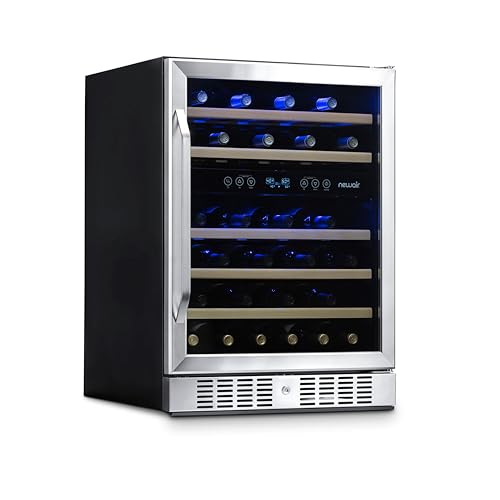
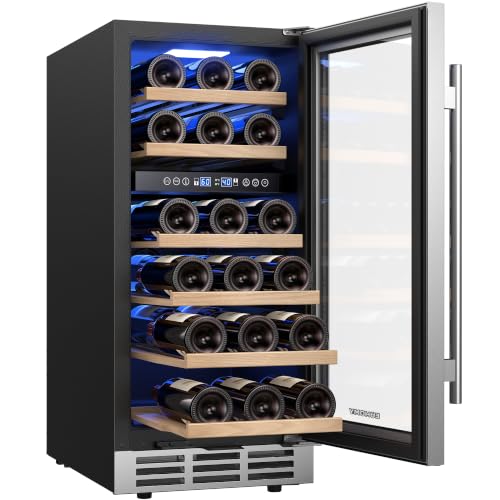
The Newair AWR-460DB is the best wine fridge for red and white wine: both of its zones are specified across the full published 40-66°F span, so you choose which half is cold and can serve whites at 45°F while reds sit at 62°F. For a 15-inch opening, the EUHOMY BC-90CU-E, which is also the budget pick with a fixed 40-55°F upper and 55-65°F lower split.
This page sits in Wine Fridges, where the rest of the category is compared the same way.
How this page is funded. Cork & Cool earns a commission if you buy through the Amazon links below, at no extra cost to you. It never changes the order of this list — see our editorial policy and affiliate disclosure. Prices come from Amazon and are refreshed daily; the price on Amazon when you buy is always the one that counts.
Quick picks
Every model below, on the specifications that decide the purchase. Tap a row to jump to the full write-up.
Comparison of wine storage models by zones, capacity, cooling type, width, published noise rating and vibration.
#
Product
Best for
Zones
Bottles
Cooling
Width
Noise
Vibration
Price
1
Newair AWR-460DBThe 24-inch slot
Forty-six bottles across two zones in a 23.4-inch cabinet rated for built-in or freestanding use
#ad — paid link. How this is funded. Price as of November 28, 2026; check Amazon for the current price.
3
Summit ALWC532PNRTwo zones behind a published panel
Forty-six bottles across two zones in a 24-inch panel-ready cabinet, with the recommended panel printed to the eighth of an inch and the viewable aperture published alongside it
#ad — paid link. How this is funded. Price as of November 28, 2026; check Amazon for the current price.
“Not published” means the manufacturer does not publish that figure. We do not estimate it. Prices and product photographs come from Amazon and are refreshed daily.
How we compared
We compared published manufacturer specifications, official product documentation and verified owner reports across 5 models. We do not physically test these units, we have no laboratory, and we do not accept payment for placement. Where a manufacturer does not publish a figure — noise ratings, most often — this page says so rather than estimating it.
What we weighted
Whether EACH compartment's published range covers a real service temperature — roughly 45-50°F for whites, 60-65°F for reds
Whether the split is adjustable or fixed at the factory, because a fixed split decides which half of your collection lives at eye level
Whether the maker publishes a per-zone bottle count, which almost none of them do and which decides whether your reds and whites actually fit
Published lower limit, since sparkling wine needs nearer 40°F than 46°F
Published upper limit, since a cabinet that stops at 64°F cannot hold a big red at the upper end of its service range
A published decibel figure where it exists — a cabinet serving two colours gets opened constantly and usually lives in a living space
Shelving that comes out, because a mixed collection is a mixed set of bottle shapes
Every model in detail
Five cabinets with two independently controlled compartments, checked against the two temperatures a red-and-white household actually needs rather than against the words on the box.
#1 — The 24-inch slot
Newair AWR-460DB
Forty-six bottles across two zones in a 23.4-inch cabinet rated for built-in or freestanding use — the default answer for a standard kitchen opening.
Product photograph via Amazon.
Published specifications
Capacity
46 bottles
Zones
2
Cooling
compressor
Temperature range
40–66°F
Noise rating
Not published by the manufacturer
Installation
both
· Exterior: 23.40 in W x 22.40 in D (24.00 in with handle) x 33.00 in H
Rated for built-in installation, so the front vent is designed for an enclosed opening
23.4-inch width drops into a standard 24-inch cabinet run
Two independently set zones across the full 40-66°F span
What does not
No published dB rating, so noise cannot be compared numerically against rivals
46 bottles is the manufacturer's count using standard Bordeaux bottles — heavy Burgundy or Champagne bottles reduce it
Who should skip it. Skip it if your opening is under 24 inches, or if you need more than about four dozen bottles — stepping up to a 160-bottle cabinet costs less per bottle.
#ad — paid link. How this is funded. Price as of November 28, 2026; check Amazon for the current price.
#2 — Two zones in a 15-inch gap
EUHOMY BC-90CU-E
Thirty-three bottles across two independently controlled zones in a 15-inch opening, with a published noise ceiling, a reversible door and a lock — the service specification rather than the storage one.
Product photograph via Amazon.
Published specifications
Capacity
33 bottles
Zones
2
Cooling
compressor
Temperature range
40–65°F
Noise rating
38 dB
Installation
both
· Exterior: 14.9 in W x 23 in D x 34.25 in H
· Capacity: 33 standard 750 ml bottles; no per-zone bottle count published
· Upper zone 40-55°F, lower zone 55-65°F, each independently controlled
· Noise published as "< 38 dB" — a ceiling, not an average
· Shelving: six removable wooden shelves, specified to reduce vibration
· Door: double-pane UV-protective glass in a stainless steel frame, reversible
· Security: lock with two keys
· Front-vented, so it is rated for a built-in opening or freestanding use
A published decibel ceiling, which most cabinets at this width do not give you
Reversible door, so the hinge side is not decided for you
A lock with two keys, which matters more in a bar than in a cellar
The upper zone reaches 40°F, cold enough for sparkling service
Front-vented and rated both ways, so an opening is optional rather than required
What does not
The zones are split at the factory — 40-55°F above, 55-65°F below — so the cold half is always the top one
No per-zone bottle count published, so how the 33 divides is unknown until it arrives
The published figure is "< 38 dB", a maximum rather than an average
EUHOMY publishes no wattage, amperage or net weight for this model
23 inches deep, which is deeper than the 22.4-inch cabinets at the same width
Who should skip it. Skip it if you only ever hold one temperature: the single-zone Whynter BWR-33SD at the same width holds the same 33 bottles on seven wooden shelves across a wider 40-72°F span. And skip it if you need the cold half at the bottom, because this split is fixed.
#ad — paid link. How this is funded. Price as of November 28, 2026; check Amazon for the current price.
#3 — Two zones behind a published panel
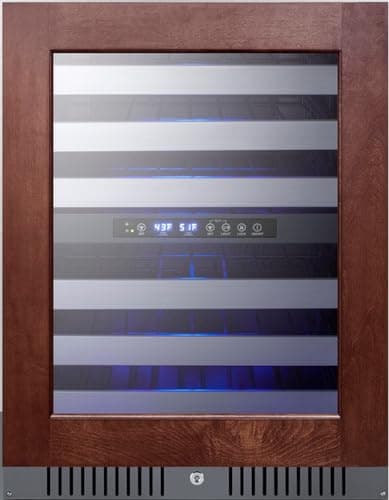
Summit ALWC532PNR
Forty-six bottles across two zones in a 24-inch panel-ready cabinet, with the recommended panel printed to the eighth of an inch and the viewable aperture published alongside it — which is what a cabinetmaker actually needs before quoting the door.
Product photograph via Amazon.
Published specifications
Capacity
46 bottles
Zones
2
Cooling
compressor
Temperature range
41–64°F
Noise rating
34 dB
Installation
built-in
· Exterior: 23.38 in W x 23.5 in D (24.25 in with the panel fitted) x 32.0 in H
· Depth with the door open at 90 degrees: 47.38 in
· Capacity: 46 bottles, or 30 Bordeaux and 16 wider Burgundy bottles
· Two zones: upper 41-50°F for whites and sparkling, lower 50-64°F for reds
· Shelving: 6 full-extension black wire shelves with stainless steel front trim
· Door: double-pane tempered glass in a panel-ready trim, reversible, right-hand swing as standard (Summit sells a dedicated left-hand model, ALWC532PNRLHD)
· Recommended panel: 3/4 in thick at 29 1/4 in H x 23 1/8 in W, with a 22 3/8 in H x 17 3/4 in W viewable area
· Sound level: 34 dB published
· Power: 1.25 A at 115 V AC / 60 Hz
· Weight: 113 lb
· Factory-installed lock with 2 keys; recessed LED lighting in both compartments
· Front-breathing with interior and exterior fans; automatic defrost
· ADA compliant at just under 32 in high
· ETL and ETL-C listed; ETL-S listed to NSF-7 for commercial establishments; CARB compliant
· Warranty: 1 year parts and labor, 5 years compressor
Two independently set zones behind a panel-ready door at a 24-inch width
Summit publishes the recommended panel size and thickness AND the viewable aperture, so the door can be quoted off a drawing before delivery
Six full-extension shelves rather than the flat half-depth shelves usual in this class
Reversible door, so the hinge side is not a purchasing decision you are stuck with
ETL-S listed to NSF-7, which is a commercial listing most domestic cabinets do not carry
ADA compliant at just under 32 inches, so it fits a lowered counter as well as a standard run
Factory-installed lock with two keys as standard
What does not
The 64°F ceiling is low for a red served warm, and the upper zone stops at 50°F — neither half covers the full span
At 23.5 in deep (24.25 in with the panel) it is a standard-depth cabinet, not one of Summit's shallow ones
Wire shelves, not wood
No handle, and no panel, included — both are separate joinery costs
Summit publishes no cubic-foot or litre figure for this model, only the bottle counts
34 dB is quiet but not the quietest published figure in this registry
Who should skip it. Skip it if your cabinet run is shallower than about 24 inches — this is a full-depth cabinet and the panel adds another three quarters of an inch in front of it. Skip it too if you serve reds above 64°F, because that is the top of the lower zone.
Fits the 15-inch cabinet opening most kitchens already have
Zone split is set up for service temperatures rather than long-term cellaring
Triple-tempered glass is a real insulation step over the usual double pane
What does not
Neither zone covers the whole 40-66°F span: the upper stops at 55°F and the lower starts at 50°F, so the split is fixed rather than something you set
29 bottles fills fast if you buy by the case
Who should skip it. Skip it if you want one cabinet at a single cellar temperature — the fixed 40-55°F upper zone means half the unit is always a serving zone.
#ad — paid link. How this is funded. Price as of November 28, 2026; check Amazon for the current price.
#5 — Wine and cans, equally
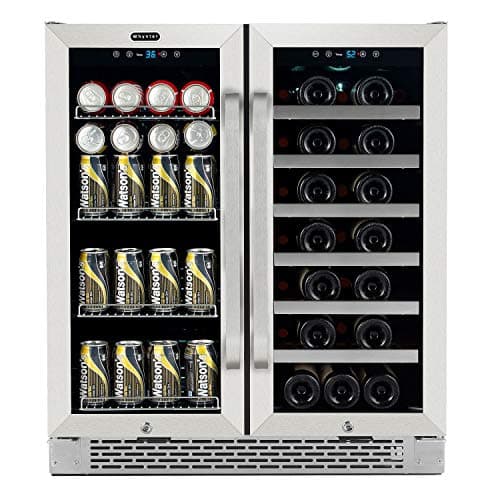
Whynter BWB-3388FDS
Thirty-three bottles on one side and 113 cans on the other, with both zones rated across the whole 36-72°F span — the only combination cabinet here that does not decide for you which half is the serious one.
Product photograph via Amazon.
Published specifications
Capacity
33 bottles
Zones
2
Cooling
compressor
Temperature range
36–72°F
Noise rating
38 dB
Installation
both
· Exterior: 29.75 in W x 22.25 in D (24.25 in with handles) x 34.00 in H
· Capacity: 33 standard 750 ml bottles in the right zone, 113 standard 12 oz cans in the left
· Both zones independently adjustable across 36-72°F / 2-22°C
· Cabinet storage: 6.0 cu ft
· Shelving: 10 removable pull-out sliding shelves — 6 stainless-trimmed wood in the wine zone, 4 chrome wire in the beverage zone
· Door: tempered double-pane gray-smoked glass for UV protection, French swing, NOT reversible
· Noise published as “under 38 dB” — a ceiling, not an average
· Power: 100 W / 0.9 A at 115 V, 60 Hz
· Weight: 120 lb net
· Cylinder lock with two keys; soft white LED interior lighting
Both zones cover the full 36-72°F range, so the wine side can hold cellar temperature while the other side gets genuinely cold
Six wood shelves on the wine side rather than wire, which is unusual in a combination cabinet
Gray-smoked double-pane glass is a real UV treatment rather than plain tempered glass
113 cans is the largest beverage half in this group by a wide margin
Publishes a decibel ceiling and a wattage figure, which most combination cabinets do not
What does not
Thirty inches wide — it will not drop into the standard 24-inch opening most kitchens have
The door is not reversible, so the French swing is fixed and the hinge sides are decided for you
Noise is published as a maximum rather than a measured average
Whynter's own page gives a per-shelf can breakdown that does not add up to the 113 total, so treat the can figure as nominal
Who should skip it. Skip it if your cabinet run is 24 inches. This is a 30-inch cabinet and no amount of wanting will shrink it — take the 24-inch Newair instead and accept the smaller can count.
#ad — paid link. How this is funded. Price as of November 28, 2026; check Amazon for the current price.
The test this page applies
A mixed household needs two temperatures at the same time: whites and rosé around 45–50°F, reds around 60–65°F. That is a wider gap than it sounds, and a great many dual-zone cabinets cannot span it, because their two compartments are specified over narrow fixed bands rather than across the whole range.
So the test here is simple and almost nobody applies it: take each cabinet’s per-zone published range and check that one zone reaches 50°F or below while the other reaches 60°F or above. Every cabinet on this page passes. Several cabinets sold as dual-zone do not.
Per-zone published ranges, and whether both service temperatures are reachable
Cabinet
Upper zone
Lower zone
Split
Whites at 45°F?
Reds at 62°F?
Newair AWR-460DB
40–66°F
40–66°F
Adjustable either way
Yes
Yes
EUHOMY BC-90CU-E
40–55°F
55–65°F
Fixed, cold on top
Yes
Yes
Summit ALWC532PNR
41–50°F
50–64°F
Fixed, cold on top
Yes
Yes, to 64°F
Newair AWR-290DB
40–55°F
50–66°F
Fixed, overlapping
Yes
Yes
Whynter BWB-3388FDS
36–72°F
36–72°F
Adjustable either way
Yes
Yes
Adjustable splits against fixed ones
Two cabinets here let you decide which half is cold. On the Newair AWR-460DB both compartments are specified across the full 40–66°F band; on the Whynter BWB-3388FDS both cover 36–72°F. That means you can put the reds at eye level and the whites underneath, or run both halves at 55°F and use the cabinet as a single-temperature cellar, or invert the whole thing after a kitchen rearrangement. It is a small freedom that turns out to matter, because the cold zone is the one you open most.
The other three have the split decided at the factory, always with the cold zone on top. The EUHOMY runs 40–55°F above and 55–65°F below; the Summit ALWC532PNR publishes 41–50°F for whites and sparkling above and 50–64°F for reds below; the Newair AWR-290DB runs 40–55°F above and 50–66°F below, and Newair is explicit that neither compartment covers the whole span. None of that is a fault — cold-on-top is the sensible default — but it is a constraint worth knowing before the cabinet is built into a run. Settings for each pattern are in dual-zone wine fridge temperature settings.
How the bottles divide, and who tells you
Here is the gap in this entire category: the published capacity is for the whole cabinet, not per compartment. A cabinet rated for 33 bottles might be 20 above and 13 below, and if your collection is two thirds red that is the wrong way round. Of the five cabinets here, exactly one publishes anything useful — Summit gives the ALWC532PNR’s 46 bottles as 30 Bordeaux plus 16 wider Burgundy bottles, which is the only per-shape breakdown any maker on this site prints. EUHOMY explicitly publishes no per-zone count.
The practical consequence is to buy more capacity than you think you need, because the division is not yours to choose. Why the headline number moves at all is covered in how many bottles does a wine fridge hold, and if your collection is genuinely large the better answer may be one cabinet at 55°F plus a chiller — argued in which wine fridge for 100 bottles of mixed red and white.
The case for one zone instead
It deserves a hearing, because for many mixed households it is the better buy. A single-zone cabinet at 55°F stores everything correctly, holds more bottles for the money because there is no divider, and has one failure point rather than two. You then chill a white for an hour before serving, or keep two or three in the kitchen fridge door. The trade is convenience against capacity, and it is argued properly in single zone against dual zone.
Two zones win when the cabinet is a serving cabinet: a home bar, a dining room, a kitchen where guests are poured from it. They lose when the cabinet is a cellar, because long-term storage wants one steady temperature and nothing else — see best wine fridges for long-term storage.
Fitting it, at two widths
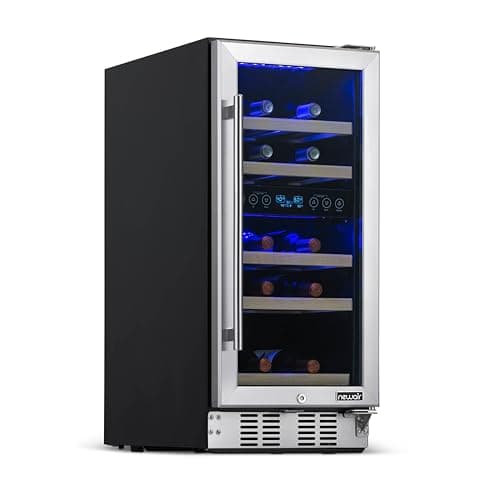
Four of these five are built around standard cabinetry. The Newair AWR-460DB is 23.4 inches wide and 24.0 inches deep with the handle; the Summit ALWC532PNR is 23.38 inches wide, just under 32 inches high and ADA compliant, with a 47.38-inch depth published for the door open at ninety degrees. The EUHOMY at 14.9 inches and the Newair AWR-290DB at 14.8 inches fit a 15-inch gap. The Whynter BWB-3388FDS is the outlier at 29.75 inches and needs a thirty-inch opening.
Buy the Newair AWR-460DB: 46 bottles, two zones you genuinely control across 40–66°F each, beechwood shelving, a 24-inch body. Nothing else here gives a mixed household that much freedom for the money. Buy the EUHOMY BC-90CU-E if the gap is 15 inches — cheapest here, with a published noise ceiling, a lock and a reversible door. Buy the Summit ALWC532PNR if the cabinet is going into finished joinery and you want the only per-shape bottle count anyone publishes. Buy the Newair AWR-290DB for triple-tempered glass at 15 inches. Buy the Whynter BWB-3388FDS if cans matter as much as bottles.
Questions people actually ask
▸ Can one wine fridge really hold reds and whites properly?
At service temperatures, yes, if it has two zones whose published ranges reach both targets. For long-term storage the better configuration is one zone at 55°F for everything, because stability matters more than readiness.
▸ Is the cold zone always on top?
On three of these five, yes, and it is fixed. The Newair AWR-460DB and the Whynter BWB-3388FDS specify both compartments across the full range, so you choose. Check the per-zone figures rather than the cabinet range before you commit to a layout.