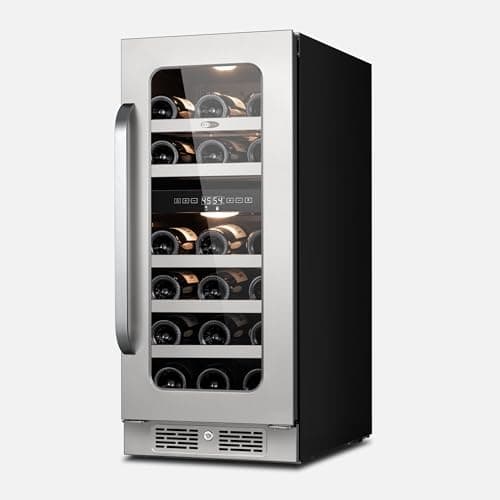
The Whynter BWR-33SD is the best wine fridge for red wine on published specification: its 40-72°F band is the widest in our registry, so it will hold reds at cellar temperature and bring them up to serving temperature in the same cabinet. For a larger collection at one steady setting, the single-zone Whynter BWR-1662SD holds 166 bottles across 40-65°F.
This page sits in Wine Fridges, where the rest of the category is compared the same way.
How this page is funded. Cork & Cool earns a commission if you buy through the Amazon links below, at no extra cost to you. It never changes the order of this list — see our editorial policy and affiliate disclosure. Prices come from Amazon and are refreshed daily; the price on Amazon when you buy is always the one that counts.
Quick picks
Every model below, on the specifications that decide the purchase. Tap a row to jump to the full write-up.
Comparison of wine storage models by zones, capacity, cooling type, width, published noise rating and vibration.
#
Product
Best for
Zones
Bottles
Cooling
Width
Noise
Vibration
Price
1
Whynter BWR-33SDThe 15-inch default
Thirty-three bottles in a 15-inch cabinet, with a published noise ceiling and seven wooden shelves
#ad — paid link. How this is funded. Price as of November 11, 2026; check Amazon for the current price.
“Not published” means the manufacturer does not publish that figure. We do not estimate it. Prices and product photographs come from Amazon and are refreshed daily; where a model is not sold on Amazon the thumbnail is an illustrative category photograph and the link is a search.
How we compared
We compared published manufacturer specifications, official product documentation and verified owner reports across 5 models. We do not physically test these units, we have no laboratory, and we do not accept payment for placement. Where a manufacturer does not publish a figure — noise ratings, most often — this page says so rather than estimating it.
What we weighted
Published upper temperature limit — the single specification that decides whether a cabinet can serve reds, not just store them
Whether the published range covers both cellar temperature and service temperature
Zone behavior: whether both zones span the full range, or whether one is locked to a cold band
Shelf spacing and removability, because Burgundy and Pinot Noir bottles are wider than the capacity figure assumes
Capacity, since reds are the half of a collection people actually lay down
What the manufacturer publishes about UV protection, which matters more for long storage than for service
Every model in detail
Ranked on the published upper limit first and capacity second. Any cabinet that stops in the low 60s can store reds; only a few can also bring them to the temperature you would want to pour.
#1 — The 15-inch default
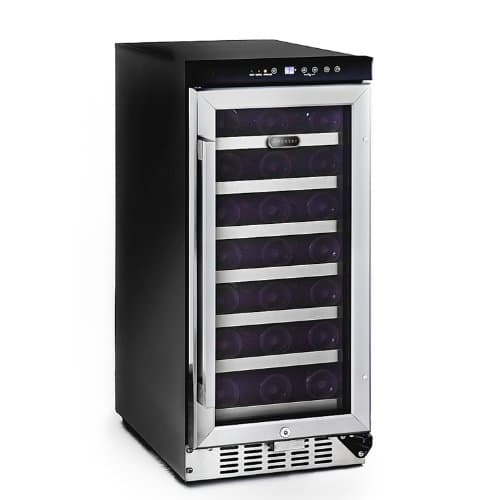
Whynter BWR-33SD
Thirty-three bottles in a 15-inch cabinet, with a published noise ceiling and seven wooden shelves — the capacity ceiling at this width, and the widest temperature band on this page.
Product photograph via Amazon.
Published specifications
Capacity
33 bottles
Zones
1
Cooling
compressor
Temperature range
40–72°F
Noise rating
42 dB
Installation
both
· Exterior: 15.0 in W x 22.5 in D (24.5 in with the handle installed) x 34.0 in H
· Capacity: 33 standard 750 ml bottles
· Noise published as "< 42 dBA" — a ceiling, not an average
Thirty-three bottles is the highest published capacity at this width
Whynter publishes a decibel ceiling, which almost nobody in this category does
Seven wooden shelves rather than the wire shelving usual at this price
40-72°F is the widest published band here, so it will also hold a bottle at room temperature
Rated for built-in or freestanding use, so an opening is optional rather than required
What does not
Single zone only — one temperature for the whole cabinet
The published figure is "< 42 dBA", a maximum rather than an average, so it cannot be compared like-for-like against a manufacturer quoting a flat number
At 15.0 inches published it is the widest cabinet in this group, which matters if your opening is tight
Depth grows to 24.5 inches once the handle is on, which is the figure that matters in a shallow run
33 bottles assumes standard Bordeaux shapes; a Burgundy-heavy collection will fit fewer
Who should skip it. Skip it if you need to serve whites cold and hold reds at cellar temperature in the same cabinet — one zone cannot do both. Skip it too if your opening measures under 15 inches, because this is the one cabinet here that needs the full module.
#ad — paid link. How this is funded. Price as of November 11, 2026; check Amazon for the current price.
#2 — An 18-inch-deep run
Summit SDHW1532
Eighteen inches deep instead of the usual twenty-two and a half — the answer when the cabinet run is shallow and every other 15-inch cabinet sticks out.
Illustrative photograph — not an image of the Summit SDHW1532.
Published specifications
Capacity
18 bottles
Zones
1
Cooling
compressor
Temperature range
41–68°F
Noise rating
Not published by the manufacturer
Installation
both
· Exterior: 33.75 in H x 14.75 in W x 18.0 in D (19.75 in D with the handle)
· Shelving: six removable steel shelves in black with stainless trim
Rated for built-in installation, so the front vent is designed for an enclosed opening
23.4-inch width drops into a standard 24-inch cabinet run
Two independently set zones across the full 40-66°F span
What does not
No published dB rating, so noise cannot be compared numerically against rivals
46 bottles is the manufacturer's count using standard Bordeaux bottles — heavy Burgundy or Champagne bottles reduce it
Who should skip it. Skip it if your opening is under 24 inches, or if you need more than about four dozen bottles — stepping up to a 160-bottle cabinet costs less per bottle.
#ad — paid link. How this is funded. Price as of November 11, 2026; check Amazon for the current price.
#5 — Two zones, either way round
Whynter BSR-029DW
Twenty-nine bottles split ten over nineteen across two zones that each cover the whole 40-65°F range — so either half can hold a red, which the other dual-zone cabinet at this width cannot.
Product photograph via Amazon.
Published specifications
Capacity
29 bottles
Zones
2
Cooling
compressor
Temperature range
40–65°F
Noise rating
38 dB
Installation
both
· Exterior: 14.8 in W x 22.4 in D x 33.9 in H
· Internal volume: 3.0 cu ft
· Capacity: 29 standard 750 ml bottles — 10 in the upper zone, 19 in the lower
· Both zones: 40-65°F / 5-18°C
· Noise published as "< 38 dB" — a ceiling, not an average
· Shelving: five removable beechwood shelves
· Door: seamless stainless-trimmed double tempered UV-resistant glass, reversible, cylinder lock with two keys
Both zones are rated across the full 40-65°F span, so the split is yours to set rather than the factory's
Whynter publishes a decibel ceiling, which the other dual-zone cabinet at this width does not
14.8 inches wide and 22.4 inches deep, the shallowest of the full-depth cabinets here
Beechwood shelves and a reversible door, so the hinge side is not decided for you
Rated for built-in or freestanding use, so an opening is optional rather than required
What does not
Twenty-nine bottles against thirty-three for the single-zone cabinets — the divider costs four
The upper zone holds only ten bottles, so the split is lopsided whichever way you use it
The published figure is "< 38 dB", a maximum rather than an average
29 bottles assumes standard Bordeaux shapes; a Burgundy-heavy collection will fit fewer
Who should skip it. Skip it if you only ever hold one temperature. The divider costs four bottles and a whole zone of shelf space, and a single-zone cabinet at this width gives both back.
#ad — paid link. How this is funded. Price as of November 11, 2026; check Amazon for the current price.
The two temperatures reds need
A red wine has two temperatures, and the gap between them is where most wine fridges fail.
Storage wants somewhere around the mid-50s Fahrenheit, held steady. That is the cellar temperature the whole category is built around, and almost every cabinet in our registry can reach it. Steadiness matters more than the exact figure: a cabinet that holds 57°F year-round is doing a better job than one that averages 55°F by swinging between 50 and 60.
Service wants warmer. The phrase “room temperature” comes from rooms that were a good deal cooler than modern heated ones, and a red served at 72°F tastes flabby and alcoholic. The usual advice puts lighter reds in the low 60s and fuller ones in the mid 60s, which means a cabinet that stops at 64 or 65°F can get a red most of the way there and a cabinet that stops at 66 or higher can do it properly.
This is why the upper limit is the specification to shop on, and it is the one nearly every buying guide ignores in favor of how cold the unit goes. If you only ever store reds and pull them out an hour before dinner, the floor is irrelevant to you. The full temperature discussion is in wine storage temperature, and what to actually set your wine fridge to turns it into dial positions.
Published ranges, ranked by upper limit
Published temperature ranges for the cabinets on this page
Model
Published range
Zones
Bottles
Whynter BWR-33SD
40-72°F
1
33
Summit SDHW1532
41-68°F
1
18
Newair AWR-460DB
40-66°F
2
46
Whynter BWR-1662SD
Low 40s to mid 60s °F
1
166
Whynter BSR-029DW
40-65°F, both zones
2
29
The Whynter BWR-33SD tops this table because 72°F is genuinely unusual: it means the cabinet will hold a bottle at ordinary room temperature if you ask it to, which no other unit in our registry publishes. The Summit at 68°F is the next most useful. Below that you are into cabinets that store reds correctly and need you to finish the job on the counter.
Why a dual-zone cabinet can be the wrong buy
The obvious answer to “I drink reds and whites” is a dual-zone cabinet, and it is often right. But read the zone specification before you assume it is.
Some dual-zone cabinets lock their upper zone to a cold band. The Newair AWR-290DB, for example, publishes an upper zone of 40–55°F and a lower zone of 50–66°F — the top half reaches cellar temperature only at its ceiling and can never hold a red any warmer, by design. If most of your collection is red, the top half of that cabinet is working at the end of its range.
The cabinets that avoid the trap publish the same range on both zones. The Whynter BSR-029DW states 40–65°F on each zone, so either half can hold reds and the split is yours to decide. The Newair AWR-460DB publishes 40–66°F across both. That is the specification to look for, and it is why those two are on this page and the locked-band cabinets are not. Dual-zone temperature settings goes into how to configure one once it arrives, and single zone versus dual zone makes the case that a red-heavy collection often wants one zone and more bottles.
Bottle shape costs more capacity than you think
Red wine is where bottle shape stops being trivia. Bordeaux bottles are straight-sided with high shoulders and nest neatly; every published capacity figure in this category assumes them. Burgundy and Pinot Noir bottles have sloping shoulders and a wider base, and they do not nest at all.
The practical effect is that a shelf designed for six Bordeaux may take four Burgundies, and a 46-bottle cabinet holding a Burgundy-heavy collection is closer to a 32-bottle one. Two features matter if that describes your cellar:
Removable shelves. Taking out alternate shelves gives you tall rows for wide bottles. Summit explicitly states that removing alternate shelves on the SWC1535B makes room for wider Burgundy bottles, which is the kind of honesty most listings skip.
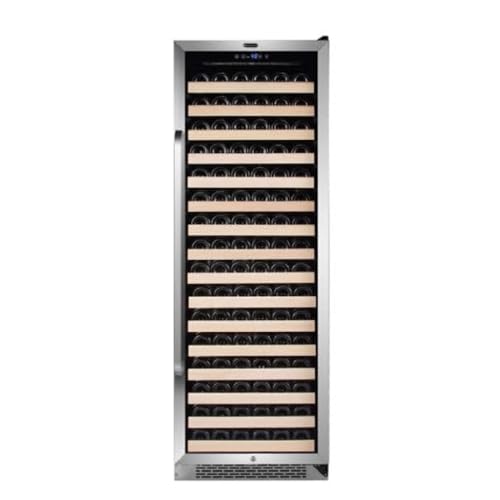
Slide-out shelving. The Whynter BWR-1662SD publishes sixteen removable wooden slide-out shelves. In a 166-bottle cabinet that is the difference between a collection you can use and a wall of glass you dig through.
If reds are most of what you own and the collection is modest, the Whynter BWR-33SD is the cabinet: one zone, 33 bottles, seven wooden shelves, and the widest published band here. If the run is shallow, the Summit SDHW1532 gives up fifteen bottles to fit an 18-inch-deep cabinet and still publishes 68°F at the top.
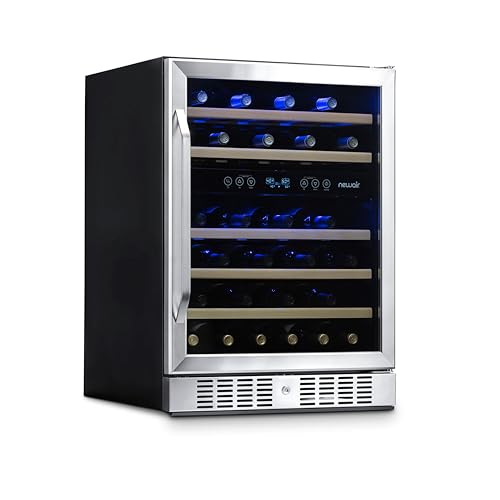
If you need both reds and whites in one cabinet in a 24-inch opening, the Newair AWR-460DB is the standard answer, with two zones that both reach 66°F. And if the collection is the point — cases laid down rather than bottles bought for the week — the single-zone Whynter BWR-1662SD is the honest choice at 166 bottles, because long storage wants one steady setting and uniform shelf spacing, not a partition. The long-term storage roundup makes that case at length, and can you age wine in a wine fridge is the honest answer on what a cabinet can and cannot replace.
Questions people actually ask
▸ What temperature should a wine fridge be for red wine?
Store reds in the mid-50s Fahrenheit and hold it steady; serve lighter reds in the low 60s and fuller ones in the mid 60s. That means the cabinet’s published upper limit matters more than its floor — a unit that stops at 65°F can store reds properly but cannot bring one all the way to serving temperature.
▸ Can you keep red wine in a wine fridge?
Yes, and it is the better place for it than a kitchen cupboard, which swings with the room. The thing to check is that the cabinet’s range reaches into the 60s, because a fridge designed around chilling whites will hold reds colder than you want to drink them.
▸ Do I need a dual-zone wine fridge if I mostly drink red?
Usually not. A single zone gives you uniform shelf spacing, no internal partition and more bottles for the same money. A dual-zone cabinet earns its place only if you regularly serve whites straight from the unit — and if you do buy one, check that both zones span the full range rather than one being locked to a cold band.
▸ How many Burgundy bottles will a 46-bottle wine fridge hold?
Fewer than 46, and the manufacturer will not tell you how many. Published capacities assume standard Bordeaux bottles; Burgundy and Pinot Noir bottles are wider with sloping shoulders and do not nest. Plan on roughly a third fewer, and favor cabinets whose shelves come out so you can make tall rows.
▸ Is a wine fridge too cold for red wine?
Only if you treat it as a serving cabinet and pour straight from it. Set to the mid-50s it is exactly right for storage. If you want to pour without planning ahead, buy a cabinet whose published range reaches 66°F or higher, or take the bottle out twenty minutes before dinner.