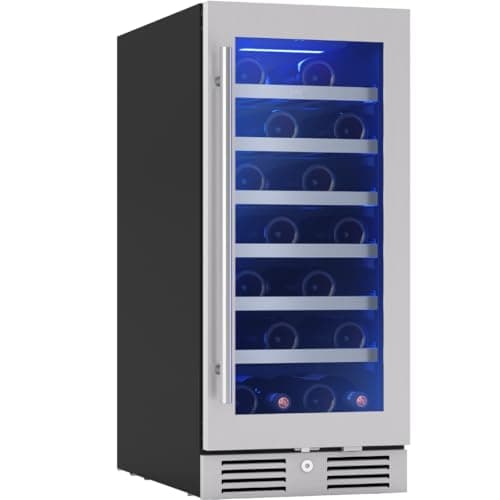
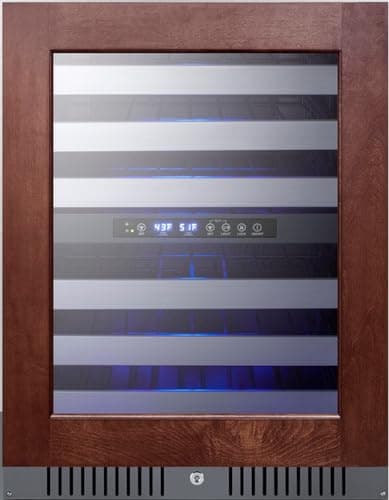
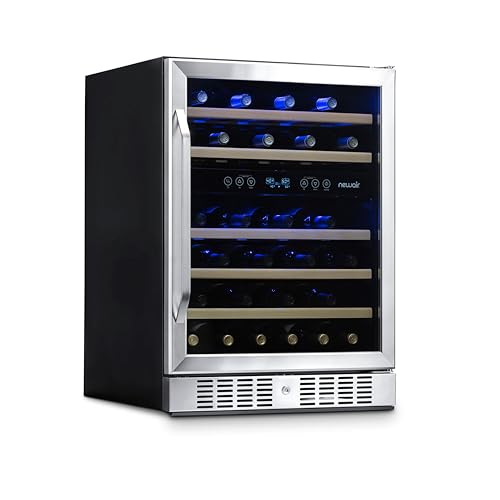
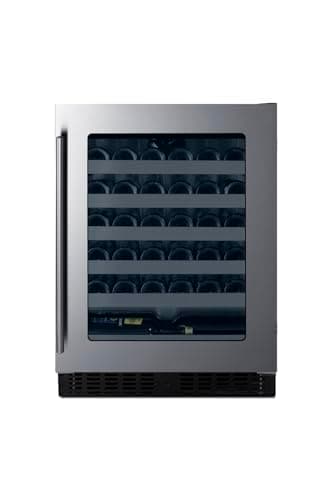
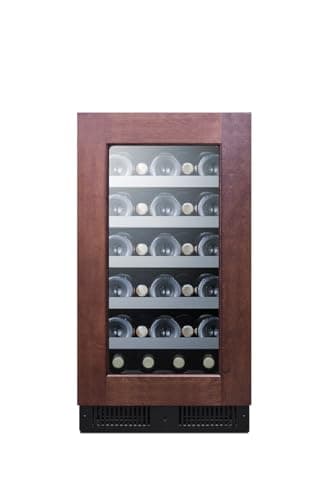
The Zephyr Presrv PRW15C01CG is the best integrated wine fridge: a field-reversible door on concealed zero-clearance hinges, front-breathing, Energy Star certified, 39 dBA published, in a 15-inch body rated for built-in or freestanding use. For a 24-inch opening behind your own door panel, the Summit ALWC532PNR, the only cabinet here that publishes the panel and aperture dimensions. The budget pick is the Newair AWR-460DB.
How this page is funded. Cork & Cool earns a commission if you buy through the Amazon links below, at no extra cost to you. It never changes the order of this list — see our editorial policy and affiliate disclosure. Prices come from Amazon and are refreshed daily; the price on Amazon when you buy is always the one that counts.
Quick picks
Every model below, on the specifications that decide the purchase. Tap a row to jump to the full write-up.
Comparison of wine storage models by zones, capacity, cooling type, width, published noise rating and vibration.
#
Product
Best for
Zones
Bottles
Cooling
Width
Noise
Vibration
Price
1
Zephyr Presrv PRW15C01CGStorage, not just chilling
Twenty-seven bottles, a published 39 dBA, and the only cabinet in this width whose maker documents a vibration dampening system
1
27
compressor
15"
39 dB
Zephyr specifies a vibration dampening system intended to minimize wine disturbance
#ad — paid link. How this is funded. Price as of November 28, 2026; check Amazon for the current price.
2
Summit ALWC532PNRTwo zones behind a published panel
Forty-six bottles across two zones in a 24-inch panel-ready cabinet, with the recommended panel printed to the eighth of an inch and the viewable aperture published alongside it
#ad — paid link. How this is funded. Price as of November 28, 2026; check Amazon for the current price.
“Not published” means the manufacturer does not publish that figure. We do not estimate it. Prices and product photographs come from Amazon and are refreshed daily.
How we compared
We compared published manufacturer specifications, official product documentation and verified owner reports across 5 models. We do not physically test these units, we have no laboratory, and we do not accept payment for placement. Where a manufacturer does not publish a figure — noise ratings, most often — this page says so rather than estimating it.
What we weighted
Hinge type: a concealed or zero-clearance hinge is what lets a door sit flush against neighbouring cabinetry instead of needing a reveal
Front venting, because an integrated cabinet is sealed on five sides by definition
Whether the maker publishes the panel and viewable-aperture dimensions a cabinetmaker needs to quote a door
Published depth with the panel or handle fitted, and door-open depth where it exists, since an integrated cabinet has to align with a counter overhang
Published height, including whether legs or a kickplate adjust it to the plinth line
Whether the door is reversible or a dedicated left-hand model exists, because an integrated run usually dictates the swing
A published decibel figure, since cabinetry reflects compressor noise forward rather than absorbing it
Whether the cabinet may also stand free, which protects the purchase if the joinery changes
Every model in detail
Five cabinets ranked on integration detail rather than on finish. Where a maker publishes a hinge type, a panel size or an aperture, we quote it; where it does not, that absence is the finding.
#1 — Storage, not just chilling
Zephyr Presrv PRW15C01CG
Twenty-seven bottles, a published 39 dBA, and the only cabinet in this width whose maker documents a vibration dampening system — you are paying for the storage conditions, not the bottle count.
Product photograph via Amazon.
Published specifications
Capacity
27 bottles
Zones
1
Cooling
compressor
Temperature range
38–65°F
Noise rating
39 dB
Installation
both
· Exterior: 15 in W x 33-7/8 in H x 23-3/8 in D
· Capacity: 27 bottles (750 ml), 3.4 cu ft
· Sound level: 39 dBA published
· Racking: six full-extension black wood racks with stainless trim
· Glass: dual-pane, Low-E, argon-filled
· Field-reversible door with concealed zero-clearance hinges, door lock, door-open alarm
· Energy Star certified; Sabbath mode; carbon-filtered air filtration
· Weight: 101 lb · Power: 115 V, 60 Hz at max 1.5 A
· Warranty: 2 years parts and labor, 5 years compressor
The only 15-inch cabinet here whose manufacturer documents vibration control at all
Publishes a flat decibel figure rather than a ceiling, so it can be compared properly
Reaches 38°F, the lowest published minimum in this group, which matters for sparkling wine
Full-extension racks mean you can reach a bottle at the back without unloading the shelf
Five-year compressor warranty against the usual one or two
What does not
Twenty-seven bottles against thirty-three for the same width — the racks take the space
23-3/8 inches deep, the deepest cabinet in this group
Costs materially more than the Whynter and Summit cabinets it sits beside
Who should skip it. Skip it if the wine is going to be drunk within a year or two. Vibration control and a 38°F floor are long-storage features, and you can have eight more bottles for less money without them.
#ad — paid link. How this is funded. Price as of November 28, 2026; check Amazon for the current price.
#2 — Two zones behind a published panel
Summit ALWC532PNR
Forty-six bottles across two zones in a 24-inch panel-ready cabinet, with the recommended panel printed to the eighth of an inch and the viewable aperture published alongside it — which is what a cabinetmaker actually needs before quoting the door.
Product photograph via Amazon.
Published specifications
Capacity
46 bottles
Zones
2
Cooling
compressor
Temperature range
41–64°F
Noise rating
34 dB
Installation
built-in
· Exterior: 23.38 in W x 23.5 in D (24.25 in with the panel fitted) x 32.0 in H
· Depth with the door open at 90 degrees: 47.38 in
· Capacity: 46 bottles, or 30 Bordeaux and 16 wider Burgundy bottles
· Two zones: upper 41-50°F for whites and sparkling, lower 50-64°F for reds
· Shelving: 6 full-extension black wire shelves with stainless steel front trim
· Door: double-pane tempered glass in a panel-ready trim, reversible, right-hand swing as standard (Summit sells a dedicated left-hand model, ALWC532PNRLHD)
· Recommended panel: 3/4 in thick at 29 1/4 in H x 23 1/8 in W, with a 22 3/8 in H x 17 3/4 in W viewable area
· Sound level: 34 dB published
· Power: 1.25 A at 115 V AC / 60 Hz
· Weight: 113 lb
· Factory-installed lock with 2 keys; recessed LED lighting in both compartments
· Front-breathing with interior and exterior fans; automatic defrost
· ADA compliant at just under 32 in high
· ETL and ETL-C listed; ETL-S listed to NSF-7 for commercial establishments; CARB compliant
· Warranty: 1 year parts and labor, 5 years compressor
Two independently set zones behind a panel-ready door at a 24-inch width
Summit publishes the recommended panel size and thickness AND the viewable aperture, so the door can be quoted off a drawing before delivery
Six full-extension shelves rather than the flat half-depth shelves usual in this class
Reversible door, so the hinge side is not a purchasing decision you are stuck with
ETL-S listed to NSF-7, which is a commercial listing most domestic cabinets do not carry
ADA compliant at just under 32 inches, so it fits a lowered counter as well as a standard run
Factory-installed lock with two keys as standard
What does not
The 64°F ceiling is low for a red served warm, and the upper zone stops at 50°F — neither half covers the full span
At 23.5 in deep (24.25 in with the panel) it is a standard-depth cabinet, not one of Summit's shallow ones
Wire shelves, not wood
No handle, and no panel, included — both are separate joinery costs
Summit publishes no cubic-foot or litre figure for this model, only the bottle counts
34 dB is quiet but not the quietest published figure in this registry
Who should skip it. Skip it if your cabinet run is shallower than about 24 inches — this is a full-depth cabinet and the panel adds another three quarters of an inch in front of it. Skip it too if you serve reds above 64°F, because that is the top of the lower zone.
Rated for built-in installation, so the front vent is designed for an enclosed opening
23.4-inch width drops into a standard 24-inch cabinet run
Two independently set zones across the full 40-66°F span
What does not
No published dB rating, so noise cannot be compared numerically against rivals
46 bottles is the manufacturer's count using standard Bordeaux bottles — heavy Burgundy or Champagne bottles reduce it
Who should skip it. Skip it if your opening is under 24 inches, or if you need more than about four dozen bottles — stepping up to a 160-bottle cabinet costs less per bottle.
Under 18 inches deep, which solves the most common undercounter fit problem
The only unit here designed around ADA counter height
Height adjusts to standard counters too, so it is not a single-use product
What does not
33 bottles is the price of the shallow depth
Summit does not publish a temperature range in this listing
Who should skip it. Skip it if your cabinet run is a standard 24 inches deep and you want the capacity — a full-depth unit in the same opening holds 13 more bottles.
#ad — paid link. How this is funded. Price as of November 28, 2026; check Amazon for the current price.
#5 — An 18-inch panel-ready gap
Summit CL18WCPNR
Twenty-nine bottles in a 17.5-inch cabinet with a panel-ready frame and a published 32.5 dB — the narrow answer when the run has no 24-inch space left.
Product photograph via Amazon.
Published specifications
Capacity
29 bottles
Zones
1
Cooling
compressor
Temperature range
41–72°F
Noise rating
32.5 dB
Installation
both
· Exterior: 17.5 in W x 23.5 in D (25.38 in with handle) x 33.75 in H
· Capacity: 2.9 cu ft (82 L), stated as 29 bottles
· Single zone; temperature range 41 to 72°F
· Shelving: 5 removable steel shelves in black with stainless trim, flat design
· Door: glass/panel-ready frame over double-pane tempered glass
· Recommended panel: 3/4 in thick at 30 in H x 17 3/8 in W with a 3 1/4 in x 3 1/4 in inner frame
· Sound level: 32.5 dB published
· Power: 1.0 A at 115 V AC / 60 Hz
· Weight: 88 lb
· Factory-installed keyed lock in the kickplate (optional upgrade); white LED side-wall lighting
· ETL, ETL-C, STAR-K certified; CARB compliant
· Warranty: 1 year parts and labor, 5 years compressor
32.5 dB is the lowest published noise figure of any cabinet in this registry
Twenty-nine bottles out of a 17.5-inch cabinet is good capacity per inch for a panel-ready unit
Panel dimensions published to the eighth of an inch
Range runs to 72°F, the widest top end here, which suits a room that is not climate controlled
Eighty-eight pounds — light enough for two people to set into an opening
What does not
Only 29 bottles, and a single zone
Steel shelves rather than wood
The lock is an optional upgrade rather than standard
At 23.5 in deep (25.38 in with the handle) it is deeper than the shallow Summit cabinets, so check the carcass
Who should skip it. Skip it if you have a 24-inch opening available. The narrow cabinet costs you bottles per dollar, and that trade only makes sense when the width is genuinely not there.
#ad — paid link. How this is funded. Price as of November 28, 2026; check Amazon for the current price.
What integrated actually means
“Integrated” is used loosely in this category, so here is the working definition this page uses: a cabinet is integrated when it can sit inside a run of cabinetry with its front aligned to the neighbouring doors, drawing and expelling air through the front, with no visible gap for ventilation and no reveal around the door. That is three separate engineering facts — a hinge, a vent and a dimension set — and a stainless finish is none of them.
It is also not the same thing as panel-ready, although the two overlap. Panel-ready is about the door: the cabinet accepts a custom panel so it matches your cabinetry exactly. Integrated is about the installation: the cabinet fits flush and vents forward. A panel-ready cabinet is usually integrated; an integrated cabinet is not necessarily panel-ready, and three of the five picks here are not. The door side of the question is ranked separately in best panel-ready wine fridges.
Published integration detail, every pick
Cabinet
Hinge / door
Venting
Panel dimensions published
Width
Noise
Zephyr Presrv PRW15C01CG
Field-reversible, concealed zero-clearance hinges
Front-breathing
Not panel-ready
15 in
39 dBA
Summit ALWC532PNR
Reversible, right-hand standard; LHD model sold separately
Front-breathing, interior and exterior fans
Yes — panel and viewable area
23.38 in
34 dB
Newair AWR-460DB
Not published
Front vent, built-in rated
Not panel-ready
23.4 in
Not published
Summit ASDW2412
Not published
Built-in rated
Not panel-ready
24 in
Not published
Summit CL18WCPNR
Panel-ready door
Built-in rated
Panel-ready
17.5 in
Not published
Hinges: the specification nobody lists
The hinge is what decides whether a cabinet can be integrated, and it is almost never in a retail listing. A standard appliance hinge swings the door out and away, which needs a reveal — a gap — around the door so it clears the cabinetry beside it. A concealed zero-clearance hinge lets the door open with its edge almost touching the neighbour, which is what makes a flush run possible.
Exactly one cabinet on this site publishes it: the Zephyr Presrv PRW15C01CG, whose door is field-reversible on concealed zero-clearance hinges, with a door-open alarm and a door lock. That single line is why it tops this page, and it comes with a package that makes sense for an integrated installation anyway: a published 39 dBA, dual-pane Low-E argon-filled glass, six full-extension racks, Energy Star certification, Sabbath mode, carbon-filtered air and a five-year compressor warranty, at 15 inches wide and 33-7/8 inches high.
Everyone else publishes the door’s reversibility but not the hinge geometry. Summit publishes that the ALWC532PNR’s door is reversible with a right-hand swing as standard and that a dedicated left-hand model, the ALWC532PNRLHD, exists — which for an integrated run is the more useful fact, because reversing a door on site and ordering the correct swing are not the same job. The practical sequence is in wine fridge reversible door.
Panel-ready against stainless, and the numbers to ask for
If the cabinet is to disappear completely, it needs your door. Two picks here take one: the Summit ALWC532PNR and the Summit CL18WCPNR.
Only one of them publishes what to make. Summit prints the ALWC532PNR’s recommended panel as 3/4 inch thick at 29 1/4 inches high by 23 1/8 inches wide, with a 22 3/8 by 17 3/4 inch viewable area, and the depth with the door open at ninety degrees as 47.38 inches. Those are the figures a cabinetmaker asks for before quoting, and a maker who cannot supply them is asking you to pay for a guess. The CL18WCPNR is the 17.5-inch panel-ready cabinet for an 18-inch gap, with 29 bottles at one temperature across a published 41–72°F span.
The other three integrate as finished cabinets rather than behind a panel. The Newair AWR-460DB is the budget route: 46 bottles, two zones each across 40–66°F, 23.4 inches wide and 24.0 inches deep with the handle, built-in rated. The Summit ASDW2412 is the specialist: 24 inches wide and under 18 inches deep, which solves the shallow-run problem that defeats most integration plans, at 32 inches high with legs and a sliding kickplate cover that raise it to 34.
The plinth line, the overhang and the swing
Three dimensions decide whether an integrated installation looks integrated or looks wrong.
The plinth line. Cabinetry sits on a recessed plinth; an appliance usually sits on the floor. A cabinet with adjustable legs and a kickplate cover — the ASDW2412 and the ALWC532PNR are both just under 32 inches and ADA compliant — can be lifted to align with the surrounding doors instead of sitting proud at the bottom.
The counter overhang. A base run is about 24 inches deep with the counter overhanging by roughly an inch, so a cabinet measuring more than about 24 inches with its handle or panel fitted will not sit flush. The ALWC532PNR is 23.5 inches deep and 24.25 with the panel on; the Newair is 24.0 with the handle.
Integration makes noise worse, not better. Cabinetry is a hard reflective box that pushes compressor noise forward into the room instead of letting it disperse. So a published figure is worth more on an integrated cabinet than on a freestanding one, and only two picks here have one: Summit’s flat 34 dB on the ALWC532PNR, which is the lowest number on this site, and Zephyr’s 39 dBA.
The other three publish nothing, which is the category norm and not a mark against them — but it does mean the noise of an enclosed installation is an unknown until it is installed. The figures that exist are collected in best quiet wine fridges, and what they mean in a room is in wine fridge noise explained.
Which one to buy
Buy the Zephyr Presrv PRW15C01CG if the cabinet must sit flush in a 15-inch slot: concealed zero-clearance hinges, a reversible door, front breathing and a published decibel figure is the complete integration specification, and nothing else here publishes the hinge. Buy the Summit ALWC532PNR for a 24-inch opening behind your own panel, with the only published panel and aperture dimensions in the group. Buy the Newair AWR-460DB for the most capacity per dollar in a flush 24-inch installation. Buy the Summit ASDW2412 if the run is shallow or the counter is ADA height. Buy the Summit CL18WCPNR for an 18-inch gap.
Questions people actually ask
▸ What is the difference between built-in and integrated?
Built-in is a ventilation rating: the cabinet may be enclosed because it vents forward. Integrated is an installation outcome: the cabinet sits flush in a run with no reveal and no visible vent. Every integrated cabinet is built-in rated; not every built-in cabinet integrates cleanly.
▸ Do I need a panel-ready model to integrate a wine fridge?
No. A panel-ready door makes the cabinet match your joinery exactly, but a stainless cabinet with front venting and a flush-fitting door integrates perfectly well in a kitchen whose other appliances are also stainless.