What panel-ready actually means
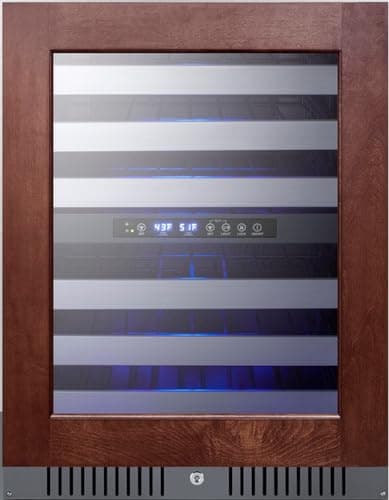
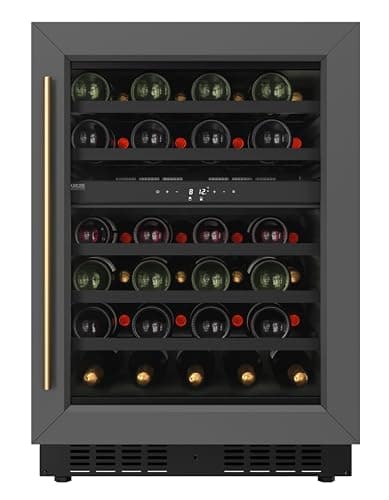
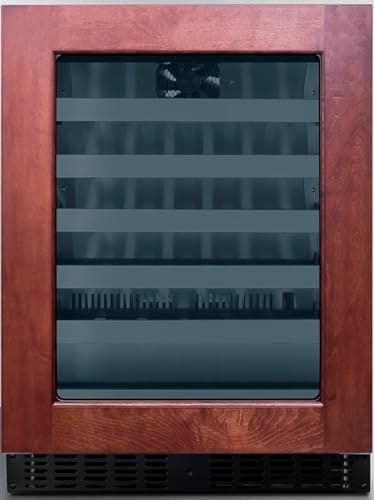
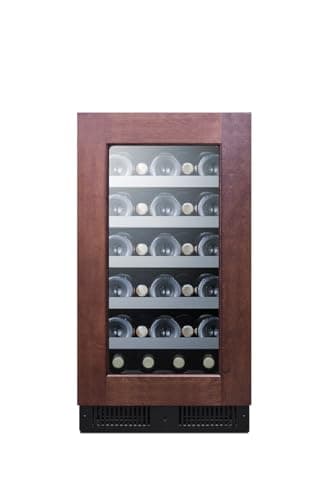
A panel-ready wine fridge ships without a finished front. Instead of a stainless or glass door, you get a door frame — usually with a bracket kit — designed to accept a custom panel made from the same material as the rest of your cabinetry. Fitted properly, the cabinet disappears: a run of kitchen doors with a wine cabinet behind one of them.
That is the appeal, and it is a real one. It is also the reason this class is bought on a different specification from every other wine fridge. With a stainless cabinet you are buying a finished product. With a panel-ready cabinet you are buying two thirds of a product and commissioning the rest, which means the question is not just “is this a good fridge?” but “can my cabinetmaker build the missing part without guessing?”
Three terms get used loosely and are worth separating:
- Panel-ready — the door frame accepts a custom overlay panel. This page is about these.
- Integrated — usually the same idea, sometimes meaning only that the cabinet is flush-fitting with a stainless front. Ask which is meant.
- Built-in — a ventilation specification, not an appearance one. It means the cabinet exhausts through the front and may be enclosed. Almost every panel-ready unit is built-in rated, but plenty of built-in units are not panel-ready. Built-in versus freestanding covers that distinction properly, and ventilation clearance has the air-gap figures.
The published panel size is the whole ranking
Here is the thing that decided the order of this page. Your cabinetmaker cannot quote, cut or hang a door panel without three numbers: the panel height, the panel width and the panel thickness. If the manufacturer publishes them, the joinery is a half-day job quoted off a drawing. If it does not, someone has to take delivery of the cabinet, measure the frame, and build to those measurements — which means the panel cannot be made until after the appliance has arrived, and that is a scheduling problem in the middle of a kitchen install.
Summit publishes these figures for every panel-ready model in its line:
Note that all three Summit panels are 3/4 inch thick, and two of the three share the same 3 1/4 inch inner frame, which tells you something useful: this is standard cabinet-door stock, not a special order. The ALWC532PNR is specified differently — Summit gives the panel size and then the viewable aperture inside it rather than a frame width — which is arguably the more useful of the two, because the aperture is what you see. Either way, a joiner reading that table can price the door over the phone.
KoolMore and Dacor both build good cabinets and neither publishes the panel geometry. That is not a reason to rule them out, but it is a real cost in coordination, and it is why the Summit cabinets rank above them here despite steel and wire shelving. We rank what is published, which is the standing rule across this site.
Handles, hinges and the weight you are adding
Two mechanical details get overlooked in this class, and both show up months after the install.
The handle is usually not included. Summit’s panel-ready pages do not state that a handle ships with the panel kit, and KoolMore states plainly that the door handle is not included. This is deliberate — the point of a panel-ready door is that it carries your cabinetry’s hardware, not the appliance maker’s. Budget for it, and order it with the rest of your door pulls so the finish matches.
A wood panel is heavy, and the hinge carries it for a decade. A 3/4-inch hardwood panel at 29 by 23 inches is a meaningful mass hanging off a door that gets opened several times a day. This is where the KoolMore earns its place: it specifies a self-closing door on an articulated hinge, which is the construction designed for exactly this load. If a panel-ready cabinet says nothing about its hinge, assume a standard one and expect to adjust the door’s alignment at some point.
A third detail, easy to get wrong at the planning stage: door swing, and in this class it is frequently not a setting but a separate product code. The Summit ALWC532PNR and ASDW2412PNR both ship right-hand-swing and are both reversible, so you can change your mind; Summit also sells a dedicated left-hand ALWC532PNRLHD if you would rather not. The KoolMore is reversible. Elsewhere in Summit’s panel-ready line the two hinge sides are genuinely two different models with two different stock positions, so decide the hinge side before you order — a custom panel with an edge profile or a visible grain direction is much less forgiving than a stainless door.
Depth, and the two-inch handle problem
Panel-ready cabinets are bought to sit flush in a run, which makes depth the measurement that decides success, and it is where the published figures earn their keep.
Two patterns worth reading out of that. First, the shallow cabinet is the interesting one. A standard base cabinet run is about 24 inches deep, and most wine cabinets are 22 to 23.5 inches deep, which leaves almost nothing for the panel, the door profile and the air gap. The Summit ASDW2412PNR at 17.75 inches is six inches shallower than the class, and that slack is what lets a panelled door sit flush instead of proud. You pay for it in bottles: it holds 33 against the ALWC532PNR’s 46 and the KoolMore’s 45 in a similar footprint.
Second, always check depth with the handle. The CL18WCPNR is 23.5 inches deep and 25.38 inches with the handle fitted — nearly two inches, which is enough to push a door out of line with the rest of the run. On a panel-ready cabinet this is doubly important, because your panel and your hardware add their own thickness in front of whatever the manufacturer measured. The full sequence is in our dimensions guide, and how to install a wine fridge under a counter covers the order of work.
One zone behind a panel is a long commitment
A stainless cabinet can be swapped in an afternoon. A panelled cabinet is part of the kitchen: the panel was made to match the run, and replacing the appliance means either finding a unit with identical frame geometry or having a new panel made. That raises the stakes on one specification in particular.
Two of the five cabinets here are single zone: the ASDW2412PNR (41–64°F) and the CL18WCPNR (41–72°F). A single zone is the correct configuration for storage — one temperature, no internal divider, uniform shelf spacing — and the wrong one if you want to serve a chilled white and a cellar-temperature red from the same cabinet.
The Summit ALWC532PNR, the KoolMore KM-CW46DZ-BPR and the Dacor DRW24G7500APDA all offer two zones. The ALWC532PNR does it with 46 bottles, the widest capacity on the page, though its zones are banded rather than free: 41–50°F up and 50–64°F down, so neither half covers the whole span. The KoolMore runs 41–68°F and adds beech shelving. If you are not certain which way you will use the cabinet in five years, a two-zone unit is the one that leaves the decision open. The argument in full is in single zone versus dual zone.
What panel-ready really costs
Four costs, and only the first is on the price tag:
- The appliance premium. A panel-ready cabinet generally costs more than the glass-door version of the same unit, despite shipping without a finished door — the panel-ready trim, the bracket kit and the heavier hinge are extra parts, and the production run is smaller.
- The panel. A matched 3/4-inch door in your cabinetry’s material and finish, made and hung by a joiner.
- The handle. Not included, and it needs to match the run.
- You lose the glass. This is the cost nobody counts. A solid panel means you cannot see the bottles, which removes the display value that is half the reason people buy a wine fridge — and it removes the daily visual check that tells you the light is on and the shelf is full. On the other hand, it also removes the UV load entirely, which is genuinely better for the wine. Our roundup of cabinets that protect against vibration and light explains why a solid door is the strongest light protection available.
Worth stating plainly: if the goal is simply that the cabinet not look like an appliance, a panel-ready unit is not the only route. How to make a wine fridge look built in covers the cheaper version — fillers, a plinth line and a trim panel around a standard stainless cabinet — which gets most of the effect for a fraction of the coordination.
Choosing between the five
For most kitchens, the Summit ALWC532PNR. Forty-six bottles across two zones in a 24-inch opening, a published 34 dB, six full-extension shelves, a factory lock with two keys, recessed lighting in both compartments, front-breathing ventilation with interior and exterior fans, a reversible door, an ETL-S listing to NSF-7, an ADA height of just under 32 inches, and the exact panel dimensions published — with the viewable aperture printed alongside them — so your joiner can quote before delivery. Its weaknesses are honest: at 23.5 inches deep it is a full-depth cabinet, not one of Summit’s shallow ones; the zones are banded at 41–50°F and 50–64°F rather than free; the shelves are wire rather than wood; and Summit publishes bottle counts but no cubic-foot figure for it.
If you want wood shelving and a warmer red zone, the KoolMore Reserve KM-CW46DZ-BPR. Forty-five bottles, two zones across the full 41–68°F rather than the ALWC532PNR’s banded 64°F ceiling, beech wood shelving, a self-closing articulated hinge built for a heavy panel, front plinth ventilation with a quarter-inch clearance requirement, and three years of parts and labor against the one year that is standard here. The costs: 45 dB published, the loudest on the page; no published panel geometry; no lock listed; and a control panel inside the cabinet, so you open the door to change the temperature.
For a shallow run, the Summit ASDW2412PNR. At 17.75 inches it is the shallowest cabinet on the page by nearly six inches, which is the difference between a panelled door sitting flush and sitting proud. It is built to 32 inches tall for an ADA counter, with legs that raise it to 34 for a standard one, so it is not a single-use product. You pay in capacity — 33 bottles, single zone — and the 64°F ceiling is low if you serve reds warm.
If the gap is narrow, the Summit CL18WCPNR. Twenty-nine bottles out of a 17.5-inch cabinet, panel dimensions published to the eighth of an inch, a range running to 72°F for a room that is not climate controlled, and a published 32.5 dB — the lowest noise figure of any cabinet in our registry. Watch the depth: 23.5 inches, or 25.38 with the handle, so it is deeper than the shallow Summits despite being narrower.
And on engineering alone, the Dacor DRW24G7500APDA. Forty-one bottles, two zones, panel-ready, and the only cabinet in our registry whose manufacturer documents a shelf system — GlideRack — specified to eliminate vibration. It is dealer-only rather than purchasable online, Dacor publishes no temperature range or decibel figure in its listing, and it costs multiples of the Summit cabinets. It is here because if you are already paying a cabinetmaker to make a door, documented vibration control is the thing worth paying the appliance premium for.
One closing caution. Panel-ready is a finished-kitchen product. If the cabinet is going into a garage, a utility room or an unheated space, the panel is money spent on an appearance nobody will see, and the cabinet should be chosen on ambient tolerance instead — which is what the garage-ready roundup is for.