
What “reversible” actually means
A reversible door is one the manufacturer has designed to be re-hung on the opposite side after delivery. The hinge plates move from one corner to the other, the plug buttons that were covering the unused holes swap over, and the handle usually moves too. It is a half-hour job with a screwdriver, not a service call.
Three variations hide behind the same word, and they are not equivalent:
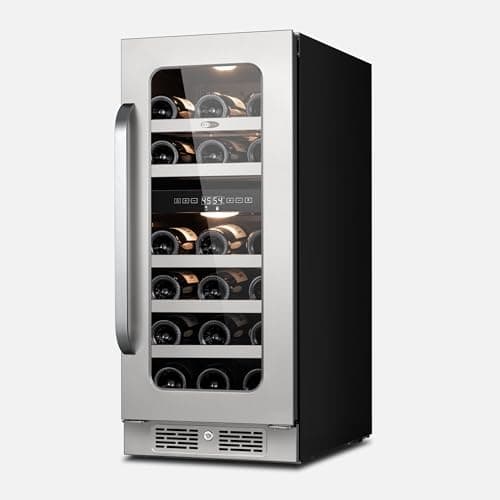
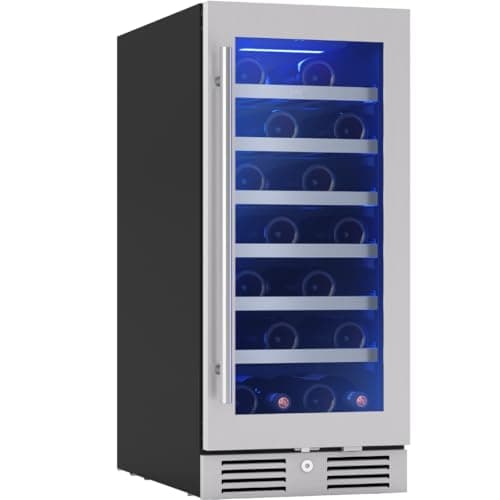
- Field-reversible. The cabinet ships with the hardware to swap sides and the manual documents the sequence. Zephyr publishes this on the Presrv PRW15C01CG, together with concealed zero-clearance hinges — the hinge does not project beyond the cabinet body, so the door can open in a tight opening.
- Reversible, right-hand as standard. The door arrives hinged on one side and can be moved. Summit publishes exactly this phrasing on its panel-ready cabinets: reversible, right-hand swing as standard.
- Two separate models. Some makers sell the left-hand version as its own product code instead — Summit sells the ALWC532PNRLHD alongside the ALWC532PNR. That is not a reversible door. If you buy the wrong code, the fix is a return, not a screwdriver.
The distinction matters most on built-in cabinets, where the door swing is fixed by the cabinetry around it and a wrong hinge side is permanent in practice even when it is reversible in theory.
Deciding which side it should open from
The rule that covers almost every room: the open door should end up between you and nothing. Stand where you will be standing when you take a bottle out, and hinge the door on the side that puts the open door out of your path rather than across it. Four specific cases cover the rest.
Against a wall or a corner. Hinge on the wall side and the door will only open to about 90 degrees before it hits the wall — which is enough to get a bottle out but usually not enough to pull a shelf out, because a slide-out shelf needs the door clear of its travel. Hinge away from the wall and the door swings into the room. On a cabinet with full-extension shelving, hinge away from the wall.
Next to another appliance. This is the one that catches people. Two appliance doors hinged on facing sides will collide, and a dishwasher door that drops forward will foul a wine cabinet door that swings across it. Work out the arcs before the cabinetry is cut, not after.
In a kitchen island. Island cabinets are approached from one side only and usually have a seated overhang on the other, so the door swing is decided by the seating — wine fridges for a kitchen island works through the venting and overhang constraints that come with it.
At the end of a run. The most forgiving position in any kitchen, and the one place where the hinge side is a preference rather than a constraint. If you have the choice, this is where a wine cabinet should go — where to put a wine fridge covers the room-by-room version of the question.
Which cabinets publish a reversible hinge
It is a common specification, but not a universal one, and it is published inconsistently enough to be worth checking per model rather than assuming. These are the cabinets in our registry whose makers state it outright.
If a listing does not say it, treat the door as fixed until the manual says otherwise. Manufacturers advertise a reversible door when they have one, because it removes an objection at the point of sale; silence usually means the hinge is decided.
The doors that cannot be reversed
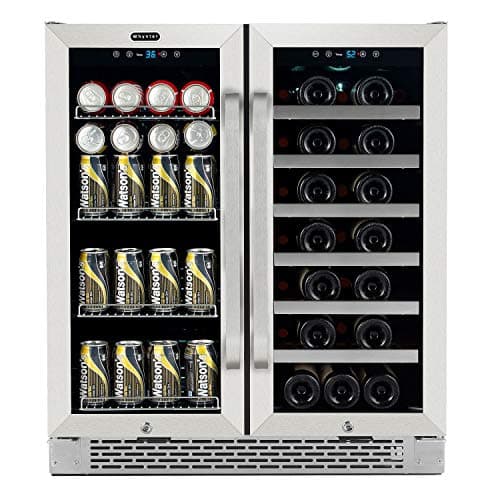
French-door cabinets. Two doors meeting in the middle, each hinged on its outer edge. Whynter publishes the BWB-3388FDS as a French swing that is explicitly not reversible, and that is the norm for the format. The compensation is real though: each door only needs half the swing clearance, which is why a French-door cabinet is the easiest format to live with in a narrow galley.
Dedicated left-hand models. Where a maker sells an LHD product code, that cabinet is built left-handed and the standard model is built right-handed. Neither one converts.
Heavy custom panels. A panel-ready cabinet carrying a cabinetmaker’s door front is holding considerably more weight on its hinges than a glass door, which is why KoolMore specifies a self-closing articulated hinge on its panel-ready cabinet. Where the hinge is engineered around panel weight, reversing it is a job to do with the manual open and the panel off. Our panel-ready roundup covers which makers publish the panel dimensions a cabinetmaker actually needs.
How a door reversal actually goes
Sequences differ between cabinets and the manual is the authority for yours, but the shape of the job is consistent, and knowing it tells you whether to attempt it on a Saturday.
- Empty it and unplug it. A loaded cabinet is well over a hundred pounds of glass and liquid, and you will be tipping it slightly to reach the bottom hinge.
- Keep it upright. On a compressor cabinet, laying the unit down risks moving oil out of the compressor. If you must tilt it, tilt it as little as possible and stand it upright for several hours before powering it back on — the same rule as moving a wine fridge.
- Top hinge first, then lift the door off. Support the door before the last screw comes out; glass doors are heavier than they look and the gasket will hold them in place just long enough to be misleading.
- Move the plug buttons. The holes on the unused side are covered with trim plugs. They swap over to cover the holes you have just vacated. Skipping this step is how a cabinet ends up with four visible holes down one edge.
- Re-hang, then level before you tighten. Hang the door with the screws finger-tight, close it, check the gap down both sides is even, then tighten. A door squared to the cabinet is the difference between a seal and a slow leak.
- Move the handle last, if the handle is on the door rather than on the trim. Then leave the cabinet to stand before powering it back up.
Adjusting a door that has stopped sealing
A door that no longer seals is the most common reason a cabinet drifts off its set temperature, and the usual cause is not the door at all.
Level the cabinet first. Wine cabinets have adjustable feet, and a cabinet standing out of level puts the door out of square with the frame. Before touching a hinge, put a level across the top of the cabinet front to back and side to side, and correct it at the feet. On a cabinet that has been moved or re-sited, this fixes the problem more often than anything else.
Test the gasket, do not guess at it. Close the door on a dollar bill and pull: it should drag. Try it at several points around the perimeter. Where it slides out freely, the gasket is not compressing there. A gasket that has gone stiff in the cold usually recovers if you warm it with a hairdryer on a low setting and work it back into shape; a gasket that has torn needs replacing.
Then, and only then, square the door. Slacken the hinge screws a quarter turn, close the door so the gasket pulls it into alignment, and retighten. This is a millimeter-scale adjustment, not a repositioning.
Check what the seal was costing you. A door that has been leaking has been running the cabinet harder and letting humidity out, and the cabinet display will not tell you — it reports the sensor, not the shelf. A logging thermometer on the middle shelf will, which is the argument in best wine fridge thermometers and hygrometers. If the cabinet has also been sweating or smelling, the rest of the diagnosis is in condensation and a cabinet that smells musty, and the routine that prevents all of it is in wine fridge maintenance.
Hinges in a built-in opening
Two specifications matter once a cabinet is going into cabinetry rather than standing in a room.
Zero-clearance hinges. A conventional hinge needs the door to travel outward slightly as it opens, which means a gap on the hinge side. A concealed zero-clearance hinge — Zephyr publishes this on the Presrv — lets the door open with the cabinet body flush to the adjacent unit. In a run of cabinetry that is the difference between a flush installation and a visible reveal down one side. It is also only ever found on compressor cabinets, for the reason set out in built-in thermoelectric wine coolers: rear-venting cabinets are not built to be enclosed at all, whichever way their door happens to swing.
Swing arc against the counter and the handle. An undercounter cabinet opens underneath a worktop, and a handle that projects can catch an adjacent appliance handle at 90 degrees of swing even when the doors themselves clear each other. Check the arc with the handle fitted, not from the cabinet dimensions alone. The measuring-up sequence is in the dimensions guide, and the air the cabinet needs regardless of hinge side is in ventilation and clearance.
One last point worth making before the cabinetry is ordered: a reversible door removes a risk, it does not remove the need to plan. Reversing a door in a finished kitchen means emptying a cabinet, unplugging it and standing it idle for a few hours. It is far easier to get the hinge side right on the order form, which is the same argument setting up a new wine fridge makes about everything else that is easy before delivery and awkward afterwards.