Two mechanisms. A compressor cabinet pumps refrigerant and moves heat out absolutely, reaching a published floor of 38-41°F whatever the room does. A thermoelectric cabinet drives heat across a solid-state module relative to ambient, which is why all three in our registry stop at 46°F.
This page sits in Wine Storage Guides, where the rest of the category is compared the same way.
How this page is funded. Cork & Cool earns a commission if you buy through the Amazon links below, at no extra cost to you. It never changes the order of this list — see our editorial policy and affiliate disclosure. Prices come from Amazon and are refreshed daily; the price on Amazon when you buy is always the one that counts.
Our picks
One cabinet of each kind, plus the best-documented cabinet in our registry - so you can see what each mechanism publishes rather than taking the explanation on trust.
How this page is funded. Cork & Cool earns a commission if you buy through the Amazon links below, at no extra cost to you. It never changes the order of this list — see our editorial policy and affiliate disclosure. Prices come from Amazon and are refreshed daily; the price on Amazon when you buy is always the one that counts.
#1 — Silence in a quiet room
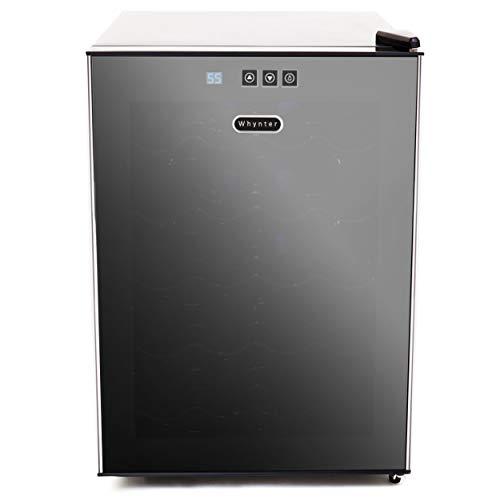
Whynter WC-201TD
Twenty bottles cooled thermoelectrically, so there is no compressor to cycle and nothing to transmit vibration into the bottles.
No compressor means no start-up thump and no vibration path into the wine
65 W is a fraction of a compressor cabinet's draw
46°F floor is cold enough for sparkling service
What does not
Thermoelectric cooling works against ambient temperature, so a warm room raises the achievable minimum
Freestanding only — it must not be enclosed
Who should skip it. Skip it if the unit will live anywhere that gets hot: a garage, a conservatory, or a cabinet run with no air gap. Thermoelectric units lose the argument above roughly 77°F ambient.
#ad — paid link. How this is funded. Price as of November 11, 2026; check Amazon for the current price.
#2 — The 15-inch default
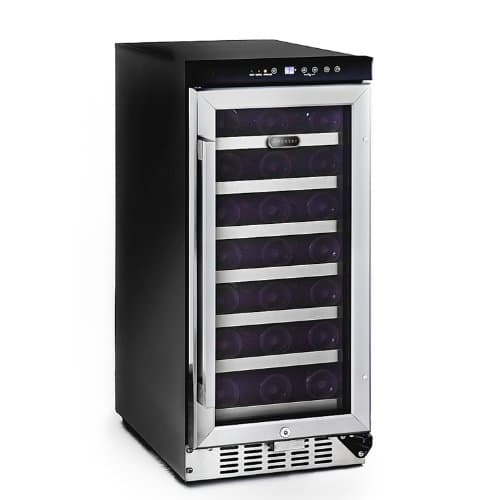
Whynter BWR-33SD
Thirty-three bottles in a 15-inch cabinet, with a published noise ceiling and seven wooden shelves — the capacity ceiling at this width, and the widest temperature band on this page.
Product photograph via Amazon.
Published specifications
Capacity
33 bottles
Zones
1
Cooling
compressor
Temperature range
40–72°F
Noise rating
42 dB
Installation
both
· Exterior: 15.0 in W x 22.5 in D (24.5 in with the handle installed) x 34.0 in H
· Capacity: 33 standard 750 ml bottles
· Noise published as "< 42 dBA" — a ceiling, not an average
Thirty-three bottles is the highest published capacity at this width
Whynter publishes a decibel ceiling, which almost nobody in this category does
Seven wooden shelves rather than the wire shelving usual at this price
40-72°F is the widest published band here, so it will also hold a bottle at room temperature
Rated for built-in or freestanding use, so an opening is optional rather than required
What does not
Single zone only — one temperature for the whole cabinet
The published figure is "< 42 dBA", a maximum rather than an average, so it cannot be compared like-for-like against a manufacturer quoting a flat number
At 15.0 inches published it is the widest cabinet in this group, which matters if your opening is tight
Depth grows to 24.5 inches once the handle is on, which is the figure that matters in a shallow run
33 bottles assumes standard Bordeaux shapes; a Burgundy-heavy collection will fit fewer
Who should skip it. Skip it if you need to serve whites cold and hold reds at cellar temperature in the same cabinet — one zone cannot do both. Skip it too if your opening measures under 15 inches, because this is the one cabinet here that needs the full module.
#ad — paid link. How this is funded. Price as of November 11, 2026; check Amazon for the current price.
#3 — Storage, not just chilling
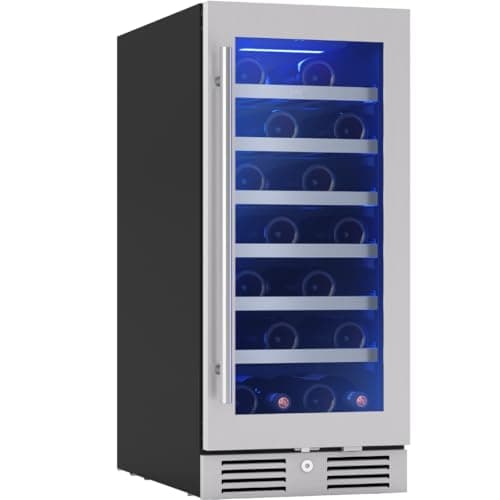
Zephyr Presrv PRW15C01CG
Twenty-seven bottles, a published 39 dBA, and the only cabinet in this width whose maker documents a vibration dampening system — you are paying for the storage conditions, not the bottle count.
Product photograph via Amazon.
Published specifications
Capacity
27 bottles
Zones
1
Cooling
compressor
Temperature range
38–65°F
Noise rating
39 dB
Installation
both
· Exterior: 15 in W x 33-7/8 in H x 23-3/8 in D
· Capacity: 27 bottles (750 ml), 3.4 cu ft
· Sound level: 39 dBA published
· Racking: six full-extension black wood racks with stainless trim
· Glass: dual-pane, Low-E, argon-filled
· Field-reversible door with concealed zero-clearance hinges, door lock, door-open alarm
· Energy Star certified; Sabbath mode; carbon-filtered air filtration
· Weight: 101 lb · Power: 115 V, 60 Hz at max 1.5 A
· Warranty: 2 years parts and labor, 5 years compressor
The only 15-inch cabinet here whose manufacturer documents vibration control at all
Publishes a flat decibel figure rather than a ceiling, so it can be compared properly
Reaches 38°F, the lowest published minimum in this group, which matters for sparkling wine
Full-extension racks mean you can reach a bottle at the back without unloading the shelf
Five-year compressor warranty against the usual one or two
What does not
Twenty-seven bottles against thirty-three for the same width — the racks take the space
23-3/8 inches deep, the deepest cabinet in this group
Costs materially more than the Whynter and Summit cabinets it sits beside
Who should skip it. Skip it if the wine is going to be drunk within a year or two. Vibration control and a 38°F floor are long-storage features, and you can have eight more bottles for less money without them.
#ad — paid link. How this is funded. Price as of November 11, 2026; check Amazon for the current price.
How compressor cooling works
A compressor cabinet is a vapor-compression refrigerator, the same cycle as the refrigerator in your kitchen, sized smaller and tuned to hold a much higher temperature. Four stages, in a loop:
Compress. A motor-driven compressor squeezes refrigerant gas, which raises its pressure and its temperature.
Condense. The hot gas passes through a condenser coil on the outside of the cabinet, dumps its heat into the room and turns to liquid. This is why ventilation is not optional and why a blocked vent destroys a cabinet — see ventilation and clearance.
Expand. The liquid passes through a restriction into a low-pressure section, where it expands and becomes very cold.
Evaporate. In the evaporator coil inside the cabinet, the cold refrigerant absorbs heat from the interior air and boils back to gas. Then it returns to the compressor and the loop repeats.
The important property: this cycle moves heat absolutely. It does not care much how warm the room is, only how hard it has to work. That is why compressor cabinets publish floors in the low forties — 40°F for the Whynter BWR-33SD, 38°F for the Zephyr Presrv — and why they are the only option above about 30 bottles.
It also explains the two costs. The compressor is a motor that starts and stops, so it makes noise when it cycles, and it is a reciprocating mass bolted to the cabinet holding your bottles, so it vibrates. Only Liebherr and Dacor, in our registry, document anything specific about controlling vibration.
How thermoelectric cooling works
A thermoelectric cabinet has no compressor, no refrigerant and no moving parts beyond a fan. It uses a Peltier module: a solid-state sandwich of two semiconductor types that, when current passes through it, drives heat from one face to the other. The cold face points into the cabinet, the hot face into a heat sink and a fan on the outside.
The important property, and it is the mirror image of the compressor: a Peltier module moves heat relative to its surroundings. It can establish a temperature difference across itself — in these cabinets, enough for a 46°F floor in a normal room, so roughly 20 to 25°F — but it cannot reach an absolute target regardless of the room. In a 68°F room that is plenty. In an 85°F room the interior rises with it.
You can see the consequence in the published specifications rather than having to take it on faith. every thermoelectric cabinet in our registry that publishes a floor publishes exactly 46°F — the Whynter WC-201TD at 46–66°F, the Ivation 18-bottle dual-zone from 46°F, the Koolatron WC12-35D at 46–66°F and the Schmécké 12-bottle at 46–64°F. Four cabinets, four brands, one physical limit.
The difference that decides purchases
The two mechanisms on the specifications that follow from how they work
Compressor
Thermoelectric
Mechanism
Vapor compression — refrigerant, pump, coils
Peltier module — solid state, no refrigerant
Cools
Absolutely, regardless of room temperature
Relative to the room, by 20–30°F
Published floor in our registry
38–41°F
46°F on every unit that publishes one
Largest capacity available
166 bottles
20 bottles
Noise
Cycles audibly; Whynter publishes < 42 dBA and < 38 dB ceilings
Fan only, continuous and quieter
Vibration
Yes — a moving mass on the cabinet
Minimal — no moving parts but a fan
Published power
80 W to 160 W
65 W on both units that publish it
Built-in installation
All built-in-rated cabinets here are compressor
Freestanding only in our registry
Read the table as a rule rather than a scoreboard. The room chooses the mechanism. A temperate interior room with a noise-sensitive occupant suits thermoelectric. A warm room, an unconditioned room, sparkling wine, real capacity or a built-in installation all require a compressor. The head-to-head, with the failure modes of each, is compressor versus thermoelectric.
The three jobs besides cooling
A wine cabinet that only cooled would be a beverage cooler. Three other things are going on inside it, and they are most of what separates the category from a mini fridge.
It does not dehumidify. A kitchen fridge dries its interior as a side-effect of running very cold. A wine cabinet operates at a much smaller temperature difference, so it removes far less moisture and corks stay damp. Nobody in our registry publishes a target relative humidity, which is why wine fridge humidity is written around what is actually verifiable.
It blocks light. Every glass door here is UV-treated: double-pane tempered and UV-protective on the Whynter, dual-pane Low-E and argon-filled on the Zephyr, mirrored UV-protective on the Koolatron. Light degrades wine, and a clear single-pane door would undo much of the point.
It filters air, sometimes. The Whynter BWR-33SD and BSR-029DW ship with an activated carbon filter, the Zephyr with carbon-filtered air circulation, the Liebherr with a user-replaceable charcoal fresh-air filter. A cork breathes, so the air around it matters.
Which mechanism you want
Short version: if the cabinet is going anywhere that gets warm, or you need more than about 30 bottles, or you serve sparkling wine, you need a compressor. Otherwise a thermoelectric cabinet is quieter, simpler, has fewer things to fail and vibrates less.
Knowing the mechanism makes two ownership pages much shorter. The condenser, the door seal and the condensate drain are the three parts that decide how long the cabinet lasts, and all three are in wine fridge maintenance. The same physics explains why the door glass mists up in a humid room and why water on a shelf is a different problem entirely — wine fridge condensation.
Questions people actually ask
▸ Do wine fridges use a compressor like a normal fridge?
Compressor models do — the same vapor-compression cycle, tuned to hold a much higher temperature. Thermoelectric models use a solid-state Peltier module instead, with no refrigerant and no compressor.
▸ Why will my wine fridge not go below 46°F?
It is almost certainly thermoelectric. Every thermoelectric cabinet in our registry that publishes a floor gives 46°F, because a Peltier module can only establish a temperature difference from the room, not an absolute target.
▸ Do wine fridges have Freon?
Compressor models contain a refrigerant, though none of the manufacturers here publishes which one on its product page. “Freon” is a brand name for a family of refrigerants long since phased out, so the answer is almost certainly no for any cabinet sold today. Thermoelectric models contain no refrigerant at all.
▸ How does a dual-zone wine fridge work?
One cooling system with separately controlled airflow and thermostats for two compartments, divided by an internal barrier. Setting them up properly is covered in dual-zone temperature settings.
▸ Why does my wine fridge run constantly?
Usually because it cannot reject heat — a blocked vent, a freestanding cabinet installed into a sealed opening, or a room warmer than the cabinet can overcome. See wine fridge not cooling.