
First: which side of the glass?
Put a finger on the mist. Almost every condensation question answers itself at this point, and the two answers lead to completely different pages of advice.
Outside the glass — you can wipe it off with your hand and it comes back — is the room condensing onto cold glass. That is physics, not a fault, and the fix is the room rather than the cabinet.
Inside the glass, or water on a shelf, or a puddle on the cabinet floor, is the cabinet. Something is letting warm humid air in faster than the condensate system can shed it, or the condensate system is blocked.
Between the panes of a double- or triple-glazed door is the third and rarest case: the sealed glass unit itself has failed, and that is a door assembly replacement rather than anything you can clean.
Why the outside of the glass mists up
Air holds a certain amount of water vapor, and the amount it can hold drops as it gets colder. The surface of a wine fridge door is the coldest thing in the room. When humid room air touches it, the air in contact cools below its dew point and the vapor becomes liquid on the glass. Exactly the same thing happens on a cold drink in summer.
Which means three things predict it, none of them faults:
- Room humidity. The higher it is, the warmer the glass can be and still condense. A kitchen after cooking, a basement in August, a bathroom-adjacent cupboard — all prime conditions.
- How cold you run the cabinet. A service zone at 42°F mists far more readily than a storage cabinet at 58°F.
- The glass itself. Single-pane glass takes on the cabinet temperature; multi-pane glass with a gas fill stays much closer to room temperature on its outer face.
So the practical fixes are all environmental: run the cabinet a couple of degrees warmer if the setpoint allows it, improve ventilation in the room, run a dehumidifier in a damp basement, or move the cabinet away from a dishwasher or a kettle that dumps steam at it. None of that is a repair. Setpoint guidance is in wine fridge temperature settings.
What published glass construction changes
This is where spec sheets earn their keep, because glass construction is one of the few published figures that predicts condensation behavior directly.
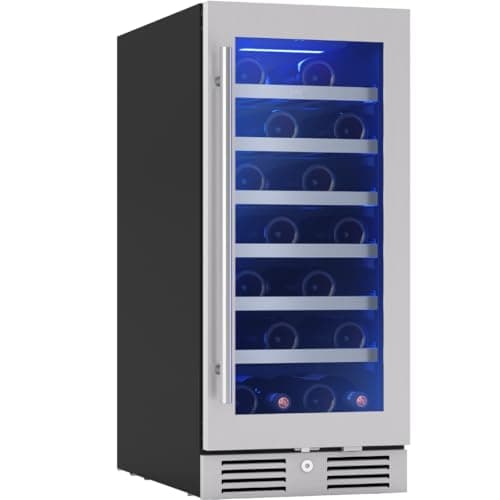
Two notes. Low-E with an argon fill, published only on the Zephyr here, is the strongest form of the spec — the coating reflects radiant heat and the heavier gas conducts less than air, so the outer pane runs warmer and condenses less. And a door-open alarm, also on the Zephyr, addresses the acute version of this whole problem: a door left ajar for an hour puts far more moisture into a cabinet than a month of normal use.
If you are still choosing, this is one of the four places the money actually shows — see best wine fridges for the money.
Water inside the cabinet: four causes
Now the real fault. Work through these in order, because they are in order of likelihood.
1. The door seal. A perished, dirty or distorted gasket lets warm humid air in continuously, and the cabinet condenses all of it. Do the paper test: close the door on a sheet of paper at six or eight points around the frame and pull — you should feel resistance everywhere. Clean the gasket, confirm the cabinet is level, warm a distorted section with a hair dryer on low and press it back, and replace it by model number if a section has split. Full routine in wine fridge maintenance.
2. A blocked condensate drain. Condensate is supposed to run from the evaporator down a drain hole to a tray at the back, where the compressor’s heat evaporates it. Block the hole and the water backs up onto the cabinet floor and the lowest shelf. Clear it with warm water and something soft — never a wire or anything metal — and empty the tray.
3. The cabinet is not level. An unlevelled cabinet sends condensate away from the drain instead of toward it, and simultaneously twists the door frame so the gasket cannot seal evenly. It causes both of the first two faults at once, which is why it is worth two minutes with a spirit level before you buy a gasket.
4. Door openings. Each opening swaps cold dry cabinet air for warm humid room air, and all the moisture in it has to go somewhere. A cabinet on a home bar, opened forty times an evening, condenses far more than a cellar cabinet opened weekly — and the fix there is behavioral, or a dedicated service cabinet. See best wine fridges for a home bar.
Ice, frost and the back wall
Ice is condensation that got cold enough to freeze, and the places it forms tell you where the warm air is getting in.
A localized patch of frost near the door frame or a hinge is a seal leak at that point — warm moist air arrives, condenses, and freezes against the cold surface. Fix the seal and the ice stops.
Frost on the rear wall where a bottle touches it is a loading problem. A bottle pressed against the back wall blocks airflow past the evaporator, and the stalled air ices up. Leave a finger’s gap at the back — see how to arrange bottles in a wine fridge.
General frosting across the whole evaporator, on a cabinet that publishes automatic defrost or frost-free operation — Summit publishes automatic defrost on the SWC1535B and frost-free fan-forced cooling on the SDHW1532 — means the defrost function or the fan is not doing its job, and that is a service call rather than a housekeeping fix. Start at wine fridge not cooling.
When condensation actually matters
Honest answer: less than people fear, and in one specific way more than they expect.
The wine is unaffected. The bottle is glass, the seal is a cork, and moisture on the outside of either does nothing to what is inside. Moderate humidity inside a storage cabinet is actively good — it is what keeps a cork from drying out over years, which is the whole subject of humidity-controlled wine storage.
What suffers is everything around the wine. Labels swell, stain and release their glue — irreversible, and the main reason to care if you ever intend to gift or sell a bottle. Wooden shelves stain and eventually warp under standing water. And persistent damp with poor airflow produces the smell that why a wine fridge smells musty exists to deal with.
So: mist on the outside of the glass, leave it alone. Water on a shelf, chase it this week — it is cheap to fix now and expensive to ignore.
Left alone, frost insulates the cooling surface and makes the cabinet run longer, which is how a seal problem turns into frozen bottles — wine fridge freezing wine covers that progression.