
What a motor actually buys
An electric opener is not faster than a practiced hand with a waiter’s key. What it does is remove force and skill from the job entirely. There is no lever to brace against the bottle lip, no two-stage pull, no judgement about how deep the worm has gone. You put the opener on the bottle, the motor drives a spiral through the cork and lifts it out, and then it reverses to drop the cork. For anyone with a weak grip, an arthritic wrist, a recent injury or simply no interest in learning a technique, that is the whole argument, and it is a good one.
The second argument is volume. Opening eight bottles in a row with a corkscrew is work; opening eight bottles with a motor is pressing a button eight times. That is why this class lives on the kind of counter where guests arrive, and why our wine cabinet roundup keeps coming back to charging bases and outlets — a powered opener has to live somewhere it can charge.
If you have not yet decided that a motor is what you want, start one level up: best wine openers compares all five mechanisms — waiter’s key, lever, winged, electric and two-prong — and is honest about where the electric one finishes last. This page assumes the decision is made and compares the powered units against each other.
Bottles per charge is the headline spec
There is exactly one capacity number in this category, and it is bottles per charge. It is also the specification makers are least consistent about publishing, which makes it a useful filter on its own: a maker willing to print a number is a maker willing to be held to it.
Fifty against thirty is not a marginal difference if you host. Five bottles on a Friday night and four the following weekend will flatten a thirty-bottle battery inside a month of ordinary entertaining, and a flat battery is the one failure mode that cannot be solved in the moment — Oster publishes a six-to-eight-hour charge, and none of the other four publishes a charge time at all. Secura is the outlier in the other direction: it publishes no capacity figure whatsoever, which is why it finishes fourth here despite being the cheapest unit on the page.
Buttons, one button, or none
The trigger is where this category quietly splits in two, and it matters most to exactly the buyer who needs an electric opener in the first place.
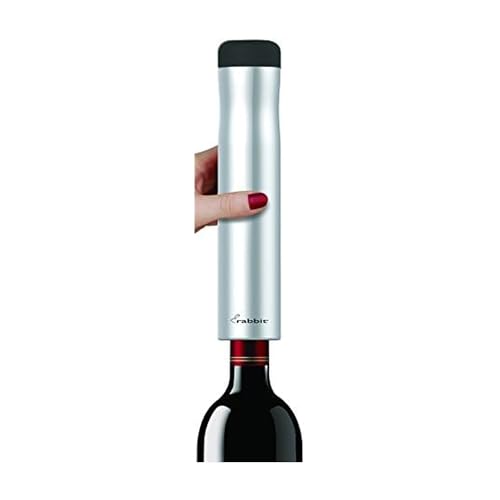
The Rabbit W6316N has no button. You set it over an uncapped bottle, press down gently, and contact starts the motor; it extracts and ejects without anything being held. Rabbit names arthritis and limited hand strength as the design target on its own listing, which is an unusually direct statement of who a product is for. If the reason you are reading this page is that holding a button down while a motor runs is itself difficult, this is the pick, and the capacity difference against the Cuisinart is a secondary concern.
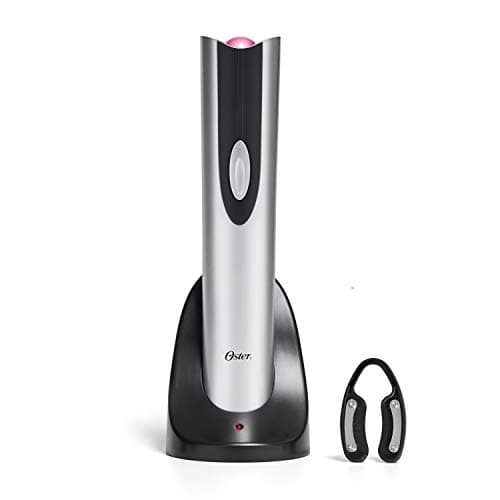
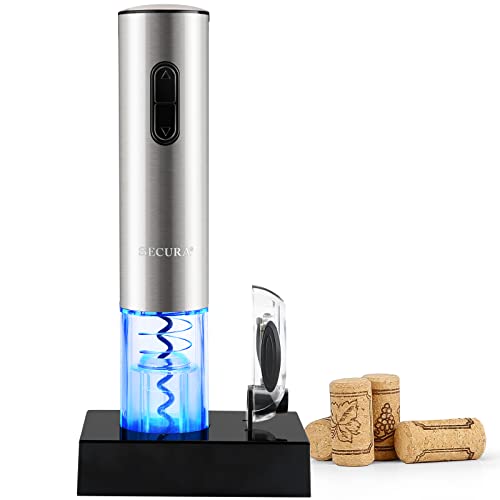
Single-button units — the Secura and the Ivation — are the middle ground: one control, pressed one way to remove and the other to eject. The Cuisinart’s two buttons sound like a step backwards and are not: separate Remove and Eject commands mean the cork comes off the spiral when you say so, over a bin, instead of being worked off by hand. The Oster asks you to press and hold in each direction, which is the same idea with one fewer button and slightly more patience.
Foil cutters and where they go to die
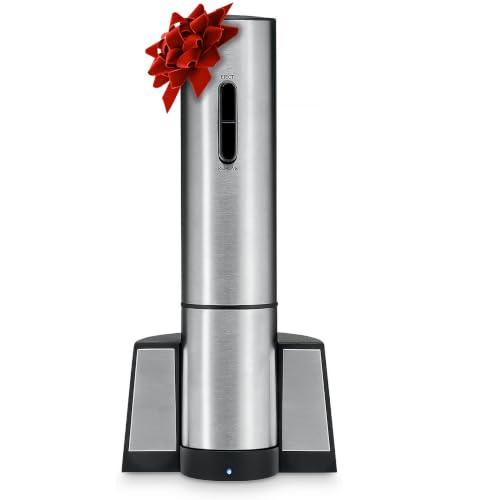
Every opener here includes a foil cutter, and that is not the useful question. The useful question is whether the cutter is attached to something. The Rabbit builds its cutter into the top of the opener, so it cannot be separated from the tool. Cuisinart’s cutter lives in a slot in the charging base, which is the next best answer: it has a home, and the home is the thing you walk to anyway. The Oster, Secura and Ivation cutters are loose discs. They work perfectly well and they are the first component to disappear into the back of a drawer.
This is a small detail that becomes a daily one. A capsule has to come off before a powered opener will seat properly on the bottle, and a cutter you cannot find turns a ten-second job into a hunt for a knife. If you have ever used a serrated steak knife on a foil capsule because the disc had vanished, the integrated cutter is worth the premium on its own.
When the bundle is the point
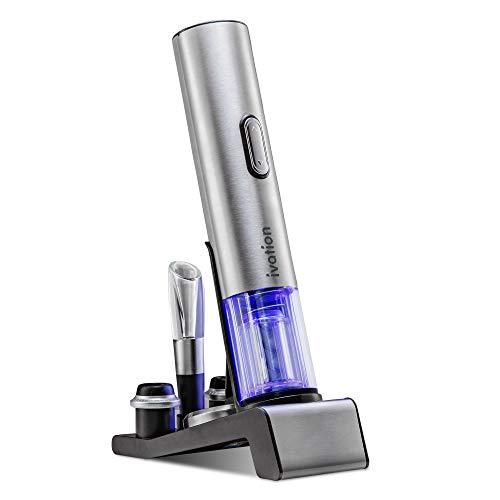
The Ivation IVAWS30SS is not really an opener purchase. The corkscrew inside it is ordinary: thirty corks per charge, one up/down button, a window in the body so you can watch the cork come out. What you are buying is the box around it — a vacuum preserver with two date-stamped stoppers, an aerating pourer, a foil cutter and an LED charging base.
Two of those pieces matter. The preserver answers the question the opener creates: you opened a bottle, you drank half, and now it is oxidizing. A pump and a stopper slow that down — they do not stop it, which is the argon systems’ job and the subject of our preservation-systems roundup — but for a bottle you intend to finish within a few days, slowing it is enough. The date-stamped stoppers are the cheap, clever part: you know when it was opened without trusting memory. The aerating pourer handles the other end of the evening and is the subject of our wine aerator roundup, where in-bottle pourers of exactly this kind are ranked honestly against better mechanisms.
The honest caveat on any set is that it is only good value if you use more than two pieces. If you already own a preserver you like, you are paying for a bundle and keeping one item from it, and the Cuisinart opens more bottles per charge for less money.
Charging, and the chore nobody mentions
Every unit here is rechargeable, and none of them tells you everything you want to know about it. Oster publishes a six-to-eight-hour initial charge and a 14 W rating. Cuisinart publishes a NiMH pack and a base, but no charge time. Rabbit ships a wall charger and publishes neither charge time nor battery capacity. Ivation publishes neither. Secura publishes neither, and additionally asks you to charge the opener every three months even when it is not being used — a maintenance instruction on a kitchen gadget, which is the sort of thing that turns up in one-star reviews two years later when a neglected cell will no longer hold a charge.
Practical consequence: treat a powered opener as an appliance that lives on its base rather than a tool that lives in a drawer. That is also the reason the charging base is worth caring about. A base keeps the opener upright, visible and charged, and it gives the foil cutter somewhere to be. If your bar or sideboard has no socket near it, the problem to solve is the socket, not the opener — some of the cabinets in our wine cabinet roundup have AC outlets built into the carcass for exactly this reason.
The one bottle you should not use these on
A motor cannot feel a cork failing. That single sentence is the most important thing on this page. A spiral driven by a motor applies steady torque and then steady lift, regardless of what the cork is doing; a hand on a lever feels the cork start to shear and stops. On a bottle whose cork has lost structure — anything genuinely old, anything stored warm or upright for years, anything where the capsule hides a weeping seal — the powered opener will keep going and the cork will come out in pieces, or not at all.
The right tool for that bottle is a two-prong puller, which slides blades down either side of the cork and twists it out whole; we cover it as one of the five mechanisms on best wine openers. A household with a cellar should own both: an electric opener for the everyday bottles and a two-prong for the ones that matter. And if corks in your house are failing regularly, the cause is usually storage rather than bad luck — what happens to wine that is not stored properly sets out the mechanism, and dry corks are the first symptom.
What the worm does to a synthetic cork
Synthetic closures are the other place powered openers earn their keep, and they are harder work than they look: a synthetic plug grips the glass more tightly than natural cork and does not compress in the same way, so the force needed to lift one is higher and more sustained. That is precisely the kind of force a motor supplies without complaint and a wrist resents.
Cuisinart and Rabbit both publish explicit claims here — Cuisinart states the CWO-25 powers through synthetic or natural corks, Rabbit states its non-stick spiral suits both without crumbling. Neither claim is independently measured, and neither helps with a screw cap, which no opener on this page can address. If most of what you drink is under a screw cap, the honest advice is that you do not need an electric opener at all.
Which of the five to buy
Buy the Cuisinart CWO-25 if you want the most capable unit here: 50 bottles per charge is the highest published figure on the page, the two-button control is the most deliberate, and the foil cutter has a home in the base. Buy the Rabbit Automatic W6316N if holding a button is itself the difficulty — contact operation and an integrated cutter make it the most accessible opener in the registry, and Rabbit says so in its own words. Buy the Oster FPSTBW8207-S as the value pick: thirty bottles per charge, a published charge time, a UL-approved rating and a price at the bottom of this category band, which makes it the budget choice here. Buy the Secura KP1-36N2 only if price is the single deciding factor, and go in knowing the maker publishes no capacity figure at all and asks for quarterly charging. Buy the Ivation IVAWS30SS set if the preserver and the aerating pourer are things you would otherwise buy separately — as a gift, it is the most complete box on the page.
Whichever you choose, the bottle you open is the start of a clock. What you do with the half you did not finish is covered in how to store opened wine, and the stoppers that do that job properly are ranked in best wine stoppers.