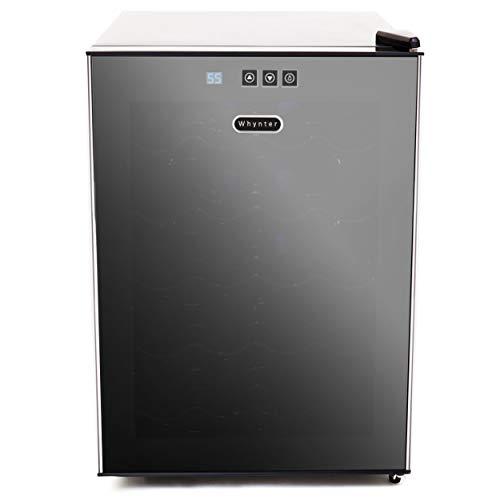
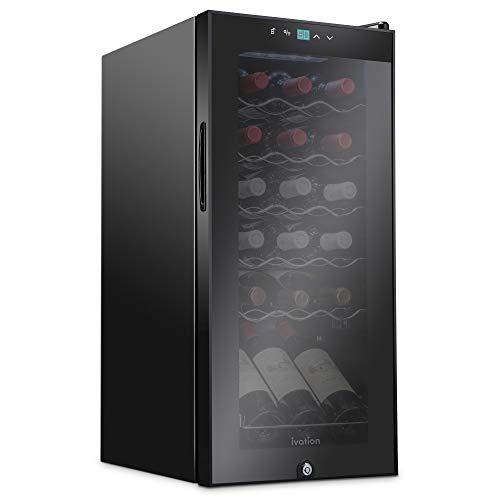
The Whynter WC-201TD is the best 20-bottle wine fridge for a room people sit in: 20 bottles cooled thermoelectrically, so there is no compressor to cycle and nothing to vibrate, across a published 46-66°F range. If you need to go below 46°F or the room gets warm, buy a compressor cabinet instead — the Ivation 18-Bottle Compressor reaches 41°F.
This page sits in Wine Fridges, where the rest of the category is compared the same way.
How this page is funded. Cork & Cool earns a commission if you buy through the Amazon links below, at no extra cost to you. It never changes the order of this list — see our editorial policy and affiliate disclosure. Prices come from Amazon and are refreshed daily; the price on Amazon when you buy is always the one that counts.
Quick picks
Every model below, on the specifications that decide the purchase. Tap a row to jump to the full write-up.
Comparison of wine storage models by zones, capacity, cooling type, width, published noise rating and vibration.
#
Product
Best for
Zones
Bottles
Cooling
Width
Noise
Vibration
Price
1
Whynter WC-201TDSilence in a quiet room
Twenty bottles cooled thermoelectrically, so there is no compressor to cycle and nothing to transmit vibration into the bottles.
1
20
thermoelectric
Not published
Not published
Thermoelectric: no compressor, which the manufacturer describes as vibration-free cooling.
#ad — paid link. How this is funded. Price as of November 11, 2026; check Amazon for the current price.
“Not published” means the manufacturer does not publish that figure. We do not estimate it. Prices and product photographs come from Amazon and are refreshed daily; where a model is not sold on Amazon the thumbnail is an illustrative category photograph and the link is a search.
How we compared
We compared published manufacturer specifications, official product documentation and verified owner reports across 5 models. We do not physically test these units, we have no laboratory, and we do not accept payment for placement. Where a manufacturer does not publish a figure — noise ratings, most often — this page says so rather than estimating it.
What we weighted
Cooling type, because at this size it changes almost everything else
Published temperature floor — the single number that decides whether sparkling wine is served properly
Whether the unit may be enclosed, since several in this class are freestanding only
Published power draw, which is where the thermoelectric units win outright
Shelving material and whether the shelves slide
Zone count, which is rarer than you would expect at this capacity
Every model in detail
The 18-to-20-bottle class, plus a 12-bottle option for a counter that cannot take anything larger. Ranked by cooling type first, because in this size bracket that decision outranks every other specification.
#1 — Silence in a quiet room
Whynter WC-201TD
Twenty bottles cooled thermoelectrically, so there is no compressor to cycle and nothing to transmit vibration into the bottles.
No compressor means no start-up thump and no vibration path into the wine
65 W is a fraction of a compressor cabinet's draw
46°F floor is cold enough for sparkling service
What does not
Thermoelectric cooling works against ambient temperature, so a warm room raises the achievable minimum
Freestanding only — it must not be enclosed
Who should skip it. Skip it if the unit will live anywhere that gets hot: a garage, a conservatory, or a cabinet run with no air gap. Thermoelectric units lose the argument above roughly 77°F ambient.
41°F floor is cold enough for sparkling wine service
Compressor cooling holds its setting regardless of room temperature
A lock, which most units this size omit
What does not
One zone only
A compressor in a small cabinet is audible in a quiet room
Who should skip it. Skip it if the unit will sit in a bedroom or a quiet home office. At this size the compressor is close to you and there is no published dB figure to reassure you.
Eighteen inches deep instead of the usual twenty-two and a half — the answer when the cabinet run is shallow and every other 15-inch cabinet sticks out.
Illustrative photograph — not an image of the Summit SDHW1532.
Published specifications
Capacity
18 bottles
Zones
1
Cooling
compressor
Temperature range
41–68°F
Noise rating
Not published by the manufacturer
Installation
both
· Exterior: 33.75 in H x 14.75 in W x 18.0 in D (19.75 in D with the handle)
· Shelving: six removable steel shelves in black with stainless trim
#ad — paid link. How this is funded. Price as of November 11, 2026; check Amazon for the current price.
What the 20-bottle class is for
Twenty bottles is the size at which a wine fridge stops being an ornament and starts being useful. Four bottles is a novelty. Ten is a week of hosting. Twenty is a working selection: a few whites ready to pour, a few reds at cellar temperature, a bottle of sparkling for the thing you did not know about on Tuesday, and a little room for the case you brought home from a trip.
It is also the last size that fits comfortably on a counter or in a corner without becoming furniture. Above this, cabinets want a dedicated spot and often an opening. Below it, you are buying a drinks chiller rather than storage. If you are not sure which side of that line you are on, what size wine fridge do I need runs the arithmetic from how you actually buy wine.
The decision that outranks capacity
In the 46-bottle class every cabinet has a compressor and you choose on fit. In this class, half the field is thermoelectric and that single fact drives everything else: the noise, the temperature floor, the power draw, whether it can be enclosed, and whether it works at all in the room you had in mind.
Thermoelectric cooling uses a solid-state heat pump. Nothing starts and stops, so there is no cycling noise and no vibration path into the bottles — the Whynter WC-201TD draws 65 W and the Ivation dual-zone the same. The catch is that it cools relative to the room: it can pull the interior a fixed number of degrees below ambient and no further. In a 72°F kitchen that is fine. In a hot conservatory it is useless, and in a garage it is the wrong product entirely.
Compressor cooling is a small refrigerator. It holds its set temperature regardless of the room, reaches lower, and cycles audibly while it does it. The Ivation 18-Bottle Compressor reaches 41°F; the Summit SDHW1532 publishes 41–68°F, the widest span in this group. The full argument is in compressor versus thermoelectric, and it is worth reading before you choose at this size, because the error is not recoverable without buying a second cabinet.
The class compared
Published specifications for the 12-20 bottle cabinets on this page
Model
Bottles
Cooling
Published range
Installation
Whynter WC-201TD
20
Thermoelectric
46-66°F
Freestanding only
Ivation 18-Bottle Compressor
18
Compressor
41-64°F
Freestanding
Ivation 18-Bottle Dual-Zone
18
Thermoelectric
Upper from 46°F, lower 54-64°F
Freestanding
Summit SDHW1532
18
Compressor
41-68°F
Built-in or freestanding
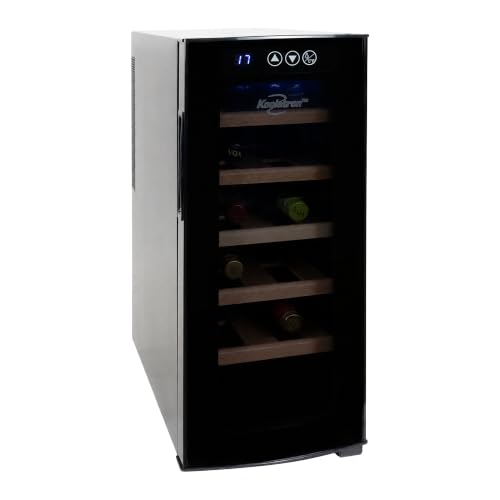
Koolatron WC12-35D
12
Thermoelectric
46-66°F
Freestanding
Two things stand out. The first is that every thermoelectric cabinet here stops at 46°F and every compressor cabinet reaches 41°F. That is not a coincidence; it is the physics of the cooling method. The second is that only the Summit is rated for built-in installation, which is the whole reason it is on this page.
The temperature floor, and why it matters here
Forty-six degrees against forty-one does not sound like much until you look at what each number is for. Sparkling wine is served in the mid-40s and benefits from being held colder; crisp whites want the high 40s; reds want the high 50s to low 60s. A cabinet with a 46°F floor will serve a white perfectly well and will never serve Champagne as cold as a dedicated cabinet does.
At 20 bottles that trade is usually acceptable, because this is a serving cabinet rather than a cellar and you can chill a bottle of sparkling the rest of the way in a bucket in twenty minutes — how long wine takes to chill has the measured times. If sparkling wine is a regular part of how you entertain, though, the compressor cabinet is the correct purchase and the Champagne roundup ranks on exactly that criterion.
The upper end matters too, and gets ignored. If you want to hold reds at a true cellar temperature of around 55°F and serve them a little warmer, you need a cabinet whose range reaches up there. The Summit SDHW1532 goes to 68°F; the roundup for reds ranks the registry on that number.
Where each of these can actually sit
Four of the five cabinets here are freestanding only, and that is a hard constraint rather than a preference. A freestanding unit rejects its heat through the back or the sides. Put it in a cabinet cut-out, a bookshelf nook or under a counter with the sides boxed in and it breathes its own exhaust, runs continuously, never reaches its set temperature, and eventually fails — a failure manufacturers specifically exclude from warranty cover.
If the plan involves an opening of any kind, the Summit SDHW1532 is the only unit on this page built for it: front-breathing, built-in rated, and 18 inches deep rather than the usual twenty-two and a half, which is the figure that decides whether it fits a shallow run. Everything else belongs on a counter, on the floor with air around it, or on a sideboard.
Two more placement notes specific to small cabinets. They are light enough to sit on a counter, which means they are also close to your ears — a compressor at head height in a quiet kitchen is far more noticeable than the same compressor under a counter. And they are small enough that people put them in bedrooms and home offices, where a thermoelectric unit is genuinely silent and a compressor one is not. Where to put a wine fridge covers the room-by-room version of this.
Questions people actually ask
▸ Is a 20-bottle wine fridge big enough?
For a household that keeps a working selection rather than a collection, yes. Twenty bottles holds a few whites ready to serve, a few reds at cellar temperature and something sparkling, with room for a short-term overflow. If you buy by the case or age bottles for years, start at 46 bottles instead.
▸ Should a 20-bottle wine fridge be thermoelectric or compressor?
Thermoelectric if it is going in a quiet room and the ambient temperature is stable — nothing cycles, nothing vibrates, and it draws about 65 W. Compressor if you need to go below 46°F, if the room gets warm, or if the unit is going into any kind of enclosure. The decision is not reversible after purchase.
▸ How cold does a 20-bottle wine fridge get?
The thermoelectric cabinets on this page publish a 46°F floor; the compressor ones publish 41°F. Thermoelectric figures also assume a normal room temperature, because that style of cooling works relative to ambient rather than independently of it.
▸ Can a 20-bottle wine fridge go under a counter?
Only the Summit SDHW1532 on this page is rated for it. The others are freestanding units that vent through the back or sides, and enclosing one causes it to recirculate hot air until the compressor fails. Check the installation rating on the specific model, never the category.
▸ Do small wine fridges use a lot of electricity?
The thermoelectric units here publish 65 W, which is less than a bright lightbulb and a fraction of what a compressor cabinet draws. Running cost depends far more on how hard the unit has to work than on its badge rating — wine fridge running costs works through the arithmetic.