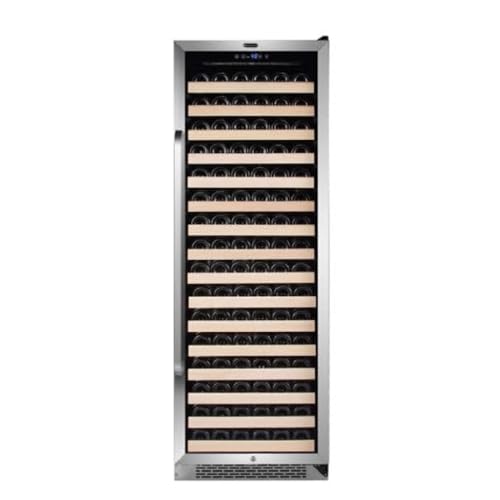
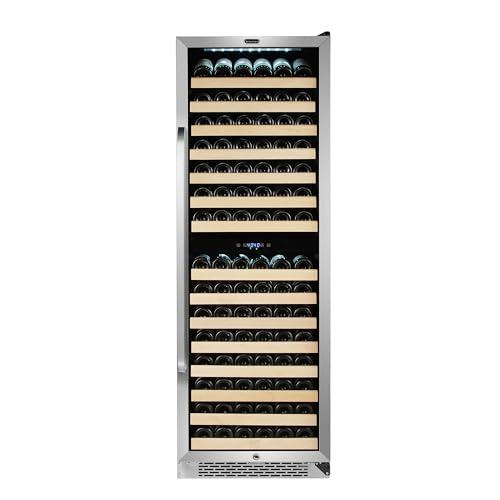
The Whynter BWR-1662SD is the best wine fridge for a basement: 166 bottles at a single steady setting on sixteen slide-out wooden shelves, which is the configuration long storage actually wants. If you need reds and whites held separately, its dual-zone sibling the BWR-1642DZ takes 164 bottles with both zones spanning the full range.
This page sits in Wine Fridges, where the rest of the category is compared the same way.
How this page is funded. Cork & Cool earns a commission if you buy through the Amazon links below, at no extra cost to you. It never changes the order of this list — see our editorial policy and affiliate disclosure. Prices come from Amazon and are refreshed daily; the price on Amazon when you buy is always the one that counts.
Quick picks
Every model below, on the specifications that decide the purchase. Tap a row to jump to the full write-up.
Comparison of wine storage models by zones, capacity, cooling type, width, published noise rating and vibration.
#
Product
Best for
Zones
Bottles
Cooling
Width
Noise
Vibration
Price
1
Whynter BWR-1662SDOne temperature, 166 bottles
The single-zone sibling: 166 bottles on 16 shelves at one setting, which is what long-term storage actually wants.
“Not published” means the manufacturer does not publish that figure. We do not estimate it. Prices and product photographs come from Amazon and are refreshed daily; where a model is not sold on Amazon the thumbnail is an illustrative category photograph and the link is a search.
How we compared
We compared published manufacturer specifications, official product documentation and verified owner reports across 5 models. We do not physically test these units, we have no laboratory, and we do not accept payment for placement. Where a manufacturer does not publish a figure — noise ratings, most often — this page says so rather than estimating it.
What we weighted
Capacity, because a basement is the one place you are not trading storage against kitchen real estate
Shelf access: whether shelves slide out, since a large cabinet you have to dig through gets used like a cupboard
Cooling type — compressor only, since thermoelectric cooling cannot cope with a cold room
Published power draw, which decides what a cabinet costs to run in a room it rarely has to fight
Whether the cabinet is finished on all sides, because a basement cabinet is usually visible from three of them
Build and warranty, since a basement cabinet is harder to get at and harder to replace
Every model in detail
Ranked on capacity and shelf access rather than on fit, because a basement imposes almost no dimensional constraints and the room is already doing the temperature work for you.
#1 — One temperature, 166 bottles
Whynter BWR-1662SD
The single-zone sibling: 166 bottles on 16 shelves at one setting, which is what long-term storage actually wants.
Product photograph via Amazon.
Published specifications
Capacity
166 bottles
Zones
1
Cooling
compressor
Temperature range
40–65°F
Noise rating
Not published by the manufacturer
Installation
built-in
· Capacity: 166 standard 750 ml bottles
· Shelving: 16 removable wooden flat slide-out shelves plus a wire display shelf
Designed around long-term aging rather than service
Five-year warranty, which is unusual in this category
The capacity figure is honestly split by bottle type, which most brands do not do
What does not
Costs multiples of anything else on this page
Sold through a single US distributor, so servicing is not a local-appliance-shop matter
Who should skip it. Skip it if you are storing wine you intend to drink within a year or two. The engineering you are paying for only pays back over a decade of aging.
Twenty extra bottles over the common 46-bottle format without moving up to a full-height cabinet
Two zones, so reds and whites can be held separately
What does not
Neither the exterior width nor the temperature range is published in the retail listing
No published dB rating
Who should skip it. Skip it if you are planning a cabinet cut-out — without a published exterior width you cannot confirm the opening before it arrives.
Thirty-three bottles in 14.75 inches, listed to NSF-7 and UL-471 for commercial premises — the one you buy for a bar, a rental or anywhere an inspector might look.
Illustrative photograph — not an image of the Summit SWC1535B.
Published specifications
Capacity
33 bottles
Zones
1
Cooling
compressor
Temperature range
41–64°F
Noise rating
Not published by the manufacturer
Installation
both
· Exterior: 33.88 in H x 14.75 in W x 22.75 in D
· Shelving: six slide-out wooden shelves; remove alternate shelves for wider Burgundy bottles
· Door: glass with stainless steel trim, reversible, factory-installed lock
· ETL-S listed to NSF-7 standards and meets UL-471 for use in commercial establishments
· Automatic defrost
· Weight: 77 lb
· ADA-height sibling sold separately as the ALWC15
Commercial listings that no other cabinet in this width carries
Floor space takes three wider bottles, which Summit states rather than leaving you to discover
Factory-fitted lock and a reversible door as standard
Rated for built-in or freestanding use and finished on all sides
What does not
Summit does not publish a decibel rating
The published range stops at 64°F, slightly short of the 65-66°F most rivals quote
Single zone
Who should skip it. Skip it if this is going into a home kitchen and nobody will ever ask about NSF listing — you are paying for commercial certification you will not use.
A basement is the best wine storage most houses already own, and it changes what you should be buying. Upstairs, a wine fridge is fighting a heated, sunlit, temperature-swinging room, and you pay for a cabinet that can win that fight. Downstairs, the room is already cool and already stable through the year, and the cabinet mostly idles.
Three consequences follow, and all of them are good:
Running cost drops. A compressor that cycles rarely draws far less over a year than one that runs half the time. Nothing on the spec sheet tells you this; the room does.
Noise stops mattering. The quietest cabinets in this category are the small thermoelectric ones, and they are also the least capable. In a basement nobody is sitting next to the compressor, so you can buy the capable one.
Dimensions stop mattering. No 24-inch opening, no counter height, no handle-depth arithmetic. You can buy the cabinet that holds the most bottles rather than the one that fits the gap.
Which is why this page is ranked on capacity and shelf access, and why the cabinets on it are large. If the basement is finished and the cabinet is going into a built bar run, the constraints come back and the undercounter roundup is the right page instead.
The one cooling type to rule out
Do not buy a thermoelectric cabinet for a basement. This is the single most common mistake in this scenario and it is worth being blunt about.
Thermoelectric cooling pulls the interior a fixed number of degrees below whatever the room is doing. In a 72°F kitchen, a unit that manages a 20-degree differential lands at 52°F, which is fine. In a 58°F basement, the same unit is trying to reach 38°F and will either run flat out or sit well below the temperature you set — and in an unheated basement in winter it can be colder in the room than inside the cabinet, at which point the thermostat simply never asks for cooling and the wine tracks the room.
Every cabinet on this page is compressor-cooled, which holds a set temperature independently of the room in both directions. Compressor versus thermoelectric sets out the full trade, and the garage guide covers the same failure mode in its more extreme form.
Damp, and what a cabinet does not fix
The classic basement problem is not temperature, it is moisture. A sealed wine cabinet is largely indifferent to it: the bottles inside are in a controlled box. What is not indifferent is everything around them.
Cardboard cases on a cold slab wick moisture, soften and collapse. If you store cases outside the cabinet, get them off the floor.
Labels are the first casualty of a damp room, and a wine with a ruined label is worth less and harder to identify.
The cabinet exterior can sweat if the room is humid and the cabinet is cold, which over years is a corrosion problem on the shell rather than a wine problem.
The answer is a dehumidifier set to a sensible level rather than the driest it will go — wine corks want some ambient humidity, not none. How to store wine in a basement covers the slab, the humidity target and the racking, and humidity-controlled wine storage explains which cabinets claim to manage it and what those claims are worth.
Shelf access is the specification that gets ignored
Here is the thing nobody tells you about a 166-bottle cabinet: if the shelves do not slide, you will use the front row and ignore the rest. Bottles at the back of a fixed shelf require moving the bottles in front of them, which is tedious enough that people stop doing it.
The Whynter BWR-1662SD publishes sixteen removable wooden slide-out shelves plus a wire display shelf; the BWR-1642DZ publishes fifteen. That is the feature that makes a cabinet this size genuinely usable, and it is worth more than twenty extra bottles of nominal capacity.
Two related points. First, a full large cabinet is heavy — 166 bottles is well over 300 lb of glass and liquid before you count the cabinet — so check the floor, which in a basement is usually a slab and fine. Second, a single zone gives you uniform shelf spacing top to bottom with no partition eating a row, which is why the single-zone BWR-1662SD leads this page over its dual-zone sibling for a storage-first basement.
When a rack beats a cabinet down there
Worth saying plainly: if your basement genuinely holds a steady temperature in the 50s or low 60s across the year, you may not need a powered cabinet at all. A rack in a cool, dark, stable room is doing most of what a wine fridge does, for a fraction of the money and with nothing to break.
The test is a thermometer left down there for a year, not an impression. Record the summer peak and the winter low. If the room swings more than a few degrees, or climbs above the mid-60s in summer, buy the cabinet. If it does not, buy racking and spend the difference on wine — basement wine racks covers that option, and wine rack versus wine fridge is the head-to-head.
The usual real answer is both: a cabinet for the bottles that matter and open racking for the working supply. That is also the cheapest way to add capacity once a cabinet is full.
Questions people actually ask
▸ Do you need a wine fridge in a basement?
Not always. If the basement holds a steady temperature in the 50s or low 60s across the whole year, a rack in that room does most of what a cabinet does. Measure it with a thermometer over several months before deciding — if the room swings more than a few degrees or climbs above the mid-60s in summer, buy the cabinet.
▸ Can a thermoelectric wine cooler go in a basement?
It is the wrong choice. Thermoelectric cooling works relative to room temperature, so in a cool basement it either runs continuously trying to reach an impossible setting or sits below the temperature you asked for. In an unheated basement in winter it may never cool at all. Buy a compressor cabinet.
▸ Is basement humidity bad for a wine fridge?
Not for the wine inside a sealed cabinet. It is bad for cardboard cases, labels and anything stored outside the unit, and a very humid room can make a cold cabinet exterior sweat. Run a dehumidifier to a sensible level rather than the driest setting — corks want some ambient humidity.
▸ How big a wine fridge should I put in a basement?
Bigger than you would upstairs. A basement imposes no cabinet-opening or counter-height constraints, so the limiting factor is your collection rather than the room. Cost per bottle stored falls sharply as capacity rises, which is why the cabinets on this page start at 66 bottles.
▸ Should a basement wine fridge be single zone or dual zone?
Single zone, if the basement is storage rather than a bar. One setting is the right configuration for aging, and it gives you uniform shelf spacing with no partition taking a row. Choose dual zone only if you serve from the cabinet directly.