Why a basement beats a wine fridge
A basement already does for free the two things a wine fridge is sold on. It is cool — below grade, insulated by earth on every side, and well away from the summer swing that cooks an upstairs cupboard. And it is stable, which matters more than the absolute number: a cellar that sits at 62°F all year is better storage than one that oscillates between 50 and 70. The reasoning behind that claim is in wine storage temperature, and the damage pattern in what happens to wine if it is not stored properly.
It is also dark, which is the third thing wine wants and the one nobody pays for. A UV-protected glass door on a cabinet is a solution to a problem a basement does not have.
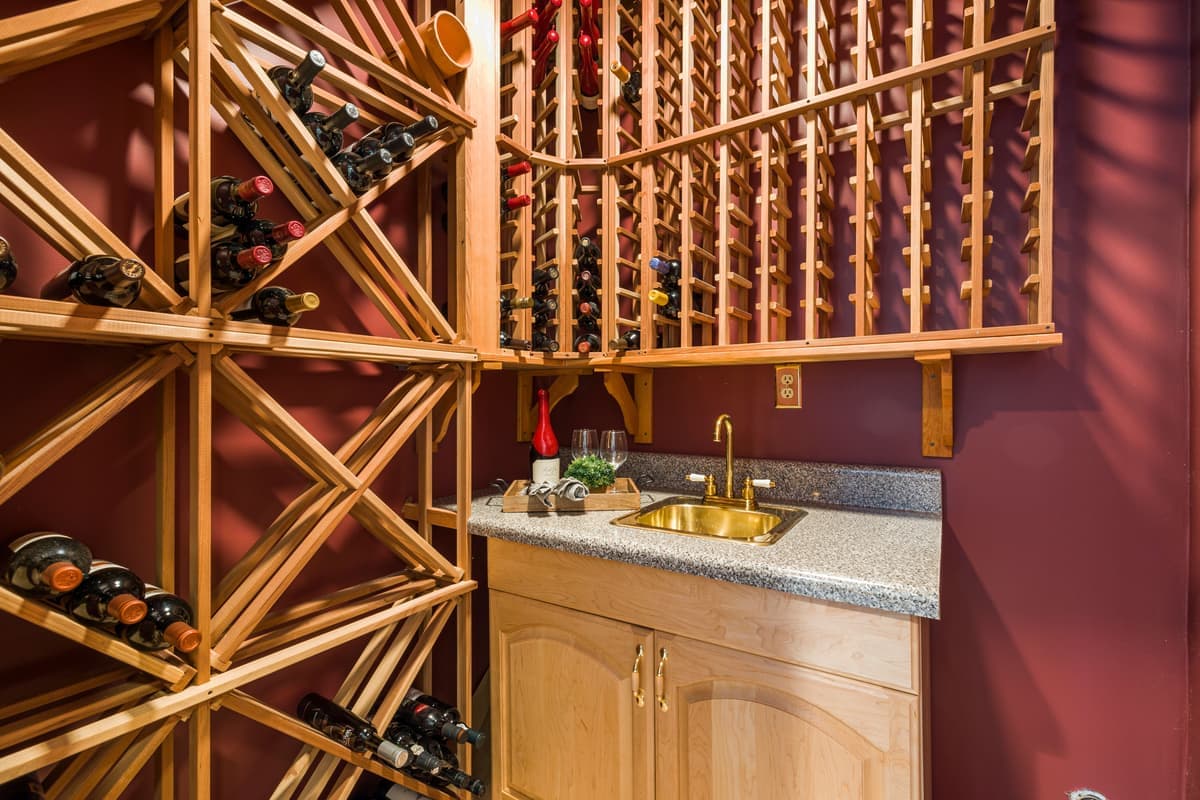
So the honest version of this page: if you have a dry basement that stays under about 68°F year round, a rack and a thermometer will store wine better than a mid-market wine fridge, for a fraction of the money and with nothing to break. The full practice — where in the basement, what to monitor, what to insulate — is in how to store wine in a basement. This page is about the rack.
The slab is the problem, not the damp
People worry about basement humidity and then store cases on the floor, which is backwards. Moderate humidity is actively good for wine: it keeps corks from drying out, and a cellar at 50–70% relative humidity is close to ideal. The threshold where it turns bad is somewhere above about 80%, where labels start to go and mold gets a foothold. That is covered in do wine fridges control humidity and in humidity-controlled wine storage.
The real problem is the concrete. A slab wicks ground moisture upward continuously, and anything resting directly on it stays wet at the contact point. Cardboard cases on a slab go soft and grow mold that transfers straight onto labels; a wooden crate on a slab rots from the bottom. A rack solves this by doing one simple thing: putting an air gap under every bottle.
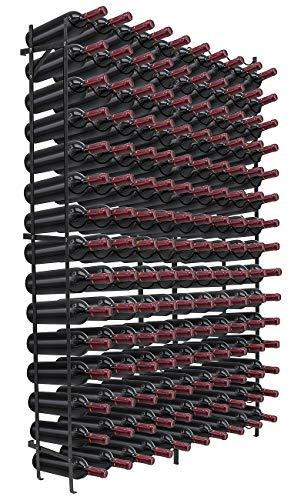
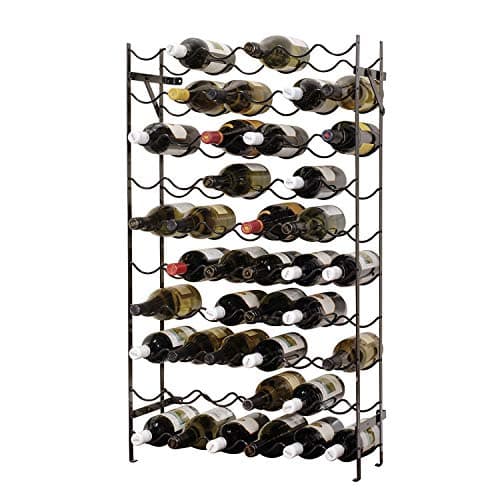
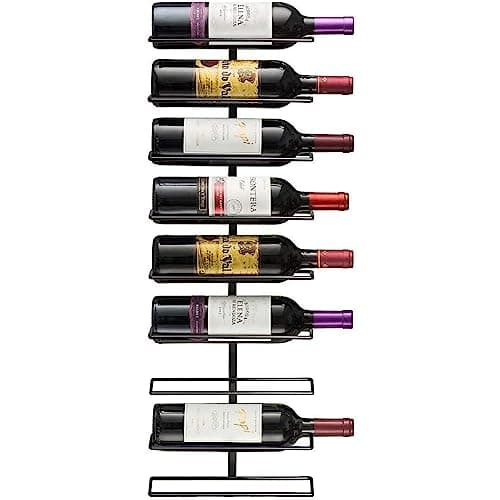
That is why a floor rack earns its place here over a stack of cases. The Sorbus 150-bottle unit is a freestanding floor rack with open shelving — every bottle sits on a shelf above the slab, air moves around all of them, and you can read the labels without lifting anything. The Oenophilia Alexander does the same for 60 bottles. Keep the rack a couple of inches off the wall as well, for the same reason: masonry is as damp as the floor.
Published capacity, side by side
A basement is the one place where buying too much rack is the right mistake. Unlike a kitchen, nothing competes for the space, and a half-empty rack costs nothing to run.
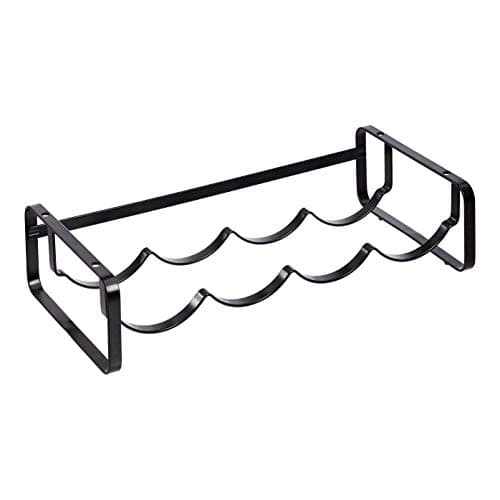
The Amazon Basics tier is in here for a specific reason, and it is not capacity. At 3.74 inches deep and 1.4 pounds it is the cheapest way to find out whether your basement is actually a good cellar before you commit to a 150-bottle rack: put twelve bottles on a shelf, leave a thermometer and hygrometer next to them, and come back in three months. Stackability means those twelve bottles are not wasted spend either way. The class is compared in best stackable wine racks.
Above that, the choice is really just how much basement you are prepared to give up. One hundred and fifty bottles is a genuine cellar; forty is a household collection that will not embarrass you. The whole floor class is in best floor wine racks.
Wood, metal and a damp room
In a dry basement this does not matter much. In a basement that runs above 70% relative humidity, it decides how the rack looks in five years.
Metal. The Sorbus wall rack publishes metal with commercial-grade welding and a black finish; the Amazon Basics tier publishes steel with a smooth black finish; the Sunnydaze folding rack publishes iron with a food-safe powder coating. Powder coat and paint are the defense, and the failure mode is rust starting at a scratch or a weld. In a damp room, inspect the welds once a year and touch up chips.
Wood. The Sorbus wood set publishes a wood backboard with metal bottle holders. Wood tolerates humidity better than people expect — traditional cellars are racked in wood for exactly that reason — but it tolerates standing water and poor airflow badly. Keep it off the floor, keep it off the wall, and it will outlast the house.
The longer trade-off, including how each material behaves under load, is in wood vs metal wine racks.
When a basement is the wrong answer
Three disqualifiers, and they are all things you can measure in an afternoon with a twenty-dollar thermometer-hygrometer.
- The furnace or water heater is down there. A basement with a heat source in it is not a cool room, and the corner nearest the furnace can run twenty degrees warmer than the far wall. Measure where the rack would actually go, not in the middle of the room.
- It floods, or the slab is visibly wet. Occasional water on the floor is survivable if the rack keeps bottles clear. A room that smells of damp when you open the door is telling you the humidity is above the threshold, and that is a labels-and-mold problem no rack fixes.
- It swings. A basement that goes from 48°F in February to 74°F in August is doing the thing that actually damages wine. Swing is worse than a warm steady temperature, which is the whole argument for a cabinet instead — see best wine fridges for long-term storage and wine fridge vs wine cellar.
If one of those applies, the rack is still useful — just for the bottles you will drink this quarter rather than the ones you are keeping. The straight comparison is in wine rack vs wine fridge.