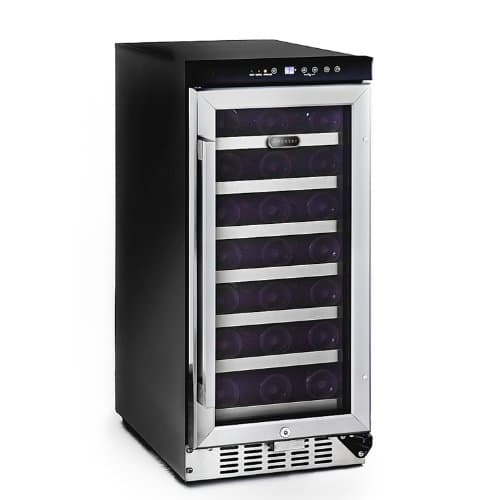
A bar cabinet is a service cabinet
Everything that makes a good cellar cabinet — a single zone held rock steady at 55°F, a door that stays shut for months, deep racking you rarely disturb — makes a mediocre bar cabinet. A bar is the opposite duty cycle. The door opens dozens of times an evening, the bottles you want are the ones you can grab without looking, and what you need out of the cabinet is wine at drinking temperature rather than storage temperature.
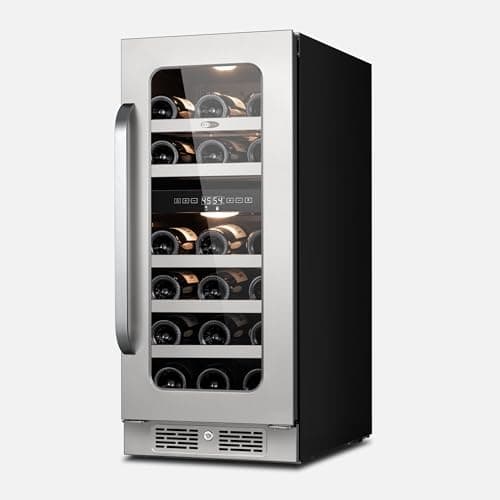
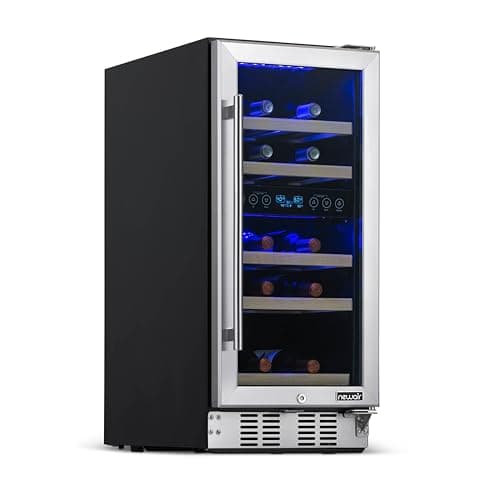
That reframes the spec sheet. The published temperature floor stops being a nice-to-have and becomes the whole point: sparkling wine and crisp whites want the low forties in the glass, and a cabinet that bottoms out at 46°F cannot do it. The cabinets here that can are the Whynter BSR-029DW and BWR-1642DZ at 40–65°F, and the Newair AWR-290DB with an upper zone fixed at 40–55°F. Serving temperatures by style are in wine fridge temperature settings.
The second thing that changes is thermal recovery. Every door opening dumps the cabinet air, and a compressor cabinet pulls it back quickly where a thermoelectric cabinet crawls. For a bar that is not a close call: buy compressor. The timings are in how long does wine take to chill.
Which zone should be the cold one
A dual-zone cabinet on a bar is not for reds and whites. It is for service and holding: one zone in the low forties for the bottles going into glasses tonight, one in the mid fifties for the rest. And whether you get to choose which is which depends entirely on the cabinet.
The Whynter BSR-029DW is the pick largely because of that last column. Both of its compartments carry the full 40–65°F range, so you decide whether the cold zone is the 10-bottle top or the 19-bottle bottom — and on a bar that depends on your bar, not on Whynter. A cabinet that fixes its cold zone to a 10-bottle compartment is fine if you pour ten bottles of white a week and wrong if you pour thirty.
The Newair AWR-290DB is not worse, it is just already decided: upper 40–55°F, lower 50–66°F. That is a sensible split for a bar with the cold wine up at eye level. Just know it before you plan the run. Settings for both patterns are in dual-zone wine fridge temperature settings, and the single-versus-dual decision in single zone vs dual zone.
Door swing, hinges and the alarm
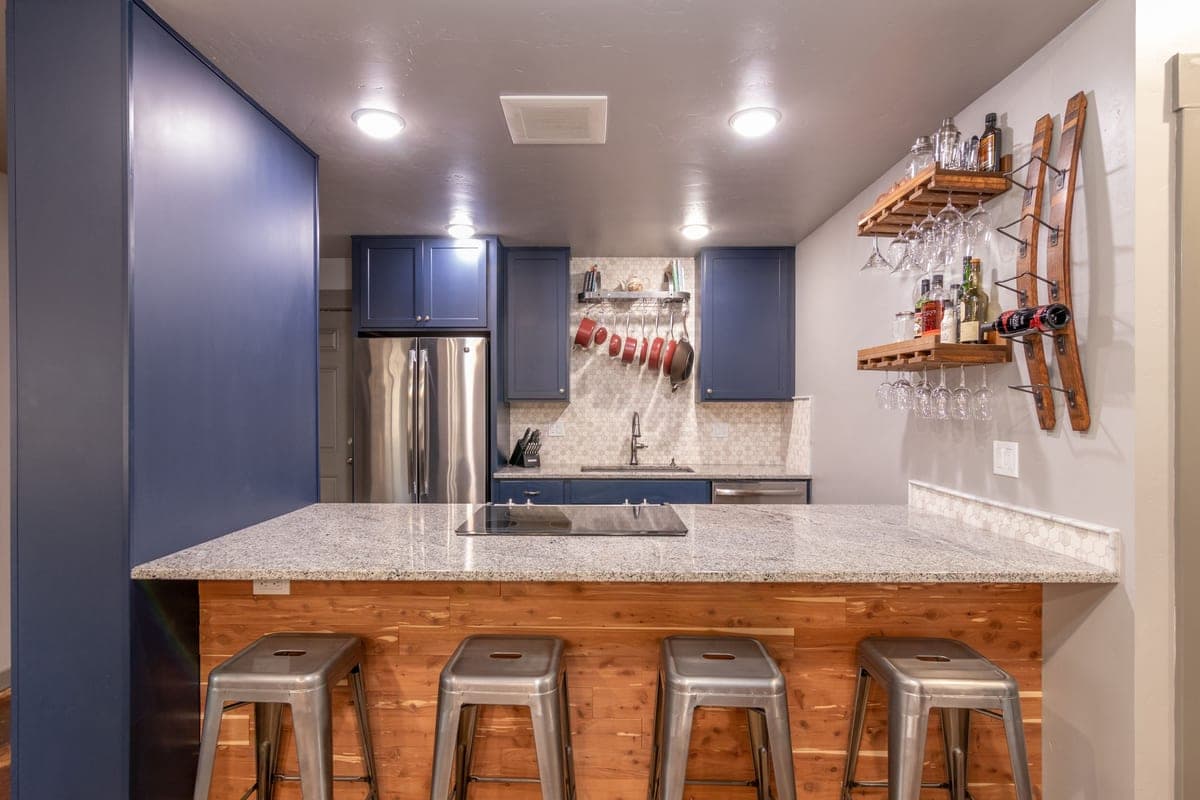
A bar run is the one place in a house where door swing is genuinely load-bearing, because the cabinet usually sits at the end of a counter with a wall on one side and the person pouring on the other. Get it wrong and you reach across the open door every time.
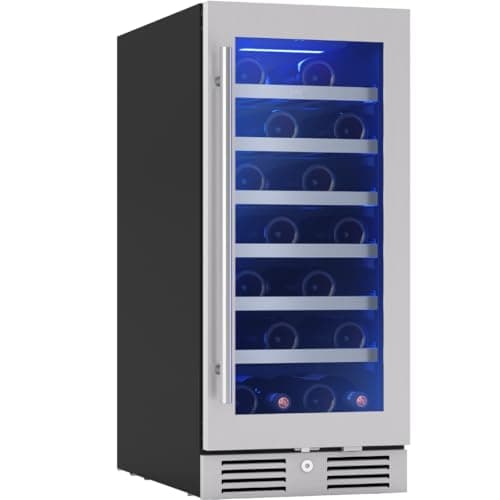
Four of these cabinets publish a reversible door: the Whynter BSR-029DW (“reversible”), the Summit SWC1535B (“reversible”), the Summit SDHW1532 (“reversible, right-hand swing as standard”) and the Zephyr PRW15C01CG (“field-reversible”). The Kalamera KRC-46DZB publishes a reversible stainless-framed glass door. The JennAir takes the other approach entirely and sells swing as a model number — JUWFR242HL right, JUWFL242HL left — which means you cannot change your mind after delivery.
Two details on the Zephyr are worth the words because they are specifically bar features. Concealed zero-clearance hinges mean the door can sit flush against an adjacent cabinet without needing a gap to swing, which is what lets a run look built rather than assembled. And a door-open alarm is the single most useful thing on any of these spec sheets for a bar, because the failure mode of a bar cabinet is a door left ajar at the end of an evening.
Depth, and the shallow bar run
Bar cabinetry is frequently shallower than kitchen cabinetry — a 24-inch counter has a 24-inch carcass behind it, but a bar back or a coffee-bar run built into a dining room is often 18 inches or less. That makes depth the first number to check, and it eliminates cabinets that are otherwise ideal.
The Summit SDHW1532 exists for exactly this problem: 18 inches deep, 19.75 with the handle, six removable steel shelves and dimmable LED lighting at three levels. Eighteen bottles is not much, but it is eighteen bottles in a run where nothing else fits. The Summit ASDW2412 solves the same problem at 24 inches wide and under 18 deep, with adjustable legs and a sliding kickplate cover that take it from a 32-inch ADA height to 34.
Note how often the handle adds two inches. Four of the cabinets above publish depth twice, with and without the handle, and the with-handle figure is the one your tape measure cares about. Full measuring discipline is in wine fridge dimensions, and if the cabinet is going into cabinetry rather than beside it, start with best undercounter wine fridges.
The lock, and the rest of the bar
A lock is a nice-to-have on a cellar cabinet and close to mandatory on a bar, which is usually in a social room rather than a utility space. The published locks here: the Whynter BWR-33SD (“security lock and key”), the Whynter BSR-029DW (“cylinder lock with two keys”), the Zephyr PRW15C01CG (“door lock”), both Summit cabinets (“factory-installed lock”) and the Ivation 18-bottle compressor (“lockable door”). The whole class is compared in best lockable wine fridges.
Three things finish a bar that a wine fridge does not do.
- Glassware off the counter. An under-cabinet stemware rack recovers the counter space the cabinet took. Options in best under-cabinet wine racks.
- Somewhere for the open bottles. A bar generates partly-finished bottles faster than a kitchen does. The preservation options are in best wine preservation systems and the practice in how to store opened wine.
- A way to rescue a warm bottle. The guests arrived, the white is at room temperature, and the cabinet cannot help in ten minutes. That is what a pour-through chiller is for — see best wine chillers.
And if the bar cabinet is also going to hold beer and cans, read can a wine fridge be used for beer and soda first — the answer is yes, with one real caveat about the temperature floor.