
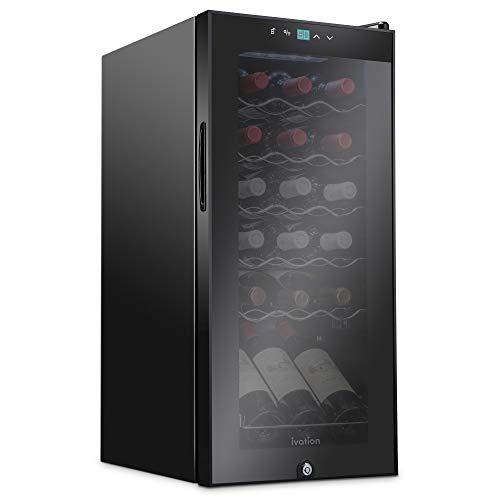
Cheapest and best value are different pages
If the budget is the constraint, go to best cheap wine fridges — that page answers “what is the least I can spend and still get a real cabinet.” This page answers a different question: across everything on this site, where does each additional dollar buy the most cabinet?
Those two answers are not the same model, and they are usually not even the same class. The cheapest real wine fridge is a four- to twelve-bottle thermoelectric unit. The best value wine fridge is a mid-size compressor cabinet, because that is where the price curve flattens: a 33-bottle cabinet does not cost three times a 12-bottle cabinet, and a 164-bottle cabinet does not cost five times a 33.
We cannot show you prices here and then have them be true next week, so this page is built on the two things that do not change: published specification per dollar, and capacity per inch of the space the cabinet takes from you. Live prices for every pick are on the cards above. Whether the purchase makes sense at all is the subject of is a wine fridge worth it.
Bottles per inch of width
Kitchen space is the scarce resource, not money, and this is the metric that respects it. Divide published bottle count by published exterior width.
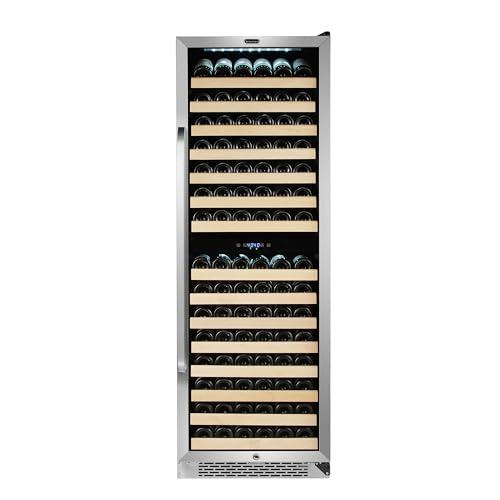
The two 24-inch Whynter towers are in a different universe, and that is the single most useful fact on this page: if you have a 24-inch opening and the vertical height, a tower holds five times the wine of an undercounter cabinet in the same footprint. The reason more people do not buy one is that a tower is a piece of furniture rather than an appliance that disappears under a counter.
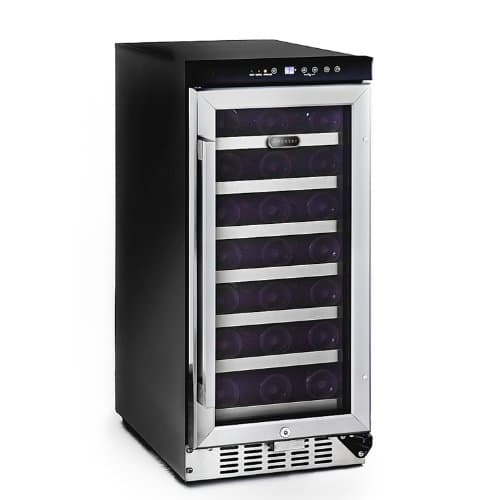
Below the towers, the 15-inch class is the value sweet spot. The Whynter BWR-33SD and the Summit SWC1535B both put 33 bottles into roughly 15 inches, which beats every 24-inch undercounter cabinet on this site per inch of width. If your constraint is a narrow gap rather than a 24-inch cut-out, you are in the best-value part of the market by accident — the class roundup is 15-inch wine coolers.
What a manufacturer will commit to
Here is the value test nobody applies: count what the manufacturer is prepared to put in writing. A specification sheet is a commitment. Silence is not.
The Whynter BWR-33SD publishes exterior dimensions to the tenth of an inch, net weight (80 lb), power draw (80 W / 0.9 A at 115 V, 60 Hz), a noise ceiling (“< 42 dBA”), shelf count and material, glass construction, a lock and a fitted carbon filter. The Zephyr PRW15C01CG goes further still: 39 dBA, Energy Star certification, and a published warranty of two years parts and labor with five years on the compressor.
Now compare the quiet end. The Kalamera KMER1018 publishes capacity, “dual zone” and “built-in installation.” The KingsBottle 24-inch publishes Low-E glass and dual zone. The JennAir JUWFR242HL publishes a door swing. Those may be perfectly good cabinets — but you are buying on the brand rather than on anything you can hold them to, and that is a worse deal at the same price.
The cost that arrives every month
A cabinet you keep for ten years spends more on electricity than the difference between any two models in this roundup. Published draw is the lever: the Whynter BWR-33SD at 80 W, the BSR-029DW at 103.5 W, the BWR-1642DZ at 160 W for 164 bottles, the Whynter WC-201TD at 65 W and the Ivation dual-zone at 65 W.
Note the shape of that list. Per bottle, the 164-bottle tower at 160 W is the most efficient object on this site by a wide margin, because the dominant cost in a refrigerated cabinet is the surface area it loses heat through, not the volume inside. A big cabinet that is full is cheap to run per bottle. A small cabinet that is half empty is expensive per bottle and always will be.
The one certified figure here is the Zephyr PRW15C01CG, which is Energy Star certified. The arithmetic for your own tariff is in wine fridge running costs, and the cabinets that measure best are in best energy-efficient wine fridges.
Where the money actually goes
Four places, in descending order of how much they matter to the price.
- Compressor and vibration control. The cheapest real upgrade. A compressor cabinet is colder, faster and ambient-independent; see compressor vs thermoelectric. Documented vibration control — Dacor’s GlideRack system is the one manufacturer here that specifies it — is the expensive upgrade.
- Two zones. Worth paying for if you serve as well as store; worth nothing if everything in the cabinet sits at 55°F. The honest version of that decision is in single zone vs dual zone.
- Glass and door engineering. Double-pane UV glass is near-universal at this level. Dual-pane Low-E argon-filled, a door-open alarm and concealed zero-clearance hinges — all published on the Zephyr — are where the money shows.
- Brand and panel-ready cabinetry. The JennAir and Dacor cabinets charge for matching a kitchen suite, which is a legitimate thing to want and is not wine storage. The brand-by-brand picture is in wine fridge brands compared.
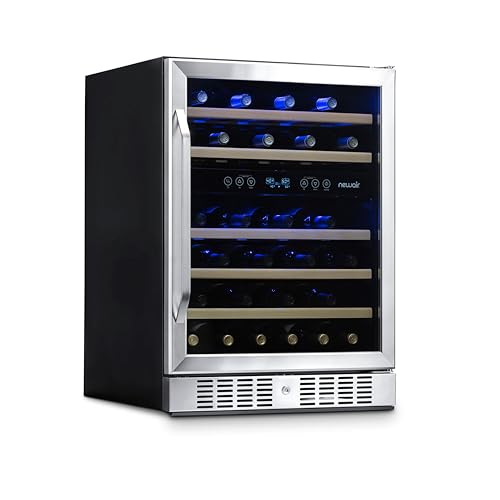
If you want the one-line version: buy the 15-inch Whynter if you have a narrow gap, buy the Newair AWR-460DB if you have a 24-inch opening and 46 bottles is enough, and buy the BWR-1642DZ if you have the floor space, because nothing else on this site comes close per bottle.