
Why the order matters
Almost everyone shops for a wine fridge backwards. They start with bottle count, because that is the number on the front of the box, pick a capacity, and then discover the cabinet they chose cannot be built into the only gap they have. Capacity is the third question, not the first.
The order below is strict because each answer eliminates options for the next one. Decide installation and you have cut the field by two thirds. Decide cooling and you have decided the temperature floor. Only then does capacity mean anything, because a 46-bottle freestanding cabinet and a 46-bottle built-in are different appliances at different prices.
If you have not yet decided whether you want a cabinet at all, start with is a wine fridge worth it and wine rack vs wine fridge. If you want the mechanism first, how does a wine fridge work.
1. Where is it going?
This is the question that eliminates the most cabinets, and it has three possible answers.
- Into cabinetry, flush with the doors. You need a cabinet rated for built-in installation, which means it vents forward through its own grille rather than out of the back. A freestanding cabinet installed this way overheats and never holds temperature — it is the single most common expensive mistake in this category. Start at best undercounter wine fridges.
- Standing free, against a wall. Any freestanding or both-rated cabinet, honoring its published clearance. See best freestanding wine fridges.
- On a counter. A different class entirely — small, usually thermoelectric. See best countertop wine fridges.
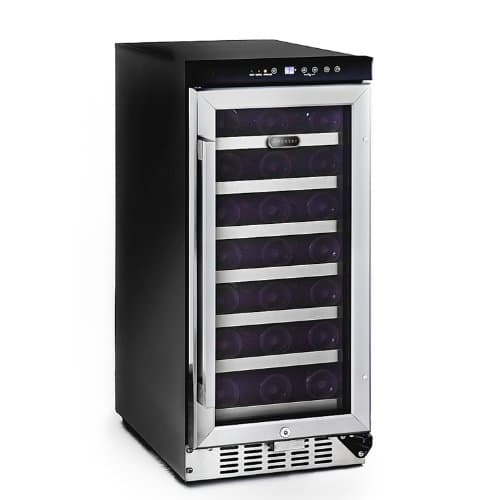
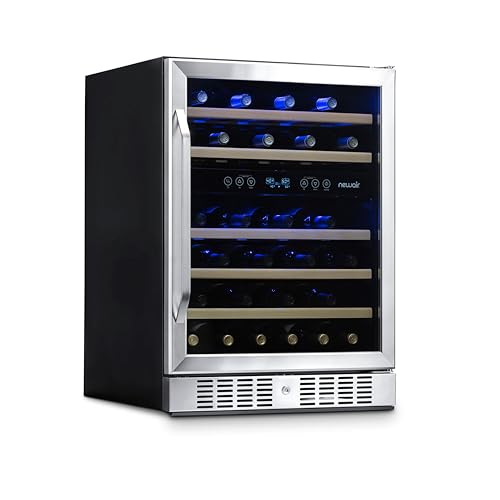
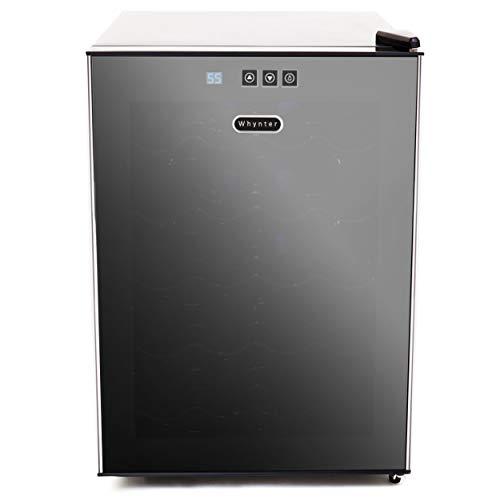
The useful hedge is a cabinet rated for both, because it does not lock you into the decision. The Whynter BWR-33SD, the Whynter BSR-029DW, the Zephyr PRW15C01CG, the Newair AWR-460DB and AWR-290DB, the Kalamera KRC-46DZB and both Summit 15-inch cabinets are all published as built-in or freestanding. The full argument is in built-in vs freestanding, and the clearances in ventilation and clearance.
Then measure. Width, height, and depth with the handle fitted — four of the cabinets on this site publish depth twice for exactly that reason, and the Whynter BWR-33SD goes from 22.5 inches to 24.5 once the handle is on. Measuring discipline is in wine fridge dimensions.
2. Compressor or thermoelectric?
One sentence version: a compressor cools absolutely, a thermoelectric module cools relative to the room, so this question is about your room rather than your wine.
Buy compressor if the cabinet lives anywhere that gets warm, if you want the low forties for sparkling wine, or if you need more than about 30 bottles. Buy thermoelectric if the cabinet lives in a bedroom, study or quiet living room, or in an apartment with shared walls, and silence and zero vibration matter more than cooling power.
The published numbers make the trade visible. Thermoelectric floors: Whynter WC-201TD 46–66°F, Schmécké 12-bottle 46–64°F, Ivation dual-zone upper from 46°F. Compressor floors: Ivation 18-bottle compressor 41–64°F, Whynter BSR-029DW and BWR-1642DZ 40–65°F in both zones. Forty-six degrees is fine for storage at 55°F and not fine for Champagne. Full treatment in compressor vs thermoelectric.
3. How many bottles, really?
A published bottle count assumes standard Bordeaux bottles filling every shelf. A real collection has Burgundy bottles, Champagne, the occasional magnum and a gap where you just took something out, so plan on about 70 to 80 percent of the rating.
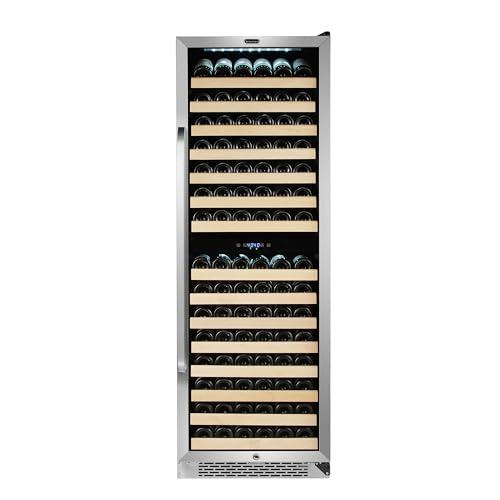
Two rules of thumb that save money. First, buy one size up from your current collection, because a cabinet you cannot rearrange is a cabinet you stop using properly. Second, bigger cabinets are cheaper per bottle both to buy and to run — the Whynter BWR-1642DZ draws 160 W for 164 bottles while the 33-bottle BWR-33SD draws 80 W for 33, because heat loss scales with surface area rather than volume.
The arithmetic in full is in what size wine fridge do I need. Capacity-band roundups: 30 bottles, 50 bottles, 100 bottles.
4. One zone or two?
The honest answer is narrower than the marketing. Both red and white wine store at about 55°F; only serving temperature differs. So a second zone is worth paying for if you serve from the cabinet, and worth nothing if you only store.
If you do want two zones, check whether both carry the full range. The Whynter BSR-029DW and BWR-1642DZ publish 40–65°F in both compartments, so you choose which side is cold. The Newair AWR-290DB fixes its upper zone at 40–55°F and its lower at 50–66°F — a sensible split, already decided for you. The Ivation dual-zone runs upper from 46°F and lower 54–64°F.
Full decision in single zone vs dual zone, and settings in dual-zone temperature settings. For a bar, where service is the whole point, see best wine fridges for a home bar.
5. What are the shelves?
The shelf is the only part of the cabinet that touches the bottle, and it is the part people stop being happy with after a year. Chrome wire supports a bottle on two thin lines, so it rocks as the compressor cycles and it drags the label when you pull it out. Shaped wood cradles the bottle at the curve.
Ask three things of a spec sheet: material, whether shelves slide out, and whether they are removable — removal is the only way to create clearance for a bottle the shelf pitch was not designed for, and Summit publishes the move outright for the SWC1535B (“remove alternate shelves for wider Burgundy bottles”). Detail in wine fridge shelf types and the cabinet-by-cabinet comparison in best wine fridges with wooden shelves.
6. What will the manufacturer publish?
This is the question almost nobody asks, and it is the best proxy for quality available to a buyer who cannot open the box. A specification sheet is a commitment. Silence is not.
Now the contrast. The Kalamera KMER1018 publishes capacity, “dual zone” and “built-in installation.” The JennAir JUWFR242HL publishes a door swing. Those may be fine cabinets, but at the same price you are buying on brand rather than on anything you can hold them to. Brand-level differences in wine fridge brands compared, and value measured properly in best wine fridges for the money.
Four things not to decide on
- “Humidity control.” Almost every cabinet at this level manages humidity as a side effect of refrigerating a sealed box, and very few publish a target or a measurement. Treat an unquantified humidity claim as marketing — see humidity-controlled wine storage.
- Bottle count on the front of the box. Covered above: discount it by 20–30%.
- Interior LED color. Blue light is a styling choice. It is not preservation, and the UV argument is handled by the glass rather than the bulb.
- An unquantified “low vibration” claim. One manufacturer here specifies a mechanism — Dacor’s GlideRack shelf system, published as designed to eliminate vibration. Everybody else says “quiet compressor.” Only the first kind is a fact.
Once the cabinet arrives, the first-week sequence is in how to set up a new wine fridge.