The three-question test
Nobody needs a wine fridge in the way they need a refrigerator. A wine fridge solves three specific problems, and if you have none of them it is an expensive cabinet for holding bottles you could hold on a shelf. Answer these honestly.
1. How long does a bottle stay in the house? If the answer is days or a couple of weeks, temperature barely matters. Wine degrades with time at the wrong temperature, and two weeks at 72°F does nothing you will taste. If bottles sit for months or years, every degree above 55°F is compounding against you.
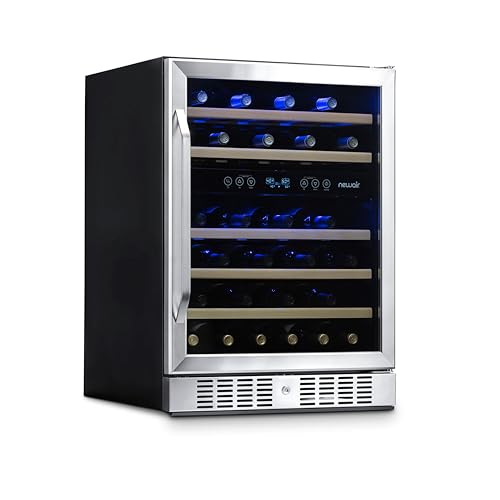
2. Do you serve reds and whites in the same evening? Whites want roughly 45–50°F and reds roughly 60–65°F. A kitchen fridge gives you one of those and a room gives you the other, badly. Two zones give you both without planning ahead, which is the single most noticeable day-to-day benefit of owning one.
3. Is there anywhere in your home that stays under 65°F year round? A north-facing cupboard, an unheated pantry, a basement. If yes, you have most of a wine cellar already and a rack may be enough. If every room swings from 60°F in winter to 80°F in summer, no rack fixes that.
Two or three yeses: buy the cabinet. One yes: read the next two sections before you spend anything. No yeses: you do not need one, and nobody selling you one will say so.
What a wine fridge actually buys you
Four things, in descending order of how much they matter.
- A stable temperature. Not a cold one — a stable one. Wine tolerates a steady 65°F far better than a weekly swing between 55°F and 80°F, because repeated expansion and contraction works the cork and eventually lets air past it. This is the whole argument, and it is explained in what happens to wine if it is not stored properly.
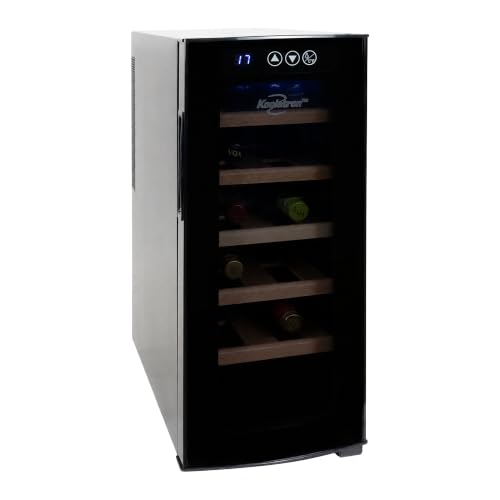
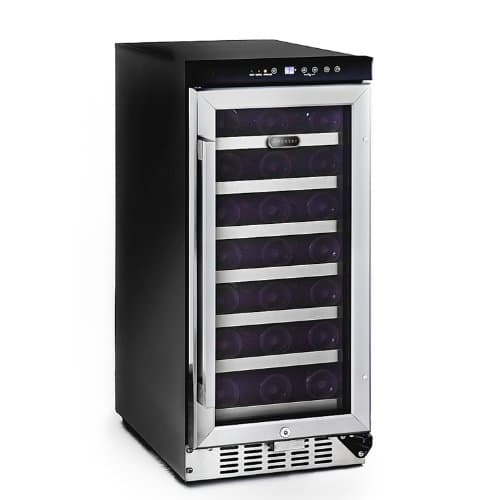
- Darkness. Every cabinet on this site has UV-filtering glass; the Koolatron uses double-pane mirrored UV-protective glass, Whynter double-pane tempered UV-protective, Zephyr dual-pane Low-E argon-filled. A cupboard gives you the same benefit for free, which is worth knowing.
- Humidity that does not dry a cork out. A kitchen fridge actively dehumidifies. A wine cabinet does not — see wine fridge humidity.
- Serving temperature on demand. The convenience benefit, and the one people actually notice. No ice bucket, no decanting a red that has been sitting at 75°F all day.
Why the kitchen fridge is not the answer
The obvious alternative, and it fails on four counts rather than one. A kitchen fridge runs at roughly 37–40°F, which is below any wine’s serving temperature and far below storage temperature. It dehumidifies continuously, which dries corks over months. It vibrates, because its compressor is sized for a much bigger box. And it is full of food, which is a problem of its own: a cork is semi-permeable and a fridge is full of smells.
For a few days none of that matters, and a kitchen fridge is a perfectly good place for a bottle you will open on Friday. For a few months it matters. The full comparison is in wine fridge versus regular fridge, and if you are weighing a cheap beverage cooler instead, read wine fridge versus beverage fridge first — a beverage cooler is a different machine with a different floor temperature.
When a cupboard and a rack genuinely win
Two situations, and we would rather say so than sell a cabinet into them.
You have a cool, dark, stable room. If a cupboard against a north wall sits at 58–64°F all year, a rack in it is better storage than a cheap cabinet in a warm kitchen, costs nothing to run, and holds any bottle shape. That is the honest case for a wine rack, and the full head-to-head is rack versus fridge.
Your collection is under about eight bottles and turns over monthly. At that scale a cabinet is storage you do not need. A countertop rack and a bottle in the kitchen fridge an hour before dinner covers it.
The crossover is somewhere around a dozen bottles held for a season or more. Below it, the cabinet is a convenience purchase. Above it, it is storage.
The cost question, done properly
We do not print prices in prose on this site, because live prices move weekly and a sentence written today would be wrong next month — the current figure is on each product card above. What we can do is the running-cost arithmetic, which does not move.
Published draws run from 65 W for a small thermoelectric cabinet to 160 W for a 164-bottle compressor cabinet, and nothing runs flat out — a compressor cycles, so average consumption is a fraction of the rating. The method for turning a wattage into your own annual cost, using your own tariff, is in do wine fridges use a lot of electricity.
The more useful frame is cost per bottle protected. A cabinet that holds 33 bottles for ten years is protecting a few hundred bottles over its life. Against that, the cabinet is cheap and one heat-damaged case is not. Expected life is covered in how long wine fridges last, and it is the number that decides whether this arithmetic works.
The verdict
A wine fridge is worth it for the household that keeps a dozen or more bottles across a season, or that serves both colors at temperature. It is not worth it for the household that buys on Thursday and drinks on Saturday, and it is not worth it as a substitute for a cool room you already have.
If the answer is yes, the next decision is cooling type rather than size — compressor versus thermoelectric is decided by the room the cabinet will stand in. Then size it with what size wine fridge do I need, and pick the model from best wine fridges.
If the answer came out yes, the next page is how to choose a wine fridge — six decisions in the order that stops you buying the wrong cabinet. And if what tipped you toward a cabinet was humidity, read humidity-controlled wine storage first: the claim is almost never quantified, and knowing that changes what you should pay for.
Worth it also depends on what you are being asked to pay for, and five things move that number — how much a wine fridge costs breaks them down, including the install and running costs people leave out.