The half inch that breaks a rack
A standard 750 ml wine bottle is published at 11.8 inches tall and 2.95 inches in diameter. A standard 750 ml Champagne bottle is published at 13 inches tall and 3.5 inches in diameter — taller, and more than half an inch fatter, because the glass has to hold several atmospheres of pressure. A Bordeaux-style 1.5 L magnum is wider again: glass supplier listings put it at roughly 92 to 100 mm across, which is about 3.6 to 3.9 inches, and 346 to 381 mm tall.
Now hold that against the one slot figure the mass market publishes. The Amazon Basics stackable tier, the only rack in our registry that states a slot size, publishes 3.25 inches by 3.25 inches. That is generous for a 2.95-inch Bordeaux bottle and physically too small for a 3.5-inch Champagne bottle. The bottle does not go in a bit tightly. It does not go in.
This is the entire reason a page like this exists. Almost every wine rack sold is designed around the 2.95-inch bottle, because that is what most people own, and the extra half inch on a Champagne bottle puts it outside the design envelope of the majority of racking on the market. If your collection is mostly sparkling wine, Burgundy and Pinot Noir shapes, or anything in magnum, slot width is not a detail to check later. It is the first filter.
Our wine rack sizes guide works through the same arithmetic for depth and load across the whole racks hub. This page is narrower: it is about the three racks we can find that are specified for the wide stuff, and what each of them is honestly good for.
Why racks list bottle types, not numbers
Here is the awkward thing about shopping in this corner of the market: even the purpose-built racks mostly describe bottle types rather than publishing a slot measurement.
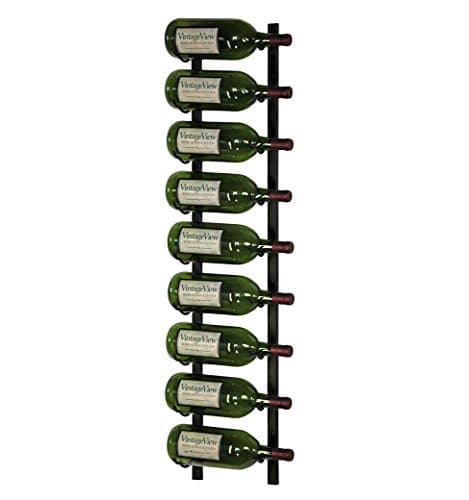
VintageView’s W Series Mag Rack is specified as being “designed specifically for magnums, Champagne, and Pinot bottles” and “purpose-built to support 1.5 L bottles”. Those are clear statements of intent from a company that makes nothing but wine racking, and they come with a lifetime warranty behind them — but they are not a number, and the published specification sheet does not give a bottle diameter. NutriChef’s magnum rack is the same story in cheaper materials: the listing states the slots are sized for magnum and oversize bottles, and publishes the thickness of the timber (a 1-inch sideboard, half-inch rack sticks) but not the width of the opening.
Only the Vinotemp Epicureanist magnum rack publishes the figure that actually answers the question: 3.25 inches between the metal bars, with a recommendation to allow 9 to 10 inches between racks mounted side by side. That is a measurement you can take to your own bottles with a tape measure, which is why it is the one we quote in the answer above.
What to do about the gap: before you buy anything, measure the fattest bottle you own at its widest point, which on a Champagne bottle is the shoulder rather than the base, and treat that as your minimum. Where a maker publishes only a bottle type, the useful question is whether that maker has a reputation and a warranty to lose. VintageView does. A listing that shows a Champagne bottle in a photograph and states nothing at all does not.
Wall, floor, or inside a cabinet
Wide bottles change the geometry of every placement decision, and not always for the worse.
Wall racking is the natural home for magnums. A label-forward wall rack holds each bottle by the neck and the base, so the body of the bottle hangs in free air and girth stops mattering as much. That is the VintageView arrangement: 9 bottles single depth or 18 double depth, in 45 inches of height and 15 inches of width, projecting only 5.25 inches from the wall. For comparison, a 9-bottle standard wall rack takes about the same wall. You are not paying a space penalty for the wide bottles, only a density one.
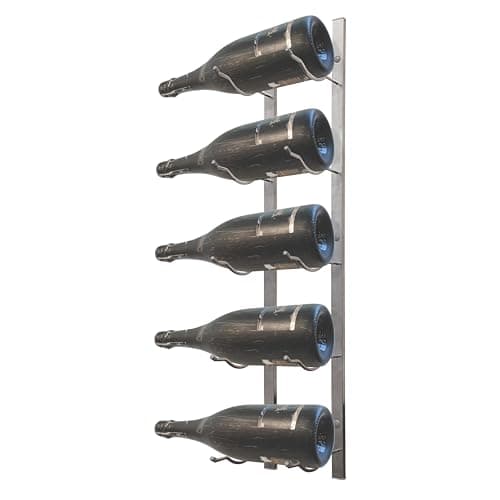
A narrow floor-standing column suits a handful of special bottles. The Vinotemp rack is 5.25 inches wide, 8 inches deep and 35.75 inches tall for five magnums. It can be fastened to a wall or mounted inside a cabinet, which is the detail that makes it useful: a magnum will not lie in a wine fridge shelf designed for Bordeaux bottles, and a five-bottle rack inside a cupboard gives those bottles somewhere sensible to live.
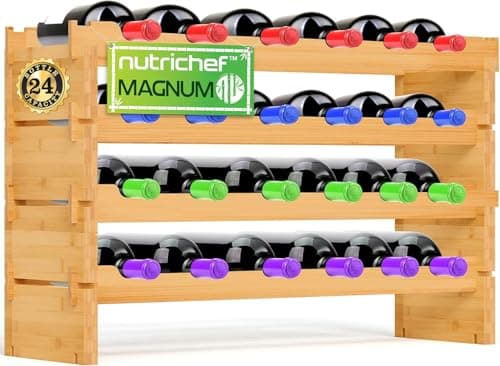
Modular timber racking is the cheap way to scale. NutriChef’s magnum rack takes 24 bottles per set and stacks, so a growing collection is a matter of buying another set. The trade is that it is bamboo on an open frame in a room, which means the room is doing all the climate control — the argument our rack versus fridge comparison goes through in full.
What does not work is trying to put the wide bottles in the cabinet. Most wine fridges cradle bottles in contoured wooden or wire shelves cut for a 2.95-inch body, and the fix is to remove shelves and lose capacity, which is the whole subject of the large-format cabinet roundup. If sparkling wine is the collection rather than a few bottles of it, the honest split is a rack for the magnums and a cabinet for what you serve cold — our Champagne cabinet roundup covers the service side.
Weight, and the fixing it needs
A full 750 ml bottle is close to three pounds. A magnum carries twice the wine in heavier glass, so a nine-bottle magnum wall rack is a materially bigger load on the wall than a nine-bottle standard rack, and it is concentrated into two mounting strips.
That makes the fixing specification part of the purchase rather than an afterthought:
- Check what hardware is supplied and for what substrate. VintageView supplies a neck mounting strip and a base mounting strip with hardware stated for drywall and wood installations, and couplers to stack units. That is a complete answer to the question.
- Find the studs anyway. Drywall anchors are rated for a static pull-out load applied gently. Loading and unloading bottles is neither static nor gentle.
- Watch the published load on timber racking. Stacked modular racks rely on the set below them, so the bottom tier carries everything above it. The same logic applies to depth: the deeper the rack, the further the load sits from the wall.
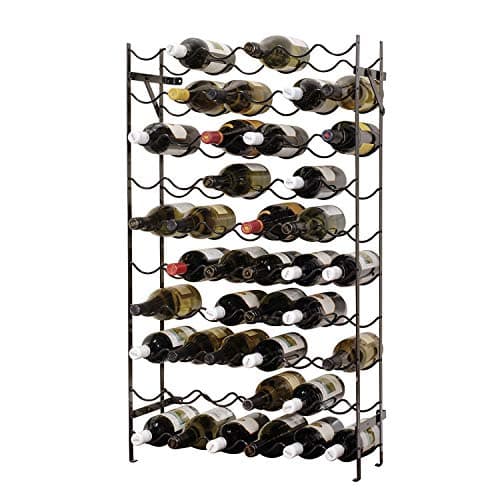
- Read a floor rack as a floor load. The Oenophilia rack here holds 60 bottles, which is well over a hundred pounds of glass and liquid in 22.5 inches of width, and the listing publishes no load rating.
Mixing magnums with the rest of the collection
Almost nobody owns only magnums. The practical layout question is how to store four or five wide bottles alongside fifty normal ones without buying two completely separate systems.
Three arrangements work, in rough order of how well:
- A small dedicated rack for the wide bottles, standard racking for the rest. This is why the Vinotemp five-bottle column is on this page. Five magnums in five inches of wall next to any standard rack solves the problem completely and cheaply.
- One rack family, two configurations. VintageView’s Mag Rack stacks with the rest of its Wall Series using the supplied couplers, so a magnum section and a standard section can read as one installation rather than two mismatched racks.
- Oversize slots for everything. Putting standard bottles in magnum-width slots works — they simply sit loose — but you are buying volume you do not use, and a loose bottle in a deep cradle can roll when the next one goes in. Fine on a 24-bottle modular set, wasteful across a whole wall.
Wherever the bottles end up, the storage conditions argument does not change because the bottle got bigger: a rack has no temperature control, no humidity control and no UV protection, so the room supplies all three or nothing does. If the room cannot hold roughly cellar conditions, read what happens to wine stored badly before spending anything — a magnum of something good is exactly the bottle you do not want to find out with. A logging hygrometer answers that question for a few dollars before you spend anything on racking, and best wine fridge thermometers and hygrometers ranks the ones worth buying.
Choosing between the four
For a real magnum and Champagne collection, the VintageView W Series Mag Rack. It is the only pick here from a company that does nothing but wine racking, it is specified for 1.5 L, Champagne and Pinot bottles, it comes in five finishes, it stacks with the rest of the Wall Series, and it carries a lifetime warranty. Nine bottles in 45 inches of wall is a low density, and the specification stops short of publishing a bottle diameter — both are real criticisms, and neither changes the recommendation.
For five special bottles and no wall to spare, the Vinotemp Epicureanist magnum rack. It publishes the figure nobody else does — 3.25 inches between bars — takes 5.25 inches of width, and can be mounted inside a cabinet, which is the tidiest answer for the two or three magnums that will not lie in a wine fridge. Five bottles is all it is, and at 35.75 inches tall it wants a run of clear height.
For the most wide-bottle capacity per dollar, the NutriChef magnum modular rack: 24 bottles per set in bamboo with an anti-moisture finish, stackable so the system grows. It is also the pick with the least published specification — no assembled dimensions and no slot width — and bamboo on an open frame gives the bottles no protection from room light.
And the one that will not take them: the Oenophilia Alexander. It is a good 60-bottle rack — welded metal, 8 inches deep, floor-standing or wall-mounted — and it is here as the standard-spacing control. Buy it for the Bordeaux bottles, put the magnums somewhere else, and do not discover the difference after drilling. If you want the wider picture of what is available in metal and wood at standard spacing, our main wine rack roundup ranks the category, and wood against metal covers the material argument.