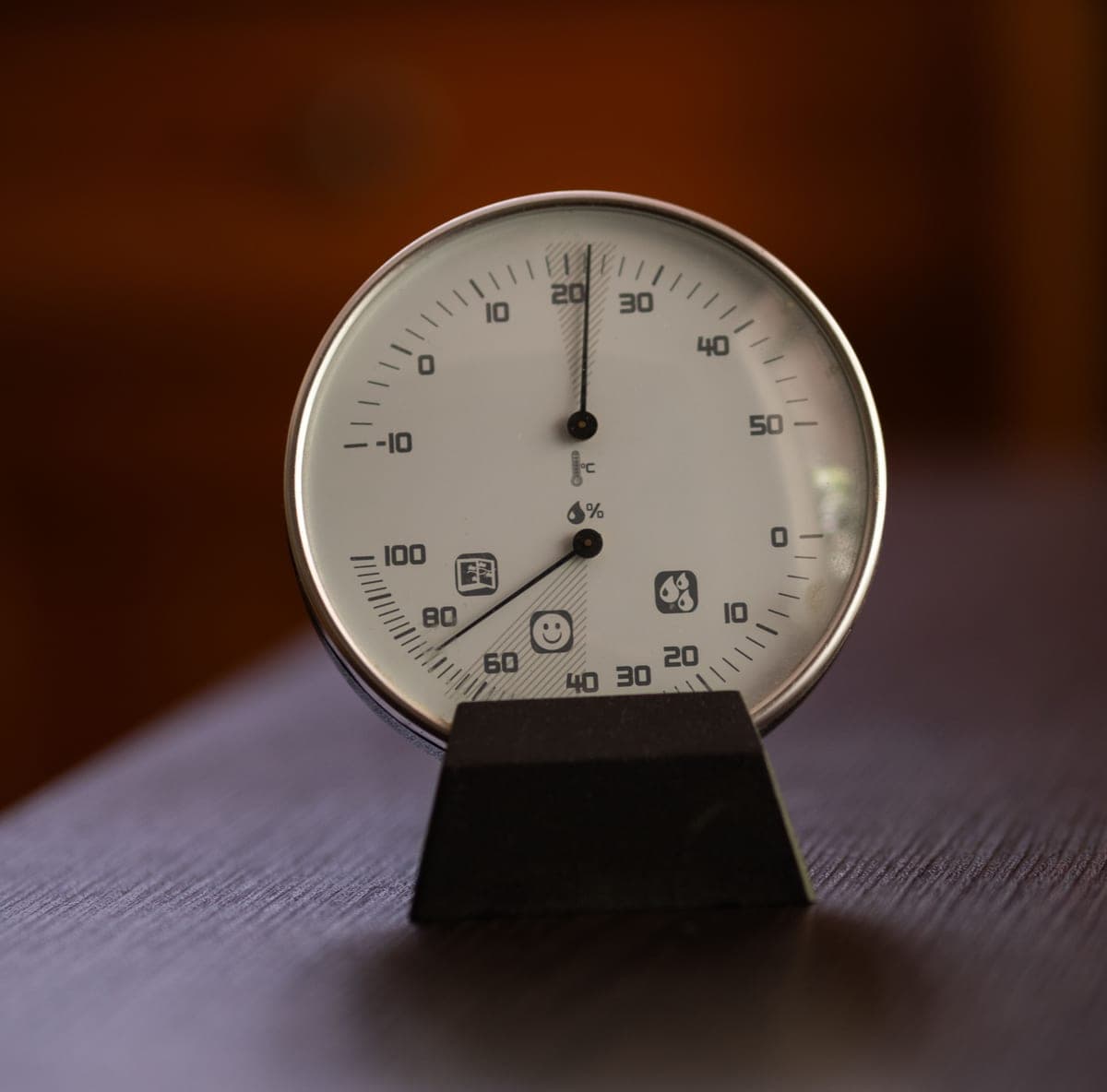
Why a cabinet needs a second opinion
A wine cabinet shows you a number. That number is what the control board is aiming at, measured by one sensor in one place — usually behind the rear wall or near the top of the compartment, where it is convenient for the wiring rather than representative of the bottles. The wine is somewhere else: lower down, further forward, behind glass that is warmed by the room on one side.
That gap is not a fault. Every refrigerated cabinet has a gradient, and the better ones have a smaller one. The problem is that the cabinet cannot show it to you. A $15 sensor sitting on the middle shelf can, and what it usually reveals is one of four things:
- A steady offset. The display says 55°F, the middle shelf reads 58°F, and it reads 58°F all week. That is a cabinet you can simply dial down three degrees, and the only thing you needed was the number.
- A swing. The shelf temperature rises and falls several degrees as the compressor cycles. Wine tolerates a slow seasonal drift far better than a daily sawtooth, which is the argument our wine storage temperature guide makes at length.
- A door problem. Readings spike every evening at the same time, because the door is being opened, or because a seal is not closing on one corner.
- Nothing at all. The cabinet holds the number it claims, and you can stop wondering. This is a perfectly good outcome for fifteen dollars.
Three of those four cannot be diagnosed from the cabinet’s own display, because the display is the thing under suspicion. That is the whole case for buying a monitor, and it is a stronger case for a cheap cabinet than an expensive one — the units in our budget roundup are the ones whose thermostats are least likely to be telling the whole truth.
Reading an accuracy figure honestly
Every product on this page publishes an accuracy figure, and the figures look almost identical: ±0.5°F or ±0.54°F for temperature, ±3% RH for humidity. Three things are worth knowing before you treat those as equivalent.
First, accuracy and range are different claims. Inkbird publishes both: the IBS-TH3 WIFI PLUS is specified over 32–122°F, the IBS-TH2 over −40°F to 140°F. Govee publishes accuracy for the H5075 and H5179 but does not state a measuring range on either product page. For a wine cabinet sitting between 40 and 65°F that is academic — every sensor here is comfortably inside its band — but if you want one instrument for a cellar and a freezer, only the published range tells you it will work in both.
Second, typical is not maximum. Inkbird publishes two numbers for each measurement: ±0.5°F typical and ±0.9°F maximum for temperature, ±3% typical and ±4.5% maximum for humidity between 20 and 80% RH. That is more honest disclosure than a single headline figure, and it is also the number you should plan around. Govee publishes a single figure for each.
Third, none of this is a calibration certificate. These are manufacturer claims for a consumer sensor, not traceable instrument specifications. Two units of the same model can disagree by a degree and both be within spec. If the exact number matters to you — because you are deciding whether a cabinet is fit to age a case of something serious — buy two, put them on the same shelf, and compare. Where they agree, believe them.
Getting the reading out of a closed cabinet
This is the specification that actually decides which of these you should buy, and it is the one nobody lists. A wine cabinet is an insulated box with a steel shell and a glass door. Radio gets out, but attenuated, and how much attenuation you get depends on the door and on where you put the sensor.
There are three workable arrangements, and one that disappoints people.
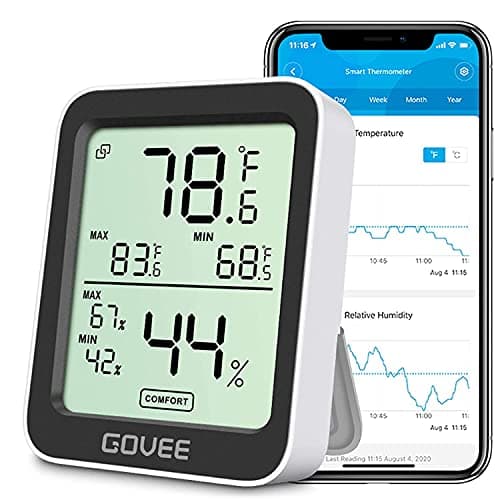
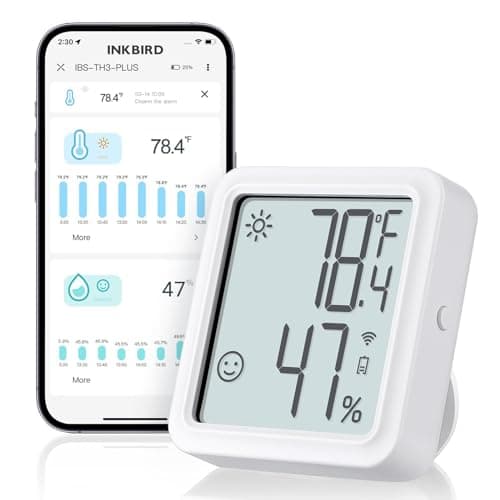
- A screen on the sensor, read through the glass. The H5075 and the IBS-TH3 WIFI PLUS both have displays. Stand the unit on a shelf facing the door and you can read it without opening anything, which makes the published radio range irrelevant for a cabinet in a room you walk through. This is the arrangement we would choose for a glass-fronted wine fridge, and it is why the H5075 leads this page.
- Bluetooth to a phone in the same room. Govee publishes up to 196 ft for the H5075 in its feature copy and 164 ft in its own FAQ; Inkbird publishes 98 ft for the IBS-TH2. All of those are open-air figures. Through a cabinet wall and a plasterboard partition, assume a fraction. In practice Bluetooth works from the same room and is unreliable from the next floor.
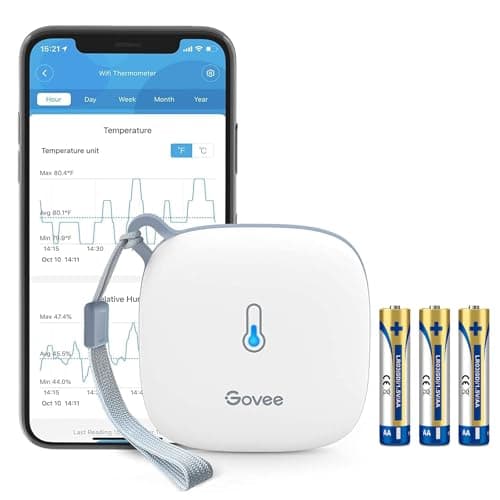
- Wi-Fi, for alerts while you are out. The H5179 and the IBS-TH3 WIFI PLUS connect to 2.4 GHz Wi-Fi (neither supports 5 GHz, which trips up anyone with a single-SSID modern router). Once connected, the sensor pushes to the app whether or not your phone is nearby, which is the only configuration that will tell you a cabinet has failed while you are away for a week.
- A solid door with an app-only sensor. This is the disappointing one. Put an IBS-TH2 inside an integrated cabinet with a solid panel-ready door, and you have a sensor with no screen behind a metal-skinned door, reachable only by Bluetooth. If your cabinet is one of the panel-ready units, buy a Wi-Fi sensor or one with a display you can see when the door is open.
Inkbird also sells a variant of the TH2, the IBS-TH2 Plus, whose listing states support for an external temperature probe and an on-device display — the classic solution of a probe inside and the readout outside. We have not included it here because stock of that variant was down to a handful of units when this page was written, and we do not rank a product you may not be able to buy.
The humidity number, and what it is worth
Every monitor here reports humidity as well as temperature, and the humidity reading is the one most likely to alarm you unnecessarily. Two reasons.
The first is that a running compressor cabinet is a dehumidifier. Cold surfaces condense moisture out of the air, the water drains away, and the compartment sits drier than the room. A reading in the 40s or low 50s is normal in a compressor cabinet, not evidence of a fault, and the people who panic about it are usually comparing it against a cellar figure that applies to a stone room with an earth floor. Our wine fridge humidity guide works through what the number means and when it genuinely matters, which is essentially only for natural cork over years rather than months.
The second is that consumer humidity sensors are less accurate than their temperature sensors, and the specifications say so if you read them. Inkbird publishes ±3% RH typical between 20 and 80% RH — but ±4.5% typical and ±7.5% maximum across the full 0–100% span. A reading of “52%” is really “somewhere in the high 40s to mid 50s”. That is fine for spotting a trend, which is what you want it for, and useless as a precise figure.
What a humidity log is genuinely good for is the opposite case: a basement or a garage where the problem is too much moisture. If you are storing on open racking in a room rather than in a cabinet, the number that matters is the room’s, and it moves with the seasons. That is the scenario in storing wine in a basement and it is the one argument for the 3-sensor logging approach rather than a single unit.
Where to put the sensor
A monitor in the wrong place produces a number that is accurate and misleading. Four rules, all of them consequences of how a cabinet moves air:
- Middle shelf, middle depth. Not on the top shelf, not against the back wall next to the cabinet’s own sensor, and not in the door. You are trying to sample where the bottles are, so put it where the bottles are.
- Not touching glass or metal. A sensor resting against the inside of the door reads the door, which is warmer than the air in winter and cooler in summer. Stand it on a wooden shelf if the cabinet has one.
- In a dual-zone cabinet, one per zone. The two compartments are separately controlled and there is no reason to assume both are equally accurate. This is where a multi-sensor set earns its money, and it is the honest check on the temperatures our dual-zone settings guide recommends.
- Give it a day before you believe it. Every sensor here reads the air, and the air in a cabinet responds to the door being opened much faster than the wine does. A spike while you are loading bottles is the sensor working correctly.
One more use worth mentioning: before you buy a cabinet at all, put a logging sensor in the place you intend to put it. A week of data from that corner of the garage, or that alcove next to the radiator, answers the question our placement guide can only answer in general terms, and it costs less than a bottle of mid-week red.
Choosing between the four
If you want one sensor for one glass-fronted cabinet, the Govee H5075. It has a screen you can read through the door, publishes ±0.5°F and ±3% RH, stores twenty days of history and exports it, runs for about six months on two AAA cells, and costs less than almost anything else in this category. The Bluetooth range is the honest weakness — Govee’s own pages give two different figures — and it will not tell you anything while you are away.
If you want to know about a failure while you are out, the Govee H5179. Same accuracy class, same twenty-day history with a two-year export, three AA cells for about seven months, and a Wi-Fi link that pushes alerts to the app without your phone being in the house. The catch Govee states itself: the alert thresholds are configured over Bluetooth, so you set it up standing next to the cabinet.
If you want to correct the reading rather than accept it, the Inkbird IBS-TH3 WIFI PLUS. It is the only unit here that publishes a calibration offset (±10°F and ±10% RH), keeps a year of history in the app with CSV export, and states both typical and maximum tolerances. It is also the only one with a rechargeable battery, which Inkbird rates at about three months at an hourly logging interval — a cable every quarter is the price of that flexibility.
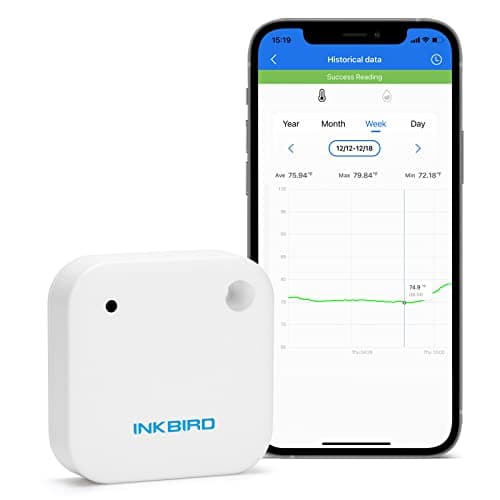
If the sensor is going somewhere cold or wet, the Inkbird IBS-TH2. Its published range runs from −40°F to 140°F, it is IPX4 splashproof, it has a magnet on the back for a steel shelf, and it logs up to 30,000 points on the device itself rather than relying on a phone being in range. There is no screen on it, so it is the wrong choice behind a solid door, and Inkbird’s own page contradicts itself on whether you can export 30,000 points or 3,000.
None of these replaces a properly specified cabinet. If the monitor tells you the cabinet cannot hold a temperature, the monitor has done its job and the answer is a better cabinet — the long-term storage roundup ranks the units whose makers publish the span they can actually hold, and the Whynter dual-zone against single-zone comparison shows what a published temperature span looks like model by model. If the bottles that will not fit the cabinet are the wide ones, that is a racking problem rather than a monitoring one: racks for Champagne and magnum bottles covers it.