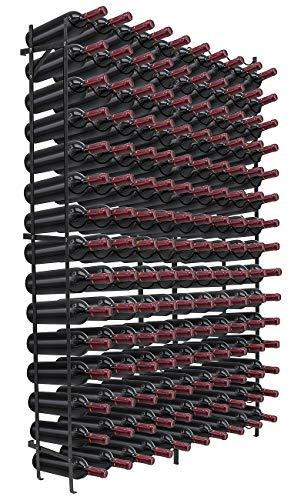
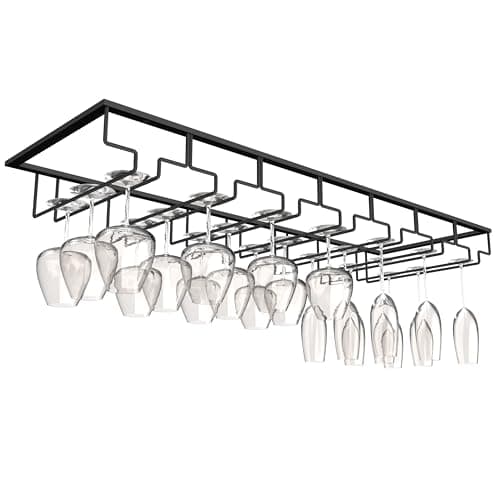
Measure three things: the slot, the depth and the loaded weight. A slot of about 3.25 inches takes a standard Bordeaux bottle but not a 3.5-inch Champagne bottle. Depth decides whether a rack fits a pantry shelf, and a full bottle is close to three pounds, so a 150-bottle rack is a 400-pound floor load.
How this page is funded. Cork & Cool earns a commission if you buy through the Amazon links below, at no extra cost to you. It never changes the order of this list — see our editorial policy and affiliate disclosure. Prices come from Amazon and are refreshed daily; the price on Amazon when you buy is always the one that counts.
Our picks
Sized smallest to largest, because that is the order this decision is actually made in. Every dimension quoted below is the manufacturer's published figure; where a listing does not publish one, we say so rather than estimating it.
How this page is funded. Cork & Cool earns a commission if you buy through the Amazon links below, at no extra cost to you. It never changes the order of this list — see our editorial policy and affiliate disclosure. Prices come from Amazon and are refreshed daily; the price on Amazon when you buy is always the one that counts.
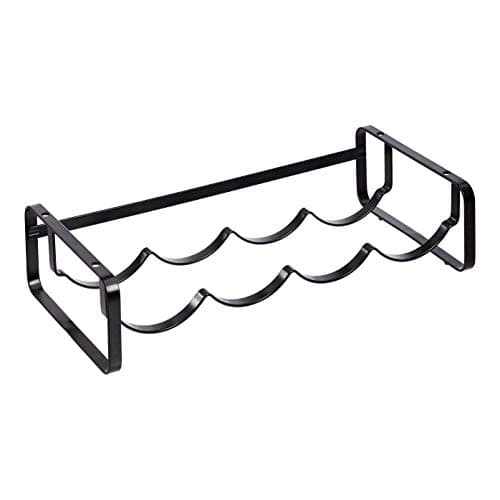
Four bottles in a pressed steel tier that stacks three high, so the rack grows to twelve bottles a tier at a time instead of being sized for the collection up front.
Product photograph via Amazon.
Published specifications
Capacity
4 bottles
Zones
Not published
Cooling
Unpowered
Temperature range
Not published
Noise rating
Not published by the manufacturer
Installation
Not applicable
· Capacity: 4 bottles per tier; stackable up to 3 tiers, so 12 bottles
· Exterior: 15.75 in W x 3.74 in D x 7.87 in H
· Material: steel, black smooth finish
· Recessed wave-shaped holders to stop bottles rolling
Modular: add a tier as the collection grows rather than replacing the rack
No assembly
3.74 inches deep, so it fits a shelf or the back of a counter
Recessed holders, which a flat wire rack does not have
What does not
The manufacturer caps the stack at three tiers, so twelve bottles is the published ceiling
Four bottles per tier, so a real collection means several
At 1.4 lb it is light enough to move when you pull a bottle out
Who should skip it. Skip it if you already know you need forty bottles of storage — the published stack tops out at twelve, and one forty-bottle rack costs less than the tiers would.
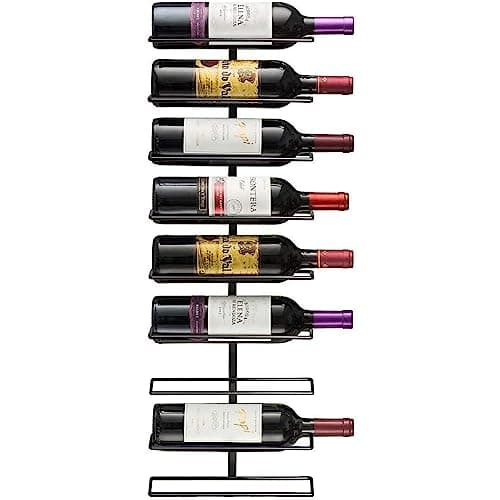
Bottles sit horizontal, keeping corks in contact with wine
What does not
Needs studs or proper anchors — nine full bottles is roughly 25 lb
Open racking gives no protection from light
Who should skip it. Skip it if the wall gets direct sunlight. Light is a real wine fault mechanism and an open wall rack offers none of the UV glass a cabinet does.
#ad — paid link. How this is funded. Price as of November 11, 2026; check Amazon for the current price.
#4 — Sixty bottles that look intentional
Oenophilia Alexander Wine Rack (60 bottle)
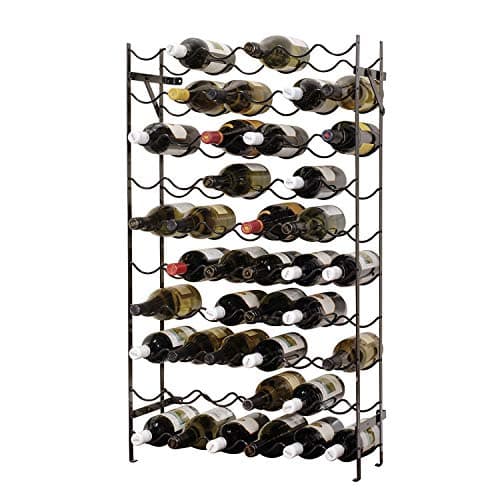
Sixty bottles in eight inches of depth, in a welded metal rack from a company that has made nothing but wine storage for decades — and it stands on the floor or goes on the wall.
Sixty bottles is a realistic household collection, not an aspirational number
Eight inches deep, so it takes a narrow strip of floor rather than a corner
Stands on the floor or mounts to a wall, so one rack suits two different rooms
Oenophilia is a wine-storage specialist rather than a general houseware brand
What does not
Unpowered, so the room's climate is the only climate
Open metal framing leaves bottles exposed to room light
The listing publishes no load rating, which matters if you wall-mount it
Who should skip it. Skip it if the plan is to hang it on drywall alone — sixty full bottles is well over a hundred pounds and the listing states no load rating, so a floor stand or a stud fixing is the only honest option.
Cost per bottle stored is a fraction of any powered cabinet
Labels stay readable, so you can actually find a bottle
No power, no compressor, nothing to fail
What does not
No temperature control, no humidity control, no UV protection — the room does all of that or nothing does
150 full bottles is roughly 400 lb; the floor has to take it
Who should skip it. Skip it if the room swings more than a few degrees across the year, or gets above the mid-60s°F in summer. A rack in the wrong room ages wine faster than no rack at all.
#ad — paid link. How this is funded. Price as of November 11, 2026; check Amazon for the current price.
Start with the bottle, not the rack
Every capacity figure in this category — on racks, on cabinets, on cellar plans — assumes a standard 750 ml Bordeaux bottle: the straight-sided one with high shoulders. It is the narrowest of the common shapes, and it is why a rack rated for twelve bottles holds twelve of some wines and nine of others.
A standard 750 ml wine bottle is published at 11.8 inches tall and 2.95 inches in diameter. The two shapes that break rack sizing are Burgundy and Champagne. Glass supplier listings for 750 ml Burgundy-style bottles publish diameters anywhere from about 80 mm to 88 mm — 3.2 to 3.5 inches — and a standard Champagne bottle is published at 13 inches tall and 3.5 inches in diameter, taller and wider, with thicker glass to hold the pressure. Half an inch of diameter does not sound like much until it is multiplied across a row of slots.
Glassmakers differ, which is why we quote these as published figures rather than as a standard. The practical version: if your collection is Burgundy, Rhône or Champagne-heavy, size the rack for those bottles and treat the manufacturer’s capacity number as a ceiling you will not reach. The same arithmetic applies inside a cabinet, which is the subject of wine fridges for large-format bottles.
Slot size: the spec almost nobody publishes
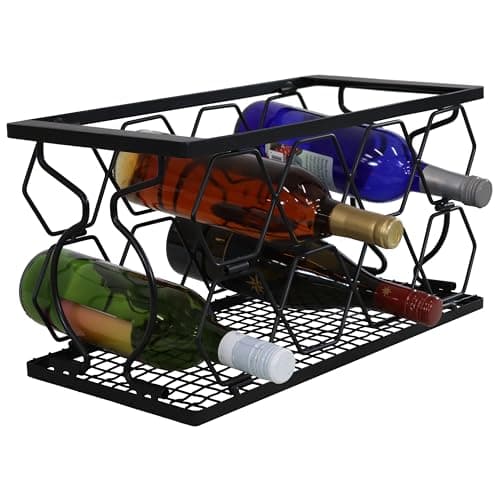
The single most useful number on a rack listing is the size of one slot, and most listings do not give it. The Sunnydaze folding countertop rack is the honorable exception in our registry: it publishes 3.25 inches by 3.25 inches per slot, and the manufacturer is explicit that a wide Champagne bottle will not seat in one.
That figure is worth memorizing, because it marks the boundary. A 3.25-inch slot takes a standard Bordeaux bottle with room to spare and refuses a 3.5-inch Champagne bottle outright. When a listing does not publish its slot size, two things substitute for it:
Capacity divided by width. The Amazon Basics stackable tier publishes 15.75 inches of width for four bottles, which is a shade under four inches per bottle including the frame — comfortable for Bordeaux, tight for Burgundy.
Cradle shape. Open wave or cradle holders flex around a wide bottle; closed hexagonal or circular slots do not. A rack with recessed wave-shaped holders, like the Amazon Basics tier, is more forgiving of mixed shapes than one with fixed apertures.
Depth is what fails on a shelf
Width gets measured. Depth is what sends the rack back. A standard kitchen pantry shelf is 12 to 16 inches deep and already holding something, and a rack that is deeper than the free space is simply not going in.
Published exterior dimensions, smallest to largest (manufacturer figures)
Rack
Width
Depth
Height
Bottles
Amazon Basics stackable tier
15.75 in
3.74 in
7.87 in
4 per tier, 12 stacked
Sunnydaze folding countertop
17.25 in
8.5 in
9.25 in (1.75 in folded)
8
Oenophilia Alexander rack
22.5 in
8 in
39.5 in
60
SereneSpace under-cabinet stemware rack
27.5 in
8.9 in
2.28 in
Up to 22 glasses
Sorbus wall mount (9 bottle)
Not published
Not published
Not published
9
Sorbus freestanding floor rack
Not published
Not published
Not published
150
Two of those rows say “not published,” and that is the honest state of this category rather than a gap in our research: the listings we checked for those racks give a capacity and a material and nothing else. If you are fitting a rack into a measured alcove, buy one that publishes its dimensions. If you are standing a rack in open floor space, the missing figures matter less.
The depth column also explains why the two shallowest racks here solve the two hardest spaces. At 3.74 inches the Amazon Basics tier fits the front of a pantry shelf with the shelf still usable behind it, which is why it leads the pantry rack roundup. At 2.28 inches tall the SereneSpace rack hangs in the dead air under a wall cabinet, which is space no bottle rack can use — see under-cabinet racks.
Capacity against footprint
Bottles per square foot is the metric that actually separates these racks, and it is not the metric any of them is sold on.
A countertop tier gives you four bottles for about 0.4 square feet of counter, and stacks to twelve in the same footprint — which is the whole argument for modular racking over a single large unit. A wall rack gives you nine bottles for no floor area at all, at the cost of a drilling job and a wall that can take the load. A freestanding floor rack at 150 bottles is the cheapest storage per bottle in this entire site, and it wants a dedicated corner of a cool room.
The step most people get wrong is in the middle. A 60-bottle rack like the Oenophilia Alexander is the right size for a household collection that is actually drunk, and it is a different purchase from a 150-bottle rack bought aspirationally and then stood half empty in a warm room. An unpowered rack contributes nothing to temperature or humidity — the room does all of it — so a bigger rack in the wrong room is worse than a smaller rack in the right one. That trade-off, powered against unpowered, is set out in wine rack versus wine fridge.
The number everyone forgets
A rack is a shelf, and a shelf has a load rating whether the manufacturer prints one or not. Work from the published figures in our registry and the arithmetic is unavoidable: nine full bottles on the Sorbus wall rack is roughly 25 pounds, and 150 full bottles on the Sorbus floor rack is roughly 400 pounds. That puts a full standard bottle close to three pounds, glass included.
Loaded weight, from published rack figures
Rack
Published rating or figure
What that means loaded
Sunnydaze folding countertop
25 lb published load rating; rack weighs 3.8 lb
Eight full bottles is approximately the rating, so it is at its limit when full
Amazon Basics stackable tier
Rack weighs 1.4 lb; no load rating published
Light enough to shift when you pull a bottle out; anchor the stack or keep it against a wall
Sorbus wall mount (9 bottle)
Roughly 25 lb of bottles when full
Needs studs or proper wall anchors, not drywall plugs
Sorbus freestanding floor rack (150)
Roughly 400 lb of bottles when full
A floor-strength question in an older house, and a reason not to put it on a joist span mid-room
Two practical consequences. First, a wall rack always goes into structure — a stud or a proper masonry anchor — because 25 pounds hanging on drywall plugs is a matter of time, not luck. Second, a folding or lightweight rack at its published rating is at its rating, and the sensible load is a notch below it.
Sizing by the space you have
Which size solves which space
The space
Size to look for
The rack in our registry
A pantry or closet shelf, 12-16 in deep
Under 4 in deep, stackable
Amazon Basics tier: 3.74 in deep, 4 bottles per tier, 12 stacked
A counter used for serving, cleared between dinners
Folds flat; publishes a slot size
Sunnydaze folding rack: 1.75 in folded, 3.25 in slots
A wall with studs and no floor space
9-12 bottles per fixing run
Sorbus wall mount: 9 bottles, welded steel
Under a wall cabinet
Under 3 in tall
SereneSpace stemware rack: 2.28 in tall, up to 22 glasses
A cool spare room or cellar, 60-bottle collection
Freestanding or wall-mounted metal rack
Oenophilia Alexander: 60 bottles, 22.5 x 8 x 39.5 in
If none of those is your space, the constraint is probably the room rather than the rack, and racks for small spaces works through the apartment version of this problem.
Measuring before you order
Five minutes with a tape measure and one of your own bottles settles this better than any specification table.
Measure a bottle you actually own at its widest point, and a second one if your collection is mixed. That diameter is your minimum slot.
Measure the space in three dimensions, including the height you need to tilt a bottle in and out — not just the height of the rack.
Subtract the clearance you need to lift a bottle out of a shelf-level rack. A rack that fits exactly is a rack you cannot load.
Check what the rack is standing on or screwed into. Studs for a wall rack, a floor that takes the loaded weight for anything over about 50 bottles.
Confirm the bottles lie horizontal. Cork contact is the reason racks are built this way, and it is covered in storing wine flat or upright.
These dimensions matter twice as much if you are making the rack yourself, where the cradle spacing and the loaded weight are both yours to get right — how to build a wine rack has the numbers to design around.
Questions people actually ask
▸ What size slot does a wine rack need?
About 3.25 inches square takes a standard 750 ml wine bottle comfortably — one is published at 2.95 inches in diameter. That is the published slot size on the Sunnydaze folding rack, whose manufacturer also states that a wide Champagne bottle will not seat in it. Published figures put a standard Champagne bottle at 3.5 inches in diameter, and supplier listings for 750 ml Burgundy glass run from about 3.2 to 3.5 inches, so a Champagne or Burgundy collection needs a wider slot or an open cradle.
▸ How deep is a standard wine rack?
It varies far more than the width does. In our registry the published depths run from 3.74 inches for a stackable countertop tier to 8.5 inches for a folding countertop rack. A pantry shelf is usually 12 to 16 inches deep, so a shallow rack leaves usable space behind it — which is the whole reason the shallow ones exist.
▸ How much does a full wine rack weigh?
Close to three pounds per full bottle. The published figures work out at roughly 25 pounds for a nine-bottle wall rack and roughly 400 pounds for a 150-bottle floor rack. That is why a wall rack needs studs and a large floor rack needs a floor you have thought about.
▸ How many bottles fit in one foot of rack?
Roughly three to four, depending on the frame. The Amazon Basics tier publishes 15.75 inches of width for four bottles, which is a little under four inches per bottle including the structure. Racks built for Burgundy or Champagne bottles space the slots wider and fit fewer.
▸ Should I buy a rack sized for my collection now or later?
Buy for now if the rack is modular, and for later if it is not. A stackable tier grows four bottles at a time, so there is no penalty for starting small. A fixed 150-bottle floor rack bought for a 40-bottle collection costs the same to stand half empty and takes the same floor area — and an unpowered rack does nothing for temperature, so the room has to be right either way.
▸ Do wine rack dimensions matter inside a cabinet?
The same arithmetic applies, with less room to negotiate. A cabinet’s bottle count assumes Bordeaux bottles on fixed shelf pitch, so a Burgundy-heavy collection fits fewer and a Champagne-heavy one fewer still. Our large-format page ranks cabinets on how many shelves come out, which is the only fix.