Buy a single-zone cabinet rated nearer 130 bottles than 100 and hold it at 55°F - the Whynter BWR-1662SD at 166 bottles is the pick. Mixed reds and whites both store correctly at 55°F; two zones only earn their place if you also serve straight from the cabinet.
This page sits in Wine Storage Guides, where the rest of the category is compared the same way.
How this page is funded. Cork & Cool earns a commission if you buy through the Amazon links below, at no extra cost to you. It never changes the order of this list — see our editorial policy and affiliate disclosure. Prices come from Amazon and are refreshed daily; the price on Amazon when you buy is always the one that counts.
Our picks
Four cabinets at or near the capacity this arithmetic lands on - one single zone at 166 bottles, one dual zone at 164, a 110-bottle cabinet that publishes capacity by bottle type, and a 66-bottle option if your count is closer to 50 real bottles.
How this page is funded. Cork & Cool earns a commission if you buy through the Amazon links below, at no extra cost to you. It never changes the order of this list — see our editorial policy and affiliate disclosure. Prices come from Amazon and are refreshed daily; the price on Amazon when you buy is always the one that counts.
#1 — One temperature, 166 bottles
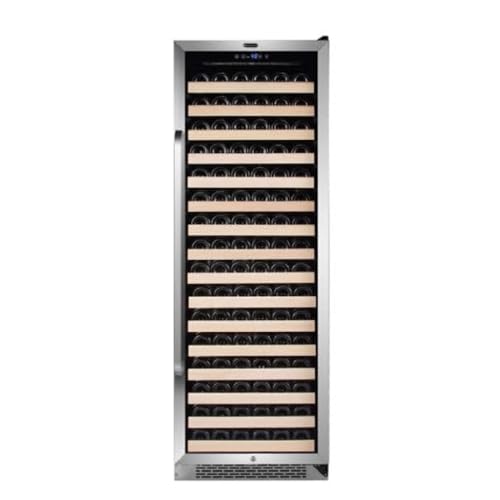
Whynter BWR-1662SD
The single-zone sibling: 166 bottles on 16 shelves at one setting, which is what long-term storage actually wants.
Product photograph via Amazon.
Published specifications
Capacity
166 bottles
Zones
1
Cooling
compressor
Temperature range
40–65°F
Noise rating
Not published by the manufacturer
Installation
built-in
· Capacity: 166 standard 750 ml bottles
· Shelving: 16 removable wooden flat slide-out shelves plus a wire display shelf
Designed around long-term aging rather than service
Five-year warranty, which is unusual in this category
The capacity figure is honestly split by bottle type, which most brands do not do
What does not
Costs multiples of anything else on this page
Sold through a single US distributor, so servicing is not a local-appliance-shop matter
Who should skip it. Skip it if you are storing wine you intend to drink within a year or two. The engineering you are paying for only pays back over a decade of aging.
Twenty extra bottles over the common 46-bottle format without moving up to a full-height cabinet
Two zones, so reds and whites can be held separately
What does not
Neither the exterior width nor the temperature range is published in the retail listing
No published dB rating
Who should skip it. Skip it if you are planning a cabinet cut-out — without a published exterior width you cannot confirm the opening before it arrives.
The instinct with a mixed collection is two zones: reds in one, whites in the other. For a 100-bottle collection that instinct is usually wrong, and the reason is that storage temperature does not vary by color. Reds and whites both keep best at about 55°F. What varies by color is serving temperature — whites at 45–50°F, reds at 60–65°F — and serving is a matter of the last hour before the bottle is opened, not the years before it.
So the honest test is: are you storing, or serving?
Mostly storing. One zone at 55°F, every bottle, and chill the whites you plan to drink an hour beforehand. Simpler, more uniform, and you get the cabinet’s full capacity as one usable space.
Storing and serving straight from the cabinet. Two zones: one at 55°F for the collection, one at 45–50°F for the dozen bottles in rotation. Not reds in one and whites in the other — storage in one and service in the other.
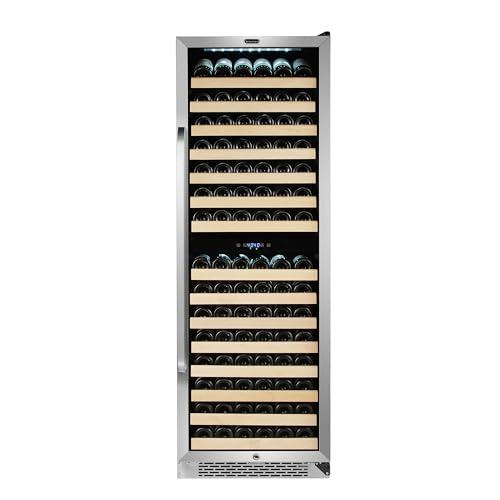
There is a second argument for a single zone at this size, and it is structural. A dual-zone cabinet divides its interior with a barrier, which fixes how many bottles can be at each temperature. The Whynter BWR-1642DZ splits 86 up and 78 down; if your collection runs 70/30 red to white, a 50/50 cabinet makes you store some bottles in the wrong zone anyway. A single zone has no such constraint. The general version of this trade-off is in single zone versus dual zone.
Why 100 bottles means 130 rated
Published capacities assume standard 750 ml Bordeaux bottles with every shelf packed full. A real mixed collection is not that, for three reasons that compound:
Bottle shapes. Burgundy, Pinot and Champagne bottles are wider than the Bordeaux bottles the rating assumes. EuroCave is the only brand in our registry that publishes the effect: the Pure L is rated at up to 110 reds or up to 60 whites — two numbers for the same cabinet.
Usable access. A cabinet rated with every shelf at maximum is a cabinet you have to excavate. Leave room to slide a shelf out and read a label and you lose a bottle or two per shelf.
Headroom. A cabinet at 100% is a cabinet that cannot take a case delivery. Running at about 70–80% full is what makes storage usable.
Put together: for 100 real bottles of mixed red and white, shop for 125–135 rated. The full sizing method is in what size wine fridge do I need, and if large-format bottles are a real part of the collection, read wine fridges for large bottles too, because shelf removal changes the arithmetic again.
The cabinets that fit
Cabinets at or around the capacity a 100-bottle mixed collection needs
Cabinet
Rated
Zones
Published range
Shelving
Whynter BWR-1662SD
166
1
40–65°F
16 removable wooden slide-out shelves plus a wire display shelf
Whynter BWR-1642DZ
164 (86 up / 78 down)
2
40–65°F, both zones
15 removable wooden slide-out shelves
EuroCave Pure L
110 reds / 60 whites
1
Not published
Multi-purpose storage shelving
Kalamera KMER1018
66
2
Not published
Not published in detail
Whynter BWR-1662SD — the pick. 166 bottles in one zone at 40–65°F, sixteen removable slide-out shelves, 140 W. Set it to 55°F and every bottle in the collection is stored correctly, with roughly 60 bottles of headroom on a 100-bottle collection. That headroom is not waste; it is what makes the cabinet work for the next five years.
Whynter BWR-1642DZ — if you serve from it. The same cabinet with two independently set zones, both carrying the full 40–65°F range. Hold the 78-bottle lower zone at 55°F for storage and the 86-bottle upper zone at 48°F for service, or invert it. Both zones running the full range is the feature that matters here: you are not stuck with a fixed cold zone and a fixed warm one.
EuroCave Pure L — if honesty about capacity is worth paying for. 110 reds or 60 whites, French-made, five-year warranty. For a 100-bottle collection that leans red it is sized right; for one that leans white it is not, and EuroCave is the only brand that tells you that before you buy. It publishes no temperature range, which at this price is a real gap.
Kalamera KMER1018 — if the count was optimistic. 66 rated, dual zone, built-in. Worth naming because “around 100” is often nearer 50 once counted; see the 50-bottle class.
If you do go dual zone, how to split it
Three rules, and the second is the one people get wrong.
Storage zone at 55°F, service zone at 45–50°F. Not “reds” and “whites”.
Put the cold zone where the cabinet puts it. Cold air sinks, so the lower compartment is the easier one to keep cold on most cabinets. Both Whynter cabinets let either zone take either job; the Newair AWR-290DB, by contrast, fixes the upper zone at 40–55°F and the lower at 50–66°F.
Keep the service zone small. Only the bottles you will open this month need to be at service temperature. Everything else belongs at 55°F.
For around 100 bottles of mixed red and white: a single-zone cabinet rated 125–135 or more, held at 55°F, and chill the whites you are about to drink. In our registry that is the Whynter BWR-1662SD. Go dual zone only if you genuinely pour from the cabinet, in which case the BWR-1642DZ gives you the same capacity with both zones adjustable across the full range.
▸ Do I need a dual-zone wine fridge for red and white?
Not for storage — both store correctly at 55°F. You need two zones only if you also serve straight from the cabinet, and then the split is storage versus service, not red versus white.
▸ What capacity should I buy for 100 bottles?
Around 125–135 rated. Bottle shapes, usable access and room for a case delivery all eat into a published figure, and a cabinet at 100% full is one you cannot rearrange.
▸ What temperature for a mixed red and white collection?
55°F for everything you are storing. Chill whites to 45–50°F and bring reds to 60–65°F in the hour before serving — see wine storage temperature.
▸ Is there a 100-bottle single-zone wine fridge?
In our registry the nearest are the EuroCave Pure L at 110 reds and the Whynter BWR-1662SD at 166. The Whynter is the one that publishes a temperature range.
▸ Can I store red and white in the same zone long term?
Yes. Color does not change storage temperature; it changes serving temperature. A single zone at 55°F is correct storage for both.