Published capacities are measured in standard Bordeaux bottles laid in the manufacturer's intended pattern. Common sizes run from 12 bottles on a countertop unit to 33 in a 15-inch cabinet, 46 in a 24-inch one and 164-166 in a full-height cabinet. Expect roughly a third fewer if much of your collection is Burgundy, Pinot Noir or Champagne shaped.
This page sits in Wine Storage Guides, where the rest of the category is compared the same way.
How this page is funded. Cork & Cool earns a commission if you buy through the Amazon links below, at no extra cost to you. It never changes the order of this list — see our editorial policy and affiliate disclosure. Prices come from Amazon and are refreshed daily; the price on Amazon when you buy is always the one that counts.
Our picks
One cabinet from each of the three classes below, so the numbers in this guide have something real attached to them: 33 bottles at 15 inches, 46 at 24 inches, and 166 in a full-height cabinet.
How this page is funded. Cork & Cool earns a commission if you buy through the Amazon links below, at no extra cost to you. It never changes the order of this list — see our editorial policy and affiliate disclosure. Prices come from Amazon and are refreshed daily; the price on Amazon when you buy is always the one that counts.
#1 — The 15-inch default
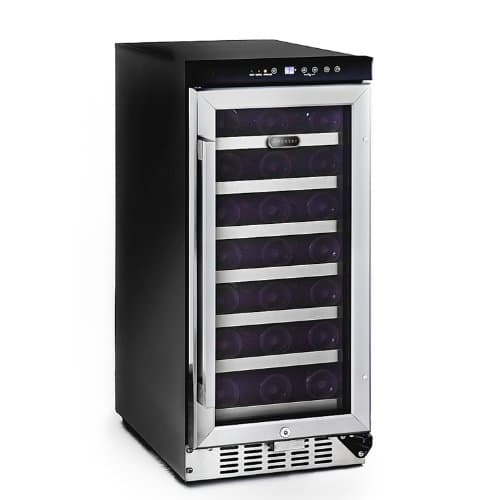
Whynter BWR-33SD
Thirty-three bottles in a 15-inch cabinet, with a published noise ceiling and seven wooden shelves — the capacity ceiling at this width, and the widest temperature band on this page.
Product photograph via Amazon.
Published specifications
Capacity
33 bottles
Zones
1
Cooling
compressor
Temperature range
40–72°F
Noise rating
42 dB
Installation
both
· Exterior: 15.0 in W x 22.5 in D (24.5 in with the handle installed) x 34.0 in H
· Capacity: 33 standard 750 ml bottles
· Noise published as "< 42 dBA" — a ceiling, not an average
Thirty-three bottles is the highest published capacity at this width
Whynter publishes a decibel ceiling, which almost nobody in this category does
Seven wooden shelves rather than the wire shelving usual at this price
40-72°F is the widest published band here, so it will also hold a bottle at room temperature
Rated for built-in or freestanding use, so an opening is optional rather than required
What does not
Single zone only — one temperature for the whole cabinet
The published figure is "< 42 dBA", a maximum rather than an average, so it cannot be compared like-for-like against a manufacturer quoting a flat number
At 15.0 inches published it is the widest cabinet in this group, which matters if your opening is tight
Depth grows to 24.5 inches once the handle is on, which is the figure that matters in a shallow run
33 bottles assumes standard Bordeaux shapes; a Burgundy-heavy collection will fit fewer
Who should skip it. Skip it if you need to serve whites cold and hold reds at cellar temperature in the same cabinet — one zone cannot do both. Skip it too if your opening measures under 15 inches, because this is the one cabinet here that needs the full module.
Rated for built-in installation, so the front vent is designed for an enclosed opening
23.4-inch width drops into a standard 24-inch cabinet run
Two independently set zones across the full 40-66°F span
What does not
No published dB rating, so noise cannot be compared numerically against rivals
46 bottles is the manufacturer's count using standard Bordeaux bottles — heavy Burgundy or Champagne bottles reduce it
Who should skip it. Skip it if your opening is under 24 inches, or if you need more than about four dozen bottles — stepping up to a 160-bottle cabinet costs less per bottle.
#ad — paid link. How this is funded. Price as of November 11, 2026; check Amazon for the current price.
What the badge number is measuring
Every capacity figure in this category is the answer to one specific question: how many standard 750 ml Bordeaux bottles fit when laid in the pattern the manufacturer designed, with every shelf in its factory position and nothing else in the cabinet.
That is a legitimate way to measure, because it is repeatable and comparable across brands. It is also a number almost nobody achieves, for four reasons: real collections contain more than one bottle shape, people take shelves out, people stand bottles up, and people put other things in the cabinet.
A few manufacturers are unusually honest about this. EuroCave publishes the Pure L as holding up to 110 reds or up to 60 whites — the same cabinet, two numbers, because the bottle shapes differ. Summit states plainly that removing alternate shelves on the SWC1535B makes room for wider Burgundy bottles. Both are telling you the same thing: the badge number is a best case.
Capacity by cabinet class
Cabinet capacities cluster, because they are all built to fit the same openings. These are the real published figures from our registry rather than round numbers.
Oenophilia-scale racking aside: Kalamera KMER1018 (66), EuroCave Revelation S (74), EuroCave Pure L (110 reds)
Full-height cabinet
164-166 bottles
Whynter BWR-1642DZ (164, dual zone), Whynter BWR-1662SD (166, single zone)
Two patterns worth noticing. Within a width, the single-zone cabinet always holds more than the dual-zone one — 33 against 29 at 15 inches — because the partition costs a row. And depth costs more than width: the Summit SDHW1532 gives up fifteen bottles against a full-depth cabinet of the same width to fit an 18-inch run.
What bottle shape costs you
This is the part the badge number cannot tell you, and it is the whole reason this page exists.
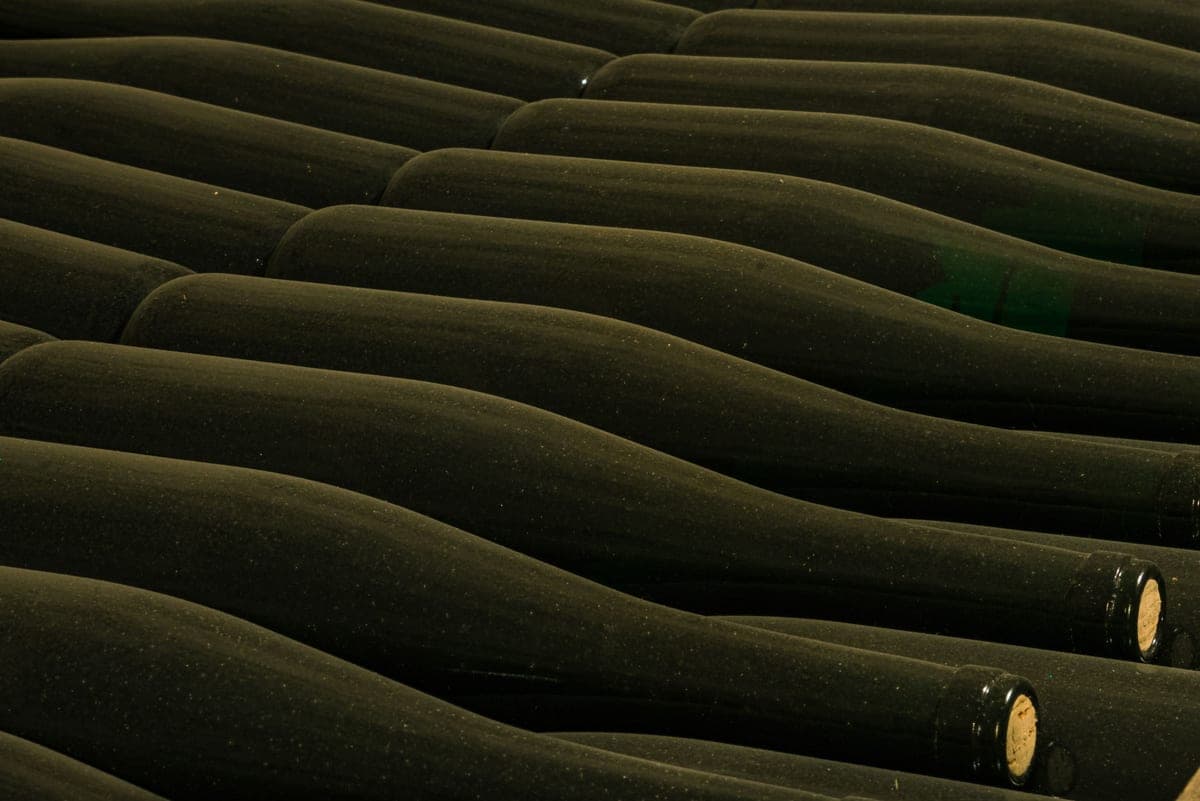
Bordeaux — straight sides, high shoulders, around 3 to 3.5 inches across. This is the reference shape. Bottles nest neatly, which is why the shelf patterns are designed around them.
Burgundy and Pinot Noir — sloping shoulders and a wider body. They do not nest. A shelf laid for six Bordeaux often takes four, and in a Burgundy-heavy collection the whole cabinet runs roughly a third below its badge.
Champagne and sparkling — wider again, heavier, and often taller. On several cabinets they fit only if a shelf comes out, which costs that shelf’s capacity as well. The Champagne roundup ranks cabinets on exactly this.
Magnums and large formats — rarely fit at all without removing shelves, and a magnum laid in a space designed for two standard bottles is a poor trade unless the cabinet is built for it. The large-format roundup covers the cabinets whose shelves come out easily.
Half bottles and odd shapes — usually fine, sometimes worse than expected, because a cradle sized for a standard diameter does not hold a narrow bottle securely.
Working out your own number
Five minutes with your actual collection beats any rule of thumb. The method:
Count what you own by shape, not by color. Twenty Bordeaux, eight Burgundy, four Champagne is a useful inventory; “about thirty bottles” is not.
Take the badge figure as your Bordeaux number. That is what it is.
Discount for the wide shapes. Plan on roughly a third fewer for the portion of the collection that is Burgundy, Pinot Noir or Champagne shaped.
Subtract a working margin. A cabinet packed to its theoretical maximum is one you cannot get a bottle out of without moving three, and tight packing also restricts the air circulation the cabinet depends on. Ten to fifteen percent slack is sensible.
Add a year of buying. This is the step people skip and then regret — see the per-bottle cost argument in how much a wine fridge costs.
If that arithmetic lands you between two cabinet classes, go up. The running cost difference is small, and the cost of buying twice is not. What size wine fridge do I need approaches the same decision from the other direction, starting with how you buy wine rather than with what you already own.
Shelves: where the capacity actually lives
Two cabinets with the same published capacity can be very different to live with, and the difference is the shelving.
Shelf count and spacing. The Whynter BWR-33SD publishes seven removable wooden shelves for 33 bottles; the BWR-1662SD publishes sixteen slide-out wooden shelves plus a wire display shelf for 166. More shelves means shallower rows, which means you reach bottles instead of excavating them.
Removability. This is the lever that converts a cabinet rated for one shape into a cabinet that fits yours. Shelves that lift out let you make tall rows for wide or sparkling bottles. Fixed shelves do not, and you discover that after delivery.
Full extension. On a large cabinet, shelves that pull all the way out are the difference between a usable collection and a front row you keep refilling. The Zephyr Presrv publishes six full-extension racks; the Whynter large cabinets publish slide-out shelves throughout.
Material. Wooden shelves damp vibration, do not mark labels and look like what you expect. Wire shelves are cheaper, hold more per inch of height and can mark a soft label. Wine fridge shelf types goes through the options, and the wooden-shelf roundup covers the cabinets that publish them. Once the cabinet arrives, how to arrange bottles in a wine fridge is how you get closest to the number on the badge.
Questions people actually ask
▸ How many bottles does a 24-inch wine fridge hold?
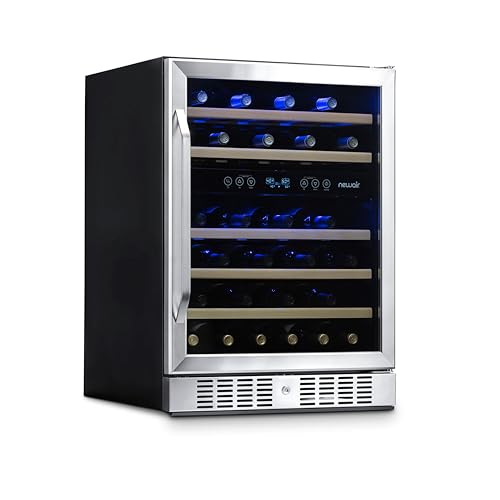
Typically 33 to 46 standard Bordeaux bottles, depending on depth and zone count. The Newair AWR-460DB and Whirlpool WUW55X24HS both publish 46; the shallow Summit ASDW2412 publishes 33 because it is under 18 inches deep; the dual-zone Dacor publishes 41.
▸ Does a wine fridge hold fewer Burgundy bottles?
Yes, noticeably. Burgundy and Pinot Noir bottles have sloping shoulders and a wider body, so they do not nest the way Bordeaux bottles do. A shelf laid for six Bordeaux often takes four, and a Burgundy-heavy collection should plan on roughly a third below the badge figure.
▸ Why does a dual-zone wine fridge hold fewer bottles?
The partition between the zones takes interior space and typically costs a row of bottles. At 15 inches wide, the single-zone Whynter BWR-33SD publishes 33 bottles while the dual-zone BSR-029DW publishes 29. If you only ever hold one temperature, the single zone gives those bottles back.
▸ Should I fill a wine fridge completely?
Leave some slack. A cabinet packed to its theoretical maximum restricts the internal air circulation it relies on, makes any single bottle hard to retrieve without disturbing others, and leaves no room for the next purchase. Ten to fifteen percent is a sensible working margin.
▸ How many bottles can you fit in a full-height wine cabinet?
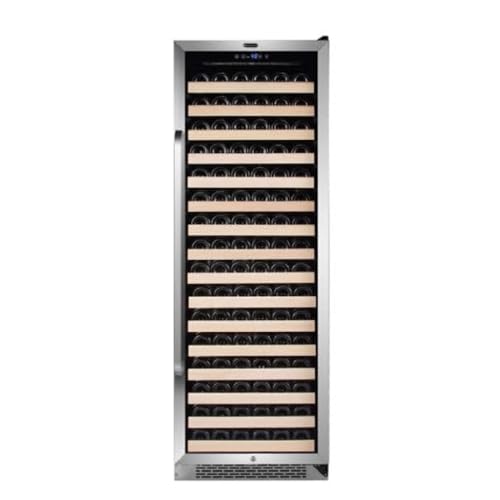
In our registry, 164 to 166 standard bottles: the Whynter BWR-1642DZ publishes 164 across two zones, the single-zone BWR-1662SD publishes 166 on sixteen slide-out shelves. Both are 24-inch built-in cabinets, and a full load is well over 300 lb of glass.