The five things that move the price
We do not print price figures in our articles, for a simple reason: they change. Every number you see on this site comes from the live price layer against a specific listing, on the day you are reading. What an article can usefully tell you is what you are paying for, so that when you look at two cabinets you can see which difference is doing the work.
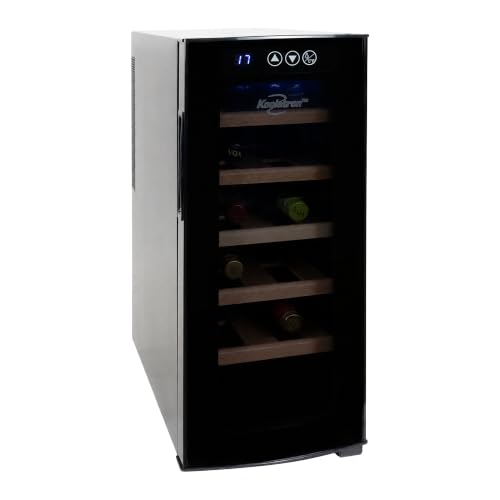
- Capacity. The single biggest lever, and the most obvious. A twelve-bottle countertop unit and a 166-bottle cabinet are different appliances in every respect, not just in volume.
- Cooling type. Thermoelectric cabinets are mechanically simpler — no compressor, no refrigerant circuit — and sit at the bottom of the market. The step to a compressor cabinet buys independence from room temperature and a lower temperature floor, and you pay for it. Compressor versus thermoelectric sets out exactly what the step buys.
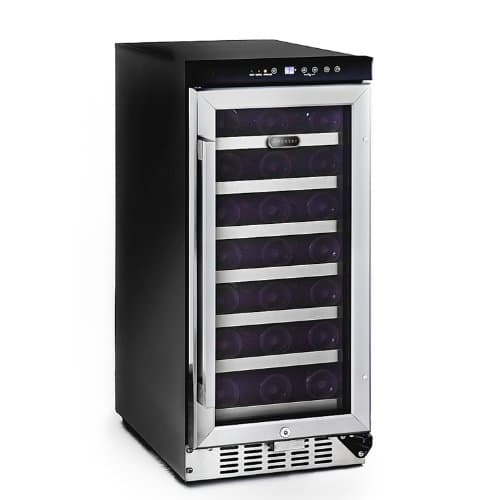
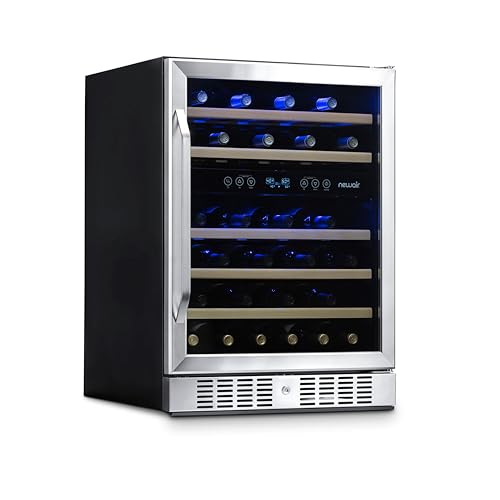
- Zone count. A second zone means a second thermostat, a second evaporator arrangement and a partitioned interior. It costs money and, on a cabinet of a given size, it costs capacity too — the Whynter BSR-029DW holds 29 bottles against 33 for the single-zone cabinet of the same width.
- Build and documented features. Beech shelving instead of wire, full-extension racks, a published decibel figure, UV or Low-E glazing, a documented vibration measure, a factory lock, a carbon filter, a five-year compressor warranty. These are the differences between cabinets that look identical in a photograph.
- Brand and service network. Rarely discussed and genuinely worth money. A mainstream brand with parts availability in most zip codes is a different ownership proposition from a direct-import cabinet with no service path, especially in an appliance you expect to keep for a decade.
Cost per bottle, not sticker price
The most useful number in this category is not what a cabinet costs. It is what it costs per bottle of storage, and it changes the ranking completely.
Cabinets do not scale linearly. A compressor, a thermostat, a door, a cabinet shell and a control board are required whether the box holds twelve bottles or a hundred and sixty-six. Scaling the box up adds sheet metal, insulation and shelves — the cheap parts. The result is a steep curve: small cabinets are expensive per bottle, large ones are cheap per bottle, and the crossover usually arrives sooner than people expect.
The practical consequence is a recurring mistake. Somebody buys a twelve-bottle countertop unit, fills it in a month, buys a second one, fills that, and then buys the 46-bottle cabinet they should have bought at the start — having paid for three appliances. If there is any chance the collection grows, buy the next size up once rather than the current size twice. What size wine fridge do I need runs the sizing arithmetic from how you actually buy wine, and is a wine fridge worth it is the honest version of the whole question.
The counterweight: an oversized cabinet run half empty costs the same to run as a full one and gains you nothing, and a large cabinet is harder to place, heavier and harder to move later. Moving a wine fridge is a cost people only discover once.
The costs that are not the cabinet
Three further costs sit outside the purchase price, and two of them can exceed it over the life of the appliance.
Electricity deserves its own note. Published power figures vary far more than people expect — thermoelectric cabinets in our registry publish around 65 W, while a 166-bottle compressor cabinet publishes 140 W — but the badge figure is not the running cost. A cabinet in a cool basement that idles most of the day costs less to run than a smaller cabinet fighting a hot kitchen. Wine fridge running costs works the arithmetic through properly.
Installation is the one that surprises people on a built-in. The appliance may be the smaller half of the bill if the opening has to be cut, the power run and the cabinetry altered. Get that priced before you choose the cabinet, not after — the install guide and the circuit question cover what is involved.
What is worth paying more for
In rough order of how reliably the money comes back:
- Capacity, if the collection is growing. The clearest value in the category, for the per-bottle reason above.
- A built-in rating, if there is any chance of an opening. It costs little on top of a freestanding cabinet and it keeps every future kitchen layout available. A freestanding-only unit is permanently excluded from an enclosed install — and there is no workaround.
- A compressor, unless the room is reliably mild. The thing that makes a cheap cabinet disappointing is almost always that it could not hold temperature in the room it was put in.
- Published specifications. A cabinet whose manufacturer prints a temperature range, a decibel figure and a warranty term is a cabinet you can hold to account. One that prints none of those is a gamble regardless of its price.
- Wooden, full-extension shelving on anything large. A big cabinet you have to dig through gets used like a cupboard, which wastes most of what you paid for.
What is usually not
Long-storage features on a drinking cabinet. Documented vibration control and Low-E glazing are real engineering and they pay back over a decade of aging. If the wine is drunk within a year or two, that budget buys more in capacity. The honest version of that argument is in the vibration and light roundup.
A panel-ready front in a kitchen with visible appliances. A stainless cabinet next to a stainless range already reads as consistent, and the panel premium plus the custom joinery buys nothing the eye registers. How to make a wine fridge look built in covers the cheap moves that do most of the work.
Two zones you will never use. If you drink mostly one color, or the cabinet is storage rather than service, a single zone gives you more bottles, uniform shelf spacing and one less thing to go wrong. Single zone versus dual zone is the decision.
Capacity you will not fill for years. The per-bottle argument has a limit. A cabinet bought three sizes ahead costs the same to run empty as full and makes the room work around it. Buy one size ahead, not three.