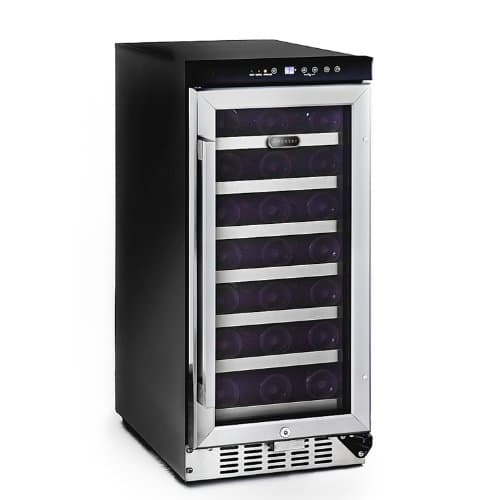
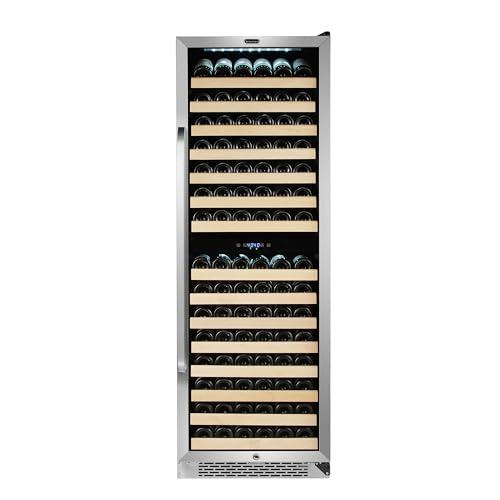
The Whynter BWR-33SD is the pick: seven removable wooden shelves with stainless steel fronts in a 15-inch cabinet. For more capacity the Whynter BWR-1642DZ publishes fifteen removable wooden flat slide-out shelves, and the Kalamera KRC-46DZB uses natural beech that cradles each of its 46 bottles individually.
This page sits in Wine Fridges, where the rest of the category is compared the same way.
How this page is funded. Cork & Cool earns a commission if you buy through the Amazon links below, at no extra cost to you. It never changes the order of this list — see our editorial policy and affiliate disclosure. Prices come from Amazon and are refreshed daily; the price on Amazon when you buy is always the one that counts.
Quick picks
Every model below, on the specifications that decide the purchase. Tap a row to jump to the full write-up.
Comparison of wine storage models by zones, capacity, cooling type, width, published noise rating and vibration.
#
Product
Best for
Zones
Bottles
Cooling
Width
Noise
Vibration
Price
1
Whynter BWR-33SDThe 15-inch default
Thirty-three bottles in a 15-inch cabinet, with a published noise ceiling and seven wooden shelves
“Not published” means the manufacturer does not publish that figure. We do not estimate it. Prices and product photographs come from Amazon and are refreshed daily; where a model is not sold on Amazon the thumbnail is an illustrative category photograph and the link is a search.
How we compared
We compared published manufacturer specifications, official product documentation and verified owner reports across 6 models. We do not physically test these units, we have no laboratory, and we do not accept payment for placement. Where a manufacturer does not publish a figure — noise ratings, most often — this page says so rather than estimating it.
What we weighted
Shelf material as the manufacturer publishes it: beech, unspecified wood, steel or chrome wire
Whether shelves slide out, and whether they are full-extension
Whether shelves are removable, which is what creates clearance for a wide bottle
Published shelf count, because count and pitch together decide real capacity
Whether the shelf has a stainless front, which is the difference between a shelf and a drawer
Documented vibration behavior, which is the real argument for wood over wire
Every model in detail
#1 — The 15-inch default
Whynter BWR-33SD
Thirty-three bottles in a 15-inch cabinet, with a published noise ceiling and seven wooden shelves — the capacity ceiling at this width, and the widest temperature band on this page.
Product photograph via Amazon.
Published specifications
Capacity
33 bottles
Zones
1
Cooling
compressor
Temperature range
40–72°F
Noise rating
42 dB
Installation
both
· Exterior: 15.0 in W x 22.5 in D (24.5 in with the handle installed) x 34.0 in H
· Capacity: 33 standard 750 ml bottles
· Noise published as "< 42 dBA" — a ceiling, not an average
Thirty-three bottles is the highest published capacity at this width
Whynter publishes a decibel ceiling, which almost nobody in this category does
Seven wooden shelves rather than the wire shelving usual at this price
40-72°F is the widest published band here, so it will also hold a bottle at room temperature
Rated for built-in or freestanding use, so an opening is optional rather than required
What does not
Single zone only — one temperature for the whole cabinet
The published figure is "< 42 dBA", a maximum rather than an average, so it cannot be compared like-for-like against a manufacturer quoting a flat number
At 15.0 inches published it is the widest cabinet in this group, which matters if your opening is tight
Depth grows to 24.5 inches once the handle is on, which is the figure that matters in a shallow run
33 bottles assumes standard Bordeaux shapes; a Burgundy-heavy collection will fit fewer
Who should skip it. Skip it if you need to serve whites cold and hold reds at cellar temperature in the same cabinet — one zone cannot do both. Skip it too if your opening measures under 15 inches, because this is the one cabinet here that needs the full module.
Beech shelving at this price point is unusual — most rivals use wire
Reversible door helps in a tight galley kitchen
Dual installation rating gives you options if the kitchen changes
What does not
Kalamera does not publish a temperature range for this model in the listing, so the achievable span is unconfirmed
No published dB rating
Who should skip it. Skip it if you need a documented temperature range before you buy — the published listing does not give one, and we will not estimate it for you.
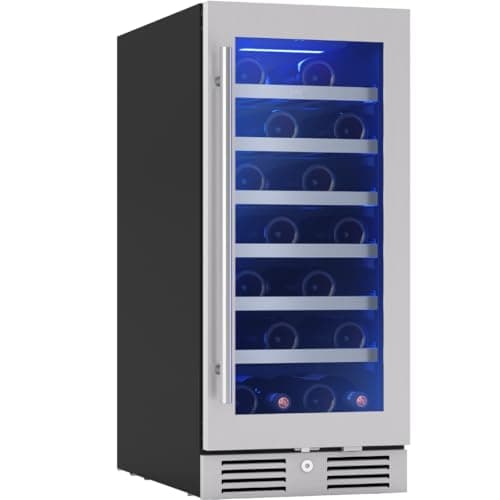
Twenty-seven bottles, a published 39 dBA, and the only cabinet in this width whose maker documents a vibration dampening system — you are paying for the storage conditions, not the bottle count.
Product photograph via Amazon.
Published specifications
Capacity
27 bottles
Zones
1
Cooling
compressor
Temperature range
38–65°F
Noise rating
39 dB
Installation
both
· Exterior: 15 in W x 33-7/8 in H x 23-3/8 in D
· Capacity: 27 bottles (750 ml), 3.4 cu ft
· Sound level: 39 dBA published
· Racking: six full-extension black wood racks with stainless trim
· Glass: dual-pane, Low-E, argon-filled
· Field-reversible door with concealed zero-clearance hinges, door lock, door-open alarm
· Energy Star certified; Sabbath mode; carbon-filtered air filtration
· Weight: 101 lb · Power: 115 V, 60 Hz at max 1.5 A
· Warranty: 2 years parts and labor, 5 years compressor
The only 15-inch cabinet here whose manufacturer documents vibration control at all
Publishes a flat decibel figure rather than a ceiling, so it can be compared properly
Reaches 38°F, the lowest published minimum in this group, which matters for sparkling wine
Full-extension racks mean you can reach a bottle at the back without unloading the shelf
Five-year compressor warranty against the usual one or two
What does not
Twenty-seven bottles against thirty-three for the same width — the racks take the space
23-3/8 inches deep, the deepest cabinet in this group
Costs materially more than the Whynter and Summit cabinets it sits beside
Who should skip it. Skip it if the wine is going to be drunk within a year or two. Vibration control and a 38°F floor are long-storage features, and you can have eight more bottles for less money without them.
#ad — paid link. How this is funded. Price as of November 11, 2026; check Amazon for the current price.
#6 — Commercial-grade listings
Summit SWC1535B
Thirty-three bottles in 14.75 inches, listed to NSF-7 and UL-471 for commercial premises — the one you buy for a bar, a rental or anywhere an inspector might look.
Illustrative photograph — not an image of the Summit SWC1535B.
Published specifications
Capacity
33 bottles
Zones
1
Cooling
compressor
Temperature range
41–64°F
Noise rating
Not published by the manufacturer
Installation
both
· Exterior: 33.88 in H x 14.75 in W x 22.75 in D
· Shelving: six slide-out wooden shelves; remove alternate shelves for wider Burgundy bottles
· Door: glass with stainless steel trim, reversible, factory-installed lock
· ETL-S listed to NSF-7 standards and meets UL-471 for use in commercial establishments
· Automatic defrost
· Weight: 77 lb
· ADA-height sibling sold separately as the ALWC15
Commercial listings that no other cabinet in this width carries
Floor space takes three wider bottles, which Summit states rather than leaving you to discover
Factory-fitted lock and a reversible door as standard
Rated for built-in or freestanding use and finished on all sides
What does not
Summit does not publish a decibel rating
The published range stops at 64°F, slightly short of the 65-66°F most rivals quote
Single zone
Who should skip it. Skip it if this is going into a home kitchen and nobody will ever ask about NSF listing — you are paying for commercial certification you will not use.
A wine fridge shelf does three jobs. It holds the bottle still, it lets you get the bottle out without disturbing its neighbors, and it does not mark the label. Chrome wire does the first one adequately and the other two badly.
The specific failures are easy to see once you own a wire-shelf cabinet. A wire shelf supports a bottle on two or three thin contact lines, so the bottle rocks as the compressor cycles and the glass makes a faint click you will eventually hear at night. Pulling a bottle out drags the paper label across the wire. And because a wire grid has no cradle, bottles roll into each other and you lose a slot per shelf to the one that will not sit straight.
Shaped wood solves all three. Beech is the material almost every manufacturer reaches for — it is dense, dimensionally stable in a humid cabinet and cheap enough to use at this price point. A milled beech cradle holds the bottle at the curve rather than on a line, which is also why the vibration argument in best wine fridges for long-term storage keeps coming back to shelving. The counter-argument is honest: wire costs less, weighs less and is easier to wipe down, which is why it survives at the bottom of the market.
What each manufacturer publishes
This is the whole comparison in one table, using each manufacturer’s own words rather than ours.
Published shelving, cabinet by cabinet
Cabinet
Bottles
Published shelving
Slide-out?
Whynter BWR-33SD
33
Seven removable wooden shelves with stainless steel shelf fronts
Removable
Whynter BWR-1642DZ
164
15 removable wooden flat slide-out shelves
Yes
Whynter BWR-1662SD
166
16 removable wooden flat slide-out shelves plus a wire display shelf
Yes
Kalamera KRC-46DZB
46
Natural beech wood; each of the 46 bottles cradled individually
Not published
Zephyr Presrv PRW15C01CG
27
Six full-extension black wood racks with stainless trim
Yes, full-extension
Koolatron WC12-35D
12
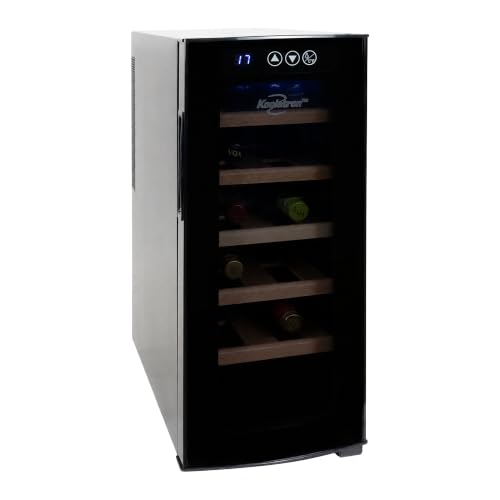
Five removable beech wood sliding shelves
Yes
Summit SWC1535B
33
Six slide-out wooden shelves; remove alternate shelves for wider Burgundy bottles
Yes
Whynter BSR-029DW
29
Five removable beechwood shelves
Removable
Newair AWR-460DB
46
Removable beechwood
Removable
Whynter WC-201TD
20
Five removable stainless-trimmed chrome shelves
No - wire
Summit SDHW1532
18
Six removable steel shelves in black with stainless trim
No - steel
Two entries in that table are there as the contrast. The Whynter WC-201TD and the Summit SDHW1532 are good cabinets with metal shelving, and they are what you buy if the cabinet lives somewhere that gets wiped down often or if the thermoelectric silence of the WC-201TD matters more than the shelf. Everything above them is wood.
Slide-out, full-extension and fixed
“Slide-out” and “full-extension” are not the same claim, and only one cabinet here makes the stronger one. Zephyr publishes six full-extension black wood racks with stainless trim for the PRW15C01CG, which means the shelf comes all the way clear of the cabinet front. A plain slide-out shelf comes part way, far enough to lift a bottle out of the front row but not far enough to reach the back row without sliding further.
In practice that distinction decides whether the back of a deep shelf is usable storage or dead space. The two Whynter 24-inch towers have the most shelves of anything here — fifteen and sixteen respectively — and both are slide-out, which is what makes a 164-bottle cabinet navigable at all. At the other end, the Koolatron WC12-35D has five sliding beech shelves for twelve bottles, which is close to a shelf per two bottles: you never reach past anything.
A fixed shelf is not a disaster in a small cabinet, because you can see and reach everything anyway. It becomes one above about 40 bottles. The layout consequences are in how to arrange bottles in a wine fridge, and the shelf-type decision on its own in wine fridge shelf types.
Removable shelves and wide bottles
A wooden shelf has one more advantage over a molded plastic insert: it comes out. That is the only mechanism any of these cabinets gives you for storing a bottle the shelf pitch was not designed for.
Summit is the clearest about it, publishing the move directly for the SWC1535B: remove alternate shelves to take wider Burgundy bottles. Whynter publishes “removable” on the BWR-33SD, BWR-1642DZ, BWR-1662SD and BSR-029DW, and Newair on the AWR-460DB. Where a manufacturer does not use the word, do not assume — the Kalamera KRC-46DZB cradles each bottle individually, which is excellent for standard Bordeaux and the exact opposite of flexible for anything else.
The arithmetic is unforgiving: pulling one shelf out of a seven-shelf cabinet costs you roughly a seventh of your capacity and buys you one double-height bay. Decide which bay that is before you load the cabinet. Large-format bottles have their own roundup in best wine fridges for large-format bottles, and Champagne — wider at the shoulder than a Bordeaux bottle — in best wine fridges for Champagne.
Looking after a wooden shelf
Beech in a cabinet held at 55°F and 50–70% relative humidity is in a benign environment, and the shelves in these cabinets routinely outlast the compressor. Three things shorten that.
Standing water. A cabinet whose drip tray has overflowed, or whose door seal has failed and is condensing onto a shelf, will stain and eventually swell the wood. That is a symptom to chase rather than a shelf to replace — see wine fridge condensation.
Wet cleaning. Wipe a wooden shelf with a barely damp cloth and dry it. Do not soak it, do not put it in a dishwasher, and do not use a solvent cleaner inside a cabinet that has to stay odor-free. The full routine is in wine fridge maintenance.
Mold on a damp shelf. Wood plus trapped moisture plus a cabinet left switched off is how a cabinet starts to smell. Diagnosis is in why a wine fridge smells musty.
None of that is an argument against wood. It is an argument for drying a shelf after you clean it, which takes a minute every six months.
Questions people actually ask
▸ Are wooden shelves better than wire in a wine fridge?
For storage, yes. A shaped wooden shelf cradles the bottle at the curve rather than on two thin wires, so the bottle does not rock as the compressor cycles and the label does not drag when you pull it out. Wire is cheaper and easier to wipe down.
▸ What wood do wine fridge shelves use?
Beech, almost universally at this price point. Kalamera and Newair both publish beech by name, Whynter publishes beechwood on the BSR-029DW, and the rest publish “wooden” without naming the species.
▸ Can you remove the shelves in a wine fridge?
In most wooden-shelf cabinets, yes, and it is the only way to fit a bottle taller or wider than the shelf pitch allows. Summit publishes the move explicitly for the SWC1535B. Check your own manual — individually cradled shelving is often not designed to come out.
▸ How do you clean wooden wine fridge shelves?
A barely damp cloth, then dry the shelf before it goes back in. No soaking, no dishwasher, no solvent cleaner in a cabinet that needs to stay odor-free.