A modular rack is a bet that your collection will grow. The specification that matters is not capacity today — it is the published limit on how far the system goes.
The FDHUIJIA Modular Floor Wine Rack is the best modular wine rack: 144 bottles of pine in stackable tiers that assemble without nails or screws, one bottle deep, with the assembled footprint published. For bamboo racking that publishes both its assembled size and a load rating, the VEVOR 36-bottle. The budget pick is the Amazon Basics tabletop tier, which starts at four bottles and stacks to a published twelve.
How this page is funded. Cork & Cool earns a commission if you buy through the Amazon links below, at no extra cost to you. It never changes the order of this list — see our editorial policy and affiliate disclosure. Prices come from Amazon and are refreshed daily; the price on Amazon when you buy is always the one that counts.
Quick picks
Every model below, on the specifications that decide the purchase. Tap a row to jump to the full write-up.
Comparison of wine storage models by zones, capacity, cooling type, width, published noise rating and vibration.
#
Product
Best for
Zones
Bottles
Cooling
Width
Noise
Vibration
Price
1
FDHUIJIA Modular Floor Wine Rack (144 bottle)A cellar room with no cellar
A hundred and forty-four bottles of pine shelving, one bottle deep so nothing is buried
#ad — paid link. How this is funded. Price as of November 28, 2026; check Amazon for the current price.
3
Amazon Basics Tabletop Stackable Wine Rack (4 bottle)Growing one tier at a time
Four bottles in a pressed steel tier that stacks three high, so the rack grows to twelve bottles a tier at a time instead of being sized for the collection up front.
#ad — paid link. How this is funded. Price as of November 28, 2026; check Amazon for the current price.
5
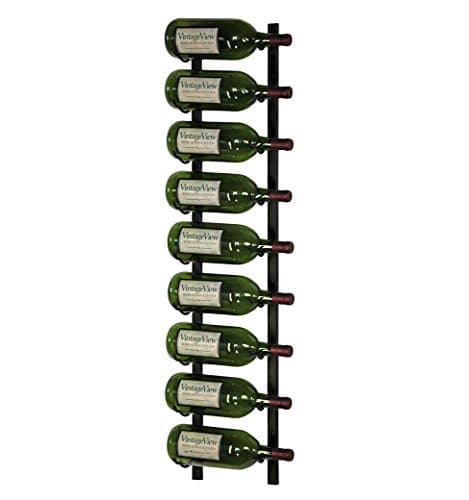
VintageView W Series Mag Rack (9 bottle)A real magnum collection
The only rack here from a company that makes nothing but wine storage, purpose-built for 1.5 L and Champagne bottles and backed by a lifetime warranty.
#ad — paid link. How this is funded. Price as of November 28, 2026; check Amazon for the current price.
“Not published” means the manufacturer does not publish that figure. We do not estimate it. Prices and product photographs come from Amazon and are refreshed daily.
How we compared
We compared published manufacturer specifications, official product documentation and verified owner reports across 5 models. We do not physically test these units, we have no laboratory, and we do not accept payment for placement. Where a manufacturer does not publish a figure — noise ratings, most often — this page says so rather than estimating it.
What we weighted
How the system extends: stacking tiers, supplied couplers, or multiple independent units in one box — these are three different kinds of modular and they are not interchangeable
The PUBLISHED limit on extension, because a rack that stacks 'infinitely' in the photography usually has a stated ceiling
Cost of each added bottle, which is the real economics of a modular system against buying one large rack
Whether the maker publishes the assembled footprint, so you know whether the next tier fits the room
A published load rating, which matters more on a stacked or wall-coupled system than on a single unit
Whether the units are interchangeable with the rest of the maker's range, which is what separates a system from a product
Assembly method, since a rack you extend is a rack you will take apart
Every model in detail
Five racks that extend, ranked by how far and how cheaply. This page is about the system; the single-unit rankings are in the stackable, wall-mounted and floor rack pages.
#1 — A cellar room with no cellar
FDHUIJIA Modular Floor Wine Rack (144 bottle)
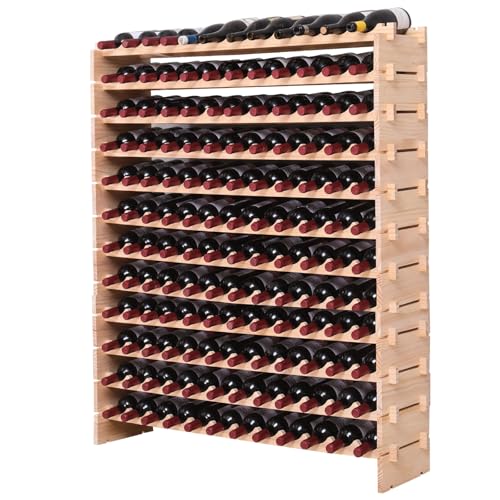
A hundred and forty-four bottles of pine shelving, one bottle deep so nothing is buried — the cheapest way to store a real collection if the room is already cool.
Product photograph via Amazon.
Published specifications
Capacity
144 bottles
Zones
Not published
Cooling
Unpowered
Temperature range
Not published
Noise rating
Not published by the manufacturer
Installation
Not applicable
· Capacity: 144 bottles
· Assembled size: 46 in W x 11.6 in D x 55 in H
· Construction: pine, published as solid wood with added support
· Stackable modular tiers; assembles without nails or screws
· Freestanding floor unit; the listing claims a 10-year warranty
Cost per bottle stored is a fraction of any powered cabinet
The listing publishes the assembled footprint, which most floor racks do not
At 11.6 inches deep it holds one bottle per slot, so nothing sits buried behind a front row
Stackable tiers, so the rack goes up a layer at a time instead of being replaced
No power, no compressor, nothing to fail
What does not
No temperature control, no humidity control, no UV protection — the room does all of that or nothing does
144 full bottles is close to 400 lb; the floor has to take it
Bottles lie neck-out on open tiers, so you read the capsule rather than the label
FDHUIJIA publishes no manufacturer site and no per-tier load rating; the 10-year warranty is the marketplace seller's to honor
Who should skip it. Skip it if the room swings more than a few degrees across the year, or gets above the mid-60s°F in summer. A rack in the wrong room ages wine faster than no rack at all.
The most bottles per dollar of anything we rank under $50
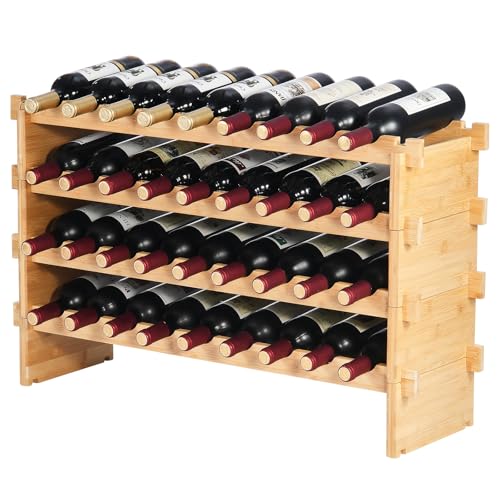
Publishes an assembled size AND a load rating, which almost nothing at this price does
Modular, so a collection that grows in ones and twos is a matter of adding a set
Interlocking assembly means no fixings to work loose under 36 bottles of glass
What does not
VEVOR publishes no slot width, and specifies the rack for standard 750 ml bottles rather than Champagne or magnums
33.5 in of width per set is a long run of floor, shelf or closet
Bamboo on an open frame gives the bottles no protection from room light
Stacked sets rest on the one below, so the bottom tier carries the whole load
Who should skip it. Skip it if the room is not already close to cellar conditions. Open timber racking does nothing about temperature, humidity or light.
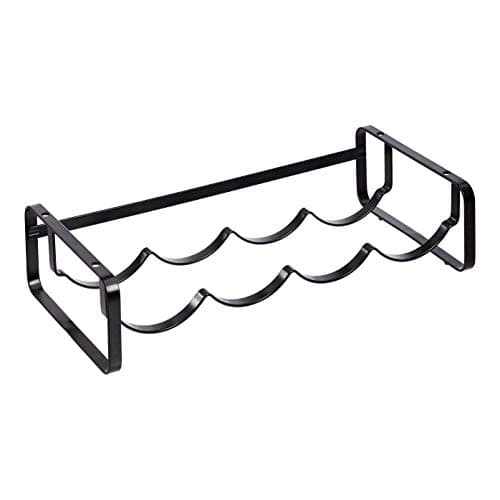
Four bottles in a pressed steel tier that stacks three high, so the rack grows to twelve bottles a tier at a time instead of being sized for the collection up front.
Product photograph via Amazon.
Published specifications
Capacity
4 bottles
Zones
Not published
Cooling
Unpowered
Temperature range
Not published
Noise rating
Not published by the manufacturer
Installation
Not applicable
· Capacity: 4 bottles per tier; stackable up to 3 tiers, so 12 bottles
· Exterior: 15.75 in W x 3.74 in D x 7.87 in H
· Material: steel, black smooth finish
· Recessed wave-shaped holders to stop bottles rolling
Modular: add a tier as the collection grows rather than replacing the rack
No assembly
3.74 inches deep, so it fits a shelf or the back of a counter
Recessed holders, which a flat wire rack does not have
What does not
The manufacturer caps the stack at three tiers, so twelve bottles is the published ceiling
Four bottles per tier, so a real collection means several
At 1.4 lb it is light enough to move when you pull a bottle out
Who should skip it. Skip it if you already know you need forty bottles of storage — the published stack tops out at twelve, and one forty-bottle rack costs less than the tiers would.
#ad — paid link. How this is funded. Price as of November 28, 2026; check Amazon for the current price.
#5 — A real magnum collection
VintageView W Series Mag Rack (9 bottle)
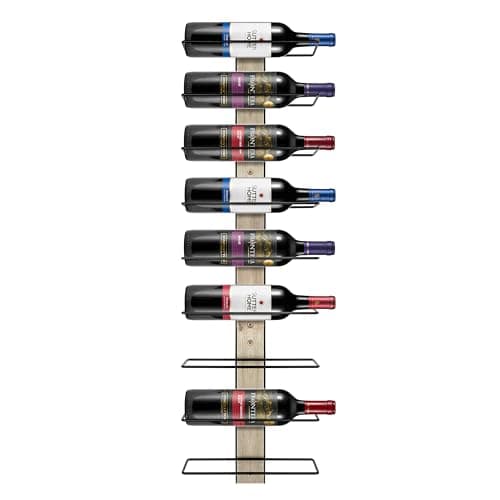
The only rack here from a company that makes nothing but wine storage, purpose-built for 1.5 L and Champagne bottles and backed by a lifetime warranty.
Product photograph via Amazon.
Published specifications
Capacity
9 bottles
Zones
Not published
Cooling
Unpowered
Temperature range
Not published
Noise rating
Not published by the manufacturer
Installation
Not applicable
· Capacity: 9 bottles single depth, 18 bottles in the double-depth version
· Specified for 1.5 L magnums, Champagne and Pinot bottles
· Dimensions: 45 in H x 15 in W x 5.25 in D (single depth)
· Material: powder-coated steel
· Mounting: neck strip and base strip, hardware stated for drywall and wood
· Stackable with other Wall Series racks using the supplied couplers
· Finishes: five published — matte black, brushed nickel, chrome, golden bronze and gun metal (the listing linked here is the black one)
Specified for the wide bottles rather than merely photographed with them
Label-forward mounting holds bottle by neck and base, so girth stops being the constraint
Projects only 5.25 inches from the wall for a 9-bottle run
Stacks and couples with the rest of the Wall Series, so a magnum section can join a standard one
Lifetime warranty is unusual at any price in racking
What does not
No bottle diameter published — the rack is specified by bottle type, not by a measurement
Nine bottles across 45 inches of wall is a low density compared with timber racking
Open display leaves the glass fully exposed to room light
Who should skip it. Skip it if you need volume per dollar. A modular timber rack holds two dozen wide bottles for less, as long as the room is doing the climate control.
#ad — paid link. How this is funded. Price as of November 28, 2026; check Amazon for the current price.
Three kinds of modular
“Modular” covers three genuinely different arrangements, and the difference decides which one suits a room. This is also what separates this page from best stackable wine racks, which ranks individual stackable units: here the question is how the system grows.
Stacking tiers. Identical units that sit on each other, growing upward. The Amazon Basics tabletop rack is the clearest example: four bottles per tier, stacking up to a published three tiers for twelve bottles, with no assembly at all and recessed wave-shaped holders so bottles do not roll. The FDHUIJIA floor rack does the same thing at a different scale — stackable modular tiers that assemble without nails or screws, up to a published 144 bottles in a 46 by 11.6 by 55-inch frame.
Coupled wall units. Wall racks that join to each other with supplied hardware. The VintageView W Series Mag Rack stacks and couples with the rest of the Wall Series using supplied couplers, which means a magnum section can be joined to a standard-bottle section on the same wall — the only true system in this group, and the only one with a lifetime warranty.
Multi-unit sets. Several independent pieces in one box, which you arrange as you like. The Sorbus Wall Mounted Wood set is three separate three-bottle racks on wood backboards, so the layout works around a window or a light switch rather than being dictated by one long rack. Buy a second set and it extends.
How each system extends, and its published ceiling
Rack
Kind of modular
Starts at
Published ceiling
Extension method
FDHUIJIA Modular Floor
Stacking tiers
Full 144-bottle frame
144 bottles, 46 x 11.6 x 55 in
Stackable tiers, no nails or screws
VEVOR 36-bottle
Stacking tiers
36 bottles
Not stated beyond stackable
Stacks when the collection outgrows it
Amazon Basics tabletop
Stacking tiers
4 bottles
3 tiers / 12 bottles (published)
Buy another tier
Sorbus Wall Wood (set of 3)
Multi-unit set
9 bottles in 3 units
Not stated
Buy another set of three
VintageView W Series Mag Rack
Coupled wall units
9 bottles (18 double depth)
Not stated; couplers supplied
Couples to the rest of the Wall Series
The published ceiling, which nobody reads
Here is the finding of this page. Marketing photography for modular racking shows towers. Two of these five makers publish an actual limit, and both limits are lower than the photography implies: Amazon Basics caps the stack at three tiers, so twelve bottles is the published ceiling for that product, and FDHUIJIA publishes 144 bottles as the assembled configuration rather than as a starting point.
The other three state that the system extends without saying how far. That is not necessarily a problem — a wall system limited by your wall rather than by the hardware is honest enough — but it does mean the planning number is the published one, not the aspirational one. If you are planning around a specific collection size, read the wine rack sizes guide first and work backwards from the wall.
The economics of adding a tier
Modular racking is bought on the promise that you pay as you grow, and it is worth checking that against one large rack. Work it from the live prices on the cards above: four bottles at a time from the Amazon Basics tier is the cheapest possible entry into wine storage and one of the most expensive ways to reach a hundred bottles, because you pay the per-unit price three dozen times. The FDHUIJIA reaches 144 bottles in one purchase at a cost per bottle stored that nothing else on this site approaches.
So the honest rule is this: modular is right when you genuinely do not know how big the collection will get, or when the room will not take a large rack today. If you already know you want sixty or a hundred and forty bottles racked, buy that rack once. The price bands are laid out in best wine racks under $50 and best wine racks under $200.
A product against a system
There is one real system in this group and four products that happen to stack. The VintageView W Series Mag Rack is from a company that makes nothing but wine storage, it is specified for 1.5 L magnums, Champagne and Pinot bottles rather than merely photographed with them, it holds each bottle by the neck and base so girth stops being the constraint, it projects only 5.25 inches from a wall, and the supplied couplers join it to the rest of the Wall Series. It also carries a lifetime warranty, which is unusual at any price in racking.
What you pay for that is density: nine bottles across 45 inches of wall is low compared with timber racking, and VintageView publishes no bottle diameter, specifying the rack by bottle type instead. If wide bottles are the problem it is solving, the dedicated page is best wine racks for Champagne.
Load, and what stacking does to it
A full bottle is about three pounds. Nine bottles is roughly twenty-five, thirty-six is over a hundred, and a hundred and forty-four is close to four hundred pounds — which is a floor question, not a rack question. Stacking concentrates that load onto the bottom tier, and wall-coupling concentrates it onto your fixings.
Two of these racks publish a load rating and three do not, which is the single most important gap on this page. FDHUIJIA publishes no manufacturer site and no per-tier load rating, and its listed ten-year warranty is the marketplace seller’s to honour. The practical advice is unchanged by any of it: fix wall racks into studs or proper anchors, put floor racks against a load-bearing wall, and do not stack higher than you can reach without climbing. Placement is covered in where to put a wine rack, and if you would rather build than buy, how to build a wine rack has the cradle spacing and timber sizes.
Which one to buy
Buy the FDHUIJIA Modular Floor Wine Rack if the destination is a real collection in a cool room: stackable tiers, no fixings, 144 bottles one deep, footprint published. Buy the VEVOR 36-bottle if you want bamboo racking that publishes both its assembled size and a load rating and still stacks later. Buy the Amazon Basics tier if you want to start at four bottles tonight and decide later — just note the published three-tier ceiling. Buy the Sorbus wood set if the wall has obstacles to work around. Buy the VintageView Mag Rack if you want a real system you can keep extending, and your bottles are wide.
Questions people actually ask
▸ What is the difference between modular and stackable wine racks?
Stackable means units sit on top of each other. Modular is broader: it also covers wall racks that couple with supplied hardware and multi-unit sets you arrange freely. All stackable racks are modular; not all modular racks stack.
▸ How high can I safely stack a wine rack?
Only as high as the maker publishes — Amazon Basics caps its tabletop rack at three tiers — and never higher than you can load without climbing. A full bottle is about three pounds, and the bottom tier carries everything above it.