What fifty dollars actually buys
Storage, and nothing else. That is the whole bargain on this page, and it is a better bargain than it sounds.
A rack has no compressor, no thermostat, no door and no glass, so what you are buying is a frame that holds bottles horizontal in a place you choose. Cost per bottle stored is a fraction of any powered cabinet — the cheapest cabinet on this site costs more than every rack on this page put together, and the racks here hold considerably more wine. If the room is already cool, dark and stable, a rack is not the compromise. It is the correct purchase, which is the case we put in wine rack against wine fridge.
What fifty dollars does not buy is a climate. Every rack here leaves the glass exposed to whatever the room does — temperature swings, daylight, humidity — and the room is therefore doing the part of the job a cabinet would otherwise do. That is a real constraint, not a caveat to skim: wine held at 70°F ages roughly twice as fast as wine at 55°F, which is the arithmetic in wine storage temperature, and what happens to wine stored badly is what that costs you in the glass.
So the honest framing for this page: these five racks are ranked on how much wine they hold per dollar, how securely they hold it, and what they physically fit — because those are the only variables a rack controls.
Bottles per dollar, and the outlier
We will not type a price into this page — prices move weekly and a stale number is worse than no number — but run the division on the live figures shown above and one pick is in a different class.
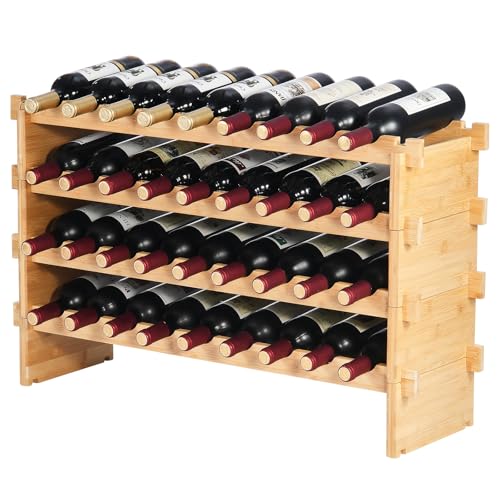
The VEVOR set publishes 36 bottles, four tiers of nine. That is four times the capacity of the next rack here and three times the published twelve-bottle ceiling of the cheapest, for a price that is still inside the fifty-dollar bracket. Per bottle stored it is the cheapest rack on this page by a distance, and cheaper than any powered cabinet on this site by an order of magnitude. It is bamboo rather than steel, and unusually for the price it publishes both an assembled size — 33.5 inches wide, 9.8 deep, 20.7 tall — and an 88-pound load rating.
Everything else here sits between 4 and 9 bottles, and the reason is what each one is actually for: a wall fixing, a counter you need back, a layout that has to work around a light switch, a shelf edge. Capacity is not the only axis on a rack this cheap, but it is the first one, and if the goal is simply to get thirty bottles off the kitchen floor then the arithmetic is not close.
Wall, counter or shelf
The five racks split cleanly into three jobs, and picking the job first saves you from buying the wrong format cheaply twice.
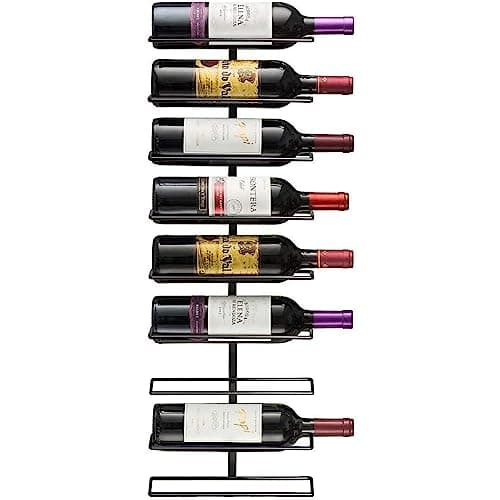
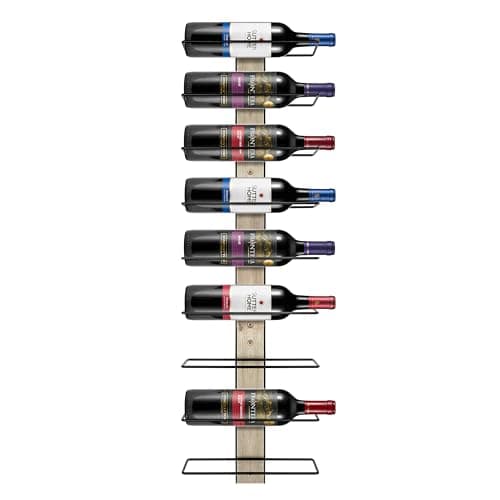
Wall. Two of these mount: the welded 9-bottle Sorbus metal rack is one drilling job for nine bottles, and the Sorbus wood set is three independent 3-bottle units you can arrange around a window, a switch or a doorway. Wall racks use the one space a kitchen always has spare, and the full format argument is in best wall-mounted wine racks. One rule applies to both: never above a seat, a cot, a hob or anywhere a failure drops glass on a person.
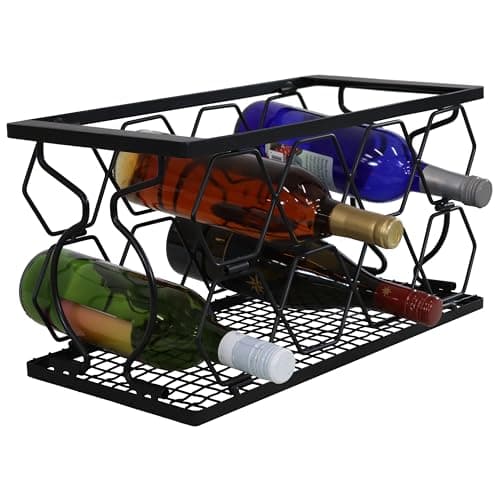
Counter. The Sunnydaze folding rack is the only rack on this page that disappears: 8 bottles standing, 1.75 inches tall folded, with a published 25 lb load rating and published 3.25-inch slots. It is a serving rack rather than storage — the bottles you are opening tonight — and that is a genuinely different job from the rest of this list. Best countertop wine racks covers the class.
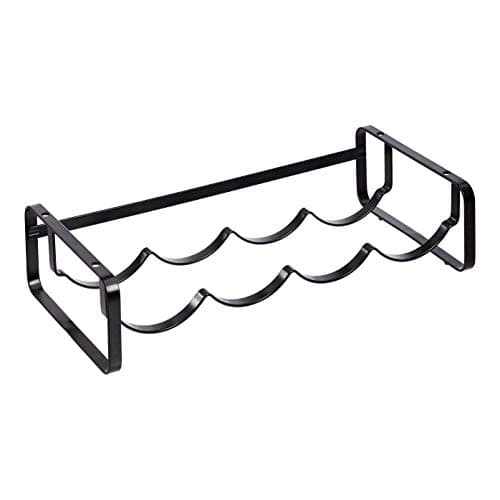
Shelf, closet or floor. The Amazon Basics tier is 3.74 inches deep, which is what lets it sit at the back of a counter or inside a cupboard, and it stacks to a published three tiers. The VEVOR set is the one that turns a closet floor or a pantry shelf into actual storage, and it is modular in the same way — buy another set and the run extends, though at 33.5 inches wide and 9.8 deep it wants that run measured first. Best stackable wine racks and racks for a pantry both deal with that case, and where to put a wine rack is the placement question, which for an unpowered rack is the storage decision.
Slot width: the Champagne problem
This is the specification that turns a cheap rack into a returned rack, and two of the five makers here publish it.
A standard 750 ml wine bottle is published at 2.95 inches in diameter. A Champagne bottle is published at 3.5 inches, because the glass has to hold several atmospheres of pressure, and a Bordeaux-style magnum is wider again. Both the Sunnydaze folding rack and the Amazon Basics tier publish a 3.25-inch slot: generous for a standard bottle, and physically too small for a Champagne bottle. It does not go in tightly. It does not go in.
Nothing on this page is specified for a wide bottle, and we would rather say so than imply otherwise. VEVOR publishes no slot width for the 36-bottle set either; what it does publish is 3.7 inches between tiers, which is vertical clearance rather than slot width, and a specification written around standard 750 ml bottles with a maker’s claim of suiting 90 percent of bottle sizes on the market. Read that as standard Bordeaux and Burgundy bottles, not as a Champagne guarantee. If wide bottles are the whole problem, racks for Champagne and magnum bottles ranks the few racks specified for them properly, including purpose-built magnum racking above this price bracket. The arithmetic for every format is in the wine rack sizes guide.
Load and fixing, which is what fails
A full 750 ml bottle weighs roughly 2.7 pounds. Nine of them is about 25 pounds hanging off a wall; thirty-six is close to a hundred pounds of glass and liquid, which is not something you want resting on a flat-pack joint.
Wall racks need studs or proper anchors. Both Sorbus racks are mounted fixings and nine bottles is a real load, so drywall plugs alone are not the answer. The wood set spreads the same nine bottles across three separate fixings, which is three drilling jobs but also three smaller loads — and the honest trade is that three bottles per fixing is not much storage per hole.
Published load ratings are rare and worth noticing. Sunnydaze publishes 25 lb, which is roughly eight full bottles — so the rack is at its rating when it is full. That is not a flaw in the rack, it is a maker being specific; most of this category publishes nothing at all. VEVOR is the other maker here that states a figure, 88 lb per set, which is roughly thirty-three full bottles against a 36-bottle capacity — so a full set is near its rating too, and a stack of them is a floor load rather than a shelf load. The step-up racks have the gap instead: the Oenophilia 60-bottle metal rack publishes no load rating at all, which is exactly why wall-mounting it is a stud-only proposition.
Stacked racks load the bottom tier. Both modular picks rest each set or tier on the one below, so the lowest unit carries everything above it. Amazon Basics caps its stack at three tiers for that reason, and the published ceiling is twelve bottles. Treat a stack as a single structure and put it somewhere level.
What a cheap rack cannot do
Four things, and they are the same four for every rack on this page regardless of price.
- No temperature control. The room is the cellar. A rack in a kitchen that hits the high 70s in August is storing wine badly, however good the rack is.
- No protection from light. Open racking leaves the glass exposed, and pale or clear bottles are the most vulnerable. Keep racks out of direct sun and off walls that get afternoon light — a cabinet’s UV glass is a feature a rack simply does not have.
- No humidity management. Very dry rooms shrink corks over years; damp ones grow mold on labels. What matters and what does not is in do wine fridges control humidity.
- No security. No rack here has a lock. If that matters, it is a cabinet question — best lockable wine fridges lists the cabinets that publish a factory lock.
The one thing every rack here does do correctly is hold bottles on their side, which keeps the cork in contact with the wine. That is not decoration; flat or upright explains when it matters and when it does not.
When to spend more
Spend a little more for capacity. Just above this bracket the Oenophilia Alexander metal rack publishes 60 bottles at 22.5 inches wide and 8 inches deep, and the FDHUIJIA pine floor rack publishes 144 at 46 inches wide — and the usual rule holds that the bigger the rack, the less it costs per bottle stored. If you already know you need forty bottles of storage, buying tiers four at a time is the expensive route; best wine racks and best floor wine racks cover the step up.
Spend more for a climate, not for a nicer rack. The moment the room cannot hold a steady temperature, no amount of racking fixes it and a powered cabinet becomes the right purchase. The cheapest honest versions of that are in best cheap wine fridges, and the bracket where a compressor cabinet with a built-in rating becomes possible is best wine fridges under $1,000.
Do both. The common end state in a real household is a cabinet for the bottles that are staying and a rack for the bottles in rotation. A rack is the cheapest storage per bottle and a cabinet is the only storage with a climate, so they are not competing products. How to store wine in a basement is the version of that for a house with the right room already.
Which one to buy
Buy the VEVOR 36-bottle stackable set for storage. Four bamboo tiers of nine bottles, an assembled size VEVOR actually publishes — 33.5 by 9.8 by 20.7 inches — an 88 lb load rating, interlocking assembly with no fixings to work loose, and sets that stack as the collection grows. It is the best bottles-per-dollar purchase on this page by a wide margin. Honest cons: VEVOR publishes no slot width and specifies the rack for standard 750 ml bottles rather than Champagne or magnums, 33.5 inches is a long run of floor or shelf, bamboo on an open frame does nothing about light, and stacked sets put the whole load on the bottom tier.
Buy the Sorbus 9-bottle metal rack for a wall. Commercial-grade welded rather than bolted, so it does not loosen, and nine horizontal bottles off one fixing run. It needs studs or proper anchors, and it offers no protection from light — so not on the sunny wall.
Buy the Sunnydaze folding rack for a counter. Eight bottles within reach, then 1.75 inches flat in a drawer, with a published load rating and a published slot size that most of this category does not bother to state. It is a serving rack, the frame is less rigid than a fixed one by design, and the 3.25-inch slots will not seat a Champagne bottle.
Buy the Sorbus wood set of three if the wall is awkward. Three independent units mean you can work around a window, a switch or a doorway, and the wood reads warmer than bare steel. Three mounting jobs for nine bottles is the price, and Amazon publishes the finish as gray rather than a wood tone.
Buy the Amazon Basics tier as the cheapest honest start. Four bottles per tier, no assembly, 3.74 inches deep so it fits a cupboard or the back of a counter, recessed wave holders rather than flat wire, and a published three-tier stack. It is the budget pick on this page by a wide margin — and at 1.4 lb it is light enough to shift when you pull a bottle out, so it wants a spot where that does not matter.
Whichever you buy, the decision that matters more than the rack is where it goes. A twenty-dollar rack in a cool, dark, stable closet stores wine better than a hundred-dollar rack in a sunny kitchen, every time.
Raising the ceiling to two hundred dollars changes the class of racking available — a 144-bottle floor frame and purpose-built magnum racking both come into range in best wine racks under $200.